New Hampshire
New Hampshire Primary Voters Can Send Biden a Powerful Message About Gaza


Politics
/
January 18, 2024
A campaign to write in the word “cease-fire” seeks to pressure the administration to shift its policy.
U.S. President Joe Biden returns to the White House December 20, 2023 in Washington, DC.
(Drew Angerer / Getty Images)
Andru Volinsky is a prominent New Hampshire Democrat. He served as a member of the state’s elected Executive Council, and nearly won the race to become the party’s gubernatorial nominee in 2020.
But on Tuesday, when New Hampshire holds its traditional first-in-the-nation presidential primary, Volinsky won’t be voting for President Biden. Instead, he will take his Democratic ballot, find the line for presidential write-ins, and print the word “cease-fire.”
“I’m not interested in replacing Biden,” says Volinsky, who expects that he will be voting for the president in November. “This is about getting a message to Biden about the urgent need for a cease-fire in Gaza.”
Volinsky won’t be alone. A grassroots movement has taken shape in the Granite State, one that’s urging voters in Tuesday’s primary to use their ballot to send a “cease-fire” signal in support of “de-escalation, humanitarian aid to Palestinians, and a just solution to the conflict in the Middle East.”
New Hampshire’s Vote Ceasefire campaign seeks to “draw attention to the urgent need to stop the violence in Palestine and the Middle East,” and let President Biden know that the United States must take action to end the killing in Gaza. And it’s gaining traction.
Current Issue

Organizers have been fielding calls from across the state and around the country. They’re spreading the word on social media and distributing signs that urge voters to take a pen to the polls and register their discontent with the administration’s support of Israeli Prime Minister Benjamin Netanyahu and the brutal assault on Gaza that has left more than 24,000 Palestinians dead, severely wounded tens of thousands and displaced an estimated 1.9 million men, women, and children.
That assault on Gaza, which followed the October 7 Hamas attack on Israeli kibbutzim and a music festival, has sparked an international outcry. In the United States, it has inspired mass demonstrations by American Muslims, Jews, and Christians calling for an end to the violence. It has also sparked significant dissension within Biden’s Democratic Party, as close to 60 members of the House and four Democratic senators have expressed support for a cease-fire.
But the Biden administration has not shifted its stance on the war. It continues to provide military aid for the Israel Defense Forces, as well as to push for Congress to fund additional aid. It’s also kept providing diplomatic cover for Netanyahu’s government at the United Nations. That’s led to frustration in New Hampshire, where Biden will face the first test of his 2024 reelection campaign.
This year’s New Hampshire primary is not sanctioned by the Democratic National Committee, and Biden’s name will not appear on the ballot with those of his most prominent challengers, author and 2020 presidential candidate Marianne Williamson and US Rep. Dean Phillips, D-Minnesota. But there’s an active and reasonably well-financed campaign to write in Biden’s name. If there is a substantial anti-Biden vote in the primary, it’s likely to get the president’s attention—and that of Democratic strategists and pundits—at a point when his approval ratings are already low.
So the Vote Ceasefire campaign is seizing the opening. “We have tried to make our voices heard in Washington. We have been ignored,” says Morgan Brown, a New Hampshire activist who was busy organizing efforts to distribute posters, yard signs and flyers urging New Hampshire Democrats to send their message to Biden by writing in “Cease-fire.” “The problem is the Democratic Party only cares about their votes, and that’s why we need to take this to the polls.”
The write-in vote won’t be the only way to send a pro-cease-fire message. Williamson, who for months has been calling for de-escalation and who has made a progressive critique of the Biden administration’s foreign policy central to her candidacy, says the best way to pressure Biden is by backing her, “a candidate who has demanded a ceasefire from the very beginning.” Phillips has also indicated that he’s supportive of a cease-fire.
“I think that the combined votes for the ‘cease-fire’ write-in and for Marianne Williamson could send a powerful message on Tuesday,” says Alan Minsky, the executive director of Progressive Democrats of America. “I don’t know if it will be as big as the Eugene McCarthy ’68 anti-war vote, but people will certainly notice if activists can point to a significant number of votes that were cast in protest against the administration’s approach on Gaza.”
A 1968 challenge to Democratic President Lyndon Johnson by McCarthy, an anti-war senator from Minnesota, drew support from 42 of New Hampshire Democratic primary voters and shocked the political world, beginning a chain of events that would eventually lead to Johnson’s decision to end his reelection bid. Few are predicting that the grassroots Vote Ceasefire campaign, which started late and has almost no money behind it, will get that level of support. But if a significant percentage of New Hampshire voters write in “cease-fire,” it is likely that Vote Ceasefire campaigning will spread beyond the border of the Granite State, says Minsky.
“swipe left below to view more authors”Swipe →
Popular
“I think you could see efforts like this in a number of other primary states,” says the head of PDA, which has historically been one of the most anti-war groupings working within the Democratic Party.
Volinsky says organizers of the New Hampshire campaign have already heard from activists in other states. But, for now, they are focused on spreading the word to New Hampshire voters, and on making sure that the national media takes note if there is a large “cease-fire” vote on Tuesday. To that end, campaigners will be closely monitoring the count of so-called “scattered” write-in votes to ensure that their message is delivered to the White House
“The Biden administration was able to veto the United Nations resolution on a humanitarian cease-fire,” says Volinsky. “But on Tuesday they won’t be able to veto my vote demanding a cease-fire.”
-
Submit a correction
-
Reprints & permissions
More from The Nation

To her detractors, presidential candidate Marianne Williamson is a political joke. But for her most fervent supporters, she’s their only hope.
Feature
/
P.E. Moskowitz

Only 11 senators joined Bernie Sanders’s effort to hold Israel to account for human rights abuses in Gaza.
John Nichols
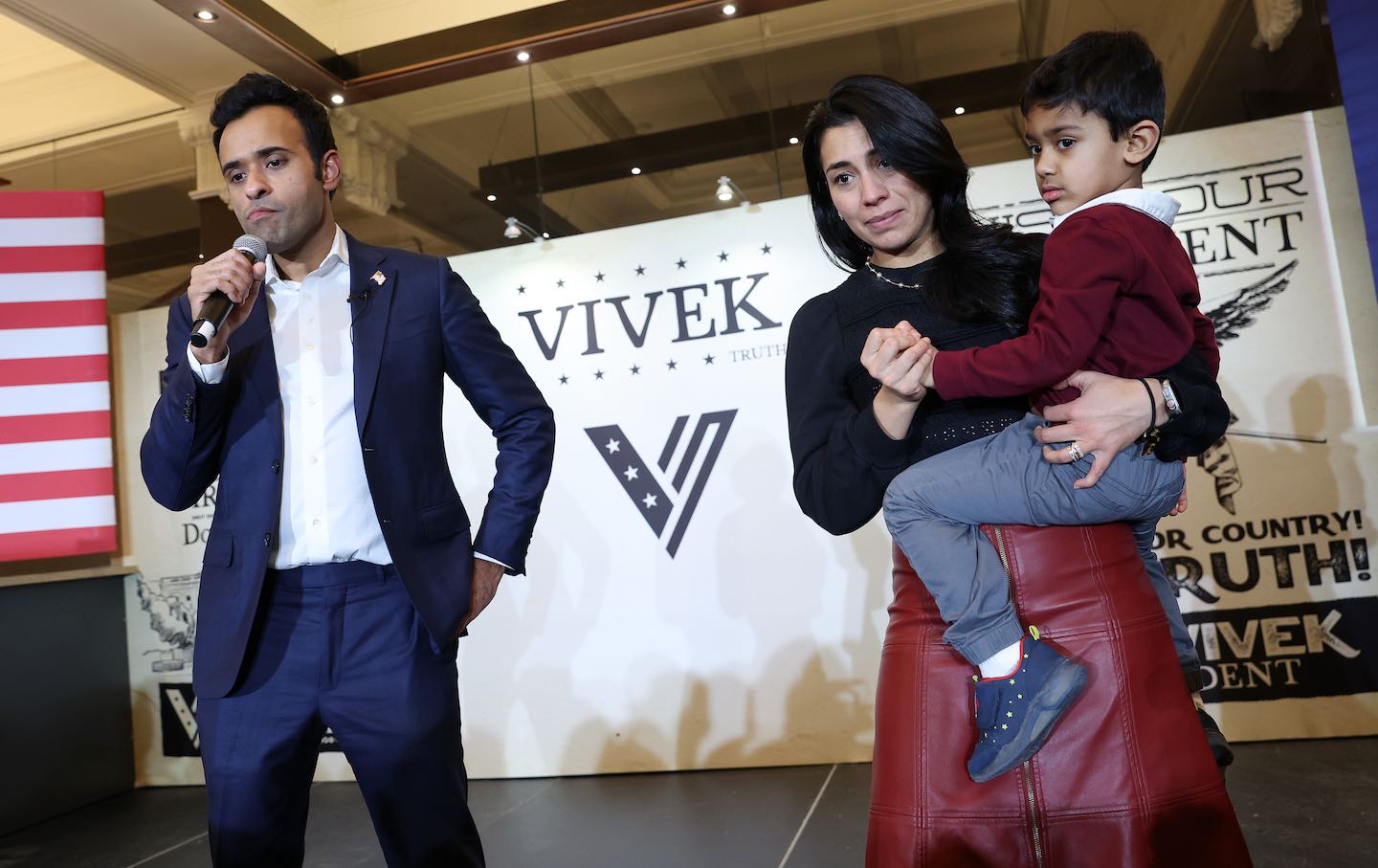
On Tuesday, the anti-woke entrepreneur dropped out of the GOP presidential race.
Chris Lehmann

The state is infamous for propelling sure losers into the Republican primary. Backing Trump, it picked another loser—but he’s likely to be the nominee anyway.
Joan Walsh

The former president won the first caucus state. But a striking one-third of caucus-goers told pollsters that a convicted Donald Trump would be unfit for office.
John Nichols

Joe Biden and the DNC have arranged a coronation, but what they don’t want you to know is that changing the rules is at least as important as choosing our rulers.
Larry Cohen



Have you ever wanted to meet the people who work every day to help keep your community safe? Now you and your family have the perfect opportunity!
One of my favorite things about living in New Hampshire is how the community genuinely makes the effort to know one another. Whether its neighbors lending a helping hand, local businesses supporting fundraisers, or first responders showing up for community events, there’s a real sense that we’re all in this together.
Events like Coffee with a Cop are a perfect example of that Granite State spirit!
Coffee with a Cop gives residents the chance to sit down with the dedicated men and women of the Bedford Police Department in a casual setting. Just real conversations over coffee and pastries.
This is a wonderful opportunity for children to meet police officers outside of an emergency situation. Instead of only seeing officers during stressful moments or traffic stops, they get to laugh, ask questions, and learn about the people behind the badge.
As a newer mom, I don’t take for granted the people who work every day to protect the community my child is growing up in.
If you’re looking for a simple way to connect with your neighbors while supporting your local law enforcement, stop by Simply Delicious Bakery on Wednesday, July 15, from 8:30 a.m. to 9:30 a.m. Grab a cold drink, enjoy a pastry, and spend a few minutes getting to know the people who work tirelessly to help keep Bedford a safe place to call home.
READ MORE: The Next Great Filmmaker Could Be Premiering Their Work Right Here In New Hampshire
I love highlighting stories like this because they remind us what makes New Hampshire special. It’s not just the beautiful scenery, it’s the people who continue to show up for one another.
These Are 15 of the Best Coffee Shops in New Hampshire
Gallery Credit: Megan Murphy
35 Community Meals for New Hampshire and Maine
Thank you to Lynne DeMelio-Rafferty for creating this.
New Hampshire
This NH Short Film Festival Returns in July, and Every Film Clocks in at 15 Minutes or Less

Independent filmmaking isn’t just alive; it’s helping shape the future of storytelling.
As technology continues to level the playing field, passionate creators have more opportunities than ever to tell meaningful stories outside the traditional Hollywood system. That’s exactly why events like the Creative Guts Short Film Festival deserve our support.
“The spirit of this festival is to celebrate the creativity, voice, and collaboration of filmmakers.” Now in its third year, The Creative Guts Short Film Festival gives a platform for filmmakers from all genres and different levels of experience to showcase their 15-minute pieces. The films selected this year were based upon a jury panel and even have a chance at the opportunity to screen at Red River Theatres on a limited run after the festival.
How cool is that!?
Awards in different categories will also be given to chosen filmmakers at the end of the event.
The evolution of cinema:
According to one of the UK’s biggest film festivals (Raindance), “The old model of filmmaking was built around gatekeepers.”
“Studios controlled production. Distributors controlled access. Television networks controlled visibility. Film festivals controlled discovery. Audiences arrived at the end of the pipeline. That structure shaped the kind of stories that could exist.”
Today, that model is rapidly changing. Raindance explains, “That pipeline is collapsing in real time. A filmmaker with a phone, editing software, and a direct audience relationship can now build attention faster than institutions that once controlled the entire ecosystem. That changes everything.”
As someone who has spent years in the filmmaking world, I know firsthand that audiences don’t always see the countless late nights, rewrites, equipment hiccups, and endless problem-solving that happen long before a film ever reaches the screen.
Every finished project represents months (or even years) of hard work, creativity, and determination.
A reason to support:
That’s one of the reasons I love short film festivals. Instead of committing to one feature-length movie, you get to experience a wide range of storytelling styles, genres, and perspectives all in one afternoon.
The best films don’t just entertain you, they linger long after the credits. They spark conversations on the drive home, challenge the way you see the world, or introduce you to a filmmaker whose work you’ll be eager to follow.
If you’re looking to experience something different while supporting New Hampshire’s creative community, this festival is a great place to start. You may discover your next favorite filmmaker before everyone else does!
2026 Creative Guts Short Film Festival
READ MORE: This Small New England Bakery Is Winning Hearts With Biscuit Flights
Date: Thursday, July 30, 2026
Time: 6:00PM
Location: Red River Theatres, Concord, NH
Early bird price: $15 (June 15th to June 30th)
Regular price: $20 (July 1st to July 30th)
These 11 Drive-In Theaters in NH, ME, and MA Are Still Operational
Gallery Credit: Meg
Movies Set in New Hampshire

A federal judge has dismissed a lawsuit by the Justice Department aimed at compelling New Hampshire to turn over its voter rolls, dealing the Trump administration another setback in its quest for detailed information about the nation’s voters.
The ruling from U.S. District Judge Joseph LaPlante found that the request to provide the state’s voter registration list did not comply with a section of the Civil Rights Act of 1960 pertaining to federal election records. His ruling, issued Monday, also found that the Justice Department failed to allege any violation under the Help America Vote Act of 2002, which established standards for states’ voting systems and voter registration lists.
That prevents “allowing the Attorney General unrestricted access to New Hampshire’s (voter list) to conduct a line-by-line audit to assess a ‘possible’ violation of a federal statute,” wrote LaPlante, an appointee of former President George W. Bush.
New Hampshire Secretary of State David Scanlan, a Republican, welcomed the ruling.
“I am committed to protecting the private information of New Hampshire voters to the fullest extent required by law,” he said in a statement.
The dismissal in New Hampshire brings to 10 the number of states where the Justice Department has lost similar cases. The department has sued to force release of detailed state voter data — which includes dates of birth, addresses, driver’s license numbers and partial Social Security numbers — in 30 states and the District of Columbia.
In addition to New Hampshire, judges have rejected those attempts in Arizona, California, Maine, Massachusetts, Maryland, Michigan, Oregon, Rhode Island and Wisconsin. In Georgia, a judge dismissed a Justice Department lawsuit because it had been filed in the wrong city, prompting the government to refile elsewhere.
In explaining their push for the records, federal officials have said they need the voter data to ensure that states are complying with federal election laws related to maintaining voter registration lists, even though states already have detailed processes to do that. In the case out of Rhode Island, a Justice Department attorney acknowledged that the department was seeking unredacted voter roll information so it could be shared with the Department of Homeland Security to check citizenship status.
Democratic and some Republican officials have objected to the Justice Department requests for detailed voter data and said such a demand violates state and federal privacy laws.
At least 13 states have either provided or promised to provide their voter registration lists to the department, according to the Brennan Center for Justice and Associated Press reporting: Alaska, Arkansas, Indiana, Louisiana, Mississippi, Nebraska, Ohio, Oklahoma, South Carolina, South Dakota, Tennessee, Texas and Wyoming.
-
 Politics1 minute ago
Bill to ban sex offenders from running for office fails in California senate committee
-
 Science8 minutes ago
After Trump axed federal employees running climate site, thousands crowdfund its comeback
-
 Sports11 minutes ago
Dodgers’ Will Smith won’t return before the All-Star break
-

 World22 minutes ago
‘Positive progress’ as US, Iran wrap up indirect technical talks in Doha
-
 News46 minutes ago
What the SCOTUS campaign finance ruling means, according to an expert
-

 Los Angeles, Ca2 hours ago
Knife-wielding man rushes at LAPD officers in tense body cam video
-

 Detroit, MI3 hours ago
5 Potential Landing Spots For Former Detroit Lions CB Terrion Arnold
-

 San Francisco, CA3 hours ago
May 17 officially declared

