New Hampshire
More NH water systems need to treat for PFAS chemicals under new federal rules
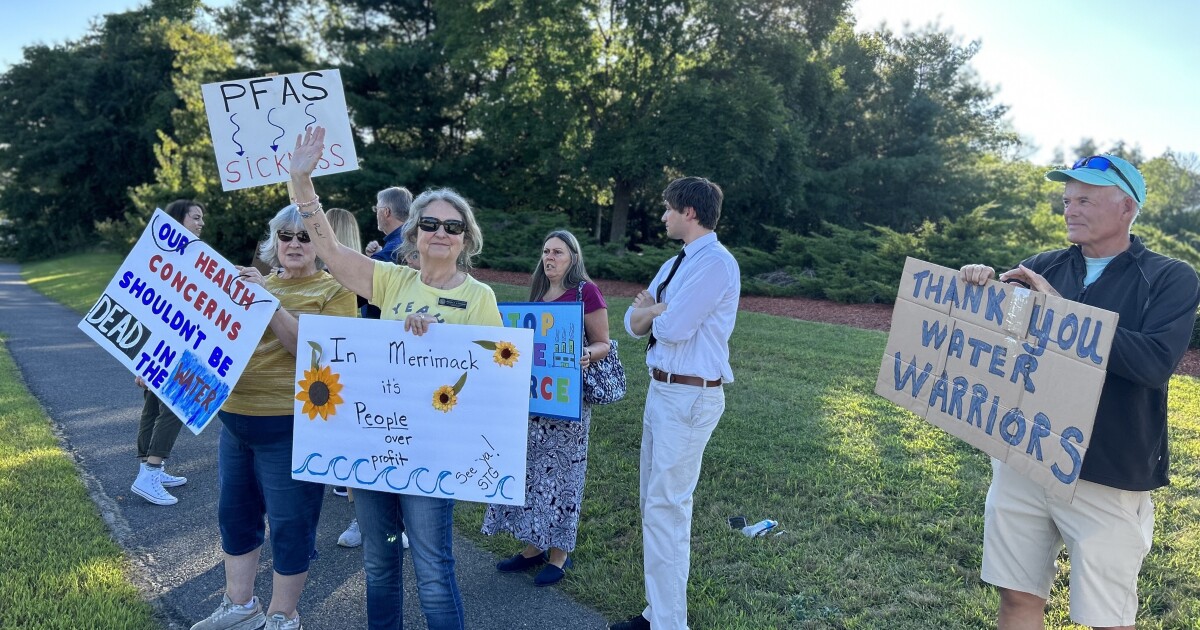
Advocates in New Hampshire are celebrating new federal regulations to limit PFAS chemicals in drinking water, after years of fighting for stronger protections for communities that have suffered from contaminated water.
That group of man-made chemicals have been used for decades in consumer products — especially those that are waterproof, stain resistant, or non-stick. They’re often called “forever chemicals,” because they persist and accumulate in the environment and in peoples’ bodies.
Studies show most people in the U.S. have some PFAS in their blood, and long-term exposure can cause cancer or other negative health effects.
New Hampshire was the first state to require local water systems, landfills, and wastewater plants to test for PFAS and treat water that had been contaminated on a regular basis. In 2019, the state adopted the strictest standards in the U.S. at the time.
But the federal regulations announced Wednesday limit certain kinds of PFAS to lower levels than New Hampshire does currently — limiting two main PFAS chemicals, PFOA and PFOS, to 4 parts per trillion, others to 10 parts per trillion, and implementing limits on mixtures of certain PFAS.
“This certainly isn’t the end of the road; there’s a lot more work to be done, but this is a humongous step in the right direction and one that will benefit so many people,” said Andrea Amico, a longtime advocate who started the group Testing for Pease after her family was exposed to PFAS on the former Pease Air Force Base on the Seacoast.
Next month, Amico said, it will have been a decade since she first learned about the contamination.
“I was shocked 10 years ago when I first learned about PFAS contamination in our public drinking water and couldn’t understand how these chemicals weren’t regulated, how there were no laws to protect people from drinking this,” she said. “Ten years is a long time. But I’m just really grateful that we’re at this point and that this is a huge milestone that we can continue to build off of.”
Implementing new standards
Under the new federal rules, regulated water systems will have three years to monitor for chemicals and five years to treat the water to reduce levels. That treatment could include installing technologies like granular activated carbon or reverse osmosis in contaminated water systems, or shutting down contaminated wells and finding uncontaminated sources of water.
The EPA says $9 billion will be available through the Bipartisan Infrastructure Law to fund PFAS remediation and another $12 billion is available for general drinking water improvements that could include PFAS.
In New Hampshire, state officials said the new regulations could double the number of water systems and private wells in New Hampshire that exceed legal standards.
New Hampshire Department of Environmental Services Commissioner Bob Scott said the state anticipated the new federal standards — but, he said, there could be barriers to implementing them.
“We expect that these lower federal drinking water standards will result in more water systems and private well owners needing financial assistance to be in compliance, which will require a greater commitment on behalf of the federal government than the funding mentioned in their announcement,” he said in a written statement.
State officials said addressing PFAS contamination in New Hampshire has already cost more than $300 million, a cost they say has fallen on state and local governments. In the statement from the Department of Environmental Services, officials said the cost of complying with the new regulations would be more than what state and federal assistance could cover.
In their fact sheet on the new rules, the EPA said the benefits of addressing PFAS exposure would justify the costs.
“Fewer people will get cancer or liver disease, pregnant women will have reduced risks, and more and children and infants will be stronger and grow healthier,” the agency said.
Federal officials estimated that compliance with the new rules would cost $1.5 billion per year nationally — a cost they said was equal to the avoided expenses of medical bills, income lost to illness and death.
For communities whose PFAS contamination comes from a specific source — like the Department of Defense, at the former Pease Air Force Base — the party that created the contamination should be responsible for the cost of cleaning it up, said Amico with Testing for Pease.
New Hampshire lawmakers have tried to implement other measures to limit the amount of PFAS residents are exposed to, including an effort this year to place restrictions on products with intentionally added PFAS, and another to require notice of PFAS contamination prior to selling property.
Laurene Allen, a co-founder of Merrimack Citizens for Clean Water, said the news of federal regulations was welcome. She’s hoping New Hampshire’s timeline for implementing them will be faster than other parts of the country.
“I’m really relieved and happy. And I also strongly urge the state of New Hampshire to adopt these standards as soon as possible, not to wait for the full phase in period, because we don’t need to. We are ahead of the nation, we have done the testing,” she said. “We can lead the nation. We can do right by the people of New Hampshire.”
She said the town of Merrimack’s success in addressing PFAS contamination in public water and minimizing local financial impacts shows that it is realistic and attainable to remediate on a larger scale.
“Lives are at stake here,” she said. “That’s what we have to remember.”

New Hampshire
N.H. city’s refusal to fly ‘Save Women’s Sports’ and ‘An Appeal to Heaven’ flags is unconstitutional, appeals court rules – The Boston Globe
A federal appeals court has ruled officials in Nashua, N.H., engaged in unconstitutional viewpoint discrimination when they denied requests to fly certain politically charged flags, while allowing others, on the city’s “citizen flag pole.”
Bethany and Stephen Scaer, whose requests to hoist banners with the slogans “Save Women’s Sports” and “An Appeal to Heaven” were rejected, teamed up with the Institute for Free Speech and filed a lawsuit in 2024 alleging their First Amendment rights were violated.
The trial court in New Hampshire initially concluded the Scaers hadn’t demonstrated a likelihood that their case would succeed, since the flags approved for display at City Hall constitute government speech. But three judges on the First Circuit Court of Appeals reversed that decision Monday, finding that the flagpole in question had actually been a venue for private speech all along.
The case relates to one Boston lost in 2022, when the US Supreme Court ruled unanimously that the city had unconstitutionally rejected an application to fly a Christian flag.
Even though Nashua sought to clarify its policy in response to that 2022 precedent, the city’s process for deciding which flags from the general public would be allowed still didn’t convert private speech into government speech, according to the First Circuit ruling.
“Nashua was doing no more than simply approving that private speech with which it agreed,” Judge Sandra L. Lynch wrote in the ruling, joined by judges Gustavo A. Gelpí and Jeffrey R. Howard.
In a statement, Beth Scaer said the ruling offers a sense of vindication.
“No one should have to face government censorship for expressing their beliefs,” she said. “We’re thrilled with this victory for free speech rights throughout New England.”
Nathan Ristuccia, an attorney with the Institute for Free Speech who argued the case on appeal, said his team is delighted by the ruling.
“As the First Circuit recognized, governments cannot get away with censorship by labeling that censorship ‘government speech,’” Ristuccia said.
Before the lawsuit was filed, Nashua Mayor James W. Donchess said the city declined to fly the “Save Women’s Sports” flag because officials interpreted it as implying transgender people should face discrimination.
The Scaers, who regularly demonstrate against gender-affirming medical interventions for minors and against inclusion of transgender athletes in women’s and girls’ sports, rejected the notion that their messaging is transphobic.
As for the “Appeal to Heaven” flag, which features a pine tree, Donchess said city officials want to avoid endorsing the additional meaning it has taken on in recent years.
The banner emerged during the American Revolution, with a nod to the Pine Tree Riot in New Hampshire, an act of American resistance that preceded the Boston Tea Party. More recently, the flag has also been used by Christian nationalists, including some who carried it to the US Capitol on Jan. 6, 2021, when a violent mob delayed the certification of President Trump’s 2020 electoral defeat.
In her application to raise the “Appeal to Heaven” flag, Beth Scaer said she wanted to honor the soldiers from Nashua who fought and died at the Battle of Bunker Hill in 1775. She and her husband said their request has nothing to do with the Capitol riot.
Nashua has also declined to fly several other flags since the 2022 policy update, including a “pro-life” flag and a Palestinian flag, according to the lawsuit.
Nashua’s attorney, Steven A. Bolton, said on Tuesday that the city has not yet determined whether to file an appeal. He noted that the appellate ruling calls for the trial court to grant interim declaratory relief while the case proceeds.
Bolton said the city has stopped inviting community members to fly their own flags.
“A new policy was adopted more than a year ago, and we no longer use the term ‘citizen’s flag pole,’” he said. “We no longer accept applications from other parties to fly flags on any of the poles on the City Hall grounds.”
Steven Porter can be reached at steven.porter@globe.com. Follow him @reporterporter.
New Hampshire
Nashua man dies after car crash and fire on Route 101 in Candia, investigation ongoing
CANDIA, NH (WGME) – Early Monday morning, a Nashua man died following a crash on Route 101 eastbound in Candia, New Hampshire.
Joseph H. Lavoie, 58, of Nashua, had been driving along Route 101 eastbound near Exit 3 when he lost control of his car, resulting in a drift off the right side of the highway before striking the cement bridge at the Old Candia Road overpass.
State troopers arrived at the scene to find Lavoie’s car on fire, though several passing drivers had helped to pull Lavoie out of his car. The fire was quickly extinguished.
Lavoie was taken to the hospital where he later died from his injuries.
JOIN THE CONVERSATION (1)
The crash remains under investigation. Anyone with information that may assist the investigation is asked to contact Trooper Kevin LeDoux via email at Kevin.P.LeDeoux@dos.nh.gov.
New Hampshire
New Hampshire’s Energy Landscape in 2025 – Concord Monitor
The biggest national news in 2025 often involved energy — how to make it, who gets to use it, who is going to need it. New Hampshire has sidestepped most of those questions so far but still saw plenty of energy news.
Goodbye, coal
The closing of the Merrimack Station power plant in Bow sounds like New Hampshire’s biggest energy news of the year and got a lot of national coverage along the lines of “New England shuts down coal!” but to be honest, it didn’t make much difference. The plant had been winding down for years, having run for fewer than 30 days in 2024, and would almost certainly have shut in a year or so because it lost what is known as capacity funding.
The more interesting question is what will replace it. Granite Shore Power President Jim Andrews has long touted plans to turn Merrimack Station, as well as the long-closed Schiller site in Portsmouth, into 21st century power plants using batteries and solar power, with perhaps some offshore wind assembly on the shores of the Piscataqua River.
But Donald Trump was elected and promptly began to trash wind and solar power, yanking subsidies and throwing up regulatory roadblocks. Granite Shore now says it is looking at all possibilities.
Both sites have excellent connections to the power grid, which makes them very valuable.
We need more electricity
New Hampshire, like New England in general, have not been swamped with proposals to build massive, power-hungry data centers for bitcoin mining and artificial intelligence. Those proposals have led to forecasts that national demand for electricity will spike by a quarter or more within a few years.
ISO-New England, the group that runs the six-state power grid, projects an 11% increase in electricity demand over the next decade, largely driven by the electrification of heating and transportation. That’s a lot, especially after years of stagnant demand, but it’s not panic-inducing.
Sidestepping regulation
New Hampshire is set to become the first state to allow energy providers to skip most utility regulation if they don’t connect to the grid. Supporters say it adds much-needed flexibility to the hidebound energy industry while critics call it a sop to very large energy users, such as data centers. It’s not clear how much it will be used, but it’s an interesting experiment, at least.
Community solar OK, wind not so much
The Republican-controlled legislature isn’t quite as anti-solar power as President Trump but it shows a lack of enthusiasm for renewable energy. They passed a bill loosening stormwater runoff rules for solar arrays but tightened the Renewable Energy Fund and as the year ended, they were looking to make severe changes to the Renewable Energy Portfolio.
On the other hand, there’s community solar. Thanks to a series of bills over the past few years, arrays up to 5 megawatts can share production with multiple customers, making big projects that opened or are being built in Exeter, Bedford, Derry, Warner and now Concord financially feasible. It seems likely that 2026 will set a record for the most solar added to the grid in New Hampshire. If the legislature would let private companies be community-solar customers, we’d do even better.
As for wind power, legislators echoed Trump’d hatred of the industry. Gov. Ayotte agreed to shorten the name of the Office of Offshore Wind Industry Development and Energy Innovation to simply the Office of Energy Innovation as part of removing virtually all support for wind power on land or in the sea. Not that we gave much support to begin with.
Ironically, this month saw New England receive a record amount of power from wind turbines — more than 1,600 megawatts at one point — as the Vineyard Wind offshore farm finally got up to speed.
What about natural gas? Nuclear? Heating oil?
As has been the case for many years, natural gas was the fuel to supply about half of New England’s electricity in 2025 and heating to about one-fifth of New Hampshire’s homes.
Many politicians are making noises about building more pipelines to bring in more natural gas from New York or Pennsylvania; Gov. Ayotte expressed support for bringing the proposed Constitution Pipeline, which was killed in 2020, back to life. Many argue that such work would be prohibitively expensive and make the region even more dependent on a single type of fuel.
Natural gas has traditionally been very cheap compared to other types of fuel but its price is increasingly affected by global patterns because of an increase in exports.
A separate question is whether the push to electrify the region’s heating can cut into our use of heating oil. Northern New England is by far the national leader in using that dirty fuel for heating; switching to electric heat pumps is almost always cheaper and definitely cleaner. New Hampshire is one of five states in the New England Heat Pump Accelerator, which looks to spend $450 million from Joe Biden’s 2022 Inflation Reduction Act to encourage more heat pumps.
-
Iowa1 week agoAddy Brown motivated to step up in Audi Crooks’ absence vs. UNI
-
Maine1 week agoElementary-aged student killed in school bus crash in southern Maine
-
Maryland1 week agoFrigid temperatures to start the week in Maryland
-
New Mexico7 days agoFamily clarifies why they believe missing New Mexico man is dead
-
South Dakota1 week agoNature: Snow in South Dakota
-
Detroit, MI1 week ago‘Love being a pedo’: Metro Detroit doctor, attorney, therapist accused in web of child porn chats
-
Health1 week ago‘Aggressive’ new flu variant sweeps globe as doctors warn of severe symptoms
-
Maine7 days agoFamily in Maine host food pantry for deer | Hand Off