New Hampshire
Knocking out New Hampshire – The Trek

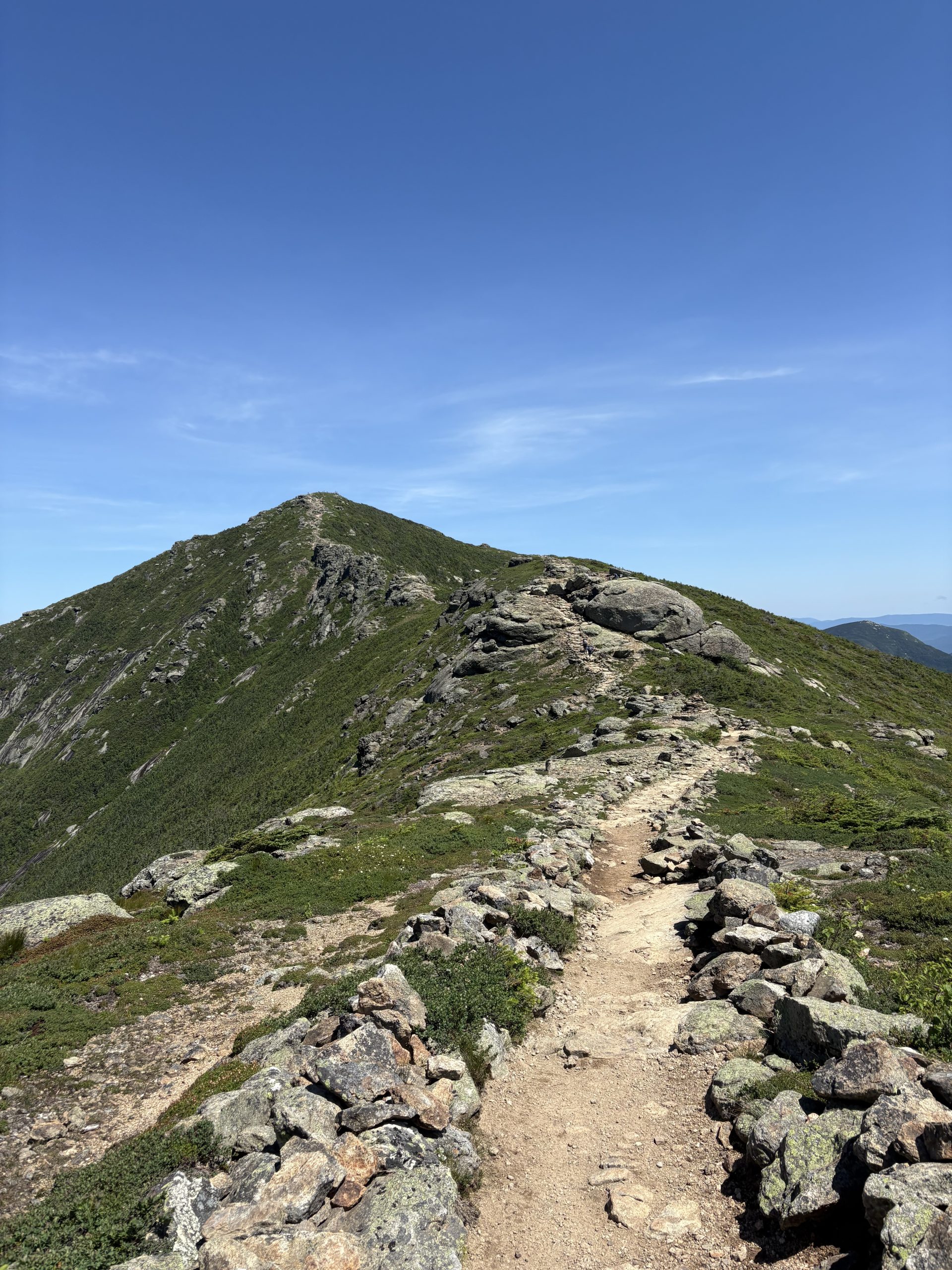
For much of the time that I have been on the trail, the White Mountains have been a continued topic of fearmongering and rumors. Hikers continually talked about how slow you had to go through the Whites and how they could totally throw off a hiker’s pace. Before I got to New Hampshire, I totally fell victim to these rumors, but after walking in those mountains, my mind has been changed.
Moosilauke and the Kinsman’s
My journey through the White Mountains started out with Mt. Moosilauke and the Kinsman mountains. I submitted Moosilauke in the pouring rain and had a very perilous descent down the backside of it as I traversed slippery rock slabs and sketchy steps. I was somewhat disappointed that my first above-treeline experience was totally covered in clouds.

On the bright side, after going over Moosilauke, I stopped at the Notch Hostel to resupply and slackpack. After hiking many of the previous sections solo, I was so excited to be reunited with so many friends at the hostel. When I arrived, it was full of familiar faces who I finally got to see again.
The following day, I slackpacked over the Kinsman Mountains. Again, the climbing and scrambling was fun, but the summit was totally covered in clouds. So without a view from the top of my first four thousand-foot mountains, I was a little disappointed about what the Whites truly held.
Franconia
After two days of clouds and inclement weather, the day I left The Notch was gorgeous. Again, I was reunited with tons of old friends as soon as I got back on the trail. These friends quickly convinced me to shorten my plans for taking on the Whites (from a total of 6 days to 5) in order to get a better weather day on top of Mt. Washington. I was in, and the climb began.
After tons and tons of climbing, we finally made it to Franconia Ridge. This was the first truly above-treeline sections that I had seen on the trail. It was a stretch of a few miles of totally exposed trail. It was so beautiful to be able to look ahead and see exactly where I would be walking in just a few miles. And being able to see out in any direction for miles was just incredible. In short, my mentality was changed. The Whites were incredible!
Getting to the Presidentials
After doing Franconia the day prior, this day had the purpose of getting me to the Presidential Range. While there were some great views on it, the excitement of what was to come outweighed them.
At the end of this day, I did get to do a work-for-stay at the Mizpah hut. Where I cleaned tables and swept the floors in exchange for leftovers from dinner and getting to sleep on the floor in the hut. Leftovers and a floor to sleep on had never seemed so great after the two long days of hiking that I had done before (17 and 20 miles, respectively). And getting to hang out with the croo was a great time as they shared their stories of work in the huts.
The presidentials
The Presidential Mountains are the cream of the crop of the Whites, a 12-mile above-treeline traverse with amazing views. But as I started my traverse, many of the views were unfortunately taken away by clouds. And the clouds continued to come on thicker as I climbed up Mt. Washington. I worried that I wouldn’t get any good views from the famous range. So I quickly took my picture with the famous sign and continued hiking.
As soon as I had descended a mile or two off of Mt. Washington, all of the views suddenly returned. I looked back and saw that just Washington was stuck inside a thick cloud, and I saw that the rest of the day was going to return to the endless views that I had gotten two days prior. The walk down the rest of the Presidential Range was absolutely stunning.
I had originally planned to stay at a designated tent site at the bottom of the Presidential Range, but another hiker convinced me that there would be some dispersed sites that were better further down the trail. Unfortunately, those sites never appeared, and I ended up doing a 22-mile day with over 7,000 feet of ascending and descending (a massive day for the Whites). We also ended up showing up at the Carter Notch Hut at 8 p.m. to beg for a work-for-stay just so we would have a safe place to sleep for the night (which we were fortunately given).
Ending the Whites
My last day in the mountains was a 15-mile stretch to get to Goram, NH. These miles went over the Carter mountain range. Which I conveniently timed going over in a thunderstorm. While the storm was a scare, I survived and made it to the hostel in Goram for a shower and felt much better after.
All in all, I was able to make it through the White Mountains much faster than I had anticipated (finishing all of New Hampshire in only 9 days). The views were also way better than I expected. I have never been so truly wowed by mountains like that before, and I want to get back to hiking like that as soon as I can!
This website contains affiliate links, which means The Trek may receive a percentage of any product or service you purchase using the links in the articles or advertisements. The buyer pays the same price as they would otherwise, and your purchase helps to support The Trek’s ongoing goal to serve you quality backpacking advice and information. Thanks for your support!
To learn more, please visit the About This Site page.



Foreign ministers from Pakistan, Saudi Arabia, Turkey and Egypt will meet in Islamabad today in an attempt to come up with a plan to de-escalate the Iran war.
The meeting comes as several thousand more U.S. troops arrived in the region and after another group got involved in the expanding conflict: Yemen’s Houthis.
The Iran-backed Houthis launched missiles towards Israel, and there’s concern their involvement could threaten another vital global shipping lane in the Red Sea.
Here are more updates on day 30 of the Iran war.
Diplomacy Push in Pakistan
The four foreign ministers from regional powers will meet in Islamabad today and Monday for a push towards diplomacy to end the war.
In a statement ahead of the meeting, the Egyptian government said: “Discussions are expected to focus on recent developments related to regional military escalation and ongoing diplomatic efforts to contain tensions and promote de-escalation.”
“The talks come amid heightened concerns about regional stability, with participating countries seeking to coordinate their stances and support political solutions to emerging crises,” it added.
Whether whatever consensus the countries known as “the quad” come up with will be accepted by the US, Israel, and Iran is another question.
Pakistan has emerged as a possible peace-broker in the conflict, passing messages between the U.S. and Tehran. Foreign Minister Ishaq Dar said Saturday that “dialogue, diplomacy, and such confidence-building measures are the only way forward.”
Dar also welcomed the fact Iran has agreed to allow 20 Pakistan-flagged ships – or two a day – through the Strait of Hormuz.
Houthis enter war
Iranian-backed Houthi militants in Yemen launched the first missile they have fired since the war began toward Israel on Saturday. Israel’s military successfully intercepted it but the Houthis’ attack opens another front in a war that has now moved into its second month.
Up until Saturday’s missile launch the Houthis had stayed out of this war. But a Houthi spokesman said attacks will continue until “the aggression on all resistance fronts stops.”
Pakistan Ministry of Foreign Affairs / AP
/
AP
The Yemen-based rebels were active during Israel’s war in Gaza, firing on cargo ships in the Red Sea and disrupting global commercial traffic.
With Iran essentially blockading the Strait of Hormuz, driving up global oil prices, there are concerns that if the Houthis start attacking ships in the Red Sea again global shipping will be even more disrupted.
Iran also hit multiple sites around Tel Aviv and Jerusalem Saturday and Israel’s military says Iran is increasingly using cluster bombs.
Designed to detonate at high altitude the munition disperses dozens of smaller bombs that are more challenging for Israel’s multi-layered air defense system to intercept and can cause damage over a wider area.
Dozens of countries have signed onto a cluster munitions treaty banning the weapons – except Iran, Israel and the U.S.
Iran threatens U.S. universities in region
Iranian authorities and residents say more airstrikes hit them overnight. Social media videos from across Iran showed strikes hitting all over the country.
Israel’s military said it had completed what it called a wide-scale wave of strikes targeting weapons production and storage sites.
Iran claims U.S.-Israeli strikes hit a Tehran university over the weekend and Iran’s Revolutionary Guard Corps threatened American university campuses in the Middle East in retaliation.
“We advise all employees, professors, and students of American universities in the region and residents of their surrounding areas” to stay a kilometer away from campuses, the statement, carried by Iranian media, said.
Several US universities have campuses in the Gulf, including New York University in the United Arab Emirates and Texas A&M University, among others, in Qatar.
Meanwhile, Iran continues to fire drones and missiles at Gulf countries, with Kuwait saying it was intercepting missile and drone attacks early Sunday. Saudi Arabia said it intercepted and destroyed ten drones.
Iran also claimed it had attacked two major aluminium sites in Bahrain and the United Arab Emirates (UAE). Emirates Global Aluminium confirmed an Iranian attack wounded several and caused significant damage to its plant.
U.S. Troops injured, more arrive
At least 15 U.S. service members were wounded Friday in an Iranian strike on a Saudi air base that hosts American troops, according to the Associated Press, including at least five in serious condition. The missile and drone strikes targeted Saudi Arabia’s Prince Sultan air base, located outside the capital Riyadh.

Iran has targeted U.S. service members at bases throughout the region since the war began a month ago, in retaliation for the U.S. attacks and seeking to drive troops out of the region. Overall, the Pentagon has put the U.S. casualty toll at 13 killed and more than 300 injured.
On Saturday, troops from the Japan-based 31st Marine Expeditionary Unit, made up of around 3,500 sailors and Marines, arrived in the Middle East, according to U.S. Central Command.
The U.S. military will not say where and how they might be deployed. Thousands more soldiers from the U.S. military’s 82nd Airborne Division are also expected to be deployed.
Journalists killed in Lebanon
Three Lebanese journalists covering the Israeli invasion of the country’s south were killed in an Israeli airstrike in Jezzine.

One of them worked for a TV channel affiliated with Hezbollah and Israel accuses him of being a militant rather than a journalist – but has not provided evidence. The journalist Israel says it targeted was Ali Shaeb, a veteran TV correspondent and household name in Lebanon. After killing him, Israel’s military issued a statement accusing him of exposing the locations of Israeli troops.
The other two journalists killed were siblings, TV correspondent Fatima Ftouni and her cameraman brother, Mohammed Ftouni. Afterward their father appeared on TV, saying he was proud of his children.
All three had been covering Israel’s invasion of southern Lebanon.
Lebanese officials called the attack a flagrant violation of international law, and said they’re complaining to the UN Security Council. Hundreds of fellow journalists marched at a protest vigil in Lebanon’s capital.
The three journalists were among at least 47 people killed Saturday in Israeli attacks, according to Lebanese health officials.
Nine of those killed were paramedics, which the head of the World Health Organization called “a tragedy,” noting health workers are protected under international law.

Israel has intensified its attacks across Lebanon, mostly in the South, where Israeli ground troops are moving northward to try to oust Hezbollah militants.
Another Israeli soldier was also killed in Lebanon, with Prime Minister Benjamin Netanyahu expressing his condolences on X over the weekend.
Developments in Syria, Iraq
The war is spreading to more parts of the Middle East. On Sunday, Syria said it had intercepted a drone strike from Iraq targeting a U.S. military base. Pro-Iran Iraqi groups have claimed responsibility for some attacks on US interests.
Separately, the Syrian and UAE governments condemned an attack targeting the residence of the Kurdish region’s president Nechirvan Barzani.
French President Emmanuel Macron also condemned the attack saying: “The sovereignty of Iraq, and of Kurdistan within it, is essential to regional stability. Everything must be done to prevent Iraq from being drawn into the ongoing escalation.”
On Sunday, the Israeli army said it had launched its “first” attack into Lebanon from Syria.
Jane Arraf in Amman, Emily Feng in Van, Turkey, Lauren Frayer in Jezzine, Lebanon, Carrie Khan in Tel Aviv, and Kate Bartlett in Johannesburg contributed to this report.
Copyright 2026 NPR
New Hampshire
Abandoned Camper Fire On South Main Street Knocked Down By Concord Fire And Rescue Teams

CONCORD, NH — The Concord Fire Department is investigating the cause of a camper fire on South Main Street late Friday night.
Around 11:30 p.m., fire and rescue teams were sent to South Main Street, not far from Langdon Avenue, for a report of a camper on fire. Dispatch said it was unknown if anyone was inside or if the camper was abandoned.
“We have a couple of calls on it,” a dispatcher said. “It’s fully involved.”
A few minutes later, the fire was confirmed, and firefighters worked to extinguish it. The battalion commander confirmed no one was inside, and it appeared to be abandoned. Dispatch said, if they recalled correctly, the camper had been there for “quite a while.”
News 603 posted videos from the scene on Facebook here:
And here:
The bulk of the fire was knocked down after about 20 minutes, with firefighters overhauling and dealing with “the hot spots.”
Not long after the overhaul update, firefighters were sent to a business on South Main Street, near the camper fire, in response to a report of an alarm activation.
After investigating, there did not appear to be an activation at the business, a commander said. Later, dispatch said the alarm appeared to restore itself automatically. Firefighters cleared the scene of the business alarm just after midnight on Saturday.

A 20-story tall, 1.3 million-pound Atlas V rocket will blast off from Florida this weekend, and Granite Staters waking up very early might able to see it if the clouds in the sky don’t cover it.
Teams with United Launch Alliance are prepping for the Atlas V rocket launch, the fifth Amazon Leo constellation mission. Liftoff is planned at 3:53 a.m. ET Sunday, March 29, 2026, from Cape Canaveral, Florida.
Pending weather conditions and cloud cover, the Atlas V-Amazon Leo predawn launch could be visible from Florida to New England, according to ULA. That is, if their city falls on the ULA Atlas V rocket launch visibility map (see below), and if they’re awake at the time of liftoff.
The Atlas V rocket will be equipped with five solid rocket boosters to launch the next batch of Amazon Leo broadband satellites (previously referred to as Project Kuiper) into low-Earth orbit, giving a great show to those watching.
However, weather could disrupt viewing, as the New Hampshire area on the visibility map is set for isolated snow showers before 10 p.m. on Saturday night as well as partly cloudy skies, the National Weather Service said.
Here’s what to know about ULA Atlas V rocket launch visibility from New Hampshire.
When will ULA Atlas V launch?
The United Launch Alliance Atlas V rocket will launch from Launch Complex 41 at Cape Canaveral Space Force Station in Florida in the early morning hours on Sunday, March 29. The 29-minute launch window will begin at 3:53 a.m.
The visibility map provided by ULA shows about when and where your best chances are to see the rocket as it streaks northeasterly into space.
Will New Hampshire be able to see the ULA Atlas V launch
New Hampshire, specifically just outside Concord, New Hampshire, falls in the semi-outer periphery of the visibility area for the ULA Atlas V rocket launch, according to ULA’s visibility map.
Estimated visibility will occur at launch +330 seconds, or about five minutes and 30 seconds, following the launch in Florida. However, viewing chances depend on weather conditions, and Concord, New Hampshire is currently set for isolated snow showers before 10 p.m. and then partly cloudy skies on Saturday night into Sunday morning, according to the National Weather Service. This might block visibility, as clear skies are essential for best views.
What is ULA Atlas V?
United Launch Alliance’s Atlas V rocket is a spacecraft with five solid rocket boosters that will send a batch of Amazon Leo broadband satellites into outer space, to low-Earth orbit.
How can you follow along live?
FLORIDA TODAY will offer live coverage via a live webcast with live tweets and updates for the rocket launch.

401Gives Starts Tuesday!

Arkansas Women’s Tennis Defeats South Carolina

TBD vs. South Dakota Coyotes – Live Score – March 31, 2026

What we learned as Vanderbilt baseball sweeps Tennessee for first time since 2013

Texas A&M avoids sweep taking Game 3, 9-7, hands Texas rare home loss

Florida High School Football Rankings: Top 25 teams – Oct. 21

How old is Bo Nix? What to know about Oregon quarterback ahead of 2024 NFL Draft

Cleary's 21 help Le Moyne down Central Connecticut State 69-64 in OT

99th annual Pony Swim held in Virginia

Indiana Members Credit Union announced as new anchor tenant at Bottleworks District

Scathing report claims nation’s oldest labor union ‘betrayed’ MAGA members through ‘shocking’ spending

Republican US lawmaker demands Congress vote on any Iran troop deployment

So you went to a No Kings protest. Now what?

JD Vance says he was ‘obsessed’ with UFOs, believes aliens are actually ‘demons’
The EU's recipe for trade deals : easy on beef, tough on wine
-

 Sports1 week ago
IOC addresses execution of 19-year-old Iranian wrestler Saleh Mohammadi
-

 New Mexico1 week ago
Clovis shooting leaves one dead, four injured
-

 Miami, FL3 days ago
Jannik Sinner’s Girlfriend Laila Hasanovic Stuns in Ab-Revealing Post Amid Miami Open
-

 Tennessee6 days ago
Tennessee Police Investigating Alleged Assault Involving ‘Reacher’ Star Alan Ritchson
-

 Minneapolis, MN3 days ago
Boy who shielded classmate during school shooting receives Medal of Honor
-

 Technology1 week ago
YouTube job scam text: How to spot it fast
-

 Politics1 week ago
Schumer gambit fails as DHS shutdown hits 36 days and airport lines grow
-

 Science1 week ago
Record Heat Meets a Major Snow Drought Across the West