Northeast
Massachusetts foster parents stripped of license for refusing to sign transgender policy

NEWYou can now listen to Fox News articles!
A Massachusetts couple says their foster license was revoked after they refused to sign a state contract requiring them to “affirm” a child’s gender identity because of their Christian beliefs.
Lydia and Heath Marvin, who live in Woburn, Massachusetts, with their three teenage children, have fostered eight children under age 4 since 2020, including a baby with special medical needs they fostered for 15 months.
“We decided that we wanted to do foster care because it’s a key part of being Christian to care for those who are most in need, like orphans,” Heath Marvin told Fox News Digital.
But everything changed after the Marvins received a new parent agreement in August 2024 asking them to agree they would “support” and “affirm” the LGBTQIA+ identity of children in their care.
SUPREME COURT SKEPTICAL OF ‘CONVERSION THERAPY’ LAW BANNING TREATMENT OF MINORS WITH GENDER IDENTITY ISSUES
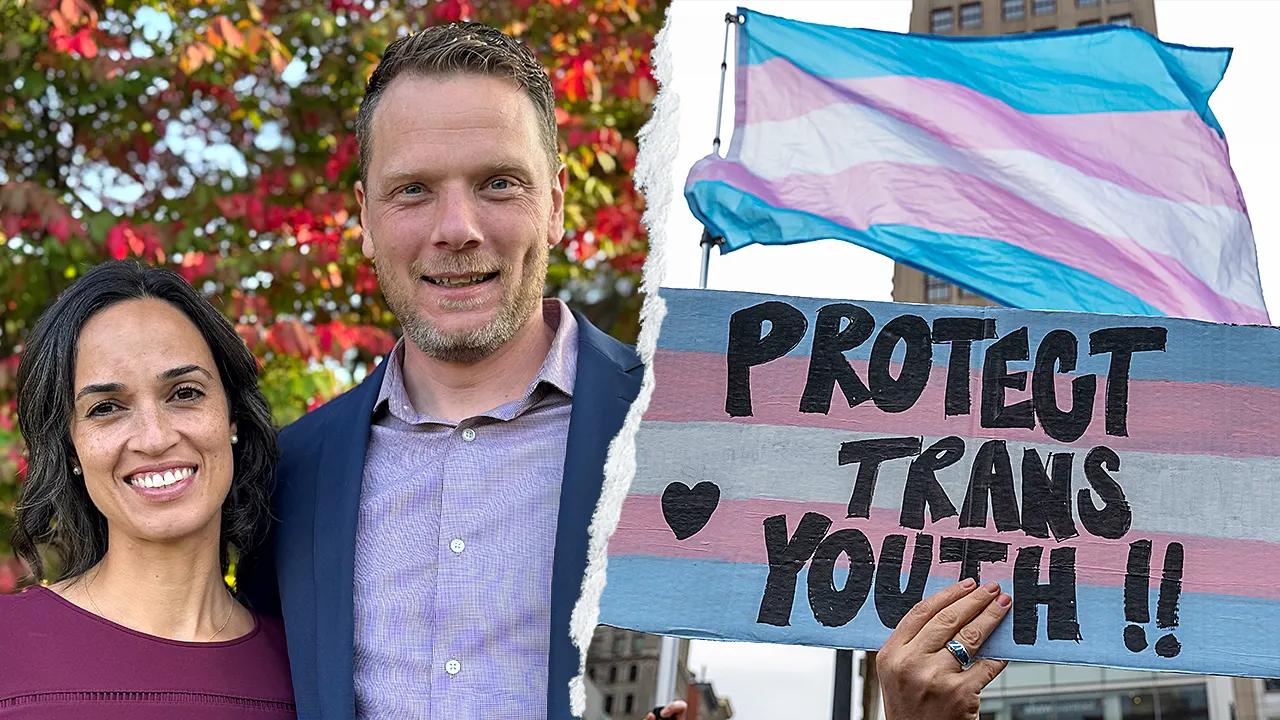
Lydia and Heath Marvin said they pleaded with the Massachusetts Department of Children and Families to provide religious accomodation to the gender policy but were denied. (The Marvins/Stephanie Keith/Bloomberg via Getty Images)
The Marvins asked for an accommodation or waiver from the state, citing their Christian beliefs about gender and sexuality. They said they assured the agency that any child in their home would be loved and taken care of.
“We would absolutely love, care, and support any child in our home, but this was asking us to go against our Christian faith,” Lydia Marvin told Fox News Digital. “We were ultimately told, ‘No, you have to sign the form as is, or else you will lose your license.’ And so, in fact, we lost our license in April of this year.”
The Marvins said they had just completed medical training in order to take care of another child with specialized needs when they learned they were no longer approved by the Massachusetts Department of Children and Families (DCF) to do so.
“It’s obviously not been what we’ve been hoping for,” Heath said, adding that their focus has always been on providing a loving home for kids who need help.
CHRISTIAN FOSTER FAMILIES FIGHT BACK AGAINST MASSACHUSETTS TRANSGENDER MANDATE
Protesters for and against gender-affirming care for transgender minors demonstrate outside the Supreme Court on Dec. 4, 2024, in Washington, D.C. (Jose Luis Magana/Associated Press file)
The couple appealed the decision in May and found out in September that the state upheld the decision to revoke their license.
According to DCF policy, the agency “actively recruits, screens, and assesses foster families for their ability and willingness to support and affirm LGBTQIA+ children placed in their care, including recruiting foster families that identify as LGBTQIA+.” But religious liberty advocates argue this requirement forces families of faith to violate their beliefs.
At least two other Christian foster families in the state are fighting the policy in court.
Alliance Defending Freedom (ADF) is representing the Schrocks and the Jones in a federal lawsuit against the DCF, alleging the policy violates their clients’ constitutional rights. These families also foster young children and refused to sign the gender contract. The Schrocks had their license revoked in June.
WASHINGTON STATE’S RADICAL NEW LAW TURNS PRIESTS INTO GOVERNMENT INFORMANTS
Nick and Audrey Jones, two foster parents who are suing Massachusetts over its “gender-affirming” policy. (Alliance Defending Freedom; Drew Angerer/Getty Images)
According to the suit, Massachusetts did not previously require foster families to pledge verbal affirmation of a child’s gender identity. That changed between 2023 and 2024, when the state began requiring families to sign agreements to speak and act in certain ways, including affirming a foster child’s sexual orientation or gender identity.
Senior Counsel Hal Frampton told Fox News Digital the state’s actions are hurting vulnerable children instead of helping them.
“What really hurts about all of this is that this hurts kids more than anything else,” he said. “Every child deserves a loving home. And children suffer when the government excludes people of faith who are ready to provide those homes to them based on the government’s radical ideology.”
ADF argues the policy is particularly harmful to children at a time when the state faces a foster parent shortage.
“They have more kids than homes ready to support them,” Frampton said. “And so the idea that you’re going to take loving families like the Marvins, like the Shrocks, like Joneses, the people we represent in our case, who have successfully provided for kids for years and say, now those people are just out of the system. In the end, what that does is it deepens the crisis, and it results in more kids not having loving homes.”
CLICK HERE FOR MORE COVERAGE OF MEDIA AND CULTURE
The Trump administration has also weighed in on the Marvins’ case.
In a Sept. 30 letter addressed to the DCF from the U.S. Department of Health & Human Services, Acting Assistant Secretary for the Administration for Children and Families Andrew Gradison called the state’s policy “troubling” and in violation of the Constitution.
“These policies and developments are deeply troubling, clearly contrary to the purpose of child welfare programs, and in direct violation of First Amendment protections,” the letter said, according to the Massachusetts Family Institute.
“It’s really heartening to see the administration noticing this issue and taking it seriously and coming down on the side of loving families like the Marvins and recognizing that states shouldn’t be in the business of using their radical gender ideology to hurt kids,” Frampton added.
CLICK HERE TO DOWNLOAD THE FOX NEWS APP
A spokesperson for the Massachusetts Department of Children and Families declined to comment when reached by Fox News Digital.
Read the full article from Here



new video loaded: The Democracy of The Dive Bar
By Anna Kodé, Gabriel Blanco, Haimy Assefa and Laura Salaberry
June 19, 2026

Boston is allowing outdoor drinking in two neighborhoods this summer while the city welcomes a wave of international visitors during the World Cup, Mayor Michelle Wu announced.
The social districts opened Friday and will run through July 31.
Boston public drinking zones
Patrons will be allowed to consume alcoholic beverages outdoors within designated areas at Union and Marshall streets in Downtown Boston’s Block Historic District, as well as on Temple Place in Downtown Crossing.
According to the city, the initiative along with the decision to extend last call until 3 a.m. for the World Cup “is creating vibrancy for patrons and expanding opportunities for Boston businesses during one of the region’s busiest summers in recent years.”
“As Boston welcomes people from around the world to gather and enjoy our city this summer, these new social districts will create even more opportunities to build community and have fun responsibly,” Wu said in a statement. “These districts help us open our streets in a safe environment for residents and visitors to enjoy themselves, ‘sip and stroll,’ and make lasting memories in our beautiful city.”
Last week, Gov. Maura Healey signed a new law that allowed for cities and towns to create designated areas for public drinking.
How drinking zones work
In order to participate, businesses within the designated zones must file a one-day amendment application with the Boston Licensing Board that states they wish to be included in the districts.
Businesses cannot sell alcohol for public consumption until they receive approval from the Licensing Board.
Hours for the Union-Marshall Street Social District will be 9 a.m. to midnight Monday through Saturday and 10 a.m. to 9 p.m. on Sunday. The Temple Place Social District will be open from 9 a.m. to 11 p.m. Monday through Saturday and 10 a.m. to 9 p.m. on Sunday.
Drinks sold for public consumption will be in clear plastic containers with a sticker or other label that shows where they were sold. Businesses cannot sell more than one 16-ounce alcoholic beverage for public consumption per customer in a single transaction.
Outside alcohol cannot be brought into businesses.
“We are grateful for this opportunity to activate our downtown, support businesses, and create a welcoming, relaxed atmosphere in two of Boston’s entertainment districts,” Corean Reynolds, director of nightlife economy, said in a statement. “Both residents and tourists can benefit from these Social Districts. After the summer, we look forward to continuing our work creating a nightlife infrastructure that works for everyone.”

The decision to trade catcher Joey Bart to the Braves gives the Pirates a solution to a problem that soon needed to be made.
Bart had been on a rehab assignment with Triple-A Indianapolis, working his way back from a left foot infection that kept him out of action for over a month.
With Bart nearing a return, the Pirates were going to have to figure out what to do at catcher with Henry Davis and Endy Rodríguez splitting time behind the plate in his absence.
Given how Rodríguez has been swinging the bat since he was recalled from Indianapolis to replace Bart on the active roster, there was no way the Pirates could’ve sent him down. In 23 games, the 26-year-old has a .267/.413/.467 batting line with three doubles, three home runs, eight RBI, two steals and a robust 19.7% walk rate.
Davis, meanwhile, has struggled to an anemic .138/.242/.285 batting line with four doubles, five home runs and 17 RBI in 47 games. While he hasn’t offered much with the bat, he’s been responsible for two defensive runs saved and leads MLB with a 55% caught stealing rate.
Now that Bart has been traded, Rodríguez and Davis will remain the catching tandem at the big-league level with Rafael Flores Jr. as the top backup option with Indianapolis. Flores is considered Pittsburgh’s eighth-best prospect on MLB Pipeline.
For the first time in the big leagues, Rodríguez is realizing the potential that once made him one of the top 100 prospects in baseball. Because of that, he should get the majority of the playing time with Davis continuing to catch Paul Skenes’ starts and filling in when needed.
As for the return, the Pirates known what to expect from Hunter Stratton, who spent nine seasons in the organization and made 47 appearances with the team from 2023-25.
The bullpen has been an obvious weak spot for the team this season, and while it was somewhat surprising to see the Pirates assign Stratton to Indianapolis, he improves the pitching depth and will almost surely be called upon at some point this year.
In 60 career big-league appearances between the Pirates and Braves, Stratton is 3-2 with a 3.75 ERA and two saves. The right-hander spent most of the 2026 season with Triple-A Gwinnett and went 2-4 with a 4.38 ERA and 24 strikeouts in 24.2 innings across 21 appearances.
One more important note about the trade is that the Pirates saved some money in the deal, which could be used later in additional trades to add to an already record-setting payroll. Stratton is a pre-arbitration player, while Bart is making $2.53 million this season.
More about:Pirates
-

 Health8 minutes ago
Video: Wii Bowling Takes Over Tulsa Retirement Homes
-
Lifestyle23 minutes ago
This Pride month, teen flicks are recasting familiar tropes with a queer sensibility
-

 Technology31 minutes ago
NASA selects Eric Schmidt’s rocket company for a 2028 mission to Mars
-

 World38 minutes ago
British Prime Minister Keir Starmer faces potential leadership challenge from newly-elected Andy Burnham
-

 Politics41 minutes ago
Reporter’s Notebook: How Trump’s surprise move on DNI confirmation upended key Senate deal on FISA
-

 Health53 minutes ago
Weight-loss drugs linked to ‘Ozempic ears’ and other cosmetic complaints, surgeons say
-

 Sports56 minutes ago
Florida AG launches civil rights investigation into MLB’s warning to Christian pitchers over Pride Night caps
-

 Technology1 hour ago
Fox News AI Newsletter: Bezos predicts labor shortage


