Maine is set to close out 2024 as a year that saw a continued decline in drug overdose deaths. But while the top official responsible for coordinating the state’s response to the opioid crisis is glad to see the trend, he’s not celebrating.
That’s because the approximately 500 total overdose deaths projected for this year is still far too high, Gordon Smith, Maine’s director of opioid response, said in an interview.
“One death is too many, but 500 is a catastrophe. It’s simply better than 720 [in 2022],” he said, referring to the year when Maine saw its greatest number of overdose deaths.
Across Maine, 405 people died after overdosing between January and October, according to the Maine Drug Data Hub. That official count represents a 20 percent decrease compared with the same time period in 2023. It continues the decline first seen in 2023, when fatal overdoses decreased 16 percent compared with 2022.
Advertisement
The reasons for the decline are not truly known, Smith said, but it is probably at least partially due to the decreasing potency of fentanyl, a powerful manmade opioid that is the most frequent cause of death. There are also more services in Maine to help people with an addiction to opioids than in the past.
The Bangor Daily News spoke with Smith about the changes he has seen since his position in state government was created in 2019, after fentanyl turned Maine’s ongoing opioid crisis even more deadly. From distributing hundreds of thousands of doses of overdose-reversing naloxone, to training more than 2,000 people as peer recovery coaches, to expanding access to treatment, Maine has significantly boosted help for people who need it, Smith said.
For instance, more than 5,000 people are currently receiving methadone, the most ever, Smith said. Providers in Maine are also prescribing a record 16,000 to 20,000 people with buprenorphine, another medication for opioid use disorder. While people can have success with an abstinence-based approach to treatment, he said, medications such as methadone and buprenorphine have been shown to increase people’s odds of staying in long-term recovery.
The following Q&A has been condensed:
Gordon Smith, state of Maine: I think one of the reasons that this is all going better now is that so many people are willing to take some help medically, and we’ve really encouraged the medical community to step up and make that available in all the primary care practices, in all the emergency departments — low-barrier access to buprenorphine. We’re only down to three to five [predominantly small, rural] emergency departments in Maine that aren’t ready to do that, and we’re working with them to make sure that they do get ready to do it.
Advertisement
Erin Rhoda, BDN: I don’t know that any ERs a number of years ago were prescribing buprenorphine. Is that right?
Smith: None were.
You’re recalling, in Executive Order 2, which established my position in February of 2019 … we said the first thing I’m going to do is buy 35,000 doses of naloxone. … Now it’s truly the thing that’s making the biggest difference in keeping people alive. The data in [the state’s monthly overdose report] is startling: 95 percent of people that overdose in Maine today are surviving their overdose. That’s remarkable. …
The second thing we said in that executive order, after we purchased 35,000 doses of naloxone, was we were going to ask every emergency department to have low-barrier access available to buprenorphine, to any patient that came in after an overdose or was otherwise struggling with substances. …
One of my favorite things in that executive order was we asked every prison and facility and every jail to make sure that people who had a substance use disorder were treated for their illness and had medication available, meaning buprenorphine generally.
Advertisement
Because it’s just stunning, as a health care lawyer, that in 2019, two decades after the Americans with Disabilities Act, that people with substance use disorder were not treated when they were incarcerated. And that’s still true in the majority of carceral settings in this country. …
Almost 50 percent of the [inmates in Maine’s prison system] are on medication for substance use disorder. Which sounds like an insane amount except we know that 70 or 80 percent of them have a substance use disorder. In many of the jails also the numbers are up around 50 percent, sometimes more.
Rhoda: Are all jails now offering treatment?
Smith: They’re all offering treatment. They’re all offering medication. They’re not necessarily all offering the injectable version of buprenorphine. The goal would be to offer all [U.S. Food and Drug Administration] approved products for substance use disorder and in all of their versions — injectable, film, pills, whichever works for that particular resident of the jail, but almost no jail or facility at this point is able to offer all those versions.
Rhoda: [The jails offering medication] seems like a huge change.
Advertisement
Smith: There’s not a single facility, Erin, that is where we’d like to have them right now, but they’re all way, way better than it was. The reason that they’re not further along is really resources. … We’ve made some more state money available to them. The governor did $4 million in the last budget, more money for the jails for these purposes, but it really is an issue of resources.
And you know, in the grand scheme of things I’d really prefer to not see people with substance use disorder in jail. I’d like to see a lot more diversion. …. The treatment courts are trucking along. We’ve got one in … every county except Aroostook County, and we’ve got a great plan up there that Todd Collins, [the district attorney], and a whole bunch of people worked on, but we need $750,000 a year to do it, and nobody has come up with that money. So we’ll try again.
Rhoda: I also remember when there were no detox beds [at facilities that medically supervise people through the acute stages of withdrawal].
Smith: We now have about 120, 130 detox beds because we’ve also been successful in getting the private places to open some beds to MaineCare, like Pine Tree in Portland and Libby Bay. We’ve got 10 beautiful Wabanaki beds [in Bangor] … but they’re not full. I think part of it is communicating to people who might need those beds that they’re not just for Indigenous Mainers, number one, and that they’re open for business.
Rhoda: When it comes to the overdose death rates, are you seeing really big declines in certain areas? Where in Maine have you seen the biggest declines?
Advertisement
Smith: Actually in Portland. It has not been uniform across the state. There are some counties that will see more deaths this year than last year. They tend to be smaller numbers, but still. …
We’ve seen the biggest decline really in the urban areas, and we’ve not done as well in reducing overdoses in some of the rural areas. We need to do a better job there. Some of it is hard to address. It takes a long time to get an ambulance out to Springfield, Maine, 20 miles east of Lincoln, right? Fentanyl acts very quickly. Too many people use alone. Why do they use alone? There’s a lot of shame and stigma associated with it.
Rhoda: Stimulants are continuing to increase as a cause of death in combination with other drugs like fentanyl. What do you make of that, why that’s happening?
Smith: I don’t think anybody knows. Not a week goes by that we’re not on some webinar with our federal partners and national people; we get together with our New England group all the time, we talk about these things. Nobody really knows. People don’t even know why the death rate is declining. We speculate.
There’s a North Carolina drug lab run by Dr. [Nabarun] Dasgupta. He posited eight different theories [for the decline in overdose deaths]. They all made sense to me: more naloxone, more treatment available. …
Advertisement
Now xylazine [a sedative added to fentanyl that is not as lethal] is a factor. We’re up to 14 to 16 percent xylazine. Oddly enough it might be some of these fillers that are helping to keep people alive. It’s still doing really bad things to them, you know, but they don’t die.
Rhoda: With xylazine, that’s a relatively new thing. Do you think that that filler is playing a role in the declining number of deaths?
Smith: It is one of the things that the researchers are speculating that may be part of why fewer people are dying. …
The fact is that nationwide we’ve seen a 10 to 12 percent decline, and not every state is doing what we’re doing, right? In some of the New England states, probably New Hampshire and Maine have seen the sharpest declines. But every state has seen some improvement. So it’s more than just what we’re doing.
Rhoda: Where does Maine stand exactly in its decrease of opioid deaths relative to the nation? We are falling faster?
Advertisement
Smith: Yes, but we were also higher to start with. We started from a pretty bad place in 2018, 2019. And so we’re coming down now towards the middle.
Rhoda: I’ve been reading about the declining toxicity of fentanyl. The fentanyl on the street is becoming weaker. Is that happening in Maine?
Smith: Probably. We don’t necessarily have enough drug checking and drug testing to know that. … It’s funny because we used to talk about fentanyl adultering everything else; now people want fentanyl, and it’s being adulterated with everything from xylazine to other fillers, including cocaine and meth.
So, again, we don’t have the sophisticated kind of drug-checking apparatus. We’ve got four new drug-checking machines that are just starting to be used. There’s one in Machias, one in Sanford, as part of Project DHARMA. It’s a federal grant run out of the Maine Medical Center. …
The whole idea is we’re going to start testing residual amounts of drugs — in syringes usually — at various sites around the state and then get that to the Colby drug lab and see what’s in these drugs. That will give us maybe a head start on what kind of drug policies we need in the state in reaction to that. So it’s possible in a year or two when you ask me the question about the strength of the fentanyl that I’d have actually good chemistry to answer that question, but it’s just starting.
Advertisement
Rhoda: What do you think next year will bring?
Smith: I don’t think we need a lot of new initiatives, but I think we need to put more resources into all the things we’re doing. We had one crisis receiving center [to help people with a range of mental health or substance use challenges]. Now we’re going to have five. We had three McAulay houses [for women in recovery and their children]. Now we’re going to have seven. We’ve got 1,000 recovery beds [at about 100 recovery residences]. We need probably 200 more in rural areas.
We need to just keep doing what we’re doing, lower the stigma, let people know we care about them, give them hope, and make sure when they’re ready today that we’ve got a bed for them, or an outpatient facility, whatever they need. That’s my hope.
Rhoda: A final note here: What do you want families to do if they have a loved one with addiction? If they’re reading this and they think, I really need to do something, what is your advice?
Smith: There are support groups for family members. We have 24 recovery community centers now. Call 211. Don’t suffer in silence alone, and don’t give up on your loved one.
Advertisement
Erin Rhoda is the editor of Maine Focus and may be reached at erhoda@bangordailynews.com.
The smell of sap and the taste of fresh syrup drew crowds to sugarhouses across Maine as the state celebrated the 43rd annual Maine Maple Sunday Weekend.
More than 100 sugarhouses statewide took part in this year’s event. At Balsam Ridge Christmas Tree Farm in Raymond, visitors got a firsthand look at how Maine sap is turned into maple syrup.
“So far we’ve had a great time, we have enjoyed all the maple treats,” said Doug Noe, a Portland resident.
Balsam Ridge Farm owner Dewey Lloy walked visitors through the process, explaining how sap moves through the evaporator. “Most of the evaporation is going to occur here in the back pan which is the evaporator pan and its going to come to the front pans which are syrup pans and now its becoming maple syrup at this point,” Lloy said.
Advertisement
Lloy said the farm plans to produce more than 300 gallons of syrup this year and expects more than a thousand visitors this weekend.
“It’s always nice to see the young and old and everybody that is just excited to get out and sample soon syrups and get stocked up on some syrup,” Lloy said.
Visitors sampled maple treats while listening to live music and exploring the Christmas tree farm.
Maine Maple Sunday weekend
“They always have great music and food and there’s always nice people to come see,” said Sam Menzel, an Oxford resident.
Advertisement
According to the Maine Maple Producers Association, Maine produces more than 575,000 gallons of maple syrup each year from more than 2 million maple tree taps across the state. As the state’s official sweetener, maple syrup remains a tradition that brings people back year after year.
“Its grown so much in the last years and its amazing to see how well their doing and i love to come support,” Menzel said.
Maine Maple Sunday festivities will continue across the state tomorrow.
New food and dining developments are taking place all across Maine. Here are some recent updates to keep you in the know:
Day Boat Cafe (website, facebook, instagram) in Waldoboro (above left) had their grand opening on Wednesday. Located at 17 Friendship Road in the town center, Day Boat is the creation of Anna Hymanson and Kelsey Woodworth. Their menu includes options like a pork with broccolini sandwich, panzanella salad and clam chowder. They also have prepared foods to go. The space features a 13-seat lunch counter, two window booths, and a large community table in an open kitchen concept. Outdoor seating will also be available as the weather warms. Day Boat will be open Wednesday through Friday, 10 am – 6 pm, and Saturday/Sunday 10 am – 4 pm.
Chef Nate Fenn is joining with Logan and Ashleigh Feeney in their relaunch of the Bowdoinham Country Store (above right). The Feeney bought the store last year and have been renovating the building. They’re hoping to launch BCS in May addressing the needs of the community with a neighborhood market and serving as a gathering space with a menu of snacks, pizza, sandwiches and prepared food to go. Later in the summer they hope to expand the seating area and launch a restaurant that will be open for dinner Thursday through Saturday. Fenn is currently the chef at Table Bar in Gardiner. He began his career at Flatlanders Pub in Greenville and has worked at Spring Creek BBQ in Monson and elsewhere in the state. The store is located at 54 River Road near the town center.
The Waldoboro Inn (instagram) has announced their summer plans and kicked of a novel crowdfunding campaign to help in the build out of their kitchen and expansion of their bar program. Starting on May 30th, Finocchi (instagram) will be operating Trattoria Finocchi at the inn on Fridays, Saturdays and Mondays throughout the summer. The Finocchi project “focuses on the story & magic of food as they queer Italian and Italian-American traditions.” They plan to grow some produce at the Inn as well as source ingredients from Landsmith Farm & Commons. You can buy tickets for the crowdfunding campaign/raffle on the TWI website. Ticket prices are aligned with prize packages, and in a unique twist even losing ticket win some type of prize. For example the winner at the $50 level gets a dinner for two, and the remaining ticket holders get a free drink at the inn’s wine bar.
The Bangor Daily News has published an article about Rasa, an Indian restaurant being launched in Bangor by Sai Guntaka from Taj and his uncle Obul Reddy. The restaurant is scheduled to open March 29th.
Cellardoor Winery took home an award from the International Wine Competition for their 2024 Late Harvest Frontenac Blanc.
Salt + Pepper Social in Newcastle is holding 3-course plant-based dinner on May 2nd.
A new pizza food truck called Colonel’s Canteen (facebook) is under development. They plan to operate at the Korean Dad space in Veazie and at events in the Bangor/Brewer area.
The Pilgrim’s Inn on Deer Isle has rebranded as The Ark. The restaurant at the inn was on the New York Times “50 best places in America right now” restaurant list in 2025.
The Crooked Spoon is holding a pop-up dinner at The Norumbega in Camden on March 28th.
Meet York County has published a field report from Bob’s Ugly Bagels in Shapleigh., and Biddo Foodies has published a field report from Fern Leaf Bakery in Saco.
The Sanford Springvale News has published a profile of Bob Rizk, the chef and owner of The Rialto in Sanford.
The Bethel Citizen reports that the Upton Village Store is under new ownership. “They will sell groceries, prepared food and Maine souvenirs year-round. The store will also offer live bait, small camping supplies and check stations for wild game and furs.”
The Press Herald reports that Maine Beer Company in Freeport is planning an 11,000 sq ft expansion that will enable them to double their production capacity to 100,000 barrels a year.
As reported last Sunday, Vince Maniaci and Jill Dutton have announced they’ll be closing their Scarborough market and cheese shop, The Cheese Iron
For a statewide guide to eating and drinking see the Maine Food Map—a growing list of coffee shops, bars, restaurants, bakeries, cafes, plus other food and dining businesses in all of Maine’s 16 counties.
Tristan Singh spells the word stratosphere correctly to win the Maine State Spelling Bee at Bowdoin College in Brunswick on Saturday. (Gregory Rec/Staff Photographer)
BRUNSWICK — A eighth grade student from Washington County returned for a second crack at the Maine State Spelling Bee Saturday and booked a ticket to the 2026 Scripps National Spelling Bee in May. He’s also headed somewhere else special — his school’s spring dance.
“It feels really awesome, especially since I made the biggest bet on winning,” winner Tristan Singh said following the bee. “There’s a spring dance coming up at my school next week, and I said I would only (go) if I won.”
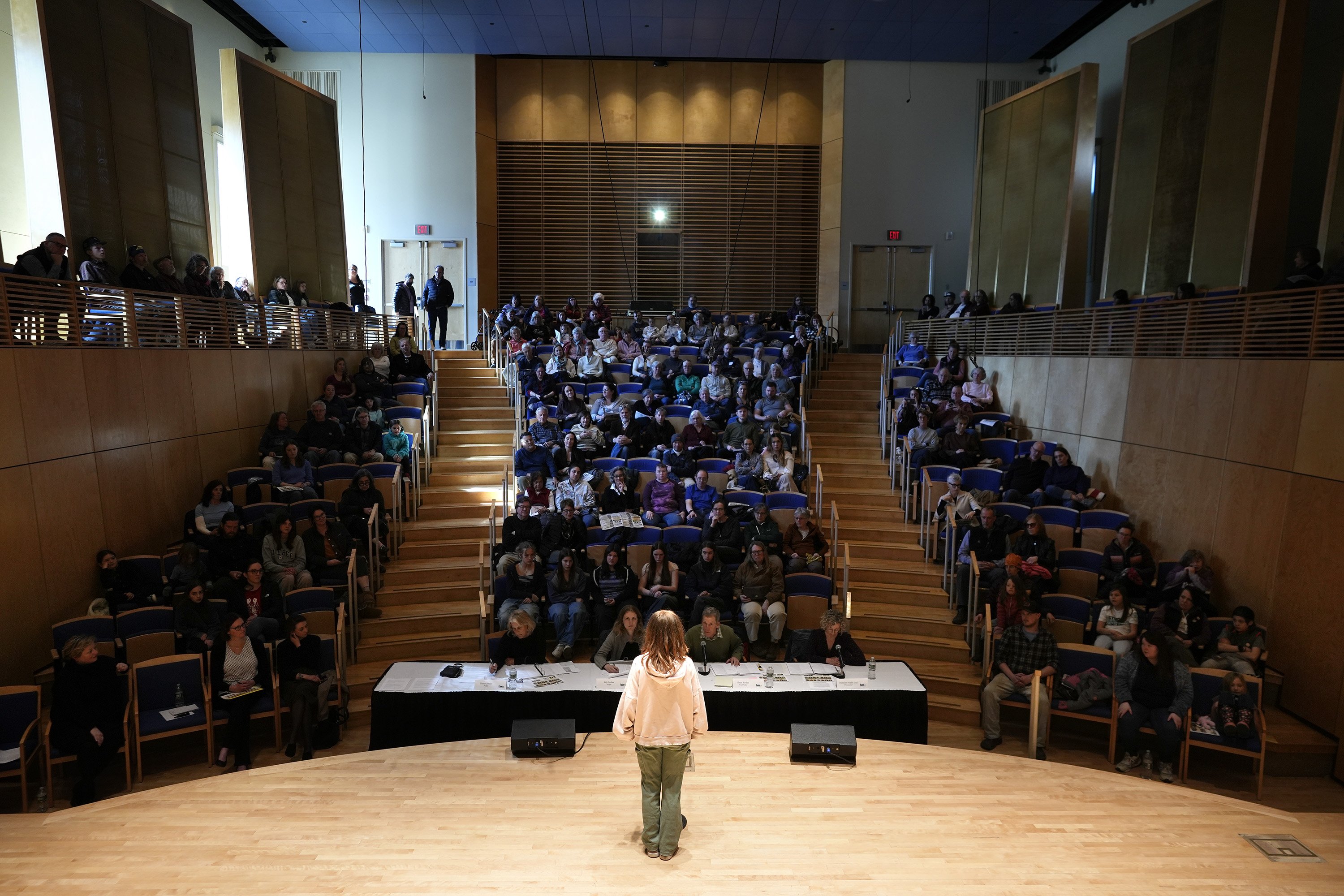
Singh, a student at Rose M. Gaffney Elementary School in Machias, beat out 13 other spellers from all over the state at Bowdoin College and took the final prize with the word “stratosphere.” Each student had won bees at the school and county level to win a spot at the state competition.
Advertisement
The bee, which was presented by the Maine Trust for Local News, went on for 18 rounds. It came down to Singh and the student representing Androscoggin County, Turner Elementary School sixth grader Grace Morris.
Spectators were biting their nails as Morris and Singh went back and forth spelling words for six rounds.
Benjamin Ho, a seventh grader at Gorham Middle School, contemplates the spelling of a word during the Maine State Spelling Bee at Bowdoin College in Brunswick on Saturday. (Gregory Rec/Staff Photographer)
At round 14, Singh misspelled “cognizant,” giving Morris the chance to win. Then, Morris misspelled “millennial” — sending the final two into more rounds until a misspelling of “philosophize” ultimately took Morris out of contention.
The heated competition was all in good fun as spellers high-fived each other on stage and celebrated each others’ wins.
“We ended up chatting a lot, (and) cheering each other on,” said sixth grader Harmony Hoyt, the speller from Aroostook County.
And families in the audience were waiting with congratulatory hugs no matter their students’ place in the standings.
Advertisement
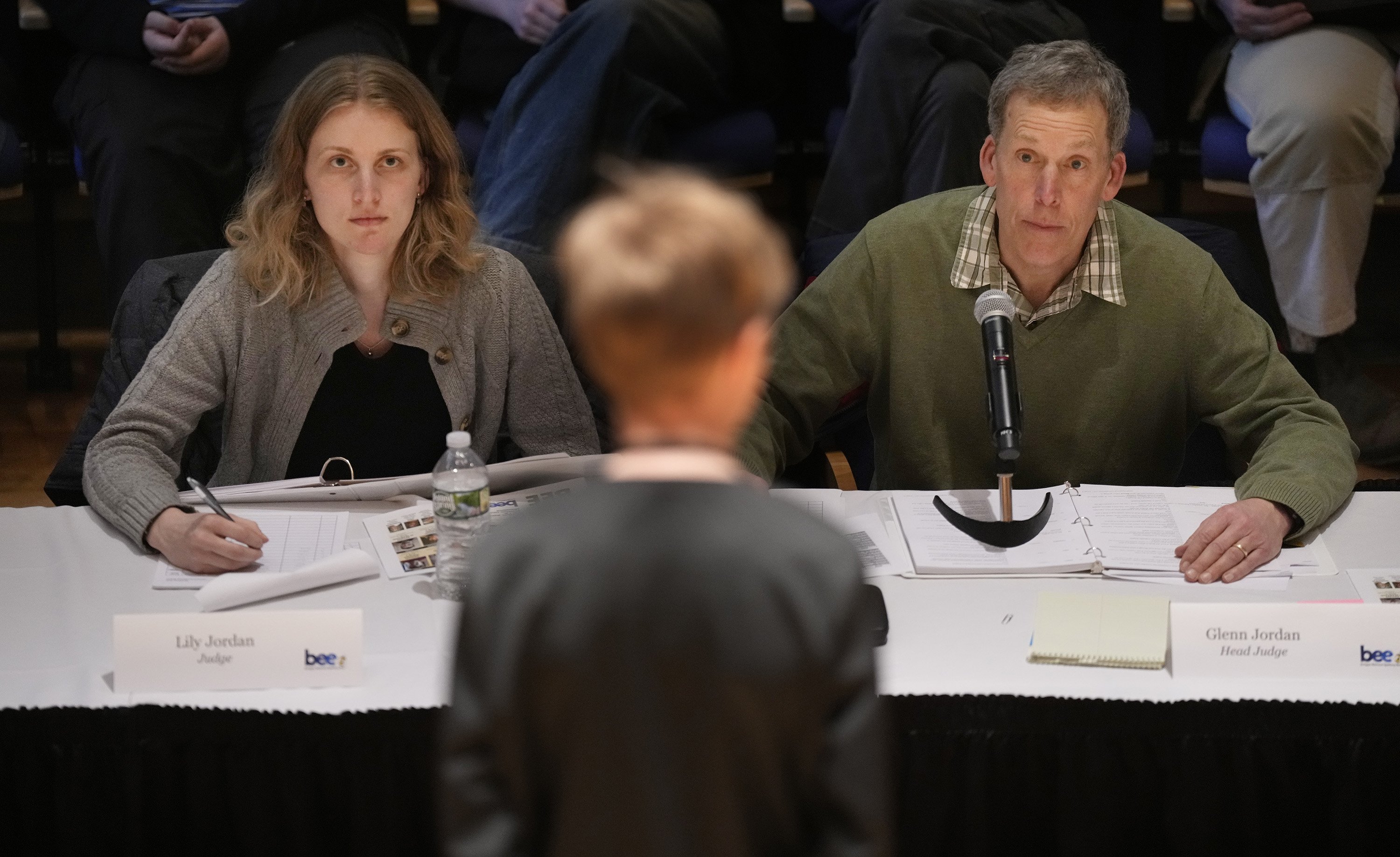
Judges Lily Jordan, left and Glenn Jordan listen as Mason Booker, a fifth grader at SeDoMoCha Middle School in Dover-Foxcroft, spells a word during the Maine State Spelling Bee at Bowdoin College in Brunswick on Saturday. (Gregory Rec/Staff Photographer)
“(We’re) so proud of him. He’s worked really hard; he’s done a lot of hours of studying,” said Elizabeth Singh, Tristan’s mom.
Three members of a spelling bee family and the president of Thomas College made up the judging team for the state bee. For each word, students could ask the judges for its definition, origin, part of speech and to use it in a sentence.
Lily Jordan, of San Francisco, returned to her home state to judge this year’s bee after winning it twice as a middle schooler. Her dad, Glenn Jordan, a retired Press Herald sports writer, and her mom, Nancy Jordan, the lead content developer at National Geographic Learning, were also at the judges’ table. Meanwhile, their dog, Webster — like the dictionary — took a nap under the table.
“It almost feels like being a kid again, and feeling the nervousness of the moment, but it’s a lot of fun,” Lily Jordan said.
Jeannine Uzzi, the president of Thomas College, served as the word pronouncer Saturday, a role she’s been coming back to for more than 15 years.
Olivia Bart, a seventh grader at Hermon Middle School, spells a word during the Maine State Spelling Bee at Bowdoin College in Brunswick Saturday. (Gregory Rec/Staff Photographer)
“It’s a great way to reinforce academics in the state,” Uzzi said.
A bee afficionado, Singh plans on competing in the Maine State Civics Bee at Colby College in June — that is, after he appears at the nation’s largest spelling competition.



 For a statewide guide to eating and drinking see the Maine Food Map—a growing list of coffee shops, bars, restaurants, bakeries, cafes, plus other food and dining businesses in all of Maine’s 16 counties.