Maine
Washington County student wins Maine State Spelling Bee


BRUNSWICK — A eighth grade student from Washington County returned for a second crack at the Maine State Spelling Bee Saturday and booked a ticket to the 2026 Scripps National Spelling Bee in May. He’s also headed somewhere else special — his school’s spring dance.
“It feels really awesome, especially since I made the biggest bet on winning,” winner Tristan Singh said following the bee. “There’s a spring dance coming up at my school next week, and I said I would only (go) if I won.”
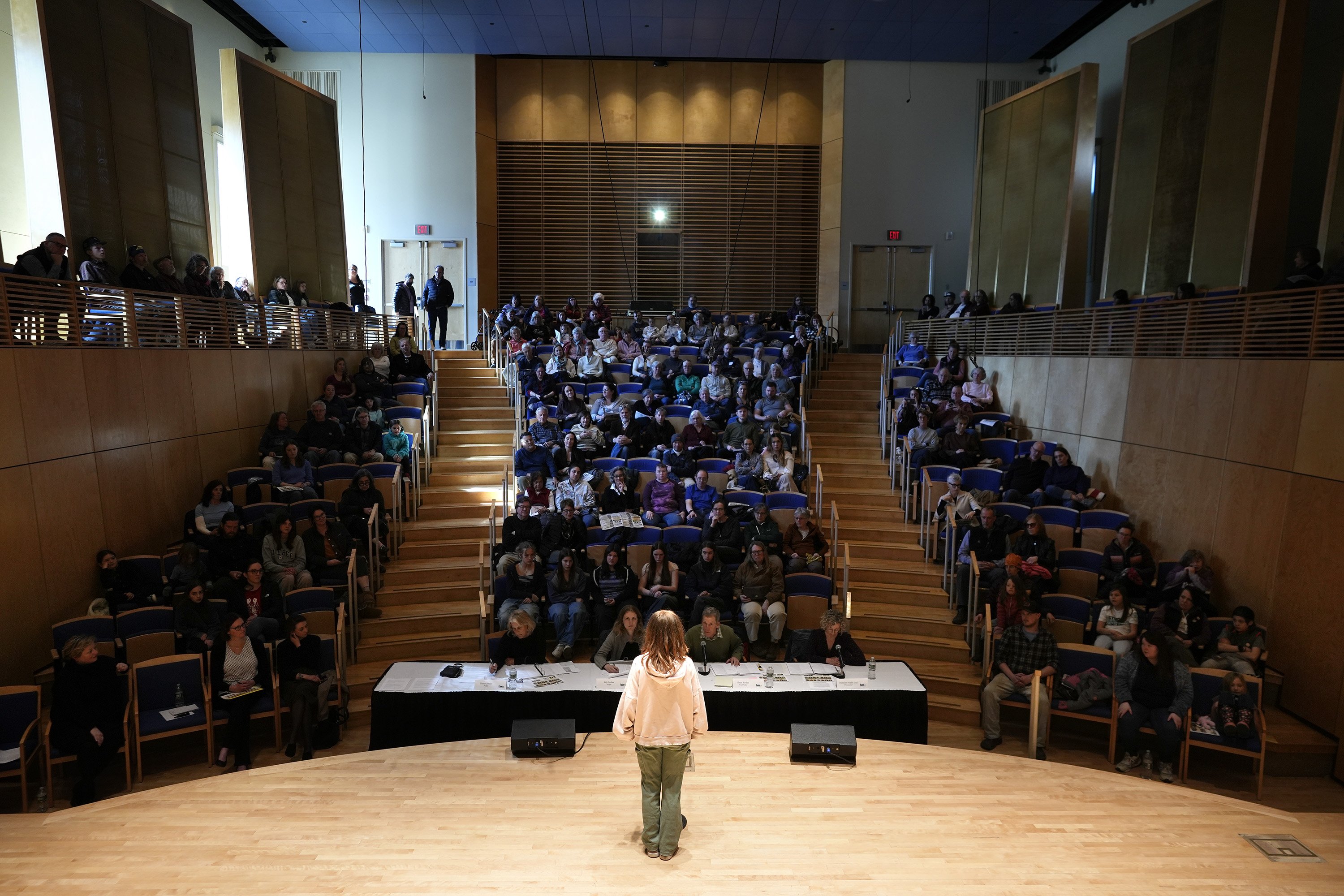
Singh, a student at Rose M. Gaffney Elementary School in Machias, beat out 13 other spellers from all over the state at Bowdoin College and took the final prize with the word “stratosphere.” Each student had won bees at the school and county level to win a spot at the state competition.
The bee, which was presented by the Maine Trust for Local News, went on for 18 rounds. It came down to Singh and the student representing Androscoggin County, Turner Elementary School sixth grader Grace Morris.
Spectators were biting their nails as Morris and Singh went back and forth spelling words for six rounds.

At round 14, Singh misspelled “cognizant,” giving Morris the chance to win. Then, Morris misspelled “millennial” — sending the final two into more rounds until a misspelling of “philosophize” ultimately took Morris out of contention.
The heated competition was all in good fun as spellers high-fived each other on stage and celebrated each others’ wins.
“We ended up chatting a lot, (and) cheering each other on,” said sixth grader Harmony Hoyt, the speller from Aroostook County.
And families in the audience were waiting with congratulatory hugs no matter their students’ place in the standings.
“(We’re) so proud of him. He’s worked really hard; he’s done a lot of hours of studying,” said Elizabeth Singh, Tristan’s mom.
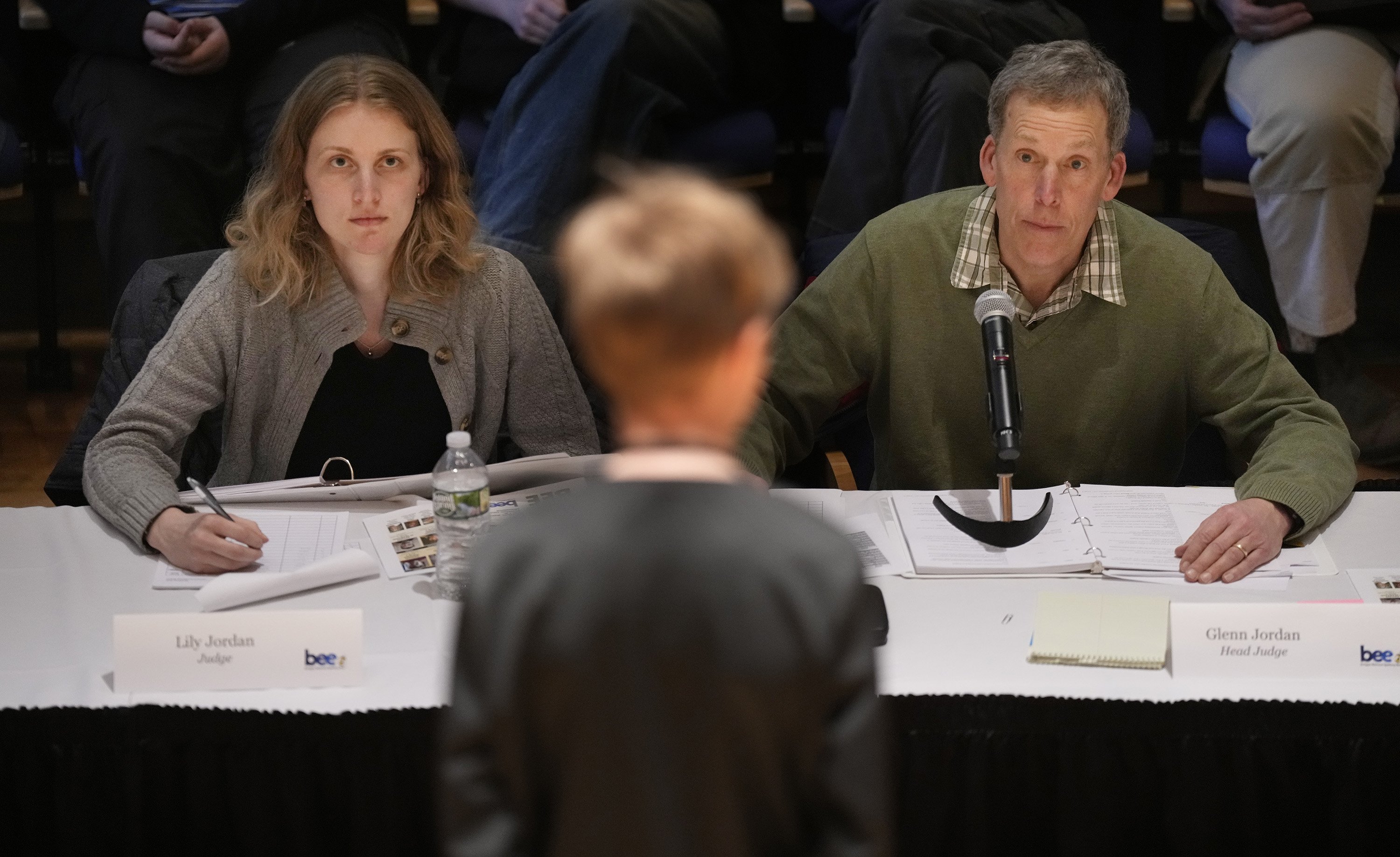
Three members of a spelling bee family and the president of Thomas College made up the judging team for the state bee. For each word, students could ask the judges for its definition, origin, part of speech and to use it in a sentence.
Lily Jordan, of San Francisco, returned to her home state to judge this year’s bee after winning it twice as a middle schooler. Her dad, Glenn Jordan, a retired Press Herald sports writer, and her mom, Nancy Jordan, the lead content developer at National Geographic Learning, were also at the judges’ table. Meanwhile, their dog, Webster — like the dictionary — took a nap under the table.
“It almost feels like being a kid again, and feeling the nervousness of the moment, but it’s a lot of fun,” Lily Jordan said.
Jeannine Uzzi, the president of Thomas College, served as the word pronouncer Saturday, a role she’s been coming back to for more than 15 years.
“It’s a great way to reinforce academics in the state,” Uzzi said.
A bee afficionado, Singh plans on competing in the Maine State Civics Bee at Colby College in June — that is, after he appears at the nation’s largest spelling competition.

Maine
How a tragedy changed the timeline — and the politics — of Maine’s Senate race – The Boston Globe

And while this is the role that many Democratic leaders would be expected to play in this situation, this crop of candidates has an added challenge.
Because this also means there are no meaningful distinctions among the candidates to help guide the eventual 601 delegates who will decide who should run in one of the most closely watched Senate contests in the country.
Indeed, the practical political impact of the tragic situation in Biddeford on the Maine Senate contest is this: What was expected to be an intense two-week primary campaign has effectively been reduced to one week. And the week currently being overtaken by the shock and anger is likely the most crucial.
That’s because 5 p.m. Wednesday is the deadline for supporters to sign up to become delegate candidates for the July 25 statewide convention in Bangor.
Those delegate candidates will then be elected at caucuses held in each of the state’s 16 counties over this coming weekend. From that process will come the 601 delegates who will decide which Democrat will challenge five-term Republican incumbent Susan Collins this fall.
In fact, the best organized campaigns will likely know by Sunday who has already won the contest because they can simply add up how many of their own supporters became delegates.
In other words, the contest could be effectively over before most Mainers even begin to really pay attention.
Further, unlike some major news developments that provide a moment of political clarity, this tragic situation in Biddeford resolves nothing. Instead, it raises the stakes for Democrats to make the right choice.
What that means in the context of choosing between a more progressive populist candidate in the mold of Platner or a more traditional Democrat in the mold of this year’s Democratic nominee for governor, Hannah Pingree, remains an open question.
There is simply less time now to discuss it.
Now, none of the above is meant to take away from the discussion about a husband and father who was killed by the government and whatever circumstances led to that tragedy.
To be sure, the moment a Democratic nominee is selected, the role of ICE will immediately become the first real dividing-line issue in the Senate race. After all, Collins oversees ICE’s budget as chair of the Senate Appropriations Committee and has been actively involved in conversations with the administration about enforcement in Maine.
But as to who should face her, the clarity and contrasts that campaigns tend to reveal are not currently there among Democrats at a time when they would be most helpful. As it stands, all of the candidates oppose the Trump administration’s overall agenda, oppose the Iran war, promote some version of an affordability message, and, above all, oppose Collins.
Nor is there an obvious choice if Maine Democratic delegates decide electability should be their highest priority.
Campaigns rarely unfold on the timetable candidates expect. Outside events intervene, reshaping what voters hear, what campaigns can talk about, and, ultimately, what party insiders have to evaluate.
In this case, Democrats face the unusual challenge of selecting a Senate nominee while the issue dominating the public conversation is one on which nearly all of the candidates already agree. That may produce unity after a bruising week, but it also leaves delegates with fewer opportunities to distinguish between the people asking for their votes before making one of the biggest political decisions in Maine this year.
James Pindell is a Globe political reporter who reports and analyzes American politics, especially in New England.


Maine Senate hopeful, Democrat David Costello, speaks with a potential voter as he gathers signatures, required to be considered at the party’s convention, in downtown Brunswick, Maine on July 12.
Tamara Keith/NPR
hide caption
toggle caption
Tamara Keith/NPR
BRUNSWICK, Maine – On a sunny Sunday, Senate hopeful David Costello worked the sidewalk in downtown Brunswick asking for signatures.
“Woud you happen to be a registered Democrat?” he asked one woman before engaging in a back and forth conversation. She asks if he’s progressive.
“Very progressive,” Costello said.
Costello is one of several Maine Democrats who see the fall of Graham Platner’s senate campaign as an opportunity to represent Maine in Washington.
Platner won June’s Democratic primary election handily. But allegations of rape by a former romantic partner last week forced him to drop out of the race. It leaves Maine Democrats scrambling to find a new nominee before the July 27 deadline to put a name on the ballot. Platner denies the allegations.
The Maine Democratic Party will hold a convention on July 25 where 601 delegates will choose that nominee. That candidate will need to capitalize on the enthusiasm Platner generated to defeat Republican Sen. Susan Collins.
An unstoppable incumbent or a top pick-up opportunity?

Sen. Susan Collins, R-Maine, leans down to listen to a young paradegoer at the annual Moxie Day Parade is Lisbon, Maine on July 11.
Susan Sharon/Maine Public
hide caption
toggle caption
Susan Sharon/Maine Public
Collins remained quiet at the end of Platner’s campaign but at the annual Moxie Day parade Saturday in Lisbon, Maine, she walked with volunteers in red shirts.
“People appreciate the fact that I provide steady leadership — and the word steady does come up a lot,” Collins said at the parade, “and that I continue to work really hard for Maine.”
Collins has represented Maine in the Senate since 1997. She has managed to stay in her seat even as Maine has voted for Democrats for president statewide, including in 2020 when the state voted for Joe Biden. Collins last won reelection that year with a comfortable margin — more than 8.5%.

At the annual Moxie Day Parade in Lisbon, Maine, supporters of Sen. Susan Collins, R-Maine, march with signs and giant letters spelling S-U-S-A-N, on July 11.
Susan Sharon/Maine Public
hide caption
toggle caption
Susan Sharon/Maine Public
Democrats see Maine as pivotal to their chances to retake the Senate. Platner’s departure from the race puts pressure on the party to choose a replacement candidate who can win over Platner’s loyal voters and appeal to independents who are key to Collins’ electoral success. Maine state Senate President Mattie Daughtry, a Democrat, is encouraged to see many of the candidates running on Platner’s progressive platform of transformational change. But she’s worried about voters being turned off by the process.
“I do have that deep seated concern of how many folks are going to say ‘oh well, this man failed me. Why trust someone ever again?’” Daughtry said.
Daughtry did not endorse Platner and she quickly called on him to drop out of the race after the rape allegations surfaced. Still, she thinks his message resonated.
“I ran for office when I was 25 because I was really really angry. I was working 4 jobs. I couldn’t afford an apartment and I had no healthcare. And unfortunately that story has not changed and it is a lived reality for millions of us across this country,” Daughtry said.
“And we need to find who can pick up that mantle. Who understands what that life is like and really tap into that raw energy,” she added.
Supporters weigh what’s next
Just one month ago, Alan Crichton was playing saxophone at Graham Platner’s primary night victory party. At a brewery in Belfast, Maine this weekend, he noted his ambivalence.
“I have so many mixed feelings. I like the guy. I like his message a great deal and I think he galvanized people who are just kind of sick of what’s happening,” Crichton said.
Now, though, Crichton calls the situation “a big old mess.” As a Democrat, he hoped the charismatic populist Platner would be the one to finally knock out Collins. Though, at this point, he’ll vote for whoever the Maine Democratic party selects.
“I hope it’s somebody who can kind of carry the torch that Graham kind of lit and held out there very strongly. He was a very inspiring guy,” he said.

Joseph Berube of Northport, Maine, gave up on politics in 1972 after Democrat George McGovern lost the race for president in a landslide. This year, though, he got excited about Graham Platner’s candidacy for U.S. Senate.
Tamara Keith/NPR
hide caption
toggle caption
Tamara Keith/NPR
Joseph Berube is an independent voter who lives in Northport, Maine. After decades disengaged from politics, Graham Platner sparked something in him he could hardly believe.
“Because I am so apolitical,” Berube said, “I want nothing to do with it. [But] I was actually considering giving money to his campaign.”
Charlotte Agell is on the opposite end of the engagement spectrum. A registered Democrat, she is very politically involved and has been for decades. She met Platner early on in his campaign.
“One of our neighbors said, ‘hey would you like to come to my backyard and meet Graham Platner?’ I had sort of heard of him,” she remembered. “When I went to that back yard event, I just by happenstance walked in with him. It was me and Graham Platner walking in.”
By the time that event ended, she had signed up to volunteer for his campaign.
“I felt a kinship with everything that was coming out of his mouth basically. Very smart. Good at identifying the problem,” Agell said.
Core to Platner’s economic populist message was that the system has been failing regular people while the rich and powerful get more rich and more powerful. He had faced controversies throughout his campaign. He easily won the nomination anyway. But then came the rape allegation. Berube believes the rush to judgment was too swift.

“I agree with women’s rights and women shouldn’t be abused,” he said. “But to have one person come up and stand up and say, ‘he abused me,’ and then that’s it? It’s just not really fair to him.””I just think they didn’t want him,” Berube added.
Berube says Democrats chopped the legs out from under someone who had brought people back into politics.
“He was bringing in people like me and that’s what’s going to do this. And you know what, we’re in the middle of a war to save this country,” Berube said. “And we have the other side that’s fighting with the gloves off and we’re putting the gloves on. We’re in trouble.”
Charlotte Agell has been processing it all a little differently. Agell admits to being a chronic optimist but says this was never about one man.
“You know, we’re not a cult. We’re just a movement that wants to take back this country for the middle and the working class,” she said.
Agell wants to believe this massive disruption won’t sap the momentum for change she felt.
“It’s really been like a rocket ship. We’ve all been on it. And that’s why, when these very serious things have been alleged and rightly he has dropped out of the race, we’re kinda still flying at 90 million miles an hour and saying ‘who can take the controls’ and we’re going to figure that out,” Agell said.
State Senator Chip Curry says the state party is doing the best it can with a tight timeline.
“It’s a winnable race and we’ve got some great people. We’ve got to get there,” Curry said.
There are more than half a dozen announced candidates. And for Democrats the stakes couldn’t be higher. No clear frontrunner has emerged from the candidates who have put themselves forward to be considered. It’s also not clear if one candidate can capitalize on the momentum that Platner was building in Maine. Still, some are remaining optimistic.
“People are going to grumble. I’ve grumbled a little bit. But I think we’ll get through this,” Senate hopeful David Costello predicted. “I think whoever the nominee is will have tremendous support.”
-

 Health24 minutes ago
The Epicenter of Drug Deaths in America Is Shifting West
-
 Lifestyle42 minutes ago
Homelessness is more common than you think. : It’s Been a Minute
-

 Technology54 minutes ago
Lucid’s bankruptcy rumor is a bad sign for the EV future
-

 World60 minutes ago
Slain American mother Jamey Carney remembered as ‘ray of sunshine’ at Ireland funeral
-

 Politics1 hour ago
Canadian woman accused of slapping Trump-supporting teen turned over to ICE
-

 Health1 hour ago
Popular diet trend could boost mental health among older adults, study finds
-

 Sports1 hour ago
Conor McGregor makes 3-word promise for UFC career in video after another devastating injury
-

 Technology1 hour ago
Insurance breach exposes 7M driver’s licenses

