Maine
Maine's warming lakes incubate damaging invasive plants

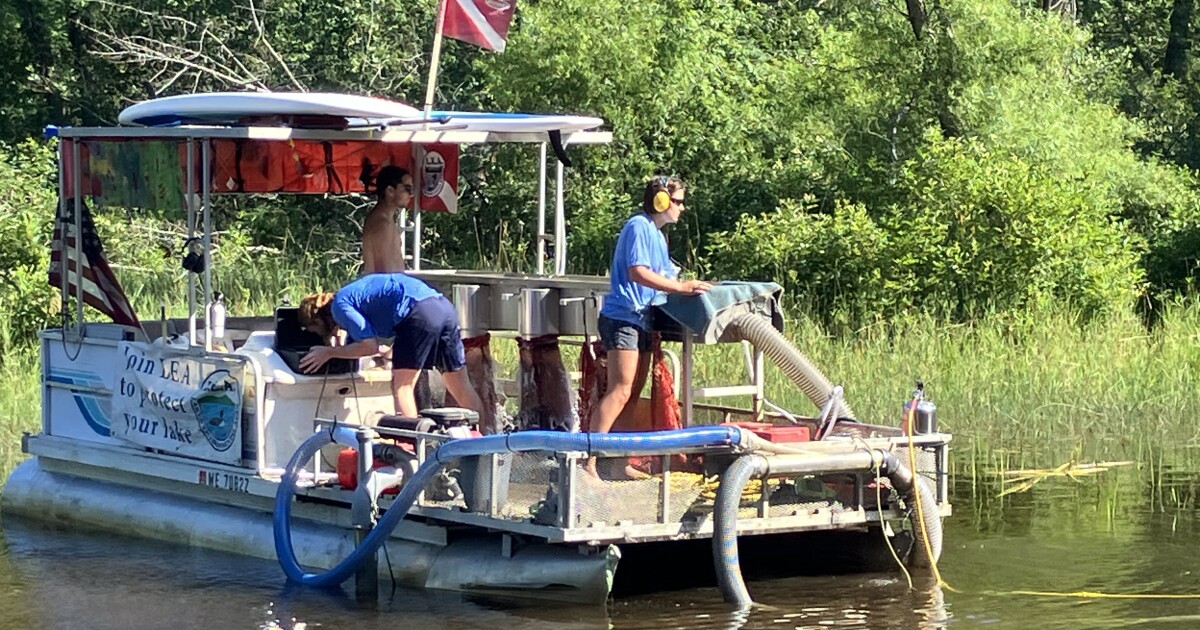
Michael Flannery pilots an open top barge into the Bayou, a narrow dead end channel where the Songo River empties into Sebago Lake. As manager of the Lakes Environmental Association’s invasives program, he helped clear variable leaf milfoil from the waterway last summer.
“We left this last year looking pretty good, and now this year it is full of milfoil,” Flannery said.
Beneath and between boats crammed against the shore milfoil spreads in thick mats. It’s the most common, and problematic, aquatic invasive plant in Maine. Even a small fragment stuck on a boat hull or propeller could spread milfoil into another water body.
“We’ve been working already this year, we’ve removed a couple thousand pounds of milfoil already, but it is just starting,” Flannery said.
Left unaddressed, the milfoil will take over shorefronts and crowd out natives species of plants, fish and wildlife. Out of control infestations can ruin a lake for fishing, boating and swimming.
It’s also becoming harder to manage. Climate change driven by burning fossil fuels has warmed Maine lakes 5.5 degrees Fahrenheit on average since the 1980s, far faster than the annual air temperature increase. With warmer water and milder winters, lake ice doesn’t last as long.
That means a much longer growing season for plants than before.
“If the ice is gone in early march, the lake is going to warm up quicker, the stuff is going to start growing,” said Lakes Environmental Association executive director Colin Holme.
“We have milfoil growing earlier and it grows later into the season. There were reports of milfoil growing vibrantly into November last year,” Holme added.
To illustrate his point, Holme points to a patch of milfoil in the Bayou that’s already flowering above the water. That’s an indication of a robust plant with good prospects to reproduce.
“Most years it didn’t flower, and when it did flower it was a big thing, we’d go down, we’d photo document it. And now it is flowering most years, and this year it started flowering in June, which is unheard of. Usually its flowering is late July and August,” Holme said.

Peter McGuire
/
Maine Public
Once invasive plants are established, they’re nearly impossible to fully eradicate and expensive to contain.
John McPhedran, from the Maine Department of Environmental Protection, said the state is lucky to have an active network of volunteers and nonprofit organizations addressing invasives. Groups survey lakes, set up boat inspections at public launches, and do removal work.
“We’re fortunate to have that interest, that capacity,” McPhedran said. “And while the threats that come with a longer growing season are a real challenge, I think we’re in good stead to try and manage those as best we can.”
Only about 40 lakes and ponds in Maine have recorded invasive plants. That makes it an outlier compared to other states.
“We still have a lot to protect in Maine,” McPhedran said. “Other states have, I think, a much higher percentage of their waterbodies that have an aquatic invasive species.”
But advocates worry the bulwark against the spread of unwanted species is starting to buckle.
Courtesy boat inspectors are the first line of defense against invasive spread, by helping vessel owners check to see they’re not transmitting plants and educating the public about the problem.
But just like the growing season, the boating season is lasting longer too. And those launches are starting to go unattended.
“The boat launches are very, very busy in the fall, that’s when there’s a lot of bass tournaments, and just a lot of a lot of people enjoying leaf peeping season and all those things,” said Sharon Mann, director of the invasives program at Seven Lakes Alliance in Belgrade.
Public funding for courtesy inspectors is miniscule to begin with, Mann said. And after high school and college students hired to monitor the public launches leave around labor day, the group struggles to find replacements.
“We have ads posted year round for courtesy boat inspectors, but there just isn’t anyone to hire outside of Memorial Day to Labor Day,” Mann said. “And it really scares me how many boats are going uninspected in and out of these launches.”

Peter McGuire
/
Maine Public
Back on the Songo, Colin Holmes from the Lakes Environmental Association shows off a long section of river that has been mostly cleared of milfoil after years of effort.
The Songo is the busiest inland waterway in the state, increasing its infestation risk, he said.
The association used divers to hand-harvest milfoil and underwater barriers to keep it from growing. Even though the river is in better shape than it was, it takes annual suppression efforts to keep invasives at bay. In early July, two dive teams from Lakes Environmental Association were still searching the Songo for milfoil and pulling it where they could.
“It’s a success story in my mind and we are so lucky we started when we did,” Holme said. “I think if we started now, the water is so warm I don’t think we could get a handle on it.”
Success doesn’t come cheap. His group budgets about two hundred thousand dollars a year for invasive work. A state grant pays for a quarter, fundraising has to cover the rest.
“It’s expensive work, there’s a lot of liability, there’s a lot of training. It’s just not easy and people don’t understand how much it costs,” Holme said.
Lawmakers recently increased the price of “milfoil stickers” that owners get when they register boats with the state. That’s expected to raise funding for the invasive program to $3 million next year, a 60 percent boost.
The money should help, Holme said. But he also hopes people start paying attention and doing more to prevent further infestations, before it is too late.



Many Maine municipalities will open cooling centers this week with the National Weather Service issuing a variety of heat advisories covering the next few days.
The Maine DEP also issued an air quality alert for Wednesday with ground-level ozone expected to reach levels that are unhealthy for sensitive groups.
All of York County, interior Cumberland and Androscoggin counties, and the southern half of Oxford County will fall under an extreme heat warning from 11 a.m. Wednesday to 8 p.m. Friday.
The warning calls for “dangerously hot conditions” that could feature heat index values of up to 110 degrees, with overnight lows only expected to fall into the 70s, according to the weather service’s office in Gray.
The rest of the state — save northern Aroostook, Piscataquis and Somerset counties — falls under a heat advisory from 11 a.m. to 8 p.m. on Wednesday. However, the weather service has also placed much of the state under an extreme heat watch for Thursday.
Heat index values, which measure how hot it feels to the human body when relative humidity is combined with the air temperature, are expected to reach up to 104 degrees during the heat advisory period, the weather service warns. They could reach 110 degrees Thursday, when the extreme heat watch is in effect.
Northern Oxford and Franklin counties, and central Somerset County, can expect a heat index value of up to 99 degrees Wednesday, according to the weather service.
The weather service advises people to drink plenty of fluids, stay in air-conditioned rooms when possible, avoid extended periods in the sun and check up on relatives and neighbors. It also warns not to leave young children and pets in unattended vehicles, as “car interiors will reach lethal temperatures in a matter of minutes.”
Cooling Centers
The Maine Department of Environmental Protection has also issued an air quality alert from 10 a.m. to 11 p.m. on Wednesday along the coast from Kittery to Acadia National Park. The agency warns that ground-level ozone concentrations are expected to reach levels that are unhealthy for sensitive groups.
Ozone levels may reach “moderate levels” further inland, according to the Maine DEP, including in all of Androscoggin and Kennebec counties, as well as parts of Cumberland, Knox, Lincoln, Penobscot, Sagadahoc, Waldo, Washington and York counties.
Elevated ozone levels can pose a risk to children, older adults and people suffering from respiratory or heart diseases, according to the Maine DEP. Anyone exerting themselves outdoors may also experience health effects, which could include coughing, shortness of breath, throat irritation and mild chest pain.
Ozone levels were already climbing in southern New England on Tuesday, according to the Maine DEP, and winds are expected to bring those conditions to Maine on Wednesday.
The Maine DEP recommends that vulnerable populations avoid strenuous outdoor activities, keep windows closed, and circulate indoor air with fans or air conditioners. Those with asthma are also advised to keep quick-relief medication handy.
Particle pollution levels are also expected to be moderate across the state on Wednesday due to wildfire smoke, the Maine DEP said in its announcement Tuesday. Wildfires in Colorado, which have claimed the lives of three firefighters, had burned nearly 90,000 acres as of Tuesday, according to the Denver Post.

Maine could face up to $50 million in penalties next year due to errors in its payments for federal food benefits under the Supplemental Nutrition Assistance Program.
Newly released data from the U.S. Department of Agriculture find that Maine’s error rate last year was nearly 11%, the bulk of which were overpayments. That’s in line with the U.S. average. But starting in October of next year, states with error rates above 6% must cover a portion of the SNAP benefits.
Anna Korsen, executive director of Full Plates, Full Potential, said the overpayments aren’t fraud — they’re human error. She said this new cost-shifting policy enacted last year under the Trump administration further complicates the SNAP application process.
“Instead, we could make this program more accessible and more efficient,” Korsen said. “And that would reduce the number of errors and also ensure that Mainers who are eligible for SNAP have access to it.”
She’s urging Congress to delay or reverse the policy under the farm bill that’s currently under consideration.
Maine’s Department of Health and Human Services said it’s taking steps to reduce the error rate, including modernizing its systems and hiring an additional 40 eligibility specialists.
This story appears through a media partnership with Maine Public.
-

 Washington7 minutes ago
Where can you watch fireworks in Washington DC on the Fourth of July?
-

 Wisconsin10 minutes ago
9-year-old drowns at western Wisconsin water park, sheriff says
-

 West Virginia15 minutes ago
Save Women’s Sports Act now the law of the land – WV MetroNews
-

 Wyoming22 minutes ago
Young bull moose captured wandering Laramie, relocated by Game and Fish
-

 Crypto25 minutes ago
Webinar: Crypto and public pensions—risks, rewards, and fiduciary duties
-

 Finance30 minutes ago
Wednesday’s Campaign Round-Up, 7.1.26: Justices help GOP with campaign finance ruling
-

 Fitness37 minutes ago
I’ve been doing the bird dog exercise instead of planks to improve my core strength – it’s even better for beginners
-

 Movie Reviews45 minutes ago
Neil’s Movie Reviews

