Maine
Maine no longer poised to release people without lawyers from jail


After years of litigation, a March ruling set the stage for criminal defendants in Maine to get released from jail or have their charges dismissed because the state had failed to provide them with attorneys.
But an order from the Maine Supreme Court earlier this month has scuttled that process, at least for now.
In March, Superior Court Justice Michaela Murphy ruled that Maine was violating the constitutional rights of poor criminal defendants by failing to provide them with state-funded attorneys when they were charged, resulting in some defendants going weeks or months without legal representation. The state’s failure to assign attorneys prevented cases from moving forward, further exacerbating a problem of too many cases for too few attorneys.
Murphy scheduled hearings about the defendants’ potential release in Bangor on June 24 and in Lewiston on July 1, two hot spots of the state’s indigent defense crisis. The proceedings are called habeas corpus hearings, after the legal concept that someone has a right to challenge their imprisonment in court.
Murphy asked the American Civil Liberties Union of Maine, which is leading the class action lawsuit against the state, to file a list of defendants in Penobscot and Androscoggin counties who would be eligible for the hearings. They filed a list of eight defendants on June 9. Five of the defendants were incarcerated in Penobscot County Jail without an attorney at the time, another two were being held at Two Bridges Regional Jail in Wiscasset.
The eighth defendant was listed as incarcerated in Androscoggin County Jail, but court records show he was released on bail on May 27. Those same court records show that as of June 25, no attorney had been assigned.
On June 12, the two sides of the case met and agreed that all eight had been assigned attorneys since the filing was made three days prior, according to court records. Despite being seemingly unaware of the eighth defendant’s release, the agreement demonstrated the state can, on a small scale, find attorneys for defendants if sufficiently incentivized.
In response to the agreement, Murphy cancelled the habeas hearings and instead ordered another hearing to implement a system for the proceedings moving forward.
But an order from the Maine Supreme Court on June 20 in response to an emergency appeal from the state halted that hearing, and all future habeas hearings, while the high court hears the state’s appeal of Murphy’s decision.
“We conclude that the trial court may not undertake further habeas corpus proceedings in this action during the pendency of this appeal,” Chief Justice Valerie Stanfill wrote in the order.
Stanfill’s order set oral arguments to begin October 7. The order represents another delay in a case that has already dragged on for more than three years.
“We’re hopeful that, because the appeal is expedited, it will at least move relatively quickly,” said attorney Carol Garvan of the ACLU of Maine. “But this is about people who, every day, are going without counsel, and that affects their cases, but also their lives in really devastating ways.”
A constant churn
The case is a class action lawsuit, with the members of the class constantly churning as defendants without lawyers get them, and new defendants enter the system and wait, either in jail or at home, for an attorney to become available.
On June 23, there were 225 cases in need of an attorney, according to a list compiled by court clerks and distributed to attorneys by the Maine Commission on Public Defense Services, which is a defendant in the lawsuit.
Most of those cases on the list involved defendants who were out on bail or otherwise not incarcerated while awaiting future court dates. Of the 225 cases, 92 had been without an attorney since before June 1.
About a quarter of those 225 cases involved defendants who were detained in county jails. Thirty cases involved defendants who had been in custody for 10 days or longer without an attorney.
The list of unrepresented cases has been shrinking in recent months, however, suggesting Maine’s indigent defense crisis may be waning as the state opens and staffs public defender offices. A year ago, there were more than 1,000 Maine criminal cases in need of an attorney.
Maine’s total backlog of criminal cases, the vast majority of which are staffed with attorneys, has fallen eight percent in the last year, according to MCPDS data. But the number of pending cases is still 32 percent higher than it was before the pandemic. This month, the number of pending felonies statewide is 65 percent greater than it was in June 2019.
Despite recent progress, Maine Commission on Public Defense Services Executive Director Jim Billings has warned that the downward trend in unstaffed cases could quickly reverse if the legislature doesn’t provide more funding. The commission oversees both the state’s public defenders as well as payments to private attorneys representing indigent defendants.
At a Wednesday meeting, Billings said the commission is on track to run out of money by April 2026, after the legislature refused to act on its additional funding request. (The legislature did pass a one-time $3.5 million payout for the commission). Mills has said the commission doesn’t need any more funding, and criticized its rules limiting attorney eligibility and the number of cases attorneys can take.
At the meeting, commissioners also discussed the possibility that attorneys will move to other types of legal work if payment for indigent criminal defense is delayed or not forthcoming, and not return.
“A thousand cases on the unrepresented list is going to be child’s play compared to where we will be next spring,” Billings said Wednesday.
A violation, but what remedy?
The appeal to the Maine Supreme Court concerns only one count of the five included in the class action lawsuit against the state. The state has also appealed other counts, including Murphy’s ruling that found Maine violated the Sixth Amendment rights of prisoners. But the state filed an emergency appeal on Count 3 specifically, asking the high court to halt the habeas hearings.
The case is complicated and sprawling, especially in light of the simplicity of the questions at the center of it all: at what point does the delay of a constitutional right, in this case the right to an attorney in criminal proceedings, become a denial? And once a constitutional right is violated, what’s the remedy?
Judges across the state have ruled in individual cases that incarcerated defendants have had their Sixth Amendment rights violated, although there appears to be no statewide count of these rulings.
In many instances, judges ruled that the public safety interest in keeping defendants incarcerated outweighed the need to remedy the constitutional violation. In those instances, the judges acknowledged the unfairness of the predicament, without doing anything to address it. In some cases, however, judges have lowered bail enough so the defendant can pay it and secure their release from jail.
Maine judges have little precedent to draw from when deciding whether, or how, to remedy Sixth Amendment violations. Those decisions are now made in the shadow of the one that went terribly wrong.
Last June, Judge Sarah Churchill lowered the bail of Leein Hinkley in response to a Sixth Amendment violation, facilitating his release from Androscoggin County Jail. A few days later, Hinkley violated the conditions of his release by going to the home of an ex-girlfriend and starting a fire that killed a man. Hinkley died at the scene following a shootout with police.
The decision to lower bail by Churchill, a former defense attorney, sparked a public outcry and criticism from Governor Janet Mills, a former prosecutor. Earlier this year, Mills nominated Kelly O’Connor of the Maine Coalition to End Domestic Violence to the commission, a rare non-attorney selection.
In March, Murphy ordered a less subjective and more clear-cut procedure for determining the remedy for Sixth Amendment violations. Her process for the now-aborted habeas hearings was based on rulings in similar cases from Oregon and Massachusetts, states that have also been mired in similar Sixth Amendment crises.
If a defendant had been in jail for 14 days without an attorney, they would be released on bail with conditions while their case proceeded. If the defendant had gone more than 60 days without an attorney, whether they were incarcerated or out of jail but subject to bail conditions, the charges would be dismissed without prejudice, meaning they could be filed again in the future.
Maine’s high court will decide months from now whether Murphy’s framework will ever be used. In the meantime, many defendants, who have not been found guilty of the charges against them, are waiting under bail conditions or in a Maine jail without an attorney. In many instances, victims of alleged crimes are also waiting for a resolution.



Whether you are a lifelong Mainer looking for a practical place to settle into retirement or you are planning a move from out of state, Bangor makes a strong case as a smart landing spot for seniors. Set inland and generally more affordable than many of Maine’s coastal communities, the third most populous city in the state delivers the essentials retirees care about: strong healthcare access and the feel of a regional hub. Fun local outings help round that out, from exploring the Cole Land Transportation Museum and its collection of historic vehicles to catching a concert at the Maine Savings Amphitheater on the waterfront. Stephen King’s famous former home on West Broadway also gives Bangor an extra point of interest that makes time in town feel a little more memorable. Better yet, Bangor puts you within easy driving distance of one of the country’s most recognizable protected landscapes: Acadia National Park and the Bar Harbor shoreline.
Money Makes it Farther in Bangor
Stable living is a critical component of retiring comfortably, and Bangor makes this possibility a reality for seniors. Many retirees become renters in their golden years when they relocate, and the median rent in Bangor for a one-bedroom house is $1,300, according to Zillow data, which is lower than the national median. The housing market for those seniors looking to purchase a new home instead is similarly promising. Homes here have a median list price of approximately $305,000, which is lower than the almost $400,000 median list price across the country and in Maine.

In terms of cost of living, Bangor falls significantly below the coastal communities of Maine. According to the Economic Research Institute’s data, Bangor is 6% less expensive than the average city in Maine, and transportation costs are more affordable than the average in the United States.
Living Life to the Fullest
One of the primary advantages of living in Bangor is the amenities that come with its larger population and city size. Between healthcare, historical landmarks, cultural centers, and eateries, seniors do not have to compromise things to do as they age in Bangor.
Dining
Eating in the city is a combination of flavors, cultures, and experiences. Locals here love Dysart’s Restaurant Broadway, a part-gas station, part-truck stop that was recognized by Food & Wine Magazine as the best of its kind in America back in 2022. This restaurant has curated a menu focused on made-from-scratch Maine staple comfort foods, whether that is the Signature Mac & Cheese or the Maine Baked Beans.
Many locals will also help places like The Butcher, The Baker, solidify their claim as the Best American Restaurant in Bangor, by keeping this upscale dining option on Hammond Street popular year-round. The menu here is diverse and meticulously crafted over 40 years in the food service industry, whether you have a plate of drunken noodles or halibut.
Things to Do
Bangor has a lot of history to find and explore for seniors, especially those interested in the evolution of land transportation through the centuries. In the Cole Land Transportation Museum, right off of I-95 and a heavily frequented tourist attraction, visitors find over 200 vehicles ranging from the logging sleds of old to locomotives and 18-wheelers. This 35-acre facility also houses a few smaller museums dedicated to the World War II Veterans Memorial, the Maine Vietnam Veterans Memorial, and the Maine Korean Veterans Memorial.
Transition from history to entertainment with some of Bangor’s most frequented attractions, such as the sprawling Victorian mansion where world-renowned horror author Stephen King lived on West Broadway. For actual entertainment, seniors and other residents fill the seats of the Maine Savings Amphitheater all year, which draws major touring acts to the waterfront.
World-Renowned Healthcare
Being connected to one of the best healthcare facilities in the state makes senior living more manageable and keeps independent living possible. The Northern Light Eastern Maine Medical Center on State Street is highly regarded, recently earning the only overall five-star rating in Maine in Forbes’ Top Hospitals in America. This facility is known for a wide array of services ranging from cardiac care and cancer treatment to orthopedics and surgery. For seniors retiring in Bangor, having Maine’s only five-star hospital nearby is a critical component to aging comfortably and safely.
Explore Nearby Bar Harbor
One of the best places for seniors to explore near Bangor is Bay Harbor, a highly recognizable coastal community in Maine. The town is about 50 miles south via Routes 1A and 3. Bar Harbor is the gateway to both Mount Desert Island and the greater Acadia National Park. This impressive natural wonder boasts 120 miles of trails for hiking up small summits and to places like Cadillac Mountain, and countless beautiful sights to behold from Sand Beach to Thunder Hole.
But the town has a lot to offer the senior for a day trip from Bangor as well, from the boutique shops, the locally owned eateries, and the whale-watching cruises. Places like Geddy’s stand out, known for being family-friendly and offering fresh seafood to go with their charming nautical themes. From ahi tuna tacos to fresh oysters, Geddy’s plates some of the best things to come out of the harbor.
Bangor Is Best for Seniors
Whether you have always lived in Maine and recently began considering the most affordable and connected place in the state for seniors entering retirement, or are making a multi-state move, Bangor makes a convincing argument as a sensible place to land. Bangor remains a more affordable option away from the coast, without compromising on amenities like a five-star hospital, and is a short drive from one of the nation’s most recognizable protected natural wonders, Acadia National Park.

HOWLAND (WGME) — The Maine State Fire Marshal’s Office says a Howland woman has been charged with arson in connection with a 2022 fire at the Howland Corner Store.
The fire happened on November 2, 2022 around 9:08 p.m.
First responders reported the fire was developing rapidly just after the store closed for the night.
Officials say 39-year-old Samantha Randall of Howland was arrested Friday and charged with arson.
The Maine State Fire Marshal’s Office says a Howland woman has been charged with arson in connection with a 2022 fire at the Howland Corner Store. (State Fire Marshal’s Office)
JOIN THE CONVERSATION (2)
The investigation remains ongoing.

Almost the first thing Ryan asked when we met three years ago was if he could see my Slopes map. And it’s a pretty good map, stretching back to the 2018-19 ski season:
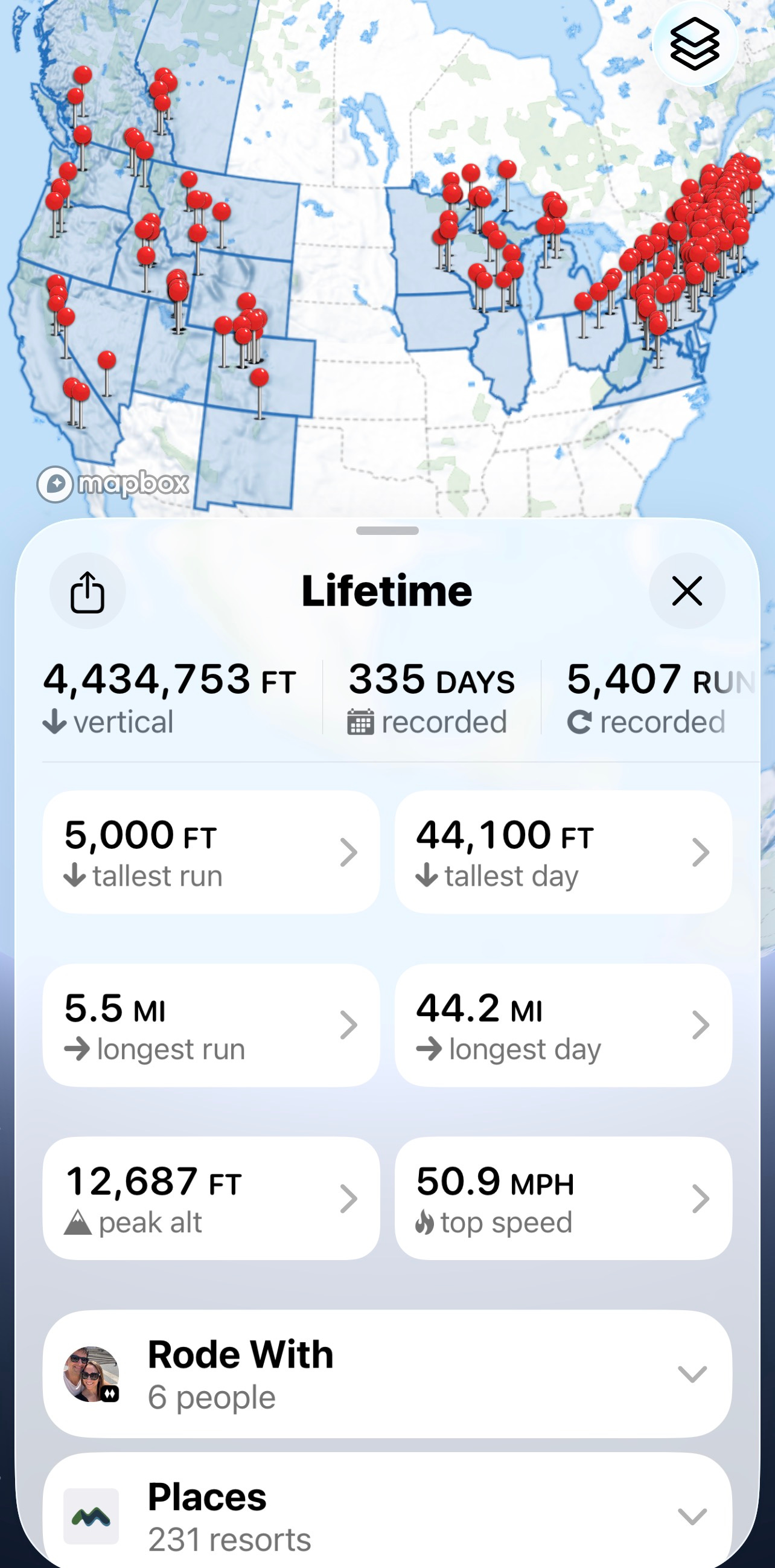
I didn’t suppose a Bozeman Bro would care about anything outside of the Bridger Bowl-Big Sky circuit, because the other first thing Ryan asked me was whether I had a transceiver, and I was like “No, I left it next to the scuba gear and car-waxing kit in my Box of Accessories I Don’t Own for Activities I Never Do on Purpose, like ski out of bounds or go underwater or pretend my minivan is anything other than a Chrysler Pacifica with a roofbox and a broken rear windshield wiper.” And he was like “Well that’s too bad you’d need one to ride Schlasman’s” and I was like “The chairlift at Bridger Bowl?” And he was like “Yeah” and I was like “Man that is so Bozeman.”
But Ryan did like the map because he’s the sort who keeps lists of, like, the names of everyone who’s ever given him a haircut and how many Oreos he ate each week in 1992 and how strange that our wives who were college roommates ended up marrying the same sort of List Bro. But I seized on his curiosity and love of novelty to insert a day of skiing into their annual family Christmas visit to New York, and after a 2024 day of blown-snowtrails over dirt at Windham and Hunter, I hoped to show him a better version of Northeast skiing.
Fortunately December 2025 shaped up better than December 2024. Storms had pounded in one after the next and the obligatory rain-thaw cyclone that would typically have pulverized millions of gallons of accumulated snowmaking back to gutter water never materialized. A fortuitous eight inches fell overnight leading into our pre-planned ski day, and we aimed for Plattekill, an 1,100-vertical-foot elevator shaft disguised as a ski hill about three hours north of the city. And this time there was no dirt to be seen:
Plattekill is the Catskills’ hidey-hole, a family-owned bunker that’s dug an atmospheric moat sufficient to fend off Vail-owned Hunter and state-owned Belleayre and whatever-the-hell-Windham-is. The bump only spins two chairlifts but there are never liftlines, even on Christmas week. The triple gets a little backed up but the double never does. And what a spectacular chair that is, one of my favorites anywhere:
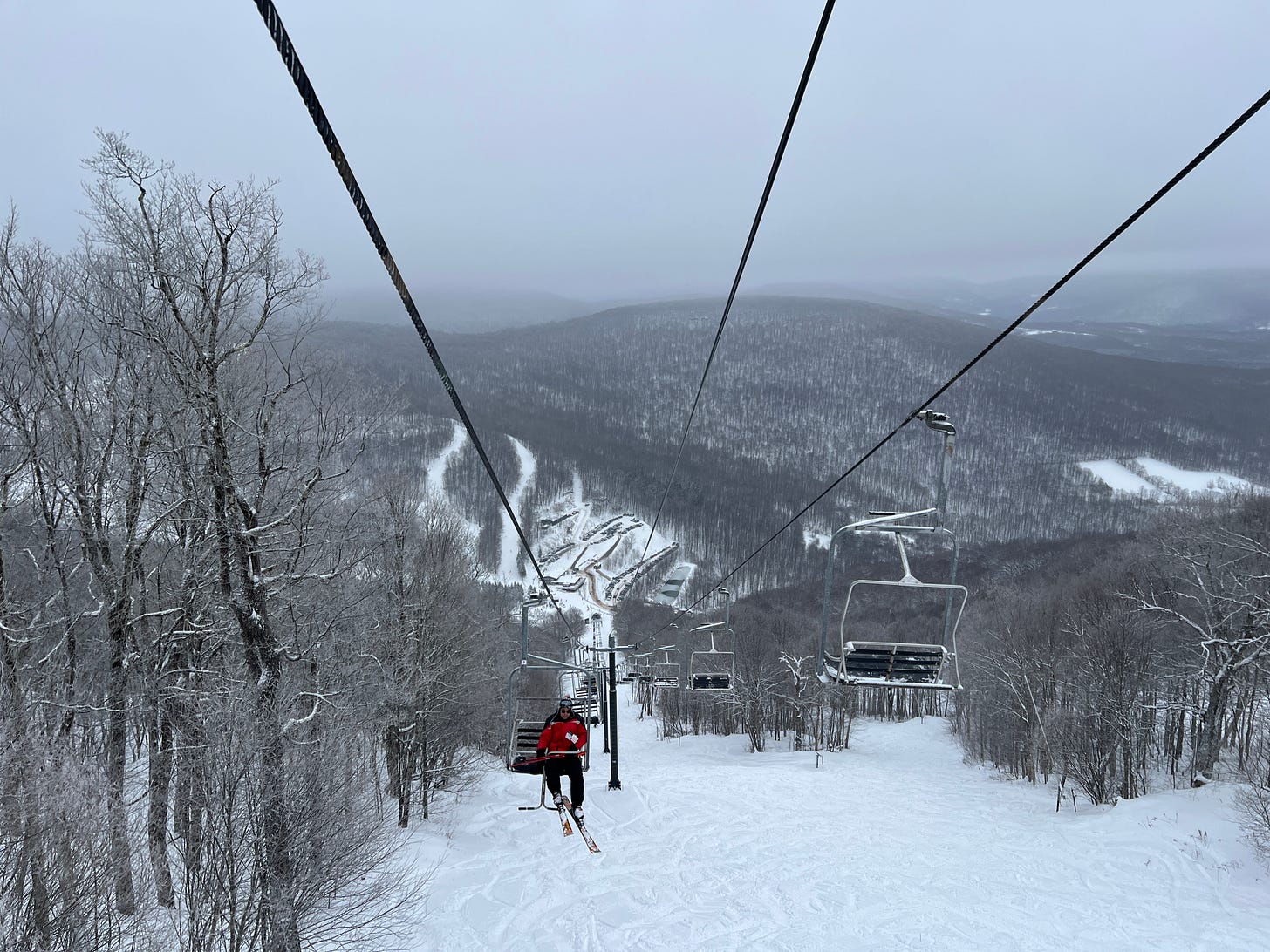
Platty is all vibes. That baselodge. Beers upstairs with the live band jamming. And yeah it was nice to have snow to share with Bozeman Bro in a year where he ended up with very little.
As we rolled into 2026, I’d skied nearly every ski area with a chairlift in New England, but Maine had proven elusive. Sort of because it tried to dismember me but mostly because it’s far and because most of those faraway ski areas are Wisconsin-sized coastal bumpies that don’t grab a ton of snow and because some of those ski areas (Baker, Jefferson) operate infrequently, have little or no snowmaking, and communicate their opening hours via websites that make the Pony Express look like Starlink. So my Maine ski history was limited to Boyne’s three mountains (Sunday River, Sugarloaf, Pleasant), Saddleback, and Black Mountain of Maine. But with the snowpack unseasonably deep, I prioritized three days in early January to survey the state’s smaller offerings.
And the first thing I thought when I arrived at Lost Valley was “Damn it I should have come here years ago.” Because my first impression of Lost Valley was that it is one of the best-run small ski areas in the country.
That meta-fact helps explain the existence, in 2026, of a 240-vertical-foot, 45-acre anthill within an hour of mega-bigster Sunday River. That, and the bump’s proximity to Lewiston, Maine’s second-largest city (population 37,121) and, so I hear, a hell of a fortunate place to land if your idea of a sickified ski trick is a tib-fib spiral fracture (I’m incapable of writing about skiing Maine without mentioning this incident a minimum of seven times).
About a decade ago, Lost Valley nearly joined the 79-plus ski areas that have dropped dead across Maine since the beginning of industrialized skiing. But then a fellow named Scott Shanaman showed up. With the help of crowd-sourced stopgap funding, he pulled Lost Valley out of debt. He cut new trails and glades and super-boosted snowmaking. In 2024, he relocated Mount Southington’s Northstar double chair to Lost Valley:
The chair is marvelously new looking for a machine that began life circa 1980 at the long-dead Craigmeur ski area in New Jersey and moved up to Connecticut in 2001 before migrating to Maine. Now called simply “Chair #3,” this is one of the few chairlifts to operate in three locations, and perhaps the only one to spin in three U.S. states.
The first sign of a well-run, skiers-first ski area: All three of Lost Valley’s chairlifts were spinning on a Wednesday night in January, even though they could have gotten away with running two. Everything about the place hummed. The grooming was outstanding, snowmaking had buried the trails. All that infrastructure helps, but what impressed me most about Lost Valley was the thing so often missing from night-skiing operations: order. Even in the froth and throng of teenage yee-haw flippy-screamy night. And everyone was nice. And yes that matters a lot, especially with the lift attendants.
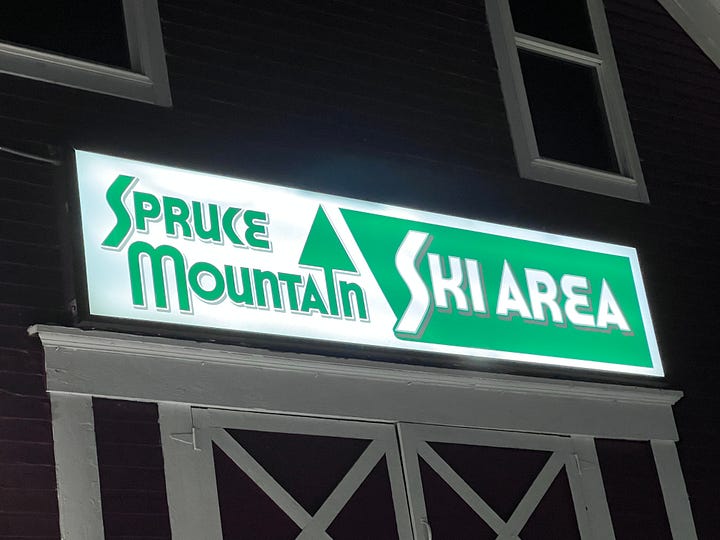
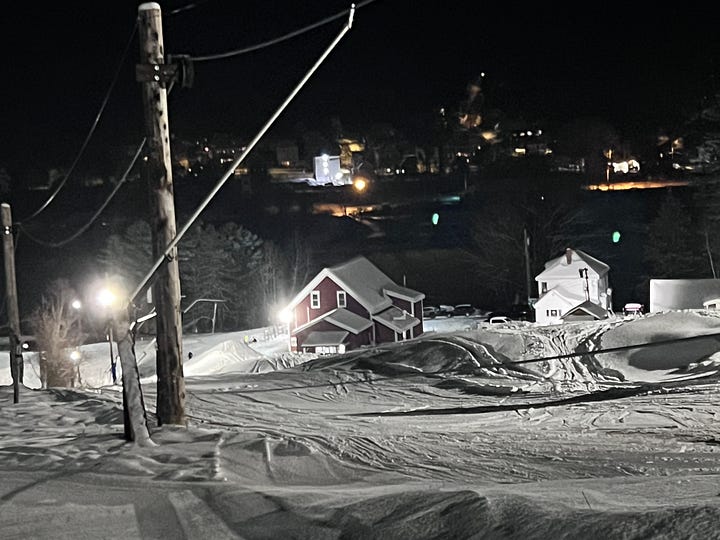
Forty minutes up the road from Lost Valley is Spruce Mountain, a three-ropetow bump so obscure that most ski area inventories miss it. It’s a down-a-dirt-road, up-a-hill, where’s-the-parking-lot-oh-this-is-the-parking-lot, still-has-wordpress.com-in-its-url, is-trying-to-raise-$20,000-to-buy-a-“new”-groomer sort of place.
Which means it was me skiing among a bunch of 12-year-olds who seemed confused as to why I would be here. But isn’t it astonishing and wonderful that places like this still exist?
Spruce maintains a surprisingly varied and dense trail network, a little of which I explored. But the upper-mountain tow isn’t night-lit (or wasn’t that night), and I’m fighting off some shoulder soreness that I later discovered is a torn rotator cuff (to be repaired next month; yes I am the king of stupid injuries and nearly dying on a more or less annual basis).
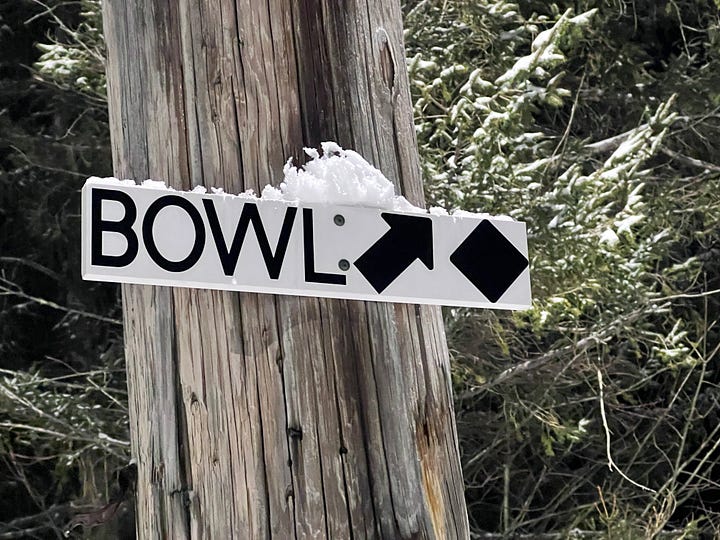
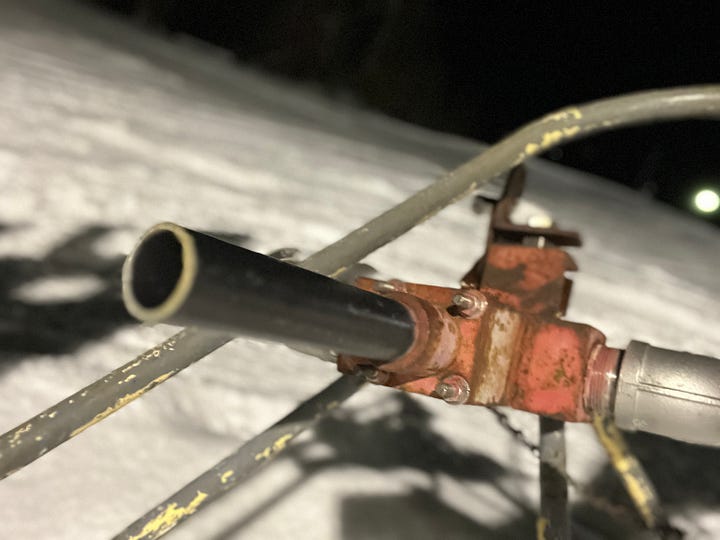
One thing I’ve learned when planning these ski-10-ski-areas-in-three-days hypertrips is that it helps a lot to not change hotels, even if that means more daily driving. So I set up in Waterville, home of Colby College and a pass-through zone for I-95. From there I drove two hours on Thursday morning to Big Moose, which, depending upon your point of view, is either the most dysfunctional or the most resilient ski area in America. In brief, Big Moose once looked like this, with an 1,700-foot lift-served vertical drop:
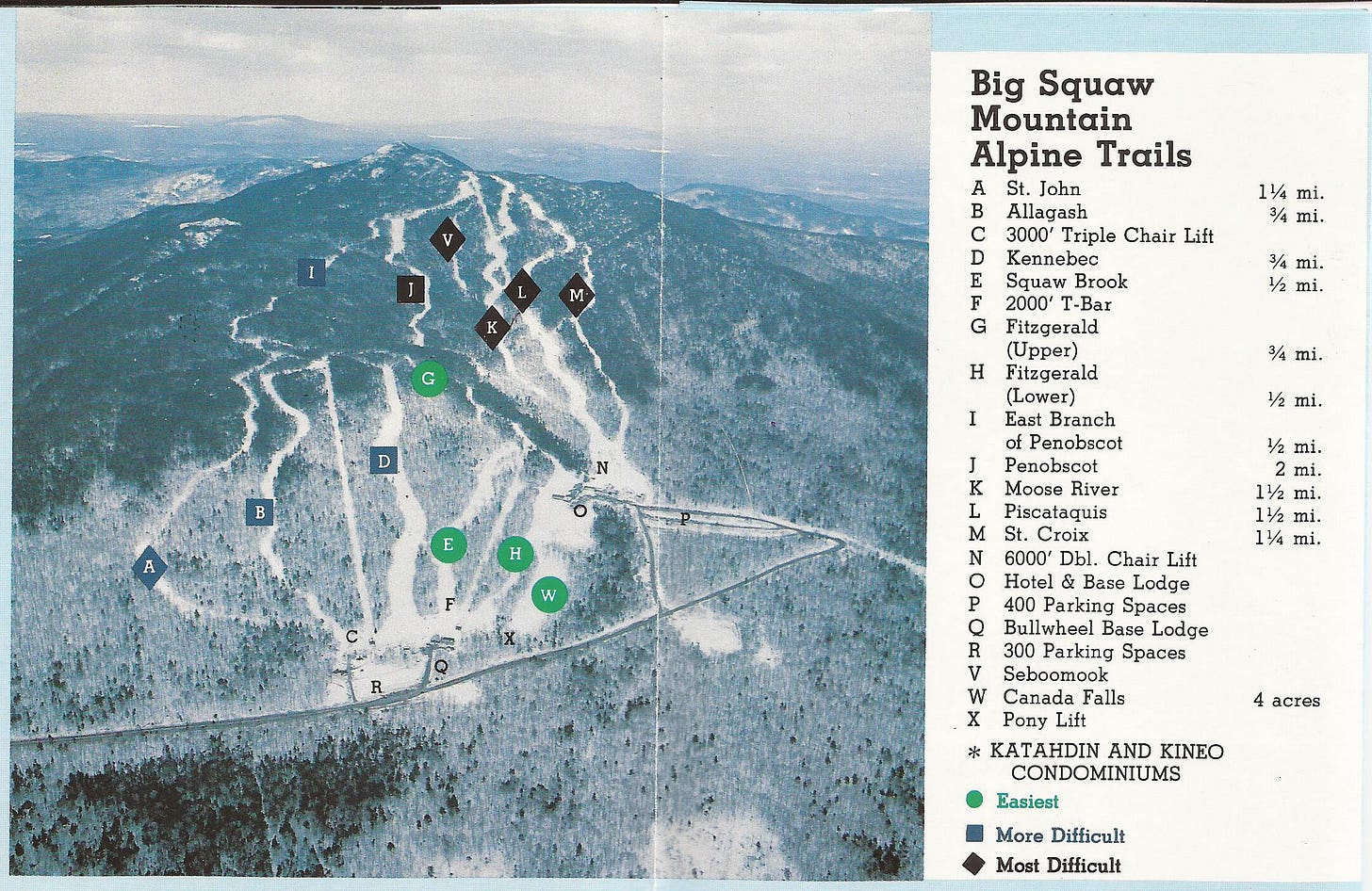
In 2004, the summit chairlift (“N” on the map above), broke, and the owner never fixed it, shrinking what had been a remote-but-large 1,700-vertical-foot ski area into a still-remote-but-teensy-tiny 583-vertical-foot ski area. Around 2010 the owner, a Mr. James Canfalone of Florida, stopped pretending to operate it, and was subsequently sued by the state, which had sold him the ski area on the condition that he not let it turn into a decrepit pile of crap. Which he did, while also allegedly running a bootleg timber operation, a crime that sounds so ridiculously antiquated that I’m tempted to ask him which pirate he owed money to.
That’s the dysfunction part. The resilience part is this: after the ski area sat idle for two years, a nonprofit group called Friends of the Mountain restored the triple chair and, over time, added snowmaking, a conveyor lift, and Cat rides to the summit. They also, against Canfalone’s indignant protests, renamed the ski area from “Big Squaw” to “Big Moose,” reflecting a change the state had made to the actual mountain that the ski area sits on 26 years ago. Friends of the Mountain’s goal is to raise nearly $6 million to purchase the ski area.
I hope they succeed. A previous plan to restore summit access with a six-pack chair as an anchor to a $113 million resort died. But this doesn’t feel like a dead or dying ski area. The place is pulsing, vibrant, filled, on the weekday I visited, with kids lapping the conveyor or riding up the old T-bar line on this thing:
Oh and there’s this gigantic abandoned hotel/condo complex in the middle of the hill, which I totally did not explore to take these photos:
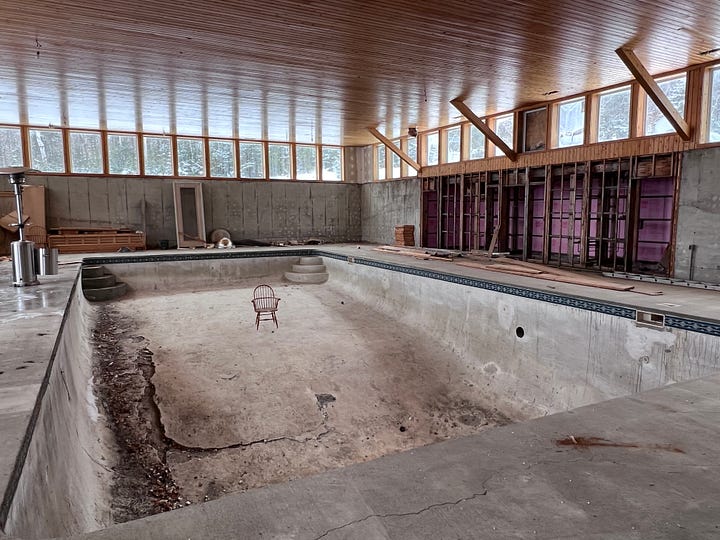
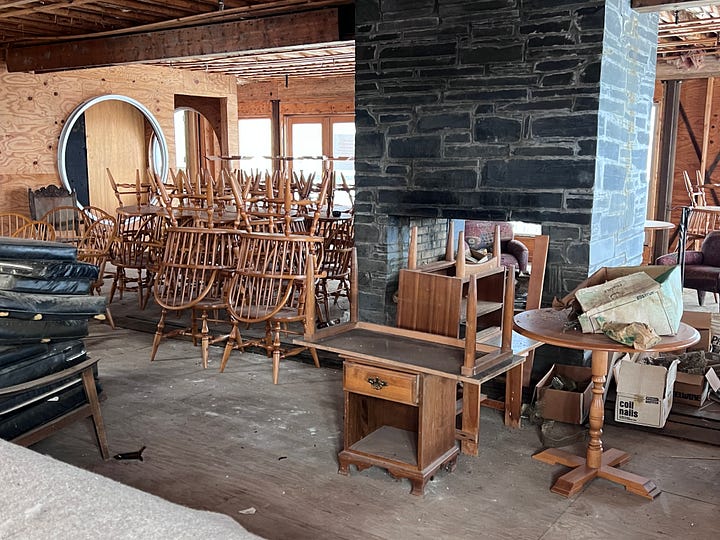
The skiing, as it stands, is fine, with a funky windy narrow trail network that delights and confuses in that New England, why-don’t-they-build-them-like-this-anymore kind of way. You can hike to the top but I did not hike to the top. Because that seemed like a lot of work for pretty mediocre snow, because I bought the kind of skis that only go down, and because I’d made the logical-sounding-at-the-time decision to chase my two-hour morning drive with a two-and-a-half-hour afternoon drive to the day’s second ski area.
Let’s start by addressing what you’re all thinking right now: there are too many “snowbowls” in America and no one can agree on how to spell it, probably because it’s not a word:

Or perhaps Camden Snow Bowl is the rebel, facing off against Arizona Snowbowl, Montana Snowbowl, and Middlebury Snowbowl – a legendary ski area trifecta most skiers refer to simply as “The Strike Lane.”* (Fun fact: all three were founded by John Snowbowl IV, a fortuitous name for the ski-loving industrialist who built his fortune selling doorhinges.**) But that doesn’t explain the matter of the intransigent Elko “Snobowl,” a semi-functional outfit in the Nevada desert, and the utterly confusing Mount Hood “Skibowl,” which, when tasked with distinguishing itself as a ski area on a mountain with a half dozen other ski areas, chose the most confusing name possible.
*No one calls it this, mostly because there are probably a maximum of five people on Earth who have skied at all three of these places, and maybe 15 people who are aware that they all exist.
**Sorry I try to stop myself but it’s impossible.
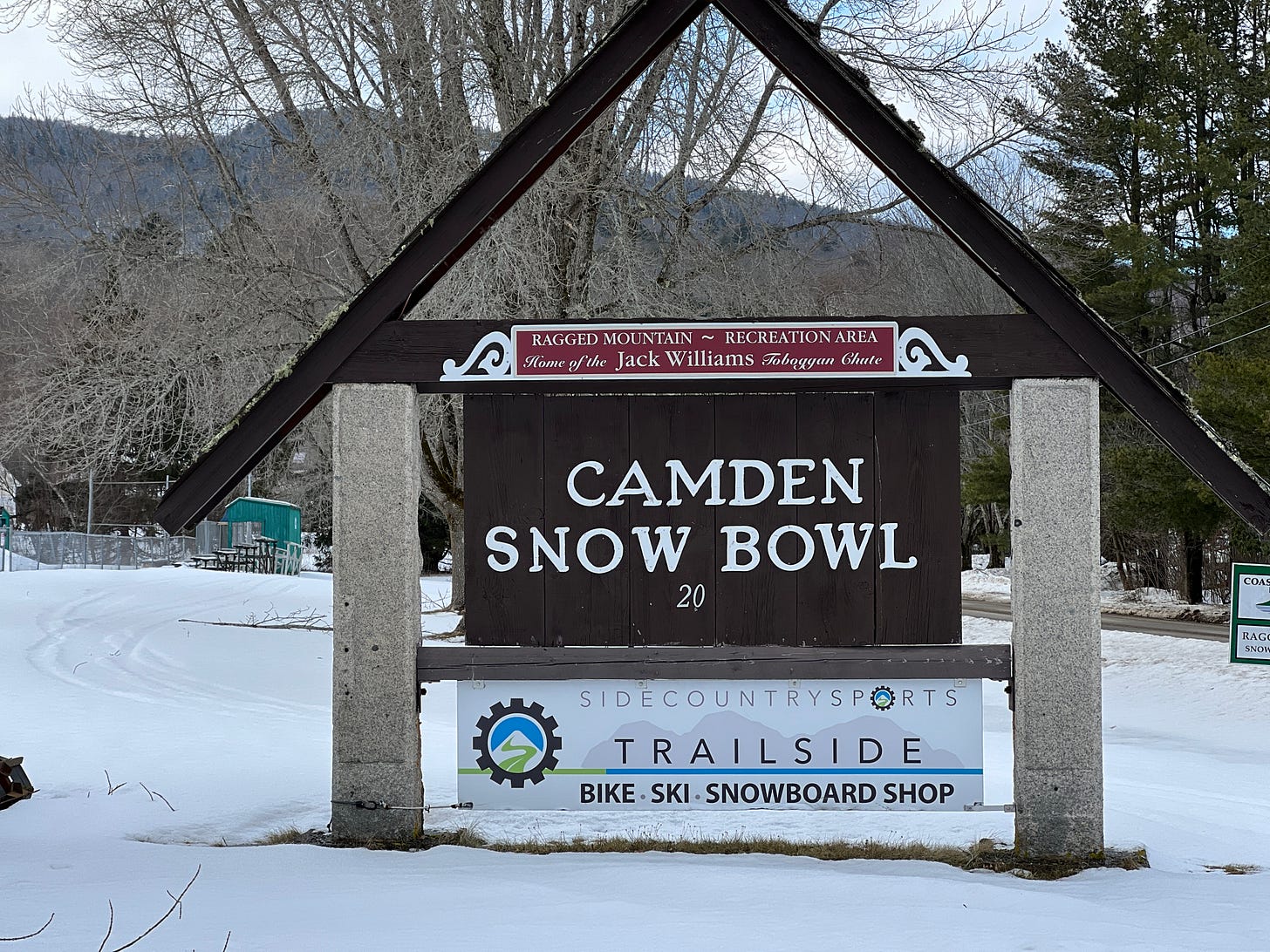
Anyway, even given all my righteous confusion, I found the Camden “Snow Bowl.” And the first thing anyone will tell you about Camden Snow Bowl when you mention Camden Snow Bowl is that from the summit of Camden Snow Bowl you can see the Atlantic Ocean.
I know that doesn’t actually sound that special. The Atlantic Ocean is not exactly hard to come by. Just go east from anywhere on the continent and eventually you’ll hit it. In fact, the Atlantic Ocean is a global brand, like McDonald’s or Wal-Mart. They have it in Europe and Africa and South America, too. It’s not like you ride the chairlift to the top of Camden Snow Bowl and they have, like, a triceratops up there. No, it’s an ocean that, incidentally, I live maybe 10 miles away from but almost never bother to visit. So why was it so goddamn cool to stand off Camden Snow Bowl’s summit unload and stare at an ocean that was difficult to even see, as water and sky had taken a similar hue on this midwinter Thursday?
I found a potential explanation in an unlikely place: Taylor Swift’s End of an Era documentary. “Taylor is my friend,” the also-very-famous Florence Welch says after a rehearsal scene of the clearly well-acquainted pair, “and I know her as this very cozy person, and I came out [on stage] and I was like, ‘Oh my God, it’s fucking Taylor Swift!”
And that’s what it’s like to get to the top of Camden Snow Bowl and see the Atlantic Ocean.
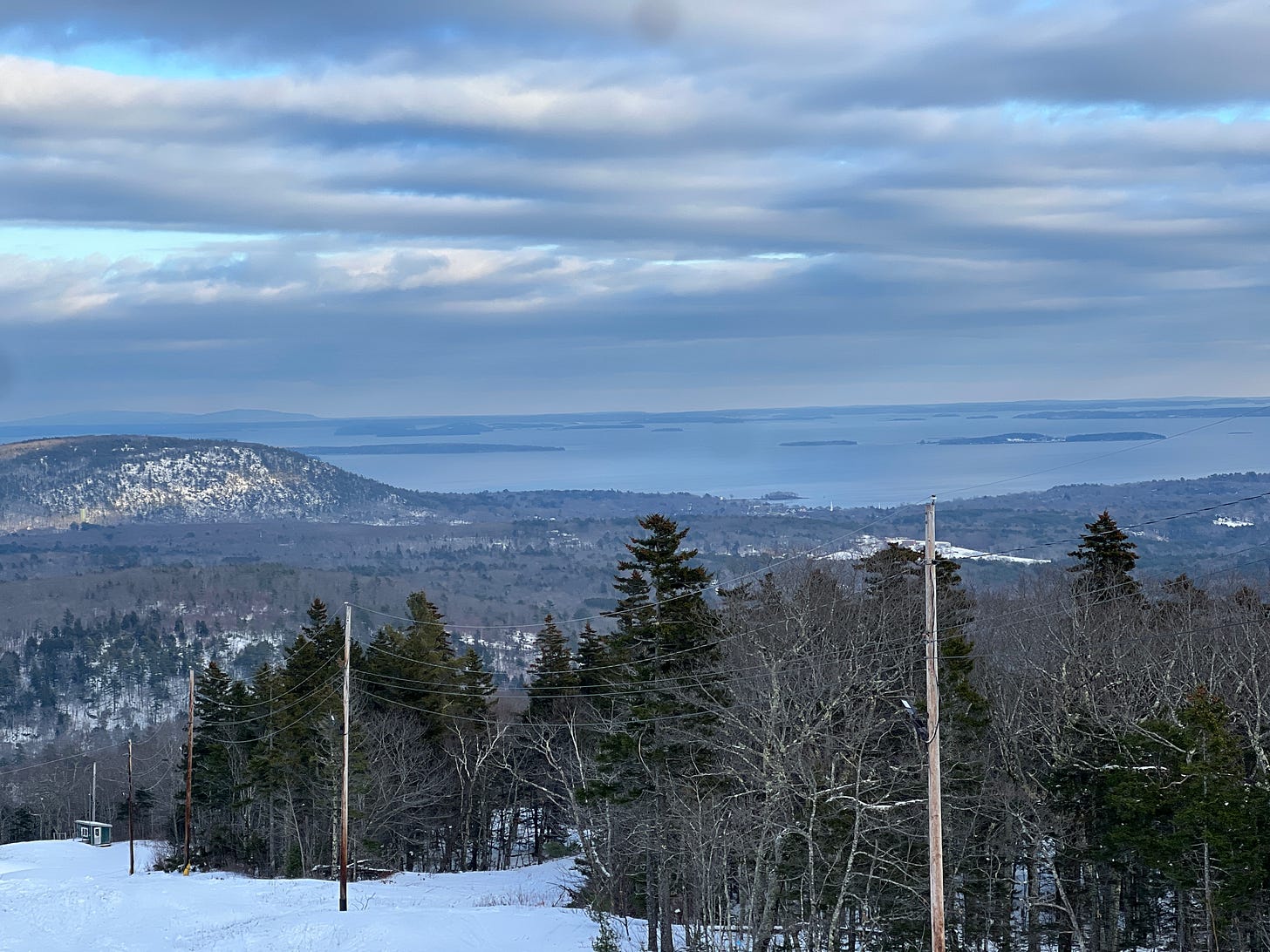
Now, there’s a reason why you can’t see the Atlantic Ocean from the top of very many ski areas. It’s because the Atlantic Coast is a lousy place to put a ski area. And Camden Snow Bowl does not get anywhere near the natural snow, at least on average, of Maine’s western monsters. Instead, Camden blows a lot of snow, and on my visit in January, mountain ops had blown a lot of snow. Unfortunately, that translated to just one top-to-bottom ski trail, which by the time I showed up at around 2 p.m. was pretty icy. So I took a few laps, snapped some photos, and bounced.
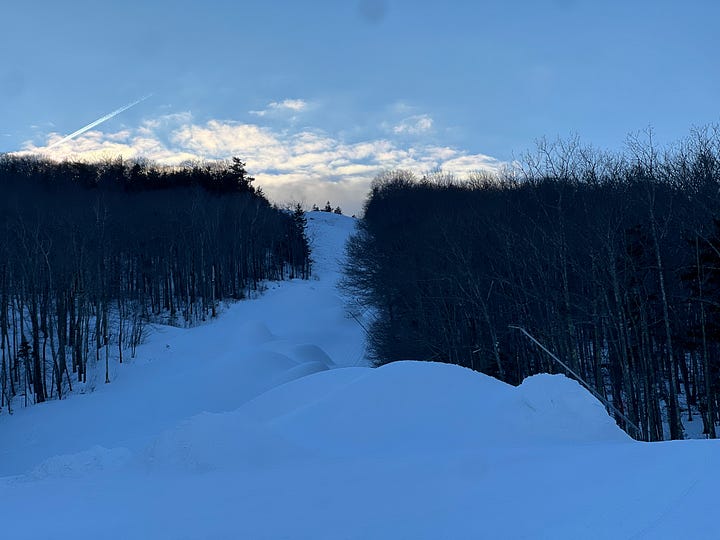
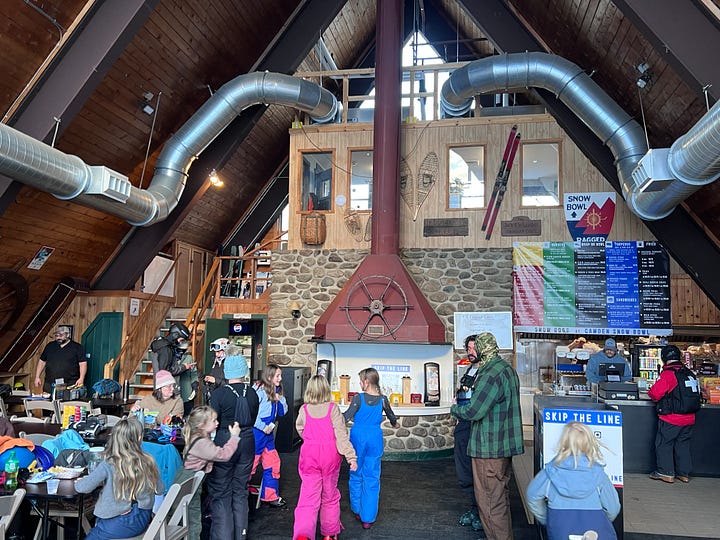
If you can help it, always try to arrive at a ski area during daylight hours, at least if it’s your first visit. And this is what I tried to do with Hermon Mountain – which joins “Snow Bowl” on the problematic-names list because it manages the trick of calling itself by two different names. Actually three:
Trying to jam Hermon Mountain/New Hermon Mountain/New Hermon Mountain, Inc. into a day that had already included two ski areas in opposite directions from my hotel was ill-advised, and under different circumstances, I may have stowed this 276-footer for a better day. But the longtime owners had declared that they would shutter the place after this season if they couldn’t find a new buyer, and while the bump is under contract, I thought it best to take a few just-in-case laps.
Me and the rest of Bangor, Maine’s third-largest city (population 31,753). From the parking lot, I could see a line backed up dozens-deep across the snow beach at the base of the mountain. And I thought to myself, “Wow, I hope that’s not a line for lift tickets because I would sure hate to have to wait in that line.”
The good news is this wasn’t a line for lift tickets. The bad news is it was the line for Herman Mountain’s only chairlift, which sits exactly parallel to a T-bar that was for some reason idle. Which meant that I didn’t have to wait in that line once, but every single lift ride.
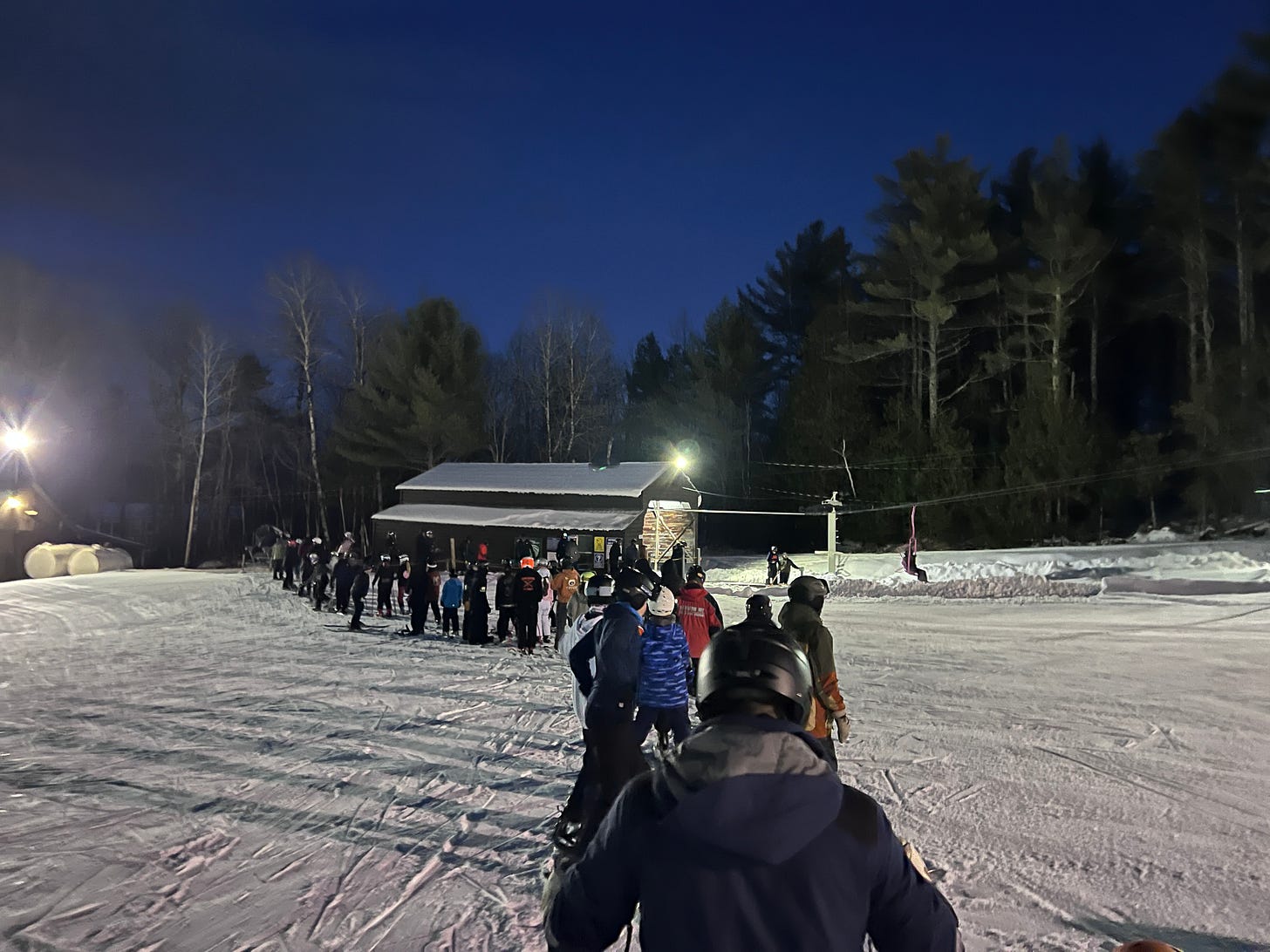
Which ended up being two lift rides. And the line actually moved pretty fast and, for a teenage scene, with great efficiency and order (Maine really is the best). But there was a lot of teenage energy pulsing through the bump. And after driving two hours up to Big Moose, two and a half hours back down to Camden Snow Bowl and an hour and change up to Herman Mountain, my Teen-O-Meter was out of gas. But, hey, I hope I can return next year.
Mt. Abram is the ski area you see as you drive out of Sunday River toward the interstate and say, “did that used to be a ski area?” Its close-cut trails don’t pop like Boyne’s megastar, and unlike Sunday River’s assortment of high-tech six- and eight-packs, which can be seen from space, it’s hard to make out Abram’s two antique double chairs from the road.
The ski area seems to be trying hard not to take itself too seriously, starting with its Rocky and Bullwinkle theme. Rocky and Bullwinkle, for those of you born after World War II, is a cartoon show that was popular in like the 1800s or something. Which was approximately 200 years after Mount Abram installed its base-to-summit Wayback Machine, a Hall chairlift which still runs, at least as an auxiliary component, on a straight-six Ford engine.* Here’s an Instagram reel where several hundred people probably tell me I’m an idiot for not giving a more complete engineering breakdown of how the various components of this chairlift work in tandem to transport skiers uphill.
*JK Bro-hombries, Abram installed Wayback in 1970.
But Abram, as it turns out, is an awesome little ski area. Fantastic grooming, with no icy patches, top to bottom, and liberal terrain management, with vast sections of off-piste available even on refrozen garbage snow.
On my second off-piste run, I stumbled across this nifty multicolored, de-roped T-bar and skied down the line.
At the bottom, I ran into a patroller who told me that Abram had run that T-bar until around Covid, then abandoned it because the west side chair was working just fine as a beginner pod. I dug up some old trail maps and here’s the terrain he was talking about – the T-bar line I skied is the short red line labelled “Mini T-bar” on the far left:
That section marked “Hillside Condo” is actually an old trailpod that was served by yet another T-bar:
I’m not sure if Abram ever plans to bring back that beginner terrain. The mountain skis plenty big enough. This was, in fact, the only stop on the Storm Skiing Maine World Tour 2026 during which I recorded more than 10,000 vertical feet on Slopes.
There’s a feeling that I get at small ski areas that I’ve always failed to recreate at larger ski areas. Short shots down the narrow trails, skiing solo, fast, no fear of ice, weeds poking up, a down-bound time machine.
And T-bars. Two of them. Titcomb actually has one of the newest T-bars in America. Doppelmayr built it last offseason, a quick-turnaround replacement for a Constam T-bar that had arrived used in 1973, after a 20-year run as Cannon’s Lower T-bar.
If you want a contrast between what you think T-bars are and what modern T-bars actually are, find $30 and a day to visit Titcomb. The old T-bar, a Franken-lift that was maybe at one point a Poma and has been swinging up the hill since 1956, sounds like the inside of an atom bomb. The lift attendant wears earplugs and stands away from the lift when no one is actively loading.
The new T-bar? Its motor wouldn’t be audible over a running microwave. The Ts tug you uphill like a 3-year-old pulling you into ankle-deep lake water. It’s clean, smooth, and fast. The lift attendant can talk to you:
And of course the skiers were great. At the top of the old T, one kid asked me if I’d ever jumped off the cliffs over in the woods. I told him that, no, I’ve actually never skied here before, and besides, I think those trails are closed. “Closed is just another level of difficulty,” he said as he skied off into the forest.
Quarry Road is a ropetow bump that opened in 1937 as “Mountain Farm,” morphed into school-run “Colby College Ski Area” in 1964, went into mothballs around 1979, and sat dormant until the Waterville Parks and Recreation department purchased the bump and, with the help of an outfit called Friends of Quarry Road, re-opened the ski hill in 2021.
It’s a neat little outfit: one tow, a QR code to pay for your $15 resident lift ticket, a nice pitch, and a Slopes-measured vertical drop of 157 feet – about three times taller than most sources list the ski area’s vert. I took exactly one lap, which reminded me that ropetows and sore shoulders are a poor match. My next stop was scheduled to be Pinnacle Ski Club, a typical New England ski “club” where anyone appears to be able to ski if they show up with $20. The single-ropetow outfit was just half an hour straight up I-95. Which means I would have had to drive 30 minutes up 95. Reboot. Ski. Then drive half an hour back down 95, then six more hours home. Or I could just do the six hours right then. So I made a rare adult decision and turned the car back toward Brooklyn and was home by midnight.
So that was my Maine off Main Street Ski Safari. Not a lot of vert, but a lot of road, captured, as always, by Slopes, which buckets your stats together by trip:
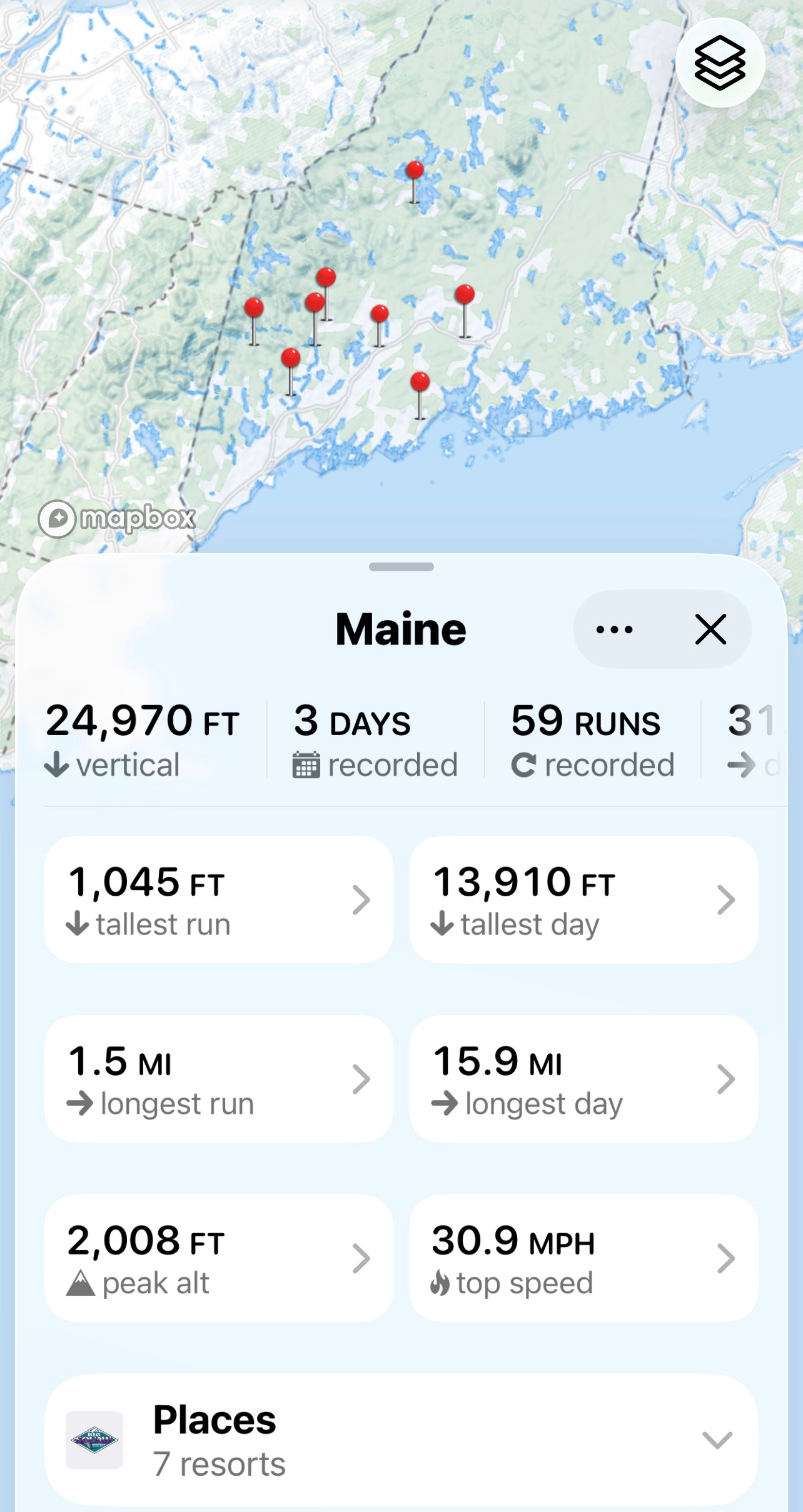
I’m documenting my 2025-26 ski season with Slopes. Here’s a recap of days one through four:

‘Quad God’ Ilia Malinin avenges Olympic disappointment with backflip for third straight world title

Baseball is changing forever with robot ump challenges

How the landmark verdict against Meta and YouTube could hit their businesses

Florida manosphere influencer Clavicular arrested on suspicion of battery

Gen Z is the loneliest generation. Here’s what can help

Florida High School Football Rankings: Top 25 teams – Oct. 21

How old is Bo Nix? What to know about Oregon quarterback ahead of 2024 NFL Draft

Cleary's 21 help Le Moyne down Central Connecticut State 69-64 in OT

99th annual Pony Swim held in Virginia

Indiana Members Credit Union announced as new anchor tenant at Bottleworks District

Hundreds of thousands march through London in stand against the far right

2 students killed, 7 other people injured in Tennessee bus crash during school field trip

Dem senators dodge crucial question on illegal alien accused of killing Chicago college student

EU Parliament unblocks key political hurdle in digital euro talks

Man arrested in plot to firebomb Palestinian activist’s home after undercover op
-

 Detroit, MI1 week ago
Drummer Brian Pastoria, longtime Detroit music advocate, dies at 68
-

 Movie Reviews1 week ago
‘Youth’ Twitter review: Ken Karunaas impresses audiences; Suraj Venjaramoodu adds charm; music wins praise | – The Times of India
-

 Sports1 week ago
IOC addresses execution of 19-year-old Iranian wrestler Saleh Mohammadi
-

 New Mexico6 days ago
Clovis shooting leaves one dead, four injured
-
 Business1 week ago
Disney’s new CEO says his focus is on storytelling and creativity
-

 Tennessee5 days ago
Tennessee Police Investigating Alleged Assault Involving ‘Reacher’ Star Alan Ritchson
-

 Technology6 days ago
YouTube job scam text: How to spot it fast
-

 Texas1 week ago
How to buy Houston vs. Texas A&M 2026 March Madness tickets