Maine
Maine manages to retain most Medicare enrollees even as pandemic-era protections end • Maine Morning Star


As pandemic-era protections end, Maine has managed to keep almost 70 percent of people formerly relying on state healthcare on Medicaid, a rate better than the national average and many other states.
More than 300,000 Mainers have renewed their MaineCare coverage so far, according to the Maine Department of Health and Human Services. MaineCare is the state’s name for federal Medicaid, which provides health coverage to millions of low-income adults, children, pregnant individuals, elderly adults and people with disabilities.
Approximately 13 percent of all renewals have been terminated, either due to procedural reasons such as an incomplete form or missing information, or due to enrollees being deemed ineligible. The rest are applications pending manually or automatic renewals.
That amounts to an enrollment decline of 16,000 people from MaineCare, according to Georgetown University’s McCourt School of Public Policy, which tracks data from the Centers for Medicare and Medicaid Services on the Medicaid unwinding.
During the COVID-19 public health emergency, the federal government offered states extra benefits to keep people enrolled in Medicaid. So even if an individual’s income increased and they no longer qualified, they still retained free dental, mental and health care benefits.
That coverage, known as continuous enrollment, officially ended in March 2023. So starting in spring 2023, states had approximately a year to redetermine eligibility and terminate coverage for people who would no longer be eligible. Maine started unwinding last April, and the unwinding period ends this October.
States have had varying success rates retaining healthcare coverage for residents, with states such as Oregon and Arizona keeping more than 80 percent of enrollees covered with state Medicaid programs, while millions of Texans lost Medicaid coverage.
The national average was a 63 percent retention rate, according to Allie Gardner, a research fellow at Georgetown.
“Medicaid enrollees largely had greater protections from disenrollment in Maine than they did in other states.”
There is no one clear reason Maine successfully kept most people who need MaineCare enrolled in the program, according to John Gale, a senior research associate at the Maine Rural Health Research Center within University of Southern Maine.
“It’s a combination of factors, I think; manageable population, reasonable policies, a smaller number of enrollees to track down, and an accepting political climate,” he said.
“Part of it is we don’t see the same level of anxiety or anger towards people on Medicaid. I mean, we pretty much accepted that this is an important safety net program for people who don’t normally, who may not qualify for coverage under the marketplaces.”
Maine’s start to unwinding was with noncompliance
Despite this overall success, the state had an uphill battle to keep most eligible Mainers covered under MaineCare when unwinding began.
In April 2023, Maine was one of the only states not in compliance with CMS because it was not offering any passive renewals, called ex parte renewals, for people already on Medicaid. Through ex parte renewals, an existing member’s eligibility can be determined automatically through available data sources, such as income data, without requiring action by the enrollee, which saves time and paperwork for state employees.
Until August 2023, all MaineCare renewals had to be done manually, but when CMS did their review of state compliance of federal renewal requirements prior to the unwinding, they found that Maine was not in compliance, Gardner said. CMS then worked with the state’s health department to develop mitigation strategies until they were able to get their ex parte system up and running.
One of the included the state not being able to terminate any coverage until there was an ex parte renewal either automatically through the system, or through manual workarounds with employees replicating that ex parte process, Gardner said.
“Considering where Maine was at the start of the unwinding with no ex parte renewals, I’d actually say it’s pretty impressive where they are,” she said.
“Cumulatively, Maine’s ex parte rate is right around 25 percent, and there are states that were doing ex parte and had those systems in place that have far lower ex parte renewals throughout the unwinding.”
Lowest rate of procedural disenrollments across the country
There are two ways someone enrolled in Medicaid can lose their coverage during unwinding: if they are deemed ineligible based on the updated eligibility requirements, or if they are disenrolled due to a missing form or information.
Only 20 percent of Mainers who were up for renewal were procedurally disenrolled, according to Georgetown data, which is the lowest procedural disenrollment rate of all states. The vast majority of disenrolled people were not deemed eligible under the updated requirements.
Because Maine was not able during those first few months of unwinding to end someone’s coverage until they had an automatic system, Gardner said this basically meant that the first few months of Maine’s unwinding, no one was terminated from coverage if they had missing or incomplete information, or if they were unresponsive.



A meal that would normally cost more than $30 is available for less than $12 at Governor’s Restaurants on Wednesday.
Governor’s is celebrating its 67th anniversary by offering its lobster roll for $11.67.
The annual promotion, known as Lobster Roll Day, begins when restaurants open at 8 a.m. and continues until supplies run out.
Governor’s operates six locations across Maine in Old Town, Bangor, Ellsworth, Waterville, Lewiston and Presque Isle.
Customers should be aware that several locations are offering cash-only drive-thru service for the event.

Join Girl Scouts of Maine for a sweet summer stop you won’t want to miss!
We’re popping up at local ice cream shops around Maine for our Ice Cream Socials—fun, casual events where families can enjoy a free treat and learn more about Girl Scouts.
Here’s what to expect:
🍦 One FREE kid-sized cone per family when you stop by and connect with us
🌱 Hands-on activity for kids (like a planting activity or fidget spinner craft)
💬 A chance to chat with our team and learn how Girl Scouts builds confidence, friendships, and unforgettable experiences
Whether you’re curious about joining, looking for activities for your child, or just want to enjoy a sweet treat, we’d love to meet you!
✨ Open to all families—no registration required. Just stop by, say hello, and enjoy some ice cream with us.
The Saco Scoop
05:30 PM – 07:30 PM on Tue, 14 Jul 2026
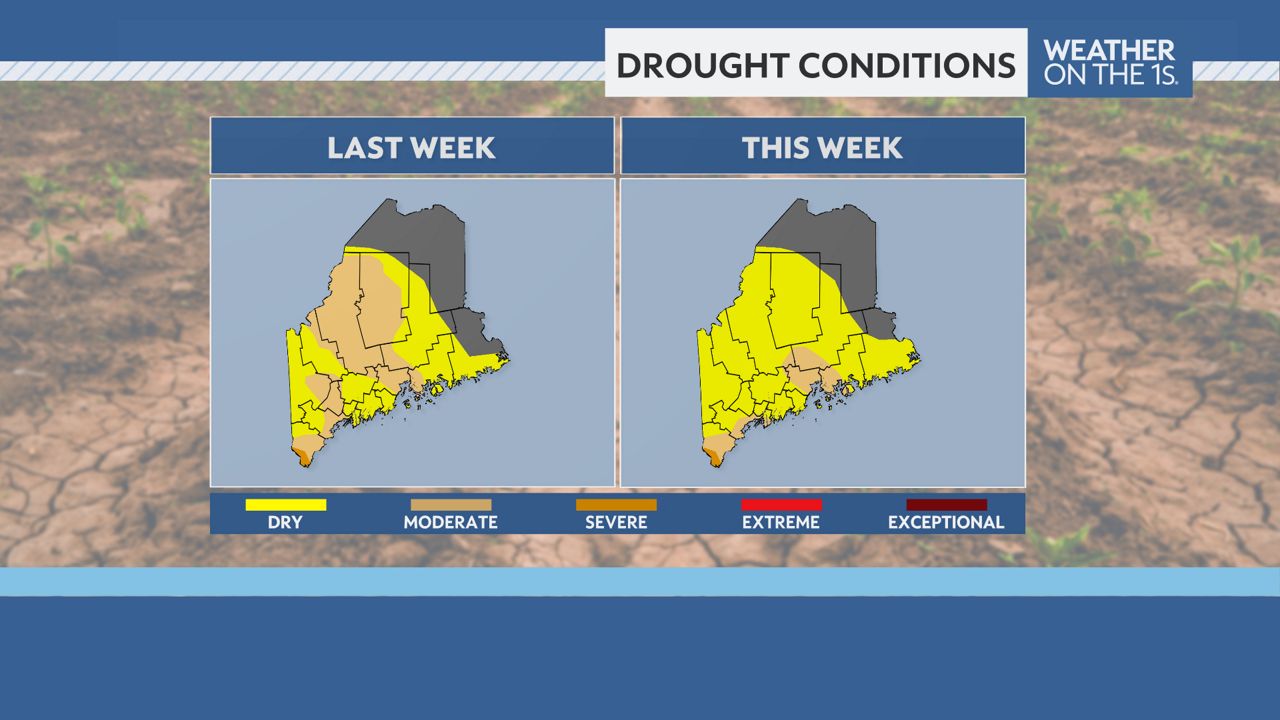
The recent rain in Maine is easing the drought that parts of the state have been experiencing since the fall.
Scott Dean, a Spectrum meteorologist, said much of Maine has been at least “dry” for several months. Parts of the state, including Portland, Bangor and Bar Harbor, are under a “moderate” drought.
Much of the country is also experiencing a drought, Dean added. The Southeast is seeing extreme levels of drought, and the West coast has been under a drought for years. There are many factors that go into this, including climate change, weather patterns like El Niño and La Niña and other factors.
And, when an area does experience drought, it can become a feedback loop. With less moisture in the ground and atmosphere, the drought can “feed upon itself,” Dean said.
“It takes a while to get into a drought and it also takes a while to get out of one,” Dean said.
But, the rainy days in Maine have been alleviating the drought, Dean said. And, the trend is likely to continue — the forecast is predicting above average levels of precipitation for the next three to four weeks.
“Hopefully, we are continuing to head in the right direction as the drought has eased in these areas,” Dean said.
In fact, if these rains do continue, Maine could come out of the drought sometime this summer.
-

 Sports19 seconds ago
2026 World Cup Third-Place Standings: Who’s In, Who’s On The Bubble
-

 Technology7 minutes ago
FCC phone ID plan could end burner phones
-
 Business10 minutes ago
Sony Pictures invests $100 million in virtual reality venue Cosm
-
 Entertainment15 minutes ago
Culture Clash knows the end is near. It wants to go out with a bang
-
 Politics25 minutes ago
Vice President JD Vance’s visit gives ‘The View’ a ratings boost
-
 Sports37 minutes ago
‘Super blessed’: Karim López makes NBA history as first Mexican-born first-round draft pick
-

 World45 minutes ago
Will the UK rejoin the European Union? MEPs debate Brexit on The Ring
-
News1 hour ago
Federal judge bars Trump from implementing proof of citizenship requirement to vote


