Maine
Alex Seitz-Wald left broadcast news for a local Maine paper. The 2026 campaign won’t let him escape the national scene. – The Boston Globe


The Globe spoke to Seitz-Wald about his reporting on the Platner campaign, how the Villager approaches its political coverage, and whether local news outlets need to be able to effectively share their reporting outside of their communities. The interview has been edited for brevity and clarity.
How did you approach this Senate race in Maine, your first as a local news editor?
I thought I was getting away from national politics, but they pulled me back in. The day before Platner launched, I got a text from an old source who I’ve known for a long time, who said, “I’ve got a candidate who’s gonna jump into the main Senate race. He’s a harbormaster of this small town, Sullivan.”
I got on the phone with Platner and was just blown away by how fully formed his message was and how articulate he was. We did a story on it, along with the New York Times and everybody else. And indeed, he did become a thing.
Then, of course, [Maine Governor Janet] Mills gets in, the “oppo” comes out, and the race suddenly takes on this whole other layer of interest and meaning. The thing that I was immediately seeing was that all the yard signs are still up, and the people that I talked to in the days after he announced who were into him were still supporting him.
That’s when I started to see there’s clearly something that’s being missed in the national coverage. I’ve covered probably hundreds of campaigns — I have seen up close and personal what a dying campaign looks like. I’m very familiar with a campaign on its last legs, and this is not that.
You have this online platform where you can get traction. You’re able to go on MSNBC. Do you think being able to share the Villager’s reporting to a wider audience helps you locally?
Absolutely. I think we all agree that there are not enough reporters in the rest of the country, and too many reporters in New York and DC. I agreed with that when I was a DC reporter.
When we live in an information ecosystem where there just are not many boots on the ground reporting up facts from how things are happening, and we simultaneously have this demand for instantaneous analysis and understanding of what’s going on the ground, you’re inevitably going to get false assumptions or perceptions, because people want to come to a conclusion right away about what’s happening. But we’re just not getting those information streams.
Do you think it’s going to be more important to have people who focus not just on serving your local audience, but also communicating what’s happening with your local community more broadly?
I do. We’re covering our communities, but we also are sort of spokespeople for the outside world for our communities, and that’s not a role that national media plays or feels equipped to play. But I think it’s appropriate for local media to sort of be champions of your community.
One of the things that I felt, and some of my colleagues felt, is that Maine was getting short shrift from the way it was being portrayed. “Oh they’re all willing to support a neo-Nazi, because it’s the whitest state in the country.” For us in Maine, that’s not what’s going on here, and it’s almost a little bit offensive. You want to speak up.
Absolutely, that’s the thing we think about a lot. And there’s a balancing test there. Frankly, we’re going after grant money. We just hired a director of development so that national media is nice, because everyone is vain and likes to say that. But there’s a strategic purpose there, which is to hopefully help us raise more money.
But the ultimate goal has to be for the local community. Anything that we are doing nationally is ultimately to serve the local community, directly or not. I think we’re very mindful of that.
We were four newspapers. We consolidated into one. The three towns had their own individual newspapers, and we’re now a regional paper. There’s inevitably some resentment and sense of loss, and I totally get that. I would love to live in a world where we could support four independent newspapers, but that’s just not the reality. So that criticism is valid.
Did your coverage of the Platner controversy have any impact on the Villager’s direct audience?
We’ve definitely seen some increased traffic. One of the top search terms that gets people to the Villager is Graham Platner, but that’s obviously people who are not local. It’s nice to have that. But really, we care about the local audience.
(Following the interview, Seitz-Wald told the Globe that the the Villager gained roughly 100 new subscribers in the wake of the Times article.)
Has the race had an impact on you and how you’re thinking about Maine politics coverage going forward?
We are experts in our community, so we’ve set this very high bar for political stories where it’s like we need to have a clear local angle or a frame on it that is something that only we can do.
We did an early Platner story that was about his oysters — what did his oysters taste like. There’s a big aquaculture industry, and people care about that stuff. Ideally, any political story that the Villager does should be a political story that only the Villager could do.
I know this was a big move for you to leave your position at NBC and come to small-town Maine and be an editor. I’m wondering if anything of the past couple weeks with the Platner controversy, or even anything broader than that, has reinforced that decision to leave national news and has you thinking differently about this job?
Absolutely. I love national news. I love NBC. They were great to me.
But as much as I love covering national campaigns, I would be one of 50 reporters at an event. I have never felt more useful to the world than I do now. The first two Graham Platner events I went to, I was the only reporter there, and that’s the standard. If we’re not there, it doesn’t get covered. And then there’s not just no news about it for our community, but there’s no record about it for history.
And so it feels so vital and important what I’m doing, even though people would say it’s smaller. Maybe, but to me, it’s so much more impactful.
Aidan Ryan can be reached at aidan.ryan@globe.com. Follow him @aidanfitzryan.



HARPSWELL (WGME) – The pain at the pump is not just hurting drivers.
It’s also leading to increased operating costs across different industries.
As of Wednesday, the average price for a gallon of diesel in the U.S. is $5.49. It’s up by nearly $2 since last month.
For diesel-dependent industries like trucking, the spike is leaving a pinch.
The pain at the pump is not just hurting drivers.{ } (WGME)
“It’s troubling for every Maine citizen,” Brian Parke from the Maine Motor Transport Association said. “Trucking companies are just trying to figure out the best way to manage all of this so they can stay in business, operate at a profit and still be operating once the fuel prices go down.”
Parke says about 85 percent of Maine’s freight is delivered by truck.
“Whether people like it or not, there’s not much in your home that doesn’t come by truck. So yeah, the impacts can hit everyone,” Parke said.
Sometimes, companies who partner with truckers include surcharge provisions in their contracts. That means companies will pay for the fuel cost spikes, not the truck drivers. But Parke says those costs are often offset in increased store prices.
“No matter what level fuel prices are, it’s already baked into what the consumer pays,” Parke said. “So if fuel is $2 a gallon, consumer prices are going to reflect a certain amount. If fuel goes from $2 a gallon to $4 a gallon, then consumers will inevitably pay that additional amount.”
The ripple effects are also shrinking profit margins for commercial fishermen like Matt Gilley.

The pain at the pump is not just hurting drivers. (WGME)
“I usually try to haul once a week. I haven’t hauled in three weeks because of the price of fuel,” Gilley said. “I’m not keen on spending money to go to work.”
Gilley says the water is quiet this time of year. That won’t be true for much longer. He says the longer fuel prices remain this high, the more concerned he will become about potentially not turning a profit this summer.
“We’re an optimistic group in a pessimistic industry,” Gilley said. “Come June, if we’re still seeing $5 fuel prices, that’s when I’d start to get nervous. That’s when everything starts to pick up, that’s when guys start setting traps.”
The all-time record high for diesel prices in the U.S. was set four years ago, when AAA says it cost $5.82. That’s only $0.33 higher than what it is today.
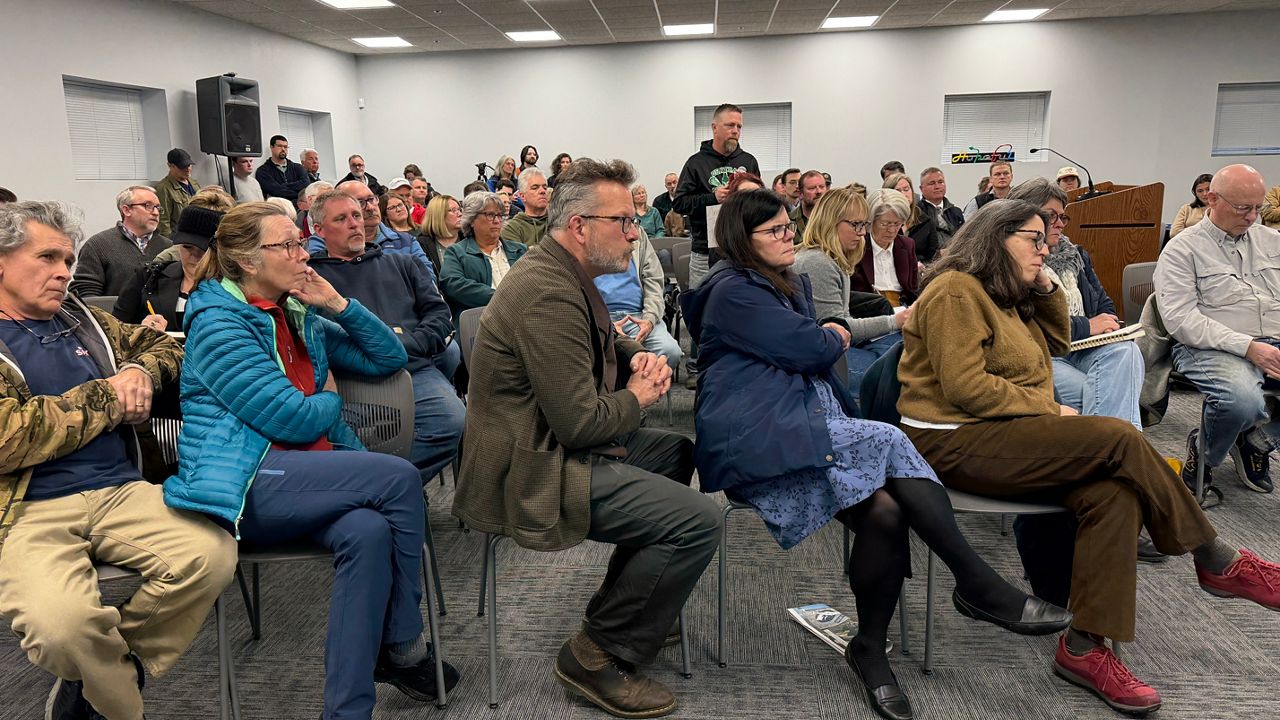
WATERVILLE — Dozens of Waterville and Sidney residents grilled Amazon representatives Tuesday night on the company’s plan to build a distribution center in central Maine.
Camber Development, a Boston-based company, is in the early stages of applying for the permits needed to build a 159,000 square foot building on about 50 acres on Junction Road near Trafton Road.
The parcel is in both the city of Waterville and the town of Sidney and is close to an I-95 offramp.
Adam Cote, a Maine based attorney who works for Amazon, said the Waterville/Sidney project, along with those in Calais, Hermon and Gorham, are designed to help the company better serve customers.
“These projects are basically to try to speed up delivery of packages to people in Maine,” he said.
The “last mile” distribution center will accept deliveries from tractor-trailers coming off I-95 — mostly from Massachusetts and Connecticut — and then allow vans to pick up the items for customer delivery.
The Waterville/Sidney location will add an estimated 150 to 200 jobs to the region and will generate about 1,000 trips per day, developers and engineers said Tuesday.
The vacant land on Junction Road near Trafton Road is the proposed site for a new Amazon distribution center in Waterville and Sidney. (Spectrum News/Susan Cover)
But locals gathered at the city hall annex raised questions about increased traffic, noise, pollution, and the impact the center could have on local businesses.
They also asked about whether drones will be used — developers said that’s not in the plan — and whether a data center could be built on the site.
The developers said the plans as drafted don’t leave enough room for a data center, which is a large building with computer servers that will be needed to power AI and other information technology advances.
They also emphasized that the Waterville/Sidney project is in the early stages and that the public will have opportunities to weigh in at local planning board, Department of Transportation and other meetings.
Sidney resident Tim Stonesifer said he came to the Tuesday meeting in hopes of getting information and to connect with neighbors about the project.
“What I heard today was a lot of concern related to traffic,” he said. “How much the volume of traffic that’s going to be coming in and out, the sound that’s related to that, how that’s going to affect neighbors and water effects.”
Tim Stonesifer of Sidney says he has many questions about the proposed Amazon distribution center. (Spectrum News/Susan Cover)

PORTLAND (WGME) — Business leaders gathered in Portland Tuesday to speak out against a data privacy bill in Augusta.
If passed, the bill would protect Mainers’ online data from being bought and sold to bigger companies like Meta and Google by establishing strict standards for data collection and giving consumers the right to legal action.
But some business leaders say there could be a big downside: blocking businesses from reaching potential customers.
“It’s been stated that the legislation before us does not end targeted advertising. No, it evaporates the data targeted advertising relies upon,” Maine State Chamber of Commerce President and CEO Patrick Woodcock said.
The data privacy bill passed both the House and the Senate last week, although the vote was very close in the Senate.
It now faces additional votes before possibly going to the governor’s desk.

2 new directors join SDNW board

Why Tennessee softball signee Avary Stockwell’s talent strikes fear into opponents

Hands-on telehealth helps reach rural Texas communities

Houston faces Utah, aims for 5th straight home win

Trucker’s brief detour into Canada leads to 3 weeks in federal custody – VTDigger

Florida High School Football Rankings: Top 25 teams – Oct. 21

How old is Bo Nix? What to know about Oregon quarterback ahead of 2024 NFL Draft

Cleary's 21 help Le Moyne down Central Connecticut State 69-64 in OT

99th annual Pony Swim held in Virginia

Indiana Members Credit Union announced as new anchor tenant at Bottleworks District

Map: 4.6-Magnitude Earthquake Shakes Northern California

What you need to know: 5 key takeaways from Trump’s Iran address
Will the Iran war threaten the EU's green transition?

Appeals court rejects HUD homelessness overhaul saying it would be “disastrous”

GOP leaders endorse Trump’s shutdown-proof move to end DHS funding lapse
-

 South-Carolina4 days ago
South Carolina vs TCU predictions for Elite Eight game in March Madness
-

 Culture1 week ago
Do You Know the Comics That Inspired These TV Adventures?
-

 Miami, FL7 days ago
Jannik Sinner’s Girlfriend Laila Hasanovic Stuns in Ab-Revealing Post Amid Miami Open
-

 Education1 week ago
Video: Trader Joe’s Dip Head-to-Head Taste Test
-

 Culture1 week ago
Wil Wheaton Discusses ‘Stand By Me’ and Narrating ‘The Body’ Audiobook
-

 Minneapolis, MN7 days ago
Boy who shielded classmate during school shooting receives Medal of Honor
-

 Tennessee1 week ago
Tennessee Police Investigating Alleged Assault Involving ‘Reacher’ Star Alan Ritchson
-

 Vermont4 days ago
Skier dies after fall at Sugarbush Resort