Northeast
Left-wing activists storming synagogue use knee pads, adult diaper to mock Dem congressman over ICE vote
NEWYou can now listen to Fox News articles!
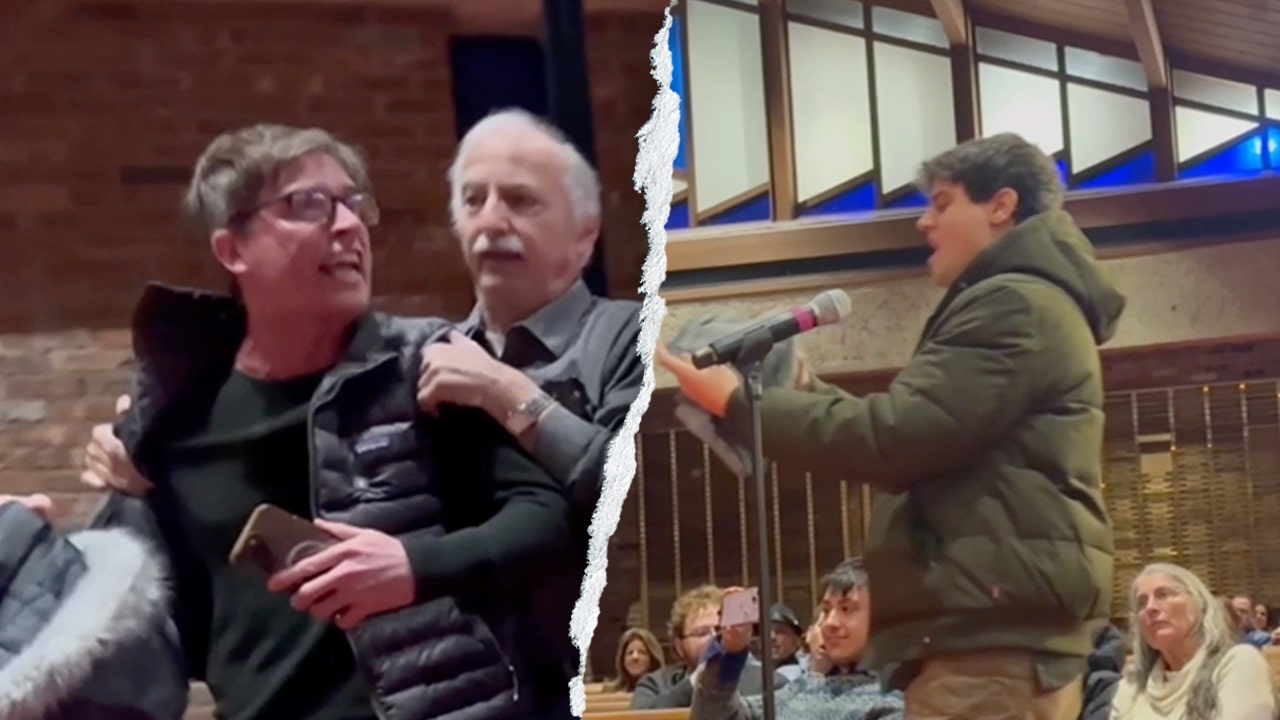
Left-wing activists disrupted an event at a Jewish temple in New York this week while Democratic Rep. Tom Suozzi was speaking, protesting his vote in favor of a government spending bill that included increased funding for Immigration and Customs Enforcement (ICE).
The demonstrators, affiliated with the activist group Climate Defiance, interrupted Suozzi on Wednesday night at the temple on Long Island, unleashing a barrage of crude theatrics and profane insults, according to the New York Post.
“We confronted Congressman Tom Suozzi,” Climate Defiance posted to X. “He is one of seven Democrats casting the decisive votes to increase ICE funding by $10,000,000,000. Hideous, grotesque, fascist-loving coward, this man has blood on his hands. We will not forgive and we will not forget.”
Video of the disruption, which has amassed millions of views online, shows activists heckling the congressman with props such as adult diapers and knee pads while mocking his support for additional funding for the Department of Homeland Security (DHS), the New York Post reported.
AOC VOICES SUPPORT FOR ANTI-ICE SHUTDOWN, DECLINES TO PARTICIPATE
Left-wing activists disrupted an event at a Jewish temple in New York this week while Democratic Rep. Tom Suozzi was speaking. (Climate Defiance via Storyful)
One demonstrator taunted Suozzi by holding up an adult diaper and saying, “I know you voted to increase ICE funding, so I wanted to get something for you. This is an adult diaper for when you pee yourself in front of Donald Trump. You’re the type of leader we need right now. Someone who soils themselves when the fascists are at our door.”
Another displayed knee pads saying, “I actually have some gifts — I have some kneepads for you — you can use these while you b— Donald Trump.”
A third individual said, “As a Jewish man, I have never felt safer than when there is a masked Gestapo in the street, so thank you, Congressman Tom Suozzi, for funding ICE.”
Comedian and activist Walter Masterson appeared to be thrown out of the temple during the disruption while attempting to read aloud the names of individuals he said had died in ICE-related incidents.
DHS PUNCHES BACK AT MOULTON FOR ‘INCITING RIOTERS’ WITH ‘GROSS’ ICE REMARKS
Left-wing activists reportedly disrupted a Jewish temple on Long Island this week, targeting Democratic Rep. Tom Suozzi over his vote in favor of a Republican-backed spending bill that increased funding for Immigration and Customs Enforcement (ICE). (Climate Defiance via Storyful)
“Nine people were killed by ICE this month, and you’re throwing me out while I’m reading their names? How f—ing dare you!” Masterson shouted.
Days after the vote, Suozzi publicly apologized for supporting the DHS spending package, which included roughly $10 billion in additional funding for ICE, Politico reported.
The apology followed intense backlash from fellow Democrats and came after the fatal shooting of 37-year-old ICU nurse Alex Pretti by Border Patrol agents in Minnesota, according to the New York Post.
LOOMING GOVERNMENT SHUTDOWN THREATENS SERVICE MEMBERS, FEMA, TSA AMID ICE IMPASSE
Comedian and activist Walter Masterson appeared to be thrown out of the temple during the disruption while attempting to read aloud the names of individuals he said had died in ICE-related incidents. (Climate Defiance via Storyful)
“I failed to view the DHS funding vote as a referendum on the illegal and immoral conduct of ICE in Minneapolis,” Suozzi said in a statement. “I hear the anger from my constituents, and I take responsibility for that. I have long been critical of ICE’s unlawful behavior and I must do a better job demonstrating that.”
Suozzi joined six other Democrats in crossing party lines to help Republicans narrowly pass the DHS funding measure in a 220–207 vote, Politico reported.
CLICK HERE TO DOWNLOAD THE FOX NEWS APP
Suozzi and Climate Defiance did not immediately respond to Fox News Digital’s request for comment.
Read the full article from Here

Pittsburg, PA
Where to watch Colorado Rockies vs Pittsburgh Pirates: TV channel, start time, streaming for
What to know about MLB’s ABS robot umpire strike zone system
MLB launches ABS challenge system as players test robot umpire calls in a groundbreaking season.
Baseball is back and finding what channel your favorite team is playing on has become a little bit more confusing since MLB announced plans to produce and distribute broadcasts for nearly a third of the league.
We’re here to help. Here’s everything you need to know Thursday as the Colorado Rockies visit the Pittsburgh Pirates.
See USA TODAY’s sortable MLB schedule to filter by team or division.
What time is Colorado Rockies vs Pittsburgh Pirates?
First pitch between the Pittsburgh Pirates and Colorado Rockies is scheduled for (ET) on Thursday, .
How to watch Colorado Rockies vs Pittsburgh Pirates on Thursday
All times Eastern and accurate as of Thursday, May 14, 2026, at 6:32 a.m.
Watch MLB all season long with Fubo
MLB regional blackout restrictions apply
MLB scores, results
MLB scores for games are available on usatoday.com . Here’s how to access today’s results:
See scores, results for all of today’s games.
Connecticut
BUILDing Connecticut’s Capital City: Unique UConn Course Celebrates Five Years of Partnership, Collaboration, and Hartford Stories – UConn Today
On a Wednesday afternoon in late April – tucked inside a quiet brick building in Hartford’s Frog Hollow neighborhood, just a few blocks from the shining gold dome of Connecticut’s State Capitol building – a celebration took place.
On the third floor of The Lyceum – an historic site that at different times in its past housed a box manufacturing company, a punk rock dance club, and a roller-skating business – there were balloons, and there was music. Drinks and hors d’oeuvres. Smiles and handshakes and hugs passed around.
But the celebration wasn’t really about those things.
The celebration was about Hartford, and about a unique partnership with UConn that has been working for five years to uplift, support, and promote all that Hartford has to offer through creators with a new perspective on the capital city: UConn students.
Since 2021, the three-credit course BUILD Hartford, offered by the Connecticut Center for Entrepreneurship and Innovation, or CCEI, has engaged cohorts of both undergraduate and graduate students working on a real-world opportunity to hone their business storytelling skills by partnering with Hartford’s business, civic, culinary and hospitality, and entrepreneurial ecosystems.
In the last five years, about 100 UConn students have collaborated with more than 30 diverse businesses and entities in Hartford on innovative and creative social and multimedia projects aimed at supporting and promoting development in the city.
“BUILD Hartford is a hands-on UConn course that turns digital storytelling into real support for Hartford’s businesses,” says Rory McGloin, CCEI’s associate director of entrepreneurial communication and research and the course’s instructor. “Students produce videos, social campaigns, and strategic content while working side-by-side with restaurants, shops, and entertainment venues right here in the downtown area.”
Fresh Perspectives
Just below the surface, there’s more to Hartford than its moniker – the Insurance Capital of the World – would suggest.
The city’s metro region is home to six major industries, and the city itself is home to more than 122,000 people – and its population is growing, increasing more than 2% since the 2020 U.S. Census.
Beyond the Hartford metro’s powerhouse industries, like the insurance, aerospace, and health sectors, is a thriving business climate bolstered by a diverse and educated workforce, an innate appreciation for arts and culture, and an ecosystem of innovation and support for start-up and second-stage companies.
But without storytelling, says McGloin, how will people know about it?
“It’s pretty simple – you’ve got to tell a story,” he says. “Because you can read all the advertisements and billboards all over the state. But if you have a good friend and they told you that they got a good cup of coffee across the street, you can get a great slice of pizza down the road, there’s a cool new retail shop on Pratt Street, then you go check it out.”
And that’s where UConn’s student come in, offering fresh perspectives from both traditional and nontraditional students, all with their own diverse backgrounds and life experiences, some from Connecticut – but many not.
Participating students range from fine arts and digital media majors, to communication and business students, to MBA and MFA candidates, but they all work toward the goal of gaining valuable life and career skills and building their own portfolios while contributing research, branding, storytelling, and exposure for Hartford businesses and civic organizations.
“And that’s what this course is about. We set a mission, we talk about our tactics, we learn what a story is, and then the students are in charge of figuring out how to get the job done,” McGloin says. “And they show up, and they present, and they reap the benefits, along with the community and business partners we get a chance to work with.”
A Little Bit of Everything
Karlas Felix ’26 MA didn’t grow up in Connecticut, and she didn’t know a lot about Hartford before coming to the state for college, first her undergraduate studies at Wesleyan and now UConn, where she’s a first-year communication master’s student.
But what drew the New York native to BUILD Hartford was the opportunity it offered to learn while stepping outside of a classroom setting.
“When I heard about the course, I thought it was the perfect opportunity for me to explore making digital content, and to learn about companies, but also to learn what I like to do and develop my voice in the workplace,” she says. “Because I want to make the most of my degree. Not just get in classes, but also get experiences.”
This year, she was part of a BUILD team partnered with Real Art Ways, a multidisciplinary nonprofit arts organization in Hartford that supports contemporary artists, and she got to collaborate not only with her fellow students but also with the marketing professionals within the organization.
“We came up with a storyboard,” Felix says. “We came up with a noun – the noun was art. We wanted to talk about art in Hartford, and we developed a story around how we could do that. How can we show that?”
They built their story through on-site interviews at Real Art Ways, and created a composed six-minute final video that brings the audience inside where art lives – here, in Hartford.
Felix has signed on to take the BUILD course again next year, and she says she’s taking the course multiple times because even though she’s based in Storrs, it’s worth the trip to Hartford to take part in a real-world experience that “gets you out of your seat.”
“Do you want a course that’s hands-on, or do you want to sit in a lecture?” she asks. “Do you want something that you can actually use and apply? Do you want to learn more about yourself, and even develop the language for networking? If you want an opportunity to get real experience, this is where to get it – this is where you’re supposed to be. You get a little bit of everything.”
Start Yesterday
In its first five years, BUILD Hartford was supported by Shari Cantor ’81 (BUS) and Michael Cantor ’80 (ENG) ’83 JD, but the program has since expanded to also include a BUILD Hartford Fellowship, supported by the state of Connecticut Department of Economic and Community Development’s Office of Statewide Marketing and Tourism.
The fellowship offers an immersive experience where undergraduate and graduate UConn students can engage directly with Hartford’s hospitality, entertainment, and food service sectors.

Abigail Robinson ’25 (CLAS/SFA) ’26 MA participated in the BUILD program before becoming a BUILD Fellow this past academic year. The communication master’s student, a New Hampshire native who majored in digital media and design as well as communication as an undergraduate, says that she was a passionate storyteller even as a child.
“In high school, I did my senior project on telling stories through photography,” Robinson says. “I was focused on telling emotion through portraiture. So, I knew when I was coming to school, applying to schools, I really wanted to be somewhere that would support me in my storytelling journey.”
One of two fellows, Robinson says her role was to essentially become an influencer on behalf of Hartford, starting with the Hartford Taste festival last June.
“It was a huge event, very hot summer day, and I really just got thrown into it,” she says. “I had to learn how to do one-on-one interviews with people, which I had maybe a little bit of experience with, but when you’re at such a big event, you really have to just start going up and being like, ‘Hi, I’m Abbie, can I have an interview?’”
She used that experience to help her jump head-first into projects involving Hartford’s historic Butler-McCook House; collaborations with Hartford Athletic and the local coffee shop, Story and Soil; and a Hartford for the Holidays campaign, launched in coordination with the Hartford Chamber of Commerce.
“Every single connection I have made has been extremely meaningful and impacted me in so many ways,” Robinson says.
But the value of BUILD isn’t only limited to what the students get out of it – the partners benefit as well, according to Ben Dubow, the executive director of Forge City Works.
One of the first local partners to agree to work with BUILD students, Forge City Works is a nonprofit organization that operates The Lyceum as well as several other social enterprises in Frog Hollow, including The Grocery on Broad Street and the Fire by Forge restaurant.
“We said ‘yes,’ because entrepreneurs often say ‘yes,’ and you led with ‘free,’” says Dubow. “But the value we got, the questions that you asked, caused us to think differently about our own businesses.
“In the real world, unlike most of the fictional world, great storytelling isn’t about creating or making up stories. It’s about finding them, and making them come alive. And these folks helped us tell our story.”
In addition to recruiting students for its next cohort, BUILD Hartford is currently searching for additional supporters and partners to be part of the ongoing collaborations between its students and the city – collaborations that current partners ringingly endorsed during the celebration at The Lyceum.
“Start tomorrow,” says Rashad Hyacenth, executive vice president of business development for Hartford Athletic, “because these students are the future, and we have some of the brightest students in the country in this program, right here. Simple as that.”
“Start tomorrow,” agrees Jennifer Accuosti, senior marketing manager for the MetroHartford Alliance. “Send that email. It’s been wonderful, and we’ll work with [BUILD Hartford] again in a heartbeat, whether that’s under the chamber, under the MetroHartford Alliance, under any of our initiatives, to tell Hartford’s story.”
“Start yesterday,” says Rachel Lenda, the state of Connecticut’s director of tourism. “We’ve invested a lot into this program on purpose, with intention. We believe in the product. We’ve seen it. And I have felt it here from these incredible young professionals who are going to be working for you in this room.
“And you’re going to be so excited to have them on your team when they do.”
All digital storytelling projects produced by BUILD Hartford students are available to view on YouTube, courtesy of the Connecticut Center for Entrepreneurship and Innovation.
For more information about BUILD Hartford and the entrepreneurial and business accelerator opportunities available through CCEI, visit ccei.uconn.edu.
Maine
A top issue in Maine and Oklahoma governors’ races? Tribal sovereignty. – ICT
This story is part one of a two-part story on gubernatorial races to watch in the 2026 midterm elections as part of the #NativeVote26.
Pauly Denetclaw
ICT
Two of the 39 states with gubernatorial races have tribal sovereignty at the top of their policy agendas: Oklahoma and Maine. The two states where tribal nations have had friction with their state governments. Now Native voters in both states will be electing a new governor, and the results will impact the relationship between tribal governments and the state for the next four years.
Wabanaki Nations in Maine had a challenging time getting state legislation signed into law by Gov. Janet Mills, Democrat, that would strengthen tribal sovereignty. The 38 tribes in Oklahoma had a tumultuous relationship with Republican Gov. Kevin Stitt.
Eighteen of the 39 governor races in 2026 will have incumbent candidates, according to the National Governors Association. Stitt is the 2025-2026 chair of the association.
What’s happening in Oklahoma?
Over the past seven years, tribal nations and the state of Oklahoma had a contentious relationship — especially after the McGirt decision. Current governor, Stitt, who is a Cherokee Nation citizen, has been outspoken against the McGirt decision, tribal compacts for tobacco and car tags, and tribal gaming compacts.
Tribal-state compacts are legal agreements between federally recognized tribes and state governments. It is most commonly used for class III gaming — slot machines and table games.
“There was a time and a day when we used to compact with the tribes. That is not a unique thing across the nation. It wasn’t a unique thing in Oklahoma,” Chip Keating said during an April 6 candidates forum. “We absolutely have to hit the full reset button with the tribes — work together, treat them with the respect that they should have been treated with, and we’ve got to get back to compacting.”
Tribal leaders are looking forward to new state leadership, said Michael Stopp, president and chief executive officer of SevenStar Holdings.
“It’s good for the tribes and the tribal leaders are happy about it,” said Stopp, a citizen of the Cherokee Nation. “It has very much been a sticking point with tribal leaders that Governor Stitt has a very different perspective on sovereignty and what role the tribes play in this state. Obviously, we’ve had some big changes with the reservation status here because of the McGirt decision in 2020, but Governor Stitt, who is a member of the Cherokee Nation, has been more of an antagonist when it comes to that, than trying to help with the transition. I can definitely say the tribal leaders are looking for leadership change.”
Cherokee Nation Principal Chief Chuck Hoskin called Stitt the most anti-Indian governor in the state’s history. Oklahoma Attorney General Gentner Drummond described Stitt as having a “penchant of racism against tribes,” during an April candidates forum. He added that it was unacceptable.
Tribal nations and state governments have to work together often. As seen in Oklahoma, Stitt vetoed several tribal compacts, despite overwhelming support by the state’s legislature, and this slowed the process for establishing the tobacco, car tag and gaming compacts between Oklahoma and tribal nations.
“Governor Stitt came in thinking that he could renegotiate this contract, and quite frankly, it just doesn’t work that way. Instead of listening and coming to the negotiating table, (Stitt) tried to come in with a really strong stance and ended up losing, honestly,” Stopp said. “I think that was unfortunate for him and for the tribes. Again, missing out on the chance of negotiating and I think the tribal leaders are definitely looking forward to having someone on the other side of the table to negotiate with.”
Oklahoma governor candidates
There are nine Republican candidates on the ballot for Oklahoma’s primary election set for June 16:
- Gentner Drummond: 20th Attorney General for Oklahoma
- Chip Keating: Former highway trooper and former Oklahoma Secretary of Public Safety
- Mike Mazzei: Former Oklahoma state Senator and former Secretary of Budget
- Charles McCall: Longest-serving Speaker of the House in Oklahoma history
- Jake Merrick: Local radio host and former Oklahoma state Senator
- Kenneth Sturgell: Local, small business owner
- Leisa Mitchell Haynes: Former marketing director and former city manager
- Calup Anthony Taylor
- Jennifer Domenico-Tillett
Three Democratic gubernatorial candidates are also running for the primary election:
- Cyndi Munson: Oklahoma House Minority leader
- Connie Johnson: Former Oklahoma state Senator
- Arya
Candidates will have to get more than 50 percent of the votes to avoid a runoff. If there is no outright winner, the top two candidates for each political party will head to a primary runoff election on August 25.
An additional three Independent candidates will automatically head to the general election this November.
Two important issues this election in Oklahoma are tribal sovereignty and a commitment to working with tribes.
During an April 6 Republican candidates forum, Gentner Drummond, Charles McCall, Chip Keating and Mike Mazzei, were asked to raise their hand if they shared Stitt’s perspective on the McGirt decision. Stitt was quoted as saying that the McGirt decision has torn Oklahoma apart and has created two justice systems based on race. None of the four candidates raised their hand.
“For three and a half years I’ve been working with every tribal leader in the state of Oklahoma, and I recognize them as unique among themselves, just like France is different from Germany,” Oklahoma Attorney General Gentner Drummond said during a candidates forum. “We have to honor and respect the culture of diversity that they bring to the table and the needs that they have. We have been working with tribal law enforcement each of the last three years to take the fight to organize crime in our rural communities. They are a great partner.”
All four candidates promised their administration would work with tribal nations and negotiate tribal compacts.
Mazzei said at two different candidate forums that he would be a strong negotiator with tribal nations.
In a recent interview with KOCO 5 News, local small business owner Kenneth Sturgell said tribal nations are their neighbors and should be treated as such. He also said that the state and tribal nations have to work together.
Jake Merrick, local radio host and former Oklahoma state Senator, was pleased that the state Supreme Court affirmed tribal nations’ right to hunt on their own lands, during a March 30 candidates forum.
Democratic candidate Cyndi Munson, Oklahoma House Minority leader, said in a recent press release that her caucus supports tribes.
“The Oklahoma House Democratic Caucus supports tribal sovereignty and acknowledges that our tribes fill important gaps in our education and healthcare systems, as well as other areas throughout our state,” Munson said. “I am extremely grateful for the work our tribes have done and continue to do despite vicious attacks on them by the Governor.”
A respectful working relationship between tribal nations and the state has shifted significantly since the last gubernatorial race in 2022.
“I think every one of them [Oklahoma governor candidates] has said something about it,” Stopp said. “[It’s] different than four years ago. It was an issue in the governor’s race, but it wasn’t a good issue. Here everyone’s saying yes, we want to change the tone and start the conversation differently. So I think as far as Indian voters go, that conversation is going to change regardless of who wins.”
Dawnland
In Maine, Gov. Mills repeatedly refused to sign a law that would strengthen tribal jurisdiction and recognize Wabanaki Nations right to access federal Indian laws. She vetoed the bill twice despite overwhelming support from state legislators.
“We’ve had multiple opportunities to send [legislation] to the governor’s desk and not just party line votes,” said Maulian Bryant, executive director of the Wabanaki Alliance and former Penobscot ambassador. “We generally have Democratic support, but we have gotten Republicans voting on these issues too. So, the governor has seen some great bipartisan work reach her desk and has still decided to veto some of these efforts.”

” data-large-file=”https://i0.wp.com/ictnews.org/wp-content/uploads/2026/05/AP26076552017637-scaled.jpg?fit=780%2C520&quality=89&ssl=1″ alt=”” class=”wp-image-329224″ srcset=”https://i0.wp.com/ictnews.org/wp-content/uploads/2026/05/AP26076552017637-scaled.jpg?resize=1024%2C683&quality=89&ssl=1 1024w, https://i0.wp.com/ictnews.org/wp-content/uploads/2026/05/AP26076552017637-scaled.jpg?resize=300%2C200&quality=89&ssl=1 300w, https://i0.wp.com/ictnews.org/wp-content/uploads/2026/05/AP26076552017637-scaled.jpg?resize=768%2C512&quality=89&ssl=1 768w, https://i0.wp.com/ictnews.org/wp-content/uploads/2026/05/AP26076552017637-scaled.jpg?resize=1536%2C1024&quality=89&ssl=1 1536w, https://i0.wp.com/ictnews.org/wp-content/uploads/2026/05/AP26076552017637-scaled.jpg?resize=2048%2C1365&quality=89&ssl=1 2048w, https://i0.wp.com/ictnews.org/wp-content/uploads/2026/05/AP26076552017637-scaled.jpg?resize=1200%2C800&quality=89&ssl=1 1200w, https://i0.wp.com/ictnews.org/wp-content/uploads/2026/05/AP26076552017637-scaled.jpg?resize=2000%2C1333&quality=89&ssl=1 2000w, https://i0.wp.com/ictnews.org/wp-content/uploads/2026/05/AP26076552017637-scaled.jpg?resize=780%2C520&quality=89&ssl=1 780w, https://i0.wp.com/ictnews.org/wp-content/uploads/2026/05/AP26076552017637-scaled.jpg?resize=400%2C267&quality=89&ssl=1 400w, https://i0.wp.com/ictnews.org/wp-content/uploads/2026/05/AP26076552017637-scaled.jpg?w=2340&quality=89&ssl=1 2340w, https://i0.wp.com/ictnews.org/wp-content/uploads/2026/05/AP26076552017637-1024×683.jpg?w=370&quality=89&ssl=1 370w” sizes=”(max-width: 780px) 100vw, 780px”/><figcaption class=)
In order for tribes to access federal Indian laws, the state has to approve it. The Wabanaki Alliance, created to educate the people of Maine about tribal sovereignty, has been working diligently to amend the Maine Indian Claims Settlement Act of 1980.
Through the settlement, tribal nations ceded land in exchange for $81.5 million. However, it also drastically limited tribal sovereignty, and brought tribes under the jurisdiction of the state. Tribal nations that predate the state, are subjected to state jurisdiction and treated more like municipalities. The act was meant to be a living document but the state resisted changes for decades.
The Wabanaki Alliance has been able to increase tribal sovereignty and self-governance one legislation or amendment at a time. Throughout her two-terms, Mills has resisted a complete overhaul of the 1980 act and this created tension between the governor and tribal nations.
“If we had a governor that came in and fully embraced the inherent rights and inherent sovereignty of our people, and fully recognized that, it would strengthen our communities and it would also uplift the entire state of Maine,” said Bryant, who is Penobscot. “Our tribal communities are near rural places that could really use economic opportunities and could really use tribal businesses that are able to grow without all of these bureaucratic restrictions. We really are coming from a place of friendliness and we want to be good neighbors and we want to uplift the communities around us.”
The Wabanaki Alliance held a gubernatorial candidates forum in March where nine governor candidates participated:
- Shenna Bellows, Democrat
- Rick Bennett, Independent
- John Glowa, Independent
- Troy Jackson, Democrat
- Derek Levasseur, Independent
- Hannah Pingree, Democrat
- Nirav Shah, Democrat
- Angus King III, Democrat
None of the eight Republican candidates participated.
Most of the gubernatorial candidates generally supported increasing tribal sovereignty, recognizing inherent rights and working with tribal nations. Angus King III said he wasn’t educated on the topic enough to make any commitments and would have to look into it. This sentiment was shared by John Glowa and Derek Levasseur.
Hannah Pingree, Rick Bennett, Shenna Bellows and Troy Jackson firmly supported tribal sovereignty for Wabanaki Nations.
“If a governor comes in, and isn’t afraid of recognizing tribal sovereignty and sees it as an opportunity, I think we could see some real progress for everyone,” Bryant said.
Related
-
Seattle, WA5 minutes agoSeattle weather: Increasing clouds and cool showers on Thursday
-
San Diego, CA11 minutes agoDaily Business Report: May 14, 2026, San Diego Metro Magazine
-
Milwaukee, WI17 minutes agoMilwaukee’s Festival of Flowers returns for second year with new additions
-
Atlanta, GA23 minutes agoAtlanta Dream sign forward Amy Okonkwo to developmental contract ahead of home opener
-
Minneapolis, MN29 minutes agoPTSD leave policy adds financial pressure to Minneapolis Fire Department
-
Indianapolis, IN35 minutes ago
Conor Daly, Alex Palou become 1st drivers to top 228 mph on 2nd day of Indianapolis 500 practice
-
Pittsburg, PA41 minutes agoWhere to watch Colorado Rockies vs Pittsburgh Pirates: TV channel, start time, streaming for
-
Augusta, GA47 minutes agoSouth Georgia wildfires 90% contained, but hot spots still a concern