Sign up for the Today newsletter
Get everything you need to know to start your day, delivered right to your inbox every morning.

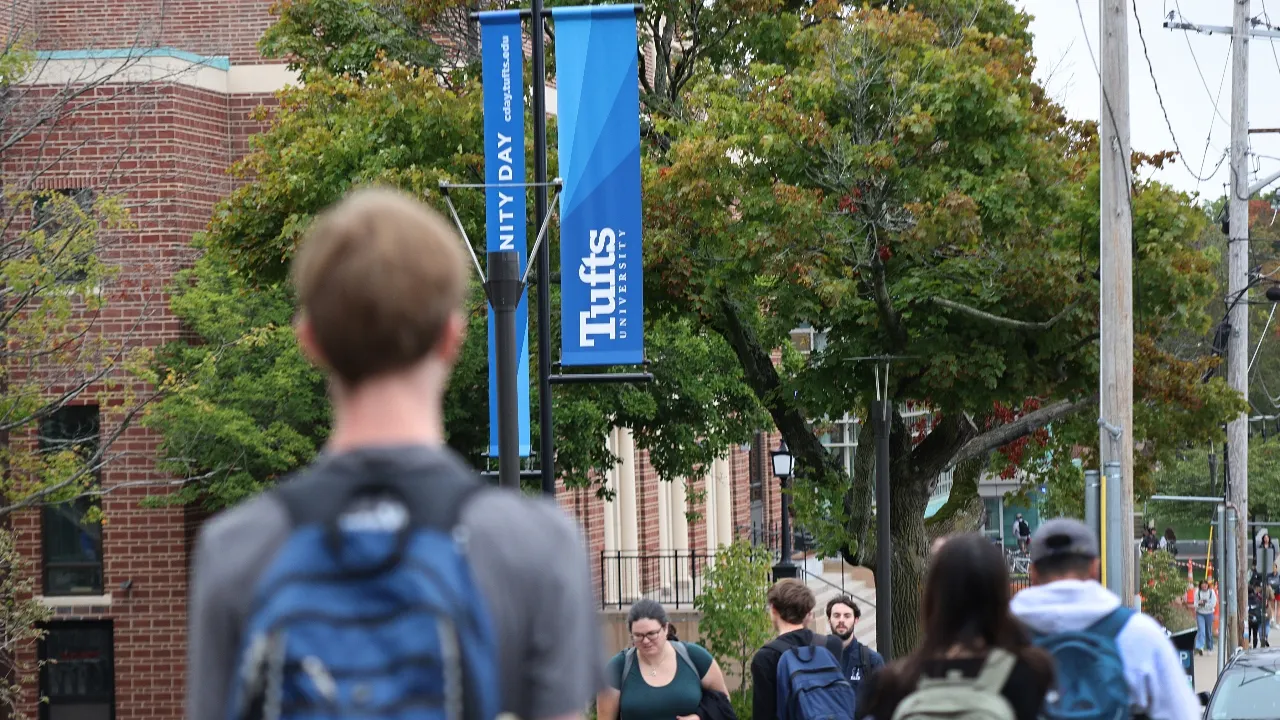
Immigration and Customs Enforcement (ICE) has detained a Tufts University student in Somerville, Massachusetts, according to the agency and a statement from university President Sunil Kumar.
ICE confirmed Rumeysa Ozturk’s detention to Fox News on Wednesday. She is originally from Turkey.
“We have received reports that an international graduate student was taken into custody this evening by federal authorities outside an off-campus apartment building in Somerville,” Kumar said in a statement. “The university had no pre-knowledge of this incident and did not share any information with federal authorities prior to the event, and the location where this took place is not affiliated with Tufts University.”
Kumar noted that the school was told Ozturk’s visa had been terminated, and the university is looking into “whether that information is true.”
COLUMBIA UNIVERSITY STUDENT PROTESTER SUES TRUMP ADMIN TO PREVENT DEPORTATION
Immigration and Customs Enforcement officials have arrested a Tufts University graduate student. (Suzanne Kreiter/The Boston Globe)
“The university has no additional information at this time about the cause or circumstances of the student’s apprehension and is attempting to learn more about the incident,” Kumar said. “Following university protocol, the Office of University Counsel will assist in connecting the student to external legal resources should the individual request our assistance.”
The legal team representing Ozturk told Fox News she had a valid F-1 visa status prior to her arrest. They also said no charges have been filed against their client and are demanding her release.
IVY LEAGUE ANTI-ISRAEL RINGLEADER MAHMOUD KHALIL WITHHELD DETAILS OF FOREIGN TIES FROM VISA APPLICATION: FEDS
“Rumeysa was heading to meet with friends to break her Ramadan fast on the evening of March 25th when she was detained near her home in Somerville, MA by DHS agents,” Khanbabai Immigration Law told Fox News in a statement. “We are unaware of her whereabouts and have not been able to contact her. No charges have been filed against Rumeysa to date that we are aware of.”
The legal team representing Rumeysa Ozturk told Fox News she had a valid F-1 visa status prior to her arrest. (Suzanne Kreiter/The Boston Globe)
On Tuesday night, U.S. District Court Judge Indira Talwani granted a habeas petition from Ozturk’s lawyers requesting she not be removed out of the District of Massachusetts.
The lawyers say no charges have been filed against her at this time and demand her release. The legal teams say Ozturk has not been disciplined for any involvement in campus protests but would not say if she has participated in pro-Palestinian campus protests.
VIDEO SHOWS ARREST OF COLUMBIA ANTI-ISRAEL RINGLEADER MAHMOUD KHALIL
“We hope Rumeysa will be released immediately. Those who wish to support Rumeysa are welcome to attend a rally this evening in Somerville,” the Wednesday statement continued.
A rally will be held for Rumeysa Ozturk on Wednesday night, according to her legal team. (Suzanne Kreiter/The Boston Globe)
In March of last year, Ozturk co-authored an op-ed in the Tufts Daily, a student newspaper, taking issue with the university’s response to several resolutions passed by the Tufts Community Union Senate on March 4, 2024, writing, “demanding that the University acknowledge the Palestinian genocide, apologize for University President Sunil Kumar’s statements, disclose its investments and divest from companies with direct or indirect ties to Israel.”
Ozturk was a medical graduate student at the Tufts University Eliot-Pearson Department of Child Study and Human Development.
President Donald Trump on Jan. 30 signed an executive order to cancel the student visas of Hamas sympathizers on college campuses.
President Donald Trump, right, and Israeli Prime Minister Benjamin Netanyahu meet at the White House in Washington, D.C., Feb. 4, 2025. (Anna Moneymaker/Getty Images)
Executive Order 13899 aims to combat the “unprecedented wave of vile anti-Semitic discrimination, vandalism, and violence against our citizens, especially in our schools and on our campuses,” since Oct. 7, 2023, when Hamas attacked Israel, sparking the beginning of a 15-month war that has left tens of thousands of people dead.
“To all the resident aliens who joined in the pro-jihadist protests, we put you on notice: come 2025, we will find you, and we will deport you,” the president said in a Jan. 30 fact sheet on the executive order. “I will also quickly cancel the student visas of all Hamas sympathizers on college campuses, which have been infested with radicalism like never before.”
Hamas is a designated terrorist organization that the Department of National Intelligence describes as “the largest and most capable militant group in the Palestinian territories and one of the territories’ two major political parties.”
Hamas terrorists watch as four hostages are released to the Red Cross as part of a ceasefire deal between Israel and Hamas. (TPS-IL)
The Trump administration has also rescinded federal grants from Columbia University over its alleged failure to address antisemitism on campus.
“We realize that tonight’s news will be distressing to some members of our community, particularly the members of our international community,” Kumar said in his statement. “We will continue to provide information, support, and resources in the days ahead as more details become available to us.”
The cost of attendance at Tufts, before financial aid, is listed as between $80,000 and $90,000 on the university’s website.
Tufts is receiving $115.2 million in funds from the National Institutes of Health as of fiscal year 2025, the university’s website says, including $88.3 million in direct costs and $26.9 million in facilities and administrative costs.
Fox News’ Andrew Fone contributed to this report.
Read the full article from Here


Health
Massachusetts health officials have confirmed the state’s first two measles cases of the year, a school-aged child and a Greater Boston adult.
The Department of Public Health announced the cases Friday, marking the first report of measles in Massachusetts since 2024.
According to health officials, the adult who was diagnosed returned home recently from abroad and had an “uncertain vaccination history.” While infectious, the person visited several locations where others were likely exposed to the virus, and health officials said they are working to identify and notify anyone affected
The child, meanwhile, is a Massachusetts resident who was exposed to the virus and diagnosed with measles out-of-state, where they remain during the infectious period. Health officials said the child does not appear to have exposed anyone in Massachusetts to measles.
The two Massachusetts cases come as the U.S. battles a large national measles outbreak, which has seen 1,136 confirmed cases nationwide so far in 2026, according to the Centers for Disease Control and Prevention.
“Our first two measles cases in 2026 demonstrate the impact that the measles outbreaks, nationally and internationally, can have here at home,” Massachusetts Public Health Commissioner Robbie Goldstein said Friday. “Fortunately, thanks to high vaccination rates, the risk to most Massachusetts residents remains low.”
Measles is a highly contagious disease that spreads through the air when an infected person sneezes, coughs, or talks. The virus can linger in the air for up to two hours and may even spread through tissues or cups used by someone who has it, according to the DPH.
Early symptoms occur 10 days to two weeks after exposure and may resemble a cold or cough, usually with a fever, health officials warned. A rash develops two to four days after the initial symptoms, appearing first on the head and shifting downward.
According to the DPH, complications occur in about 30% of infected measles patients, ranging from immune suppression to pneumonia, diarrhea, and encephalitis — a potentially life-threatening inflammation of the brain.
“Measles is the most contagious respiratory virus and can cause life-threatening illness,” Goldstein said. “These cases are a reminder of the need for health care providers and local health departments to remain vigilant for cases so that appropriate public health measures can be rapidly employed to prevent spread in the state. This is also a reminder that getting vaccinated is the best way for people to protect themselves from this disease.”
According to the DPH, people who have had measles, or who have been vaccinated against measles, are considered immune. State health officials offer the following guidance for the Measles-Mumps-Rubella (MMR) vaccine:

Get everything you need to know to start your day, delivered right to your inbox every morning.

It’s a scheme made famous by a nearly 30-year-old episode of the sitcom Seinfeld.
Hoping to earn a quick buck, two characters load a mail truck full of soda bottles and beer cans purchased with a redeemable 5-cent deposit in New York, before traveling to Michigan, where they can be recycled for 10 cents apiece. With few thousand cans, they calculate, the trip will earn a decent profit. In the end, the plan fell apart.
But after Connecticut raised the value of its own bottle deposits to 10 cents in 2024, officials say, they were caught off guard by a flood of such fraudulent returns coming in from out of state. Redemption rates have reached 97%, and some beverage distributors have reported millions of dollars in losses as a result of having to pay out for excess returns of their products.
On Thursday, state lawmakers passed an emergency bill to crack down on illegal returns by increasing fines, requiring redemption centers to keep track of bulk drop-offs and allowing local police to go after out-of-state violators.
“I’m heartbroken,” said House Speaker Matt Ritter, D-Hartford, who supported the effort to increase deposits to 10 cents and expand the number of items eligible for redemption. “I spent a lot of political capital to get the bottle bill passed in 2021, and never in a million years did I think that New York, New Jersey and Rhode Island residents would return so many bottles.”
The legislation, Senate Bill 299, would increase fines for violating the bottle bill law from $50 to $500 on a first offense. For third and subsequent offenses, the penalty would increase from $250 to $2,000 and misdemeanor punishable by up to one year in prison.
In addition, it requires redemption centers to be licensed by the state’s Department of Energy and Environmental Protection (previously, those businesses were only required to register with DEEP). As a condition of their license, redemption centers must keep records of anyone seeking to redeem more than 1,000 bottles and cans in a single day.
Anyone not affiliated with a qualified nonprofit would be prohibited from redeeming more than 4,000 bottles a day, down from the previous limit of 5,000.
The bill also seeks to pressure some larger redemption centers into adopting automated scanning technologies, such as reverse vending machines, by temporarily lowering the handling fee that is paid on each beverage container processed by those centers.
The bill easily passed the Senate on Wednesday and the House on Thursday on its way to Gov. Ned Lamont.
While the bill drew bipartisan support, Republicans described it as a temporary fix to a growing problem.
House Minority Leader Vincent Candelora, R-North Branford, called the switch to 10-cent deposits an “unmitigated disaster” and said he believed out-of-state redemption centers were offloading much of their inventory within Connecticut.
“The sheer quantity that is being redeemed in the state of Connecticut, this isn’t two people putting cans into a post office truck,” Candelora said. “This is far more organized than that.”
The impact of those excess returns is felt mostly by the state’s wholesale beverage distributors, who initiate the redemption process by collecting an additional 10 cents on every eligible bottle and can they sell to supermarkets, liquor stores and other retailers within Connecticut. The distributors are required to pay that money back — plus a handling fee — once the containers are returned to the store or a redemption center.
According to the state’s Department of Revenue Services, nearly 12% of wholesalers reported having to pay out more redemptions than they collected in deposits in 2025. Those losses totaled $11.3 million.
Peter Gallo, the vice president of Star Distributors in West Haven, said his company’s losses alone have totaled more than $2 million since the increase on deposits went into effect two years ago. As time goes on, he said, the deficit has only grown.
“We’re hoping we can get something fixed here, because it’s a tough pill to be holding on to debt that we should get paid for,” Gallo said.
Still, officials say they have no way of tracking precisely how many of the roughly 2 billion containers that were redeemed in the state last year were illegally brought in from other states. That’s because most products lack any kind of identifiable marking indicating where they were sold.
“There’s no way to tell right now. That’s one of the core issues here,” said state Rep. John-Michael Parker, D-Madison, who co-chairs the legislature’s Environment Committee.
Parker said the issue could be solved if product labels were printed with a specific barcode or other feature that would be unique to Connecticut. Such a solution, for now, has faced technological challenges and pushback from the beverage industry, he said.
Not everyone involved in the handling, sorting and redemption of bottles is happy about the upcoming changes — or the process by which they were approved.
Francis Bartolomeo, the owner of a Fran’s Cans and Bart’s Bottles in Watertown, said he was only made aware of the legislation on Monday from a fellow redemption center owner. Since then, he said, he’s been contacting his legislators to oppose the bill and was frustrated by the lack of a public hearing.
“I know other people are as flabbergasted as I am because they don’t know where it comes out of,” Bartolomeo said “It’s a one sided affair, really.”
Bartolomeo said one of his biggest concerns with the bill is the $2,500 annual licensing fee that it would place on redemption centers. While he agreed that out-of-state redemptions are a problem, he said it should be up to the state to improve enforcement.
“We’re cleaning up the mess, and we’re going to end up being penalized,” Bartolomeo said. “Get rid of it and go back to 5 cents if it’s that big of a hindrance, but don’t penalize the redemption centers for what you imposed.”
Lynn Little of New Milford Redemption Center supports the increased penalties but believes the solution ultimately lies with better labeling by the distributors. She is also frustrated by the volume caps after the state initially gave grants to residents looking to open their own bottle redemption businesses.
“They’re taking a volume business, because any business where you make 3 cents per unit (the average handling fee) is a volume business, and limiting the volume we can take in, you’re crushing small businesses,” Little said.
Ritter said that he opposed a move back to the 5-cent deposit, which he noted was increased to encourage recycling. However, he said the current situation has become politically untenable and puts the state at risk of a lawsuit from distributors.
“We’re getting to a point where we’re going to lose the bottle bill,” Ritter said. “If we got sued in court, I think we’d lose.”





Exclusive: DeepSeek withholds latest AI model from US chipmakers including Nvidia, sources say


Mother and daughter injured in Taunton house explosion


2026 MHSA Montana Wrestling State Championship Brackets And Results – FloWrestling


Wildfires rage in Oklahoma as thousands urged to evacuate a small city


Wildfire near Gum Swamp Road in Livingston Parish now under control; more than 200 acres burned


10 acres charred, 5 injured in Thornton grass fire, evacuation orders lifted


YouTube TV billing scam emails are hitting inboxes


Stellantis is in a crisis of its own making
