Northeast
Homeless man ‘terrorized’ communities in 2 states after allegedly killing 3 family members during crime spree

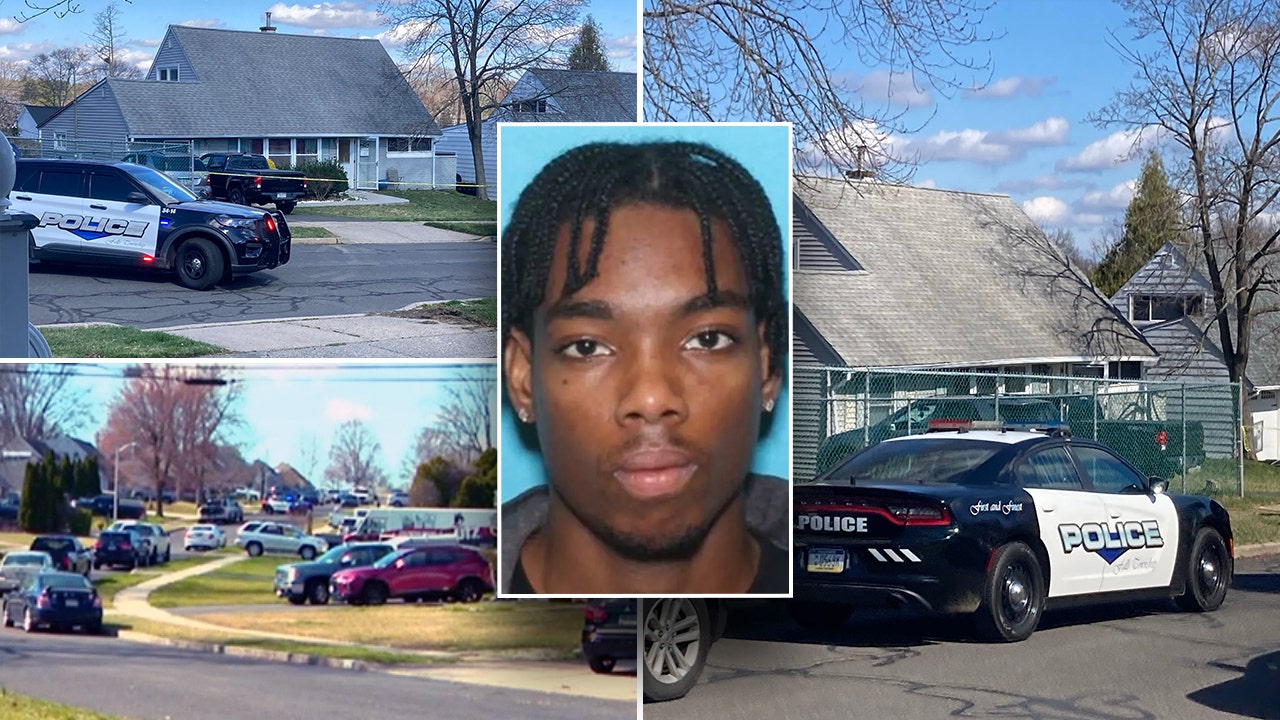
A Fallsington, Pennsylvania homeless man who allegedly killed three people in his home state before fleeing across state lines into New Jersey now faces serious charges, including murder and gun-related crimes, in both states.
Andre Gordon Jr., 26, is accused of shooting and killing his 52-year-old stepmother, Karen Gordon, and 13-year-old sister, Kera Gordon, inside a Falls Township home on Saturday morning. At the time of the shooting, there were three other people inside the home who were able to hide from the alleged gunman.
He then went to another home in the area and allegedly shot and killed 25-year-old Taylor Daniel, who was the mother of his two children. Four others inside the home survived.
One of the survivors, Daniel’s mother, was injured when she was bludgeoned by his gun but is expected to survive, according to Bucks County District Attorney Jennifer Schorn.
3 SHOT DEAD IN PENNSYLVANIA; SUSPECTED GUNMAN ARRESTED
Andre Gordon, 26, is the suspect in shootings that killed three people in Falls Township, Pennsylvania. He is believed to be driving a stolen vehicle, according to police. (Falls Township Police Department)
Officers with the Falls Township Police Department were dispatched to reports of a shooting on Viewpoint Lane in Levittown, Pennsylvania, at about 8:50 a.m. When investigators arrived, they learned Gordon allegedly shot and killed his stepmother and sister, who lived at the residence.
Just after 9 a.m., Gordon went to the second location on Edgewood Lane, where he allegedly shot and killed Taylor, before fleeing the scene.
Nearly 12 minutes later, the suspect is accused of carjacking a victim at gunpoint in the parking lot of a Dollar General on Bristol Pike in Morrisville, Pennsylvania.
PHILADELPHIA DUO FACE CHARGES FOR ALLEGEDLY KILLING MAN AND WOMAN ‘EXECUTION STYLE’: POLICE
A SWAT team is seen at a residence in Trenton, New Jersey where the suspected shooter barricaded himself and took hostages, according to police. (FOX 29 Philadelphia)
The vehicle Gordon stole was a 2016 dark gray Honda CRV with a Pennsylvania license plate, which was located at about 11:40 a.m., unoccupied, on Miller Street in Trenton, New Jersey, police said.
New Jersey Attorney General Matthew J. Platkin said in a press release that Gordon allegedly carjacked a vehicle in Trenton before going to Falls Township and committing the shootings.
When he returned to Trenton, Platkin’s release read, he entered a home on Phillips Avenue and was apprehended on New York Avenue at about 5 p.m.
FBI resources were on standby while the ATF, NJSP, Mercer County Rapid Response Team, and Mercer County Homicide Task Force assisted the Trenton Police Department with apprehending Gordon.
THIRD SUSPECT ARRESTED FOR PHILADELPHIA BUS STOP SHOOTING; FOURTH REMAINS AT LARGE
Police activity along Viewpoint Lane in Falls Township March 16. A shooting canceled events and closed businesses in the Levittown area on Saturday.
“The string of violent acts that took place yesterday, allegedly at the hands of a single armed individual, alarmed and terrorized communities in Bucks and Mercer counties,” Platkin said. “It is the latest in a horrific litany of illustrations of how illegal guns and assault rifles can empower one aggrieved and disturbed actor to do immense damage and leave a trail of tragedies in their wake.”
Pennsylvania authorities charged Gordon with three counts each of first- and second-degree murder; two counts of burglary of overnight accommodations resulting in bodily injury; two counts of aggravated assault; robbery of a motor vehicle; unlawful restraint of a minor or parent; discharging a firearm into an occupied structure; theft; unlawful restraint; possession of an instrument of crime; making a terroristic threat; simple assault; and eight counts of recklessly endangering another person.
In New Jersey, he faces a whole slew of other charges including first-degree carjacking; second-degree possession of a weapon for an unlawful purpose; second-degree unlawful possession of an assault firearm; third-degree unlawful possession of a firearm without a serial number; third-degree receiving stolen property; fourth-degree unlawful possession of large-capacity ammunition magazines; and fourth-degree possession of hollow-point ammunition.
PHILADELPHIA POLICE ARREST TWO 18-YEAR-OLDS IN CONNECTION TO SEPTA BUS STOP SHOOTING, INJURING 8 STUDENTS
A map showing where Falls Township, Pennsylvania is located. (Fox News)
“Yesterday’s events are a profound tragedy and a shock that instilled fear in many residents in two states,” J. Stephen Ferketic, director of the New Jersey Division of Criminal Justice said. “Thankfully, they ended with the apprehension of the suspect without further gunfire. We will work closely with our partners in Bucks County to ensure that the defendant answers for his alleged crimes in both Trenton and Falls Township.”
Gordon is currently being held at the Mercer County Correction Center.
The Bucks County St. Patrick’s Day Parade was canceled due to the shelter-in-place order and several local businesses were temporarily closed, FOX 29 Philadelphia reported.
CLICK TO GET THE FOX NEWS APP
Falls Township is located about 28 miles northeast of Philadelphia.
Fox News Digital’s Chris Pandolfo and Brie Stimson contributed to this report.
Read the full article from Here


Come February a former New York Yankees first-round draft pick, will get a chance to prove himself to their longtime rivals.
Left-hander T.J. Sikkema, 27, is one of seven non-roster invitees to Red Sox spring training, the club announced Tuesday.
Catcher Jason Delay, infielder Vinny Capra, lefty Alec Gamboa, and right-handers Osvaldo Berrios, Hobie Harris and Devin Sweet round out the group.
The Yankees drafted Sikkema 38th overall in the ‘19 draft. He was one of three minor league pitchers they dealt to the Kansas City Royals for former Red Sox star Andrew Benintendi at the ‘22 MLB trade deadline.
Sikkema spent the last two years in the Cincinnati Reds organization. Last year he reached Triple-A for the first time, and pitched to a 3.47 ERA over five games (four starts) with nine earned runs allowed over 23.1 innings, following the late-August promotion.
While the Red Sox had a top-ranked farm system last year, their catching depth is notoriously thin. Delay, 30, has 134 games of big-league experience with the 2022-24 Pittsburgh Pirates, including 131 behind the dish, a career .231/.333/.400 line in the majors. He spent last season with the Double-A and Triple-A levels of the Atlanta Braves organization.
Capra, 29, appeared in 47 major league games last season, 24 with the Milwaukee Brewers and 23 with the Chicago White Sox. Since his debut with the ‘22 Toronto Blue Jays, he has played 67 big-league games over the last four years.
Though a lifetime .133/.181/.188 hitter in the majors, Capra brings defensive versatility to the table. In just 58 fielding games, he has already covered third base, second, shortstop, left and right field, and made three pitching appearances.
Gamboa, 28, comes to the Red Sox after a season split between the Los Angeles Dodgers’ Triple-A Oklahoma City Comets and the Lotte Giants of the Korean Baseball League. He was the Dodgers’ ninth-round pick in ‘19, and owns a 4.23 ERA over 131 career minor league games, including 41 starts.
Berrios is one of several former St. Louis Cardinals who will be in Red Sox camp next month. The Puerto Rico native split last season between Cardinals’ Double-A Springfield and Triple-A Memphis. Working primarily in relief, he logged a 5.12 ERA and struck out 62 over 58 innings (40 games, four starts).
Harris’ name will likely be familiar to Red Sox fans, as he spent all of last season in Triple-A Worcester. The 32-year-old righty posted a 4.05 ERA with 45 strikeouts over 31 relief appearances and one start. He also has 16 games of major league experience, from his time with the ‘23 Washington Nationals.
Like Sikkema, Harris is a former Yankees draft pick; they selected him in the 31st round in 2015.
The Red Sox signed Sweet to a minor league deal last month. He has seven games of big-league experience between the ‘23 Seattle Mariners and then-Oakland Athletics. He spent last season with the Philadelphia Phillies’ Triple-A Lehigh Valley IronPigs, with whom he posted a 5.08 ERA over 46 games, including two starts, and struck out 49 batters in 51.1 innings.
Tumbling from top spot
Entering last spring training, the Red Sox earned the top spot in Baseball America’s farm system rankings for the first time since the publication began their assessments in 1984.
“The Red Sox have returned to the top of the farm system rankings, even after dealing four prospects to the White Sox to bring Garrett Crochet to Boston,” Baseball America’s explanation stated. “No other organization can match the trio of Roman Anthony, Kristian Campbell and Marcelo Mayer, and Boston’s pitching depth has improved as well.”
The publication’s annual Prospect Handbook ranks the Red Sox 14th.
Chalk some of that up to the aforementioned trio making their respective big-league debuts and progressing out of prospect eligibility. Players like Anthony don’t exactly grow on trees.
Other top prospects, like slugging outfielder Jhostynxon Garcia, have since been traded away. (Chief Baseball Officer Craig Breslow has made a staggering 49 trades since taking the reins in November ’23.)
At present, most of Boston’s current top prospects are in the lower levels of the farm system. Three of the organization’s top five on MLB Pipeline are expected to debut in 2027 or later; the exceptions are lefties Payton Tolle (No. 2) and Connelly Early (No.4), who both debuted late last season but remain prospect-eligible.

A puppy is being cared for by the Humane Animal Rescue of Pittsburgh in Homewood after police said his owner zipped him inside a suitcase on Christmas Day.
When you see him, you would never know how his little life got started. The little white dog loves to play and has quickly become a favorite at HARP.
However, nearly two weeks ago, Pittsburgh police said his owner, 56-year-old Jayme White, zipped him inside a suitcase she was carrying on Christmas Day. They said a witness told them she was yelling at the dog and hit it several times before putting it in the bag.
Now White is facing several charges, including animal neglect and public drunkenness.
HARP executive director Dan Cody said animal control brought them the puppy the next morning.
“When the dog arrived, he was in relatively good condition, given the circumstances,” Cody said.
They couldn’t find any signs of physical abuse.
“He was a little bit shy, but he very quickly warmed up,” Cody said.
They believe he’s about two and a half months old now, and expect he’ll be a large breed. Most importantly, they said he’s completely healthy.
“He’s just so energetic and loving,” Cody said.
The Allegheny County District Attorney’s Office told KDKA that White has surrendered custody of the animal to the rescue, so once he’s neutered, microchipped and vaccinated, he should be up for adoption in the coming days.
“We’ll find a great home for him,” Cody said.
While the circumstances remain unclear, Cody hopes this case serves as a reminder that owning a pet comes with a great responsibility.
“If you do know someone who is struggling or needs help, we are a place where you can come for resources,” Cody said.
White is now out of jail after a judge ruled she get a mental health evaluation. Her preliminary hearing is set for April.
Connecticut
State opens investigation into former New Haven police chief amid stolen money allegations

Connecticut State Police and the Chief State’s Attorney have opened an investigation into former New Haven Police Chief Karl Jacobsen and allegations that he misused public funds.
The City of New Haven reported the allegations to State’s Attorney John Doyle on Monday.
New Haven Mayor Justin Elicker said Monday Jacobson admitted to stealing money from a fund used by the New Haven Police Department to pay for an support its confidential informant program.
Several officers flagged irregularities in the account and notified the three assistant chiefs in the department, according to Elicker. It was then that the assistant chiefs confronted Jacobson on Monday morning.
Elicker said after being confronted, Jacobson admitted to taking the funds. The assistant chiefs then notified Chief Administrative Officer Justin McCarthy, who then notified Elicker.
Jacobson was called in for a meeting with Elicker, where he was to be placed on administrative leave. Elicker said that before the meeting, Jacobson handed in his paperwork to retire, effective immediately.
The mayor was unable to share additional details on how much money was reportedly taken or for how long due to the ongoing investigation.
Assistant Chief David Zannelli has been appointed as the acting police chief.
State police will conduct the investigation and Chief State’s Attorney Patrick Griffin has appointed New Britain Judicial District State’s Attorney Christian Watson to oversee the investigation to avoid any potential conflicts of interest.

The first Detroit Lions OC candidate has emerged

San Francisco has a tax plan to save Muni

Dallas County eyes new multibillion-dollar jail to replace aging Lew Sterrett facility

Miami Heat-Minnesota Timberwolves Final Injury Update: Anthony Edwards’ status divulged

Ex-Yankees 1st-rounder among non-roster invitees to Red Sox spring training

Florida High School Football Rankings: Top 25 teams – Oct. 21

Cleary's 21 help Le Moyne down Central Connecticut State 69-64 in OT

How old is Bo Nix? What to know about Oregon quarterback ahead of 2024 NFL Draft

99th annual Pony Swim held in Virginia

Video: ‘It Didn’t Have to Happen This Way:’ U.Va. Faculty Call for Review of Police Response to Protests

Video: Nvidia Shows Off New A.I. Chip at CES

Pelosi heir-apparent calls Trump’s Venezuela move a ‘lawless coup,’ urges impeachment, slams Netanyahu

EU Commission examines childlike sexual images created by Musk’s AI

Lawmakers split over Maduro’s seizure. And, CDC cuts childhood vaccine schedule

Federal officials to halt more than $10B in funding to 5 states over non-citizen benefit concerns: report
-

 World1 week ago
Hamas builds new terror regime in Gaza, recruiting teens amid problematic election
-
 News1 week ago
For those who help the poor, 2025 goes down as a year of chaos
-
 Business1 week ago
Instacart ends AI pricing test that charged shoppers different prices for the same items
-

 World1 week ago
Podcast: The 2025 EU-US relationship explained simply
-
 Business1 week ago
Apple, Google and others tell some foreign employees to avoid traveling out of the country
-

 Technology1 week ago
ChatGPT’s GPT-5.2 is here, and it feels rushed
-

 Health1 week ago
Did holiday stress wreak havoc on your gut? Doctors say 6 simple tips can help
-

 Politics1 week ago
‘Unlucky’ Honduran woman arrested after allegedly running red light and crashing into ICE vehicle