Northeast
Gilgo Beach suspect Rex Heuermann loses bid to toss DNA evidence at upcoming murder trial


NEWYou can now listen to Fox News articles!
Suspected Gilgo Beach serial killer Rex Heuermann lost a long shot bid to have damning DNA evidence thrown out Wednesday, after a New York judge ruled that prosecutors can use the evidence against him at trial in a decision police expect to impact far more cases.
Heuermann’s shocking arrest came more than a decade after the death of his last known alleged victim. At the time, he was a New York City architect who commuted daily from his home in the suburban village of Massapequa Park. Prosecutors have alleged he tortured and killed his victims in the basement while his wife and children took vacations.
The sides had been tangling over the evidence since March, when the judge held a Frye hearing to determine whether a new type of DNA testing should be admissible. Heuermann’s attorney, Michael Brown, questioned the validity of new testing on rootless hair samples, which he likened to “magic” and said had not been used in New York state before.
Prosecutors allege that the state-of-the-art technology linked hairs found on six of the seven murder victims to Heuermann. Brown said it’s “a little weird” that each of the bodies is linked to his client by just one hair apiece. The hairs themselves do not all belong to Heuermann. Some were linked to his wife and daughter, whom authorities do not believe were involved in the crimes but whose hairs were allegedly transferred to the victims by Heuermann.
KOHBERGER PROSECUTOR REVEALS CRUCIAL MOMENT: ‘EVERYTHING HINGED ON THAT ARGUMENT’
Alleged serial killer Rex A. Heuermann is escorted into Judge Tim Mazzei’s courtroom at Suffolk County Court in Riverhead for a Frye hearing in Riverhead, N.Y. July 17, 2025. (James Carbone/Pool/Getty Images)
Judge Timothy Mazzei ruled that the new testing is accepted by the scientific community and therefore valid as evidence.
“This case was very aggressively and effectively litigated by both sides,” Suffolk County District Attorney Ray Tierney told reporters after the hearing. “I think that the reason why we were able to prevail was one simple reason: The science was on our side.”
Tierney called it a “significant step” in forensic DNA analysis and said it looks at hundreds of thousands more points of data than traditional DNA testing, and he said the new method is already being rolled out to county cold case detectives, like any other new law enforcement technology.
FOLLOW THE FOX TRUE CRIME TEAM ON X
“When you look at old cases that happened that have remained unsolved for whatever reason, one of the first things you do, whether it’s phone evidence, whether it’s DNA evidence, whether it’s anything else, you know, new technology [can] help us to gather more information,” he said.
John Ramsey, the father of 1996 cold case murder victim JonBenet Ramsey, weighed in on the Gilgo case and the new DNA method in Denver at CrimeCon’s 2025 conference Saturday. He said he had already asked police handling his daughter’s case to try the new method.
“This is 21st century technology that should be used, and I expressed that strongly,” he said.
Joseph Giacalone, a retired NYPD cold case investigator and a professor of criminal justice at Penn State Lehigh Valley, called the judge’s decision in the Gilgo case “awesome news.”
“This DNA is leading the way to closing more cases,” he told Fox News Digital. Although he expects an appeal if Heuermann is convicted.
REX HEUERMANN’S FAMILY KEPT GRUESOME PIECE OF EVIDENCE, SOURCE SAYS
Crime scene investigators use metal detectors to search a marsh for the remains of Shannan Gilbert, Dec. 12, 2011 in Oak Beach, N.Y. Her disappearance led to the discovery of 11 bodies and kicked off the investigation into the so-called Gilgo Beach serial killings. (James Carbone/Newsday via AP, Pool, File)
The hearing
Heuermann entered the courtroom at 9:54 a.m. wearing a black suit, blue shirt and a green tie, looming over his attorney as the judge rendered his decision.
His ex-wife, Asa Ellerup, who divorced him after the charges but has publicly maintained she doesn’t believe he could’ve committed the crimes, sat quietly in the gallery. Their daughter, Victoria Heuermann, did not attend Wednesday’s hearing.
Prosecutors said Heuermann killed seven women over a period of at least two decades, dumping most of their remains on a remote parkway near Long Island’s Gilgo Beach. Some victims were dismembered, with parts of their bodies recovered from wooded areas about 50 miles to the east.
EX-WIFE OF ALLEGED GILGO BEACH KILLER STILL DEFENDS HIM, BUT DAUGHTER SAYS HE ‘MOST LIKELY’ DID IT
Rex A. Heuermann appears in Judge Tim Mazzei’s courtroom with his lawyer Michael Brown for a conference in Riverhead, N.Y., Oct. 16, 2024. (Newsday/James Carbone)
The oldest case in which he’s been charged was a cold case murder stretching back to 1993. The alleged crimes include torture and mutilation, and Heuermann allegedly took notes on the crimes, the targets and measures to avoid detection.
The victims were all described as “petite” women, most of them around 5 feet tall and barely over 100 pounds. An eyewitness in the case, who was the last to see one of them alive, described Heuermann, whose identity was unknown at the time, as an “ogre” driving a Chevrolet Avalanche.
SIGN UP TO GET THE TRUE CRIME NEWSLETTER
The Gilgo Four, clockwise from top left: Maureen Brainard-Barnes, Melissa Barthelemy, Megan Waterman and Amber Costello. The background shows a wooden cross in the marsh next to Gilgo Beach, N.Y., where their remains were found in the brush just yards from Ocean Parkway. (Suffolk County Police Department/Mega for Fox News Digital)
On July 13, 2023, Suffolk County police arrested Heuermann, who is 61, outside his Manhattan office in three cold case murders — the deaths of Melissa Barthelemy, 24, Megan Waterman, 22, and Amber Costello, 27, in 2010.
SUSPECTED SERIAL KILLER REX HEUERMANN CHARGED WITH SEVENTH SLAYING
Jessica Taylor, left, and Valerie Mack, right, were both murdered and dismembered. Suffolk County police discovered partial remains of each victim in both Manorville, N.Y., and along a stretch of Ocean Parkway near Gilgo Beach. (Suffolk County Police Department/Handout)
Over the next 12 months, they tacked on charges in four additional slayings. First, they charged him with killing Maureen Brainard-Barnes, 25, whose remains were near the other three. They filed charges for the alleged murders of Jessica Taylor in 2003 and Sandra Costilla in 1993. Then they added charges in the 2000 murder of Valerie Mack, a 24-year-old from Philadelphia.
Heuermann pleaded not guilty to all the charges.
But Tierney said his office has a lot of evidence prosecutors are ready to introduce at trial.
GET REAL-TIME UPDATES DIRECTLY ON THE TRUE CRIME HUB
“So, we now have nuclear DNA. We have mitochondrial DNA. We have phone records. We have witness statements. We have financial records. We have internet searches. We have phone activity. And we have other [evidence],” he told reporters. “When you look at the interaction of all of that evidence, it’s, we would submit, compelling.”
Next up for Heuermann is a hearing on whether he should be tried on all the cases together. His lawyer wants them split up, but Tierney said he believes they are all “intertwined” and should be tried at the same time.
It was the disappearance of another woman that set off the whole case and surprised the residents of Long Island, which includes the two easternmost boroughs of New York City and a pair of suburban counties.
In 2010, Shannan Gilbert placed a frantic and incoherent 911 call, begging for help and claiming someone was after her. The search for her went on for months. And before police found her remains, they found 10 other bodies along Ocean Parkway. Her death is the only one that police have said they believe was accidental.
Read the full article from Here



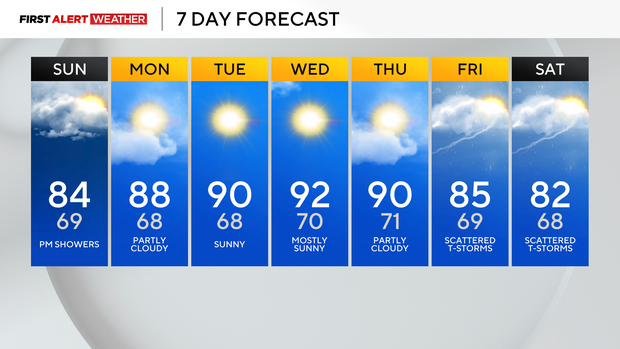
Today we are seasonable with partly cloudy skies and highs in the mid-80s.
There are a few isolated showers this afternoon and evening, but not a washout, and nothing severe is expected.
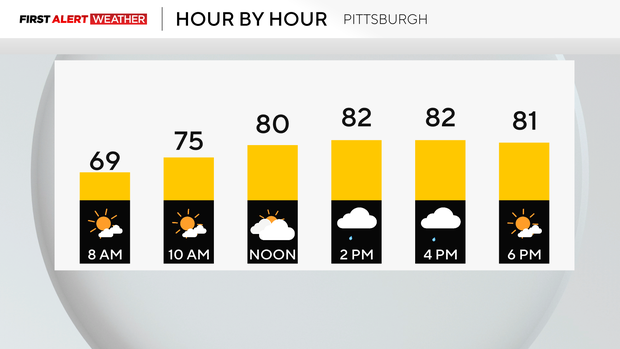
Most will be mainly dry, and the dry weather carries into the week with highs near 90 and plenty of sunshine.
Hourly Conditions:
- 9 a.m.: 74° Mostly Sunny
- Noon: 80° Mostly Cloudy
- 3 p.m.: 82° Showers
- 6 p.m.: 81° Mostly Sunny
We could see our 6th 90-degree day of the year on Tuesday, with two more following through Thursday, plus it could feel in the triple digits for some areas. Wednesday will be the hottest!
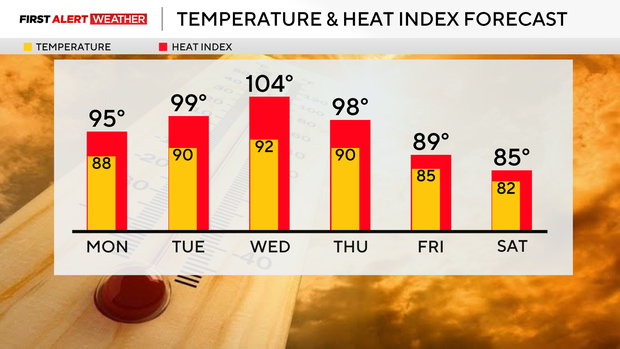
Our next best chance of rain and storms is Friday and throughout the weekend!

Chip Rubenstein, owner of Chip’s Auto Sales of Milford, says he’s honored to celebrate the dealership’s 50th anniversary alongside America’s 250th birthday.
“I opened Chip’s Auto Sales in 1976, during a chaotic time for our nation in the world,” said Rubenstein, “50 years later, I am so proud of the legacy I’ve created as somebody who always tried his best to do right, and to serve my community proudly.”
-

 World5 minutes ago
‘Coalition of the Willing’ leaders to meet in Paris on Monday
-

 News30 minutes ago
Mexico-US relations are already strained, but experts say they’re about to get worse | CNN
-

 Los Angeles, Ca2 hours ago
Rosemead High School student identified as teen stabbed to death in El Monte
-

 Detroit, MI2 hours ago
Three dead in Metro Detroit mall shootings in eight days: What we know
-
San Francisco, CA2 hours ago
I’m a writer who left LA for an AI startup in San Francisco. It was like stepping into a whole new world.
-

 Dallas, TX2 hours ago
Dallas weather: Widespread thunderstorms bring flash flood risks and brief heat relief
-

 Miami, FL3 hours ago
Why I’m Not Worried About Giannis in Miami
-

 Boston, MA3 hours ago
Gallery: Tall ships display their splendor at Sail Boston


