
Connect with us

Northeast

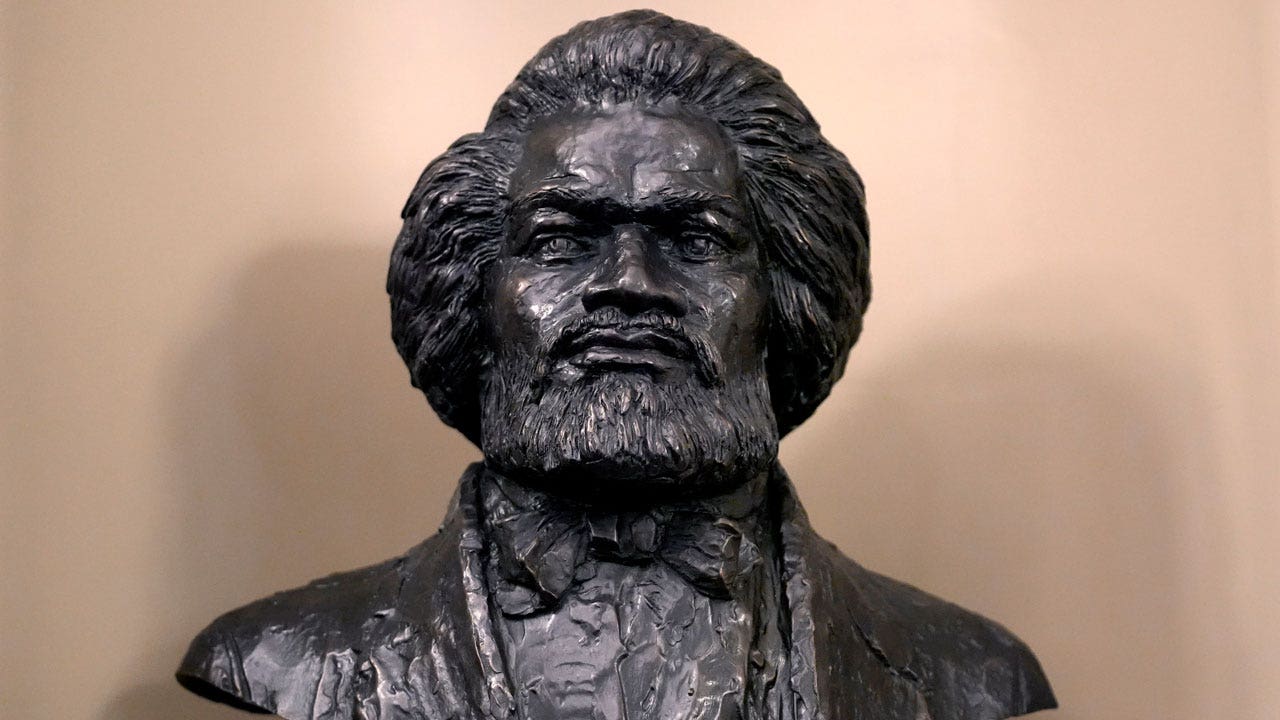
Frederick Douglass bust unveiled in Massachusetts Statehouse

Published

on

Frederick Douglass bust unveiled in Massachusetts Statehouse

A bust of famed abolitionist Frederick Douglass was unveiled in the Massachusetts Senate Chamber on Wednesday, the first bust of an African American to be permanently added to the Massachusetts Statehouse.

It’s also the first bust to be added to the Senate Chamber in more than 125 years.

Senate President Karen Spilka emphasized the ties that Douglass — who lived for a time in the state and delivered speeches in the Senate chamber and at Boston’s Faneuil Hall — had to Massachusetts.

MASSACHUSETTS RESIDENT CONDEMNS RIGHT-TO-SHELTER LAW TURNING BAY STATE INTO ‘DESTINATION FOR MIGRANTS’

“Though he was not born here, in Massachusetts we like to call Frederick Douglass one of our own,” she said. “He came to our state after escaping enslavement. This is where he wanted to come.”

Advertisement

Douglass also first heard news of President Abraham Lincoln’s Emancipation Proclamation while in Boston, she said.

With the bust, Douglass takes his place as a founding father in the chamber and offers some balance in a Statehouse which honors people who are predominantly white, leaving out the stories of countless people of color, Spilka said.

A bust of famed abolitionist Frederick Douglass, by artist Lloyd Lillie, is seen here in the Senate Chamber after being unveiled during ceremonies on Feb. 14, 2024, at the Massachusetts Statehouse in Boston. Mass. (AP Photo/Steven Senne)

Noelle Trent, president of the Museum of African American History in Boston, also emphasized the connections Douglass had to the state.

“It is here where he would write his groundbreaking book the ‘Narrative of the Life of Frederick Douglass, An American Slave,’” she said. “It is here where he would begin his career as one of the most renowned orators of the 19th century.”

Advertisement

Senate leaders chose February 14 to unveil the bust. With the true date of his birth unknown, Douglass opted to celebrate February 14 as his birthday. A quote by Douglass – “Truth, justice, liberty, and humanity will ultimately prevail” – adorns one wall of the chamber.

Other states have recognized Douglass.

In 2020, Chicago renamed a sprawling park on the city’s West Side after Douglass and his wife, Anna Murray-Douglass. Earlier that year, county lawmakers voted to rename the airport in Rochester, New York, after Douglass. Also in 2020, Maryland unveiled bronze statues of Douglass and Harriet Tubman in the Maryland State House.

Douglass was born into slavery in Maryland in February 1818. His mother died when he was young and he never knew his father. Barred from attending school, Douglass taught himself to read and, in 1838, dressed as a sailor and with the help of a freed Black woman, boarded a train and fled north to New York City.

Fearing human traffickers, Douglass, now married to Anna Murray, fled again to New Bedford, Massachusetts, where he gained a reputation as an orator speaking out against slavery with the Massachusetts Anti-Slavery Society. Abolitionists ultimately purchased his freedom, and the family settled in Rochester, New York.

Advertisement

In 1845 in Boston, Douglass published his experiences as an enslaved person in his first autobiography, which became a bestseller.

He also embraced the women’s rights movement, helped formerly enslaved people fleeing to freedom with the Underground Railroad, and bought a printing press so he could run his own newspaper, The North Star.

In 1855, he published his second autobiography, “My Bondage and My Freedom.”

During the Civil War, Douglass recruited Black men to fight for the Union, including two of his sons who served in the 54th Massachusetts Volunteer Infantry Regiment. A memorial to the famed Civil War unit made up of Black soldiers is located directly across the street from the Massachusetts Statehouse.

Advertisement

He met with Lincoln to press for equal pay and treatment for Black troops and pushed to ensure that formerly enslaved people were guaranteed the rights of American citizens during Reconstruction.

He also served in high-ranking federal appointments, including consul general to Haiti from 1889-1891.

Douglass died from a heart attack on Feb. 20, 1895, at age 77.

Read the full article from Here

Advertisement
Continue Reading
Click to comment

Leave a Reply

Your email address will not be published. Required fields are marked *

This site uses Akismet to reduce spam. Learn how your comment data is processed.

Pennsylvania

Pennsylvania House approves bill to restrict cellphones in schools

Published

on

Pennsylvania House approves bill to restrict cellphones in schools


Pennsylvania is another step closer to restricting cellphone usage in schools after the state House passed a bill on a bipartisan vote on Monday, June 1, 2026.

House Bill 1814 would prohibit students in Pennsylvania’s public schools from using or possessing a cellphone during the school day. Under the bill, students would be required to secure their phones in a way that prevents access until the end of the day with exceptions being for certain emergency and medical needs approved by school administrators.

The bill now moves to the Pennsylvania Senate for consideration. The state Senate had previously passed legislation back in 2024 that encouraged school districts in Pennsylvania to start a pilot program that effectively banned cellphone use during the school day in an effort to improve the mental health and academic performance of students.

Governor Josh Shapiro and multiple Pennsylvania educators have also called for restrictions on cellphone usage in schools.

Advertisement

“Our children need this bill,” Rep. Mandy Steele (D-33rd District) said. “It’s taken a lot of hard work to get this bill to this point, but it’s been worth the effort. Research shows that unfettered access to devices is harming our children, and many educators tell me this bill is desperately needed. Governor Shapiro has urged the General Assembly to send him a bill banning cell phones in schools, and I urge the Senate to send this bill to his desk for the benefit of our children.”

Currently, at least 38 states and the District of Columbia restrict cellphone usage in schools, according to Education Week.


Source link

Advertisement
Continue Reading

Rhode Island

Rhode Island Senate approves bill requiring staffed lanes alongside self-checkout

Published

on

Rhode Island Senate approves bill requiring staffed lanes alongside self-checkout


A bill that puts restrictions on self-checkout lanes is headed to the Rhode Island House of Representatives.

The legislation would require grocery stores to have one staffed checkout lane for every three self-checkouts.

The bill was passed by the Rhode Island Senate on May 21.

Senate President Valarie Lawson said it is to help cashiers, as well as customers who may struggle with checking out their groceries, and Rep. Megan Cotter said the bill is about both cashier and customer protection.

Advertisement

Coastal ABC’s Cate Hanewich spoke with customers about the bill. (WJAR)

However, Scott Bromberg, executive director of the Rhode Island Food Dealers Association, sees the bill in a different way.

Bromberg said he does not want limitations on self-checkout, and that consumers want the fast-shopping experience that self-checkout has to offer.

“The way modern consumers shop has changed, and they want a faster checkout,” he said.

However, Cotter claims that consumers want staffed registers.

Advertisement

Bristol resident Alan Gorbutt agrees and said he does not like self-checkout.

“I like the old-fashioned way. Just go to the regular checkout, seeing the regular lady with the happy smile. I get my groceries that way,” Gorbutt said.

Shopper Christine Auserwald said she will go between the two options but has a preference.

“I prefer manual checkout, but if the lines are too long, I do go to self-checkout,” Auserwald said.

Other customers said they only use self-checkout.

Advertisement

“More convenient, I’m mostly, in and out,” one shopper said.

Bromberg also voiced concern that the bill only limits grocery stores.

Customers using the self-checkout lanes. (WJAR)

Customers using the self-checkout lanes. (WJAR)

“Right now, self-checkout is everywhere you can think of. It’s in hardware stores. It’s in pharmacies, dollars stores, craft stores, discount stores. And we just don’t understand why it only applies to grocery stores,” Bromberg said.

However, Cotter said the bill also includes retail stores Target and Walmart.

Advertisement

If passed, Rhode Island would be the first state in the country to have a statewide restriction on self-checkout.


Source link

Continue Reading

Vermont

Debate over ICE masking bill complicates, for a moment, end of session in the Vermont House – VTDigger

Published

on

Debate over ICE masking bill complicates, for a moment, end of session in the Vermont House – VTDigger


Protesters and ICE agents in South Burlington in March 2026. File photo by Glenn Russell/VTDigger

We’re outta here

That’s all, folks.

The Vermont Legislature adjourned for the year, and for the 2025-26 biennium, Friday night. Senators finished up their work just before 6 p.m., and the House followed suit two hours later. I’m not complaining about the time. I was happy, in fact, to be on the road home with a sliver of daylight left.

The House took longer to finish in part because its adjournment got tangled up in a bill, ultimately doomed, that as originally proposed would have barred federal officers such as ICE agents from wearing masks.

The bill, S.208, emerged from a joint House and Senate conference committee Thursday. In order for the latest version of the legislation to be taken up on the floor so soon after, though, the House needed to suspend its rules. Such a procedural move needs three-quarters approval. And while rules suspensions are common late in the session, when it came to taking up S.208 “for immediate consideration,” that was not the case.

Advertisement

House lawmakers voted 81-51 in favor of expediting the bill’s timeline, falling 18 short of the 99 needed to meet the threshold to cast aside the chamber’s rules.

After that, the House took up and passed, with no debate, this year’s budget bill, H.951. Then, House Speaker Jill Krowinski, in her last floor session holding the gavel, brought up the last thing lawmakers had to approve for the year: a resolution formally dictating the terms of adjournment.

But some lawmakers weren’t ready to be done with S.208. Rep. Brian Cina, P/D-Burlington, stood and asked for a roll call vote on the adjournment resolution itself, “due to the important impact of S.208 on our open democracy.” 

His comments mirrored those of several senators earlier in the night who had lamented on the chamber floor how the bill was falling by the wayside. The Senate also adjourned without taking any floor action on the compromise version of S.208.

Ultimately, 15 other House members joined Cina voting against the adjournment resolution in a vote of 114-16. After it was approved, the rest of the formalities of adjournment played out, including a requisite speech from Gov. Phil Scott.

Advertisement

“I’m going to try and make this brief,” the governor said at the outset of his remarks. “I guarantee it’ll take less time than it did to roll call the adjournment address.”

Beyond debate over S.208, adjournment in both chambers was marked by emotional farewell remarks from Krowinski, D-Burlington, and Senate President Pro Tempore Phil Baruth, D/P-Chittenden Central, both of whom aren’t seeking reelection.

Krowinski said her favorite memories from her 14 years in the House have been “the quieter moments most Vermonters never witness,” such as “members helping one another through difficult days, offering support regardless of politics and members coming together to support a colleague through a rough time.”

Baruth at times teared up as he recounted his 16 years in the Senate. And the English professor closed his speech with a nod to some of his favorite literature.

“It will hurt not to find my seat when the bell rings next session,” Baruth said. “But even Frodo Baggins — and you know that ‘The Lord of the Rings’ means everything to me — even Frodo Baggins knew when it was time to follow Bilbo to the Grey Havens.”

Advertisement

OK, our turn now

VTDigger reporters fanned out this session to bring you the news from Montpelier. Clockwise from top left, Shaun Robinson, Ethan Weinstein, Charlotte Oliver and Corey McDonald. File photos by Glenn Russell/VTDigger

Before we go, some thanks are in order. 

Putting together an originally-reported newsletter every day of the session — on top of the traditional news stories our readers expect — is no easy task. While you’re used to seeing my byline, and that of our fearless Statehouse Bureau Chief, Ethan Weinstein, there are a host of others who make this work possible. 

Several other VTDigger reporters took the lead on issues of Final Reading this year, including Charlotte Oliver, Olivia Gieger, Theo Wells-Spackman and Corey McDonald. Meanwhile, ace photographer Glenn Russell captured many of the moments — like this one — that defined this year’s session.

Chad Lorenz, contributing editor on the politics desk, and Ruth Hare, VTDigger’s managing editor, brought their decades of experience and watchful eyes to each day’s newsletter. Noel Clark, VTDigger’s digital editor, and Night Editor Nathan Allen turned the plain text of a Google Doc into the email that landed in your inbox every night. Taylor Haynes, the newsroom’s audience and product director, made sure that email looked as good as it did. 

And of course, we’re grateful to all of you — almost 8,000 subscribers — who turned to this newsletter, and do so year after year, to stay on top of the news under the Golden Dome.

Advertisement

If Final Reading has helped you cut through the noise and understand our government better, please consider supporting VTDigger in an amount that works for you. 

This week, every donation helps fund our reporting and provides a new book to a Vermont child through the Children’s Literacy Foundation. 

Reliable information matters. So does helping young readers discover the power of reading. Today you can support both with one donation. Pretty cool!

— VTD editors

While we’re gone

Even though the legislative session lasts just five months, our coverage of state government and politics is year-round. Your tips and pitches help us find the stories readers care about and that need to be brought to light. So don’t be a stranger, even if it’s just a little harder to reach us than flagging us down in the Statehouse hallways.

Advertisement

Reach me at srobinson@vtdigger.org and Ethan at eweinstein@vtdigger.org. You can send a secure tip on our website here, and find other reporters’ contact information here.

Until next year!

— Shaun Robinson


Source link

Advertisement
Continue Reading
Advertisement

Trending
