Northeast
Frederick Douglass bust unveiled in Massachusetts Statehouse

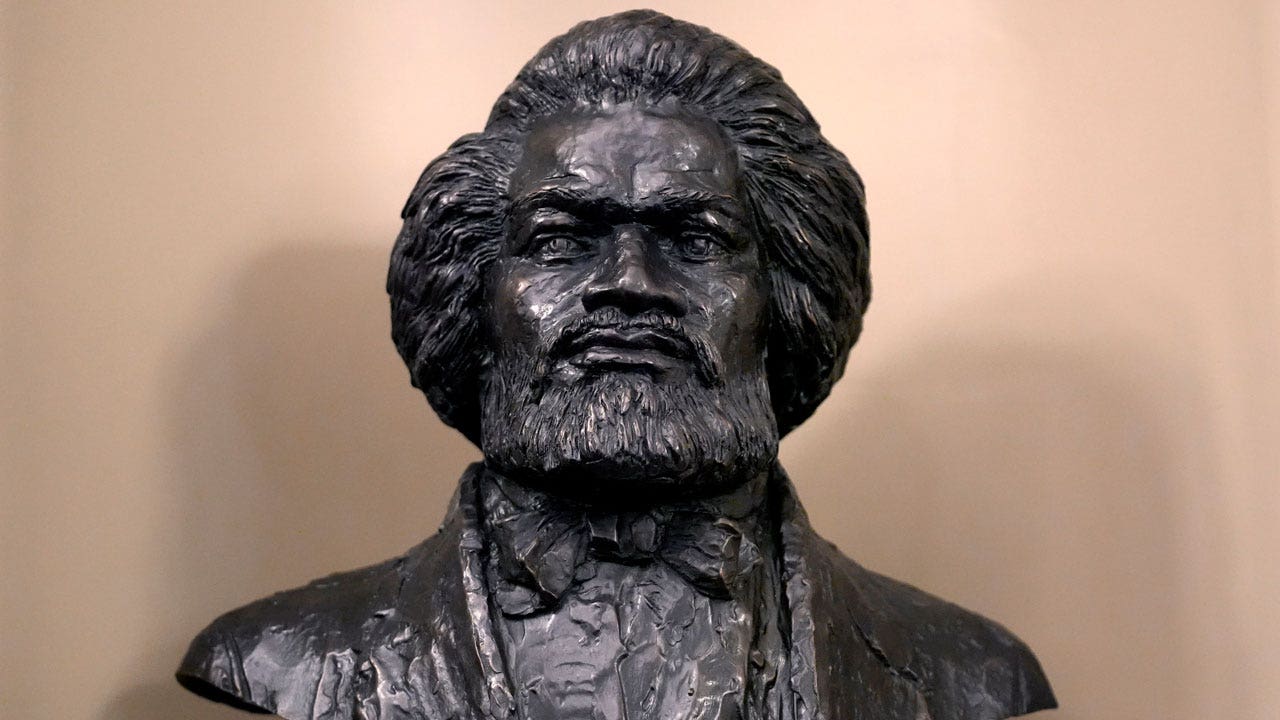
A bust of famed abolitionist Frederick Douglass was unveiled in the Massachusetts Senate Chamber on Wednesday, the first bust of an African American to be permanently added to the Massachusetts Statehouse.
It’s also the first bust to be added to the Senate Chamber in more than 125 years.
Senate President Karen Spilka emphasized the ties that Douglass — who lived for a time in the state and delivered speeches in the Senate chamber and at Boston’s Faneuil Hall — had to Massachusetts.
MASSACHUSETTS RESIDENT CONDEMNS RIGHT-TO-SHELTER LAW TURNING BAY STATE INTO ‘DESTINATION FOR MIGRANTS’
“Though he was not born here, in Massachusetts we like to call Frederick Douglass one of our own,” she said. “He came to our state after escaping enslavement. This is where he wanted to come.”
Douglass also first heard news of President Abraham Lincoln’s Emancipation Proclamation while in Boston, she said.
With the bust, Douglass takes his place as a founding father in the chamber and offers some balance in a Statehouse which honors people who are predominantly white, leaving out the stories of countless people of color, Spilka said.
A bust of famed abolitionist Frederick Douglass, by artist Lloyd Lillie, is seen here in the Senate Chamber after being unveiled during ceremonies on Feb. 14, 2024, at the Massachusetts Statehouse in Boston. Mass. (AP Photo/Steven Senne)
Noelle Trent, president of the Museum of African American History in Boston, also emphasized the connections Douglass had to the state.
“It is here where he would write his groundbreaking book the ‘Narrative of the Life of Frederick Douglass, An American Slave,’” she said. “It is here where he would begin his career as one of the most renowned orators of the 19th century.”
Senate leaders chose February 14 to unveil the bust. With the true date of his birth unknown, Douglass opted to celebrate February 14 as his birthday. A quote by Douglass – “Truth, justice, liberty, and humanity will ultimately prevail” – adorns one wall of the chamber.
Other states have recognized Douglass.
In 2020, Chicago renamed a sprawling park on the city’s West Side after Douglass and his wife, Anna Murray-Douglass. Earlier that year, county lawmakers voted to rename the airport in Rochester, New York, after Douglass. Also in 2020, Maryland unveiled bronze statues of Douglass and Harriet Tubman in the Maryland State House.
Douglass was born into slavery in Maryland in February 1818. His mother died when he was young and he never knew his father. Barred from attending school, Douglass taught himself to read and, in 1838, dressed as a sailor and with the help of a freed Black woman, boarded a train and fled north to New York City.
Fearing human traffickers, Douglass, now married to Anna Murray, fled again to New Bedford, Massachusetts, where he gained a reputation as an orator speaking out against slavery with the Massachusetts Anti-Slavery Society. Abolitionists ultimately purchased his freedom, and the family settled in Rochester, New York.
In 1845 in Boston, Douglass published his experiences as an enslaved person in his first autobiography, which became a bestseller.
He also embraced the women’s rights movement, helped formerly enslaved people fleeing to freedom with the Underground Railroad, and bought a printing press so he could run his own newspaper, The North Star.
In 1855, he published his second autobiography, “My Bondage and My Freedom.”
During the Civil War, Douglass recruited Black men to fight for the Union, including two of his sons who served in the 54th Massachusetts Volunteer Infantry Regiment. A memorial to the famed Civil War unit made up of Black soldiers is located directly across the street from the Massachusetts Statehouse.
He met with Lincoln to press for equal pay and treatment for Black troops and pushed to ensure that formerly enslaved people were guaranteed the rights of American citizens during Reconstruction.
He also served in high-ranking federal appointments, including consul general to Haiti from 1889-1891.
Douglass died from a heart attack on Feb. 20, 1895, at age 77.
Read the full article from Here


Boston Legacy FC vs Utah Royals
Boston Legacy FC vs Utah Royals LIVE GAME: Boston Legacy FC vs Utah Royals look to seize control of thrilling Boston Legacy FC vs Utah Royals. Every team in the Boston Legacy FC vs Utah Royals has two wins apiece as we go into the final two game weeks. Boston Legacy FC vs Utah Royals will host Boston Legacy FC vs Utah Royals at Boston Legacy FC vs Utah Royals Park Stadium with the Boston Legacy FC vs Utah Royals a single point ahead of Boston Legacy FC vs Utah Royals in the standings and just one behind leaders Boston Legacy FC vs Utah Royals.

Spring football may not carry the same weight as the NFL, but it still offers an opportunity for everyone involved. Fans can satisfy the urge to watch the game they love, while players in the United Football League work to earn another shot at the NFL. No one should expect top-tier play from these teams, but the UFL can still deliver compelling storylines.
Several recognizable names will take the field this spring, including personnel with ties to the Pittsburgh Steelers.
One reason or another, things didn’t work out between the Steelers and these members of the UFL, and that’s why they are attempting a comeback. Pittsburgh either cut them or let them go, and few have heard much from these former members of the Steelers since. The United Football League will see them be thrust back into the spotlight in hopes of landing a shot in an NFL training camp.
Fans will witness several Ex-Pittsburgh Steelers making a comeback in the UFL
Benny Snell Jr., RB, Louisville Kings
The name Benny Snell Jr. has disappeared from football conversations in Pittsburgh since he left the team in 2022. A fourth‑round pick in the 2019 NFL Draft, Snell never fully found his footing with the Steelers. He was known as a tough, physical runner who could contribute on special teams, but his role in the NFL rarely extended beyond that.
Snell struggled to make a lasting impact in Pittsburgh, and the UFL now offers him a chance to rebuild his reputation and revive his professional prospects.
Todd Haley, OC, Columbus Aviators
It has been nearly a decade since Todd Haley left the Steelers after his stint as offensive coordinator. His last NFL role came in 2018 with the Browns, and since then, his coaching career has taken a winding path that has included high school football and spring league opportunities. Haley’s role with the Aviators could provide him with a chance to re-enter the NFL coaching conversation.
Anthony McFarland Jr., RB, Birmingham Stallions
Many had high expectations for Anthony McFarland Jr. when the Steelers selected him in the fourth round of the 2020 NFL Draft. His speed stood out immediately, but he struggled to develop into a complete running back. McFarland now enters his second season in the UFL after a solid stretch of production in 2025. He will need to take the next step and show more consistency this spring.
Tre Norwood, S, Birmingham Stallions
Another United Football League veteran with ties to Pittsburgh is Tre Norwood.
A seventh-round pick by the Steelers in the 2021 NFL Draft, Norwood used his positional flexibility to carve out a role early in his career. He now enters his second season with the Stallions after posting modest production last year. If the versatile defensive back hopes to earn another opportunity in the NFL, he will need to make a stronger impact in 2026, particularly by creating turnovers.
Roc Taylor, WR, Columbus Aviators
Fans were hopeful for Roc Taylor after he signed with the Steelers last year as an undrafted free agent. The wide receiver group on the roster lacked depth at the time, but Taylor was unable to make it through training camp. Despite that setback, his talent remains evident, and the UFL may represent his best path forward. Taylor has a valuable opportunity in front of him to take advantage of.

A Bridgeport firefighter is dead after a homicide in Stratford, according to officials.
At approximately 1:44 a.m., the Stratford Police Department responded to a report of a shooting on Feeley Street.
Upon arrival, officers found a male bleeding heavily from a gunshot wound. He was pronounced dead on the scene shortly after by paramedics.
The firefighter was identified as 41-year-old Terrence Cramer of Bridgeport.
Cramer was an active-duty Bridgeport Firefighter for the last 9.5 years.
“Chief Edwards and the Bridgeport Fire Department are aware of the passing of Bridgeport Firefighter Terrence Cramer. We send our heartfelt condolences to the friends and family of Terrence,” said Bridgeport Public Information Officer Shawnna White.
After a brief motor vehicle pursuit, 41-year-old Jabari Bush was taken into custody in Derby at approximately 4:30 p.m. on Saturday.
Earlier in the day, a felony arrest warrant for the murder of Terrence Cramer was charged to Bush.
Bush is charged with Murder, Home Invasion and Criminal Possession of a Firearm.
He is being held on a $2 million court set bond. His court date is issued for March 30, 2026.
The Stratford Police Department was assisted by the New Haven Police Department, the Seymour Police Department, the Shelton Police Department, the Derby Police Department and the Connecticut State Police.

High school baseball and softball: Saturday’s scores
The EU's recipe for trade deals : easy on beef, tough on wine

Photos: ‘No Kings’ protests across the country

Ken Roczen wins second race of 2026 in Detroit, Hunter Lawrence crashes and loses points lead

San Francisco’s 5 Best Affordable Places To Stay On A Tight Budget, According To Guests – Islands

Florida High School Football Rankings: Top 25 teams – Oct. 21

How old is Bo Nix? What to know about Oregon quarterback ahead of 2024 NFL Draft

Cleary's 21 help Le Moyne down Central Connecticut State 69-64 in OT

99th annual Pony Swim held in Virginia

Indiana Members Credit Union announced as new anchor tenant at Bottleworks District
The EU's recipe for trade deals : easy on beef, tough on wine
Photos: ‘No Kings’ protests across the country

Jeffries declines to break with indicted Democrat after ethics panel’s guilty verdict

Hundreds of thousands march through London in stand against the far right

2 students killed, 7 other people injured in Tennessee bus crash during school field trip
-

 Movie Reviews1 week ago
‘Youth’ Twitter review: Ken Karunaas impresses audiences; Suraj Venjaramoodu adds charm; music wins praise | – The Times of India
-

 Sports1 week ago
IOC addresses execution of 19-year-old Iranian wrestler Saleh Mohammadi
-

 New Mexico6 days ago
Clovis shooting leaves one dead, four injured
-

 Tennessee5 days ago
Tennessee Police Investigating Alleged Assault Involving ‘Reacher’ Star Alan Ritchson
-

 Technology7 days ago
YouTube job scam text: How to spot it fast
-

 Minneapolis, MN3 days ago
Boy who shielded classmate during school shooting receives Medal of Honor
-

 Texas1 week ago
How to buy Houston vs. Texas A&M 2026 March Madness tickets
-

 Science1 week ago
Record Heat Meets a Major Snow Drought Across the West