Lifestyle
Toxic Confidence Has Taken Over


Toxic
Confidence
Make way for a new attitude
Everywhere you look these days, the landscape is clogged with confidence men: People with limited experience landing high-ranking government roles. Networks helmed by leaders with scant broadcasting experience. Wellness empires built by entrepreneurs without medical training. An arrogant acquaintance whose presence you find thrilling, maybe.
Perhaps you, too, have noticed the decline in humble brags and performative apologies on social media? A concurrent rise in unshakable self-assurance, unsolicited advice and provocative hot takes? The overqualified don’t hesitate to remind you of their résumé; the underqualified declare themselves authorities; the appropriately qualified claim that their email job is “saving lives.”
If ChatGPT can replace us while insisting that there are only two Rs in the word “strawberry,” it’s no wonder some see the time for a spiky new affect.
“Everyone’s trying influencing; everyone’s paywalling their Substacks,” said Gutes Guterman, 29, a founder of the magazine Byline. “You have to seem like an expert for people to believe in you.”
Amelia Dimoldenberg, a comedian who has made a career out of charming celebrities in her YouTube video series “Chicken Shop Date,” was an early adopter. Deploying the attitude — perhaps the natural register of flirtation — to great effect, she reliably convinces her A-list guests that they are probably a little bit in love with her.
And it has a natural progenitor in drag and hip-hop culture, where reads, diss tracks and storied beefs are founded on inflated egos. It’s the inner voice that drives someone to put out a song titled “I Am a God” and set out to conquer other industries.
Still, it used to be that “impostor syndrome” dominated conversations, the anxious stance of millennials with adult responsibilities and women leading corporate workplaces trying not to rankle. Even if you felt deserving of accolades, the social graces of the time required the expression of modesty.
Now, in an era of aggressively handsome incels and macho political posturing, cultivated humility feels trite. A younger generation, coming out of high school and college in Covid lockdown, feels less beholden to dampening their light. Who has time for affected meekness when playing the braggart not only tickles the soul, but has the potential to convince others of one’s own greatness?
“You’re standing on the ledge, wondering, ‘Should I dive in?’” said the actor and comedian Ivy Wolk on an episode of the popular TikTok show “Subway Takes,” summing up the potential pitfalls of self-doubt. At the same time, she added, other people are coming up behind you “ready to jump.”
Maybe It’s Fun?
It’s partly a product of a new media environment. On platforms like Substack and TikTok, where success relies on convincing others to invest in your singular personality, showing vulnerability or doubt can be risky. Whether it’s posting about a reading series at your local bar or achieving internet notoriety by instructing young men on how to become “gigachads,” these ventures require being bullish on one’s own value.
At its least offensive, toxic confidence is low stakes and entertaining. It’s newsletter writers filling your inbox with unsolicited gift guides and dishy, unedited diary entries. It’s that mediocre actor you barely dated starting a podcast with a paywall and calling herself a political pundit. It is the author Lisa Taddeo directing a post on Instagram to the winners of a fellowship she had been not been granted: “I’ll be watching what you do. I hope it’s better than what I do. But I don’t think it will be. Because what I’m doing is going to be EXCEPTIONAL.”
It’s whatever drives the chaos agents in your orbit to become life coaches.
Perhaps a simple truth is that toxic confidence is charming if you like the person and intolerable if you don’t.
Consider Amanda Frances, a new cast member of “The Real Housewives of Beverly Hills” who has embraced the moniker of “Money Queen” and says she made her fortune selling money manifestation courses.
“I had no formal business experience,” she told her castmate Bozoma Saint John, the first Black C-suite executive at Netflix, over lunch. “I found out I had a gift around, like, the energetic part of money.”
Later, Ms. Saint John gossiped to another castmate, Rachel Zoe, about the interaction: “You’ve never had a job before, so how are you telling people how to get money?”
All of this bravado probably owes something to President Trump, who is known for — among other swaggering displays — using superlatives to boast of his intelligence.
“Nobody knows more about taxes than me, maybe in the history of the world,” he once claimed, for example.
Rarely does Mr. Trump shy from holding forth in speeches and free-associative monologues beyond those typical of presidents. It has become a modus operandi for his administration. Last September, for example, Secretary of Defense Pete Hegseth summoned hundreds of the U.S. military’s top officials to the Marine Corps base in Quantico, Va., for a widely broadcast, in-person meeting.
Highly decorated admirals and generals sat stone-faced as Mr. Hegseth delivered a nearly hourlong speech. He concluded the address by warning enemies abroad with the acronym “FAFO” — language more commonly found in online circles than in formal military settings, roughly translating to “mess around and find out.”
The proclamation was met with minimal audience response — a lonely woo from the crowd — and the assembly was later described as a “waste of time” by former Secretary of Defense Leon Panetta. Senate Democrats estimated the event’s cost at roughly $6 million in taxpayer funds.
Borrowed Ego
If we occasionally find ourselves in the thrall to confidence men, it may be because we desire a bit of what they have.
Looking up to someone bold and brash can give one “that feeling of borrowing ego strength,” said Rachel Easterly, a psychotherapist based in Brooklyn. She referred to narcissism in children, an otherwise normal phase of childhood development.
“It’s very frightening to be a small, helpless person — you’re in a world where you don’t have a lot of power, so you compensate with this defense,” Ms. Easterly said. “It can happen on a societal level.” When Freud, Donald Winnicott and others were developing their theories on why people were drawn to cults of personality, she said, it was “in the context of societal collapse and war.”
“We are feeling similar sorts of existential dread as adults now,” she added, “in terms of nihilism in our culture, climate change, income inequality.”
That may be why so many were drawn to “Marty Supreme,” last year’s blockbuster about a striving table tennis wunderkind, and captivated by Timothée Chalamet’s brashness in promoting it.
“This is probably my best performance, you know, and it’s been like seven, eight years that I feel like I’ve been handing in really, really committed, top-of-the-line performances,” Mr. Chalamet, the film’s lead, said in an interview last year.
“This is really some top-level stuff,” he added, using an expletive.
Mr. Chalamet collected a Golden Globe and a Critics Choice Award for his portrayal of Marty. But by the time the Academy Awards rolled around, he had gotten a bit too comfortable in the culture’s embrace of his toxic confidence, and it quickly turned Icarian.
In a sit-down with the actor Matthew McConaughey, Mr. Chalamet claimed that “no one cares about” opera and ballet. It didn’t seem to occur to him to backtrack or to try to reassure members of those communities of his admiration. Instead, he doubled down, taking aim at artists’ lack of income: “I just lost 14 cents in viewership.”
Punching down is one way to make these high levels of confidence less charming. Those who manage to pull it off tend to be those who are not enjoying their success at another’s expense. Light ribbing is passable.
At the Winter Olympics in Milan, the Chinese freestyle skier Eileen Gu exhibited a bubblier version of toxic confidence as she described what it was like to be inside her own head (“not a bad place to be”) and what she would tell her younger self (“I would love me, and that’s the biggest flex of all time”). She was also honest about the intensive routines she maintains so that she can compete in the Olympics, study quantum physics at Stanford and model with IMG — and the enormous pressure she puts on herself to keep it all up.
That makes it difficult to argue that moments like this are unearned: After winning gold in the women’s halfpipe and two additional silver medals this winter, a reporter asked if she considered her achievements “two silvers gained” or “two golds lost.”
She broke into laughter: “I am the most decorated female free skier in history.”
Don’t Be Coy
For those who aren’t multihyphenate Olympians, it’s possible that beneath the slick veneer of seemingly absolute assurance remains the same anxious, uncertain person merely following the new social dictates of the moment.
“I genuinely don’t know if everyone believes in themselves as much as they say they do, but I think it’s sort of the only option,” said Ms. Guterman, the magazine founder, who described herself as “appropriately” confident. “Because if you don’t really believe in yourself right now, you don’t really have anything going for you.”
The mentality seems to have helped Ms. Wolk. After being forced to delete her social media by a cable network as a teenager, she kept posting anyway, quickly gaining half a million followers. Last year, after a turn in the film “Anora,” Ms. Wolk, now 21, portrayed a brutally assertive, pigtailed motel clerk in the A24 mommy-horror flick “If I Had Legs I’d Kick You,” working alongside ASAP Rocky and Rose Byrne.
If you have a goal, it doesn’t serve you to be coy about it, Ms. Wolk said over the phone. “You can’t lie down and hope that opportunities just come up,” she said. “You have to go out and grab it and say yes.” •
Share this with someone who needs more toxic confidence.

Toxic
Confidence



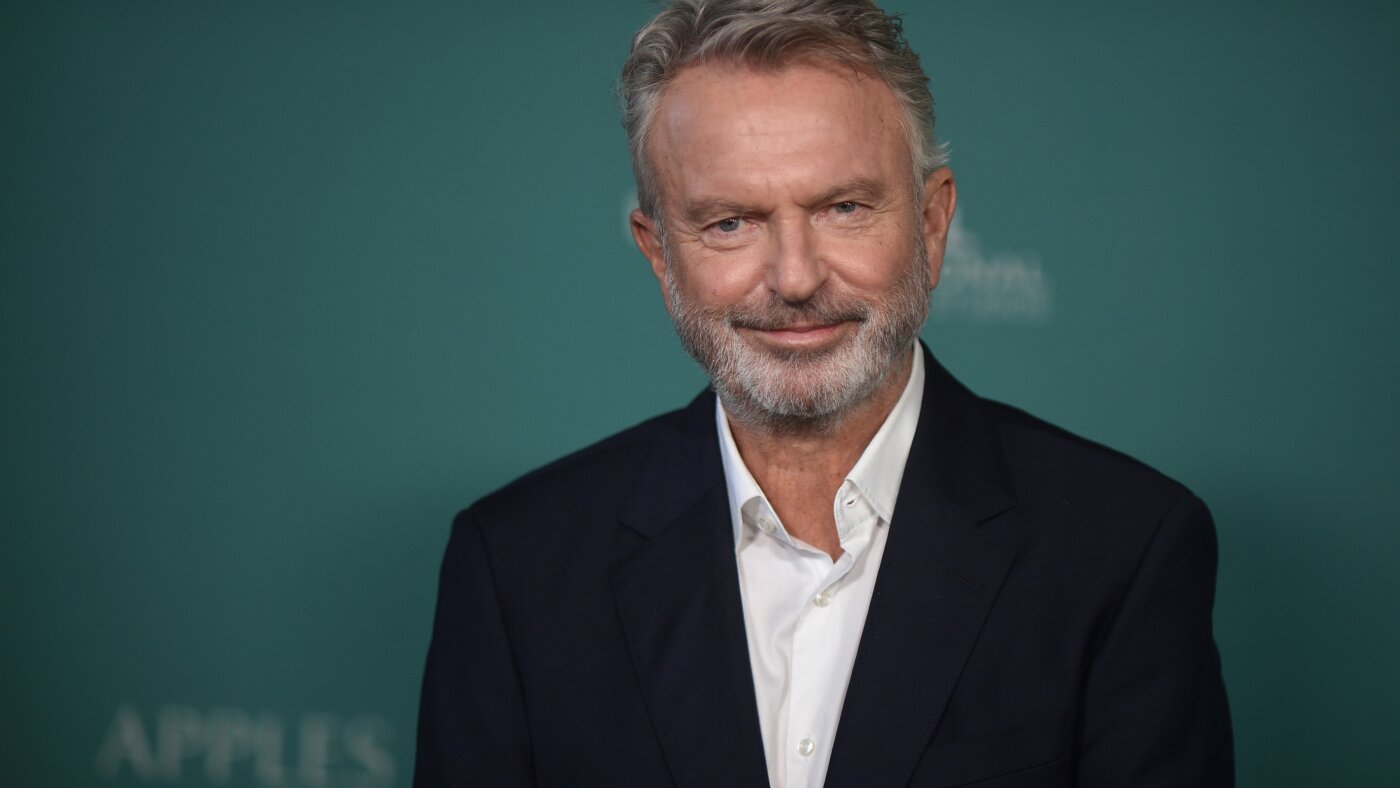
Sam Neill arrives at the premiere of “Apples Never Fall” on March 12, 2024, in Los Angeles.
Richard Shotwell/AP Photo/Invision
hide caption
toggle caption
Richard Shotwell/AP Photo/Invision
WELLINGTON, New Zealand — Sam Neill, a smoothly elegant and versatile actor whose career moved from art film to blockbuster as he dodged velociraptors in “Jurassic Park” to playing Holly Hunter’s husband in “The Piano,” has died. He was 78.
In 2023, Neill disclosed he had been diagnosed with angioimmunoblastic T-cell lymphoma, a rare type of non-Hodgkin lymphoma. Neill died on Monday in Sydney, according to a statement posted to the actor’s social media page.
His death was “sudden and unexpected,” the statement said, adding that he “remained cancer free” when he died. A cause of death wasn’t specified.
“Sam was surrounded by family and passed with the dignity that has characterised his whole life,” his family wrote.
Actor came to world’s notice with ‘Dead Calm’ and ‘My Brilliant Career’
Neill was one of a host of actors and directors who achieved international fame after an explosion of Australian films that began in the late 1970s, a list that includes Paul Hogan, Mel Gibson, Geoffrey Rush, Russell Crowe, Jane Campion, Peter Weir and Gillian Armstrong. His range was remarkable, playing opposite Helena Bonham Carter in the Alan Ayckbourn comedy “Sweet Revenge” to chopping off Hunter’s finger in “The Piano” to poking his own eyes out in the sci-fi horror “Event Horizon.”
In “Omen III: The Final Conflict,” he played Damien the Antichrist and he also played Cardinal Thomas Wolsey in “The Tudors.”
The actor first came to the attention of international audiences in Armstrong’s 1979 film “My Brilliant Career,” which also introduced Judy Davis. He later appeared in Phillip Noyce’s “Dead Calm,” a classy thriller set at sea and co-starring the then-relatively unknown Nicole Kidman.
Neill twice co-starred with Meryl Streep, in Australian director Fred Schepisi’s “Plenty” and — again for Schepisi — in “A Cry in the Dark,” a film about the sensationalized aftermath of a dingo killing a baby in the Australian Outback. He earned an Emmy nomination for his performance in the title role of the 1998 miniseries “Merlin” and another as narrator of 2017’s “Wild New Zealand.”
‘Jurassic Park’ was his best-known film
Perhaps Neill achieved his highest level of fame in “Jurassic Park” playing paleontologist Alan Grant, who is summoned to an island off Costa Rica where a theme park has been built to house herds of cloned dinosaurs. He co-starred alongside Laura Dern, Jeff Goldblum and Richard Attenborough.
His character was thoughtful and reasonable, a scientist who warned the mastermind of the theme park before the chaos: “Dinosaurs and man, two species separated by 65 million years of evolution have just been suddenly thrown back into the mix together. How can we possibly have the slightest idea what to expect?”
Grant survived the harrowing events when the creatures get loose, but didn’t return for “The Lost World: Jurassic Park II” in 1997. He came back for the third episode in 2001 and “Jurassic World: Dominion” in 2022.
“It’s probably a little late to learn these things,” he told the Daily New of New York in 2001, “but I finally feel I’ve worked out how to be an action hero. I’m happier with Grant this time. He’s gnarly and grizzled, but he looks like he knows what he’s doing.”
Neill grew up in Northern Ireland, then New Zealand
Born in 1947 in Northern Ireland, Neill emigrated to New Zealand at the age of 7. He was born Nigel Neill, but told interviewers he started to go by Sam because there were too many Nigels at his school.
His family settled in Dunedin on the South Island and he was sent to boarding school in Christchurch. After college, he took the lead in “Sleeping Dogs” in 1977, the first feature made in New Zealand in more than a decade.
Neill’s other film roles included playing a Soviet submarine officer who memorably dreams of a home in Montana in “The Hunt for Red October” and an investigator in director John Carpenter’s “In the Mouth of Madness.”
On the small screen, Neill played the malign Chester Campbell in TV’s “Peaky Blinders” and Thomas Jefferson in the four-hour CBS miniseries, “Sally Hemings: an American Tragedy.” On Apple TV+, he was on “Invasion,” playing Oklahoma Sheriff John Bell Tyson, a man late in his career searching for his purpose. In 2024 he starred opposite Annette Bening in the Peacock series “Apples Never Fall.”
Actor beloved in New Zealand as an unassuming celebrity
The actor became known in New Zealand as a modest and unassuming person who didn’t embrace celebrity. On social media, he often posted images of his farm animals, many of them affectionately named after celebrities and friends, like Laura Dern the chicken, Kylie Minogue the duck and Helena Bonham Carter the cow.
New Zealand Prime Minister Christopher Luxon mourned Neill as “one of the greats” in a statement posted to social media.
“He started out when there was barely a film industry to speak of,” Luxon wrote. “For more than fifty years he took New Zealand stories to the world and his talents helped make our film industry into what it is today.”
Neill was also a vintner and under his Two Paddocks brand, he produced pinot noir and riesling wines from his winery in the Central Otago region of New Zealand’s South Island.
His memoir “Did I Ever Tell You This?” came out in March 2023 and he was awarded a knighthood in recognition of his “outstanding contribution to film,” a title approved by the late Queen Elizabeth II.
“I can’t pretend that the last year hasn’t had its dark moments,” Neill told The Guardian in 2023, referring to his cancer diagnosis and treatment. “But those dark moments throw the light into sharp relief, you know, and have made me grateful for every day and immensely grateful for all my friends.”
He is survived by his four children and eight grandchildren.
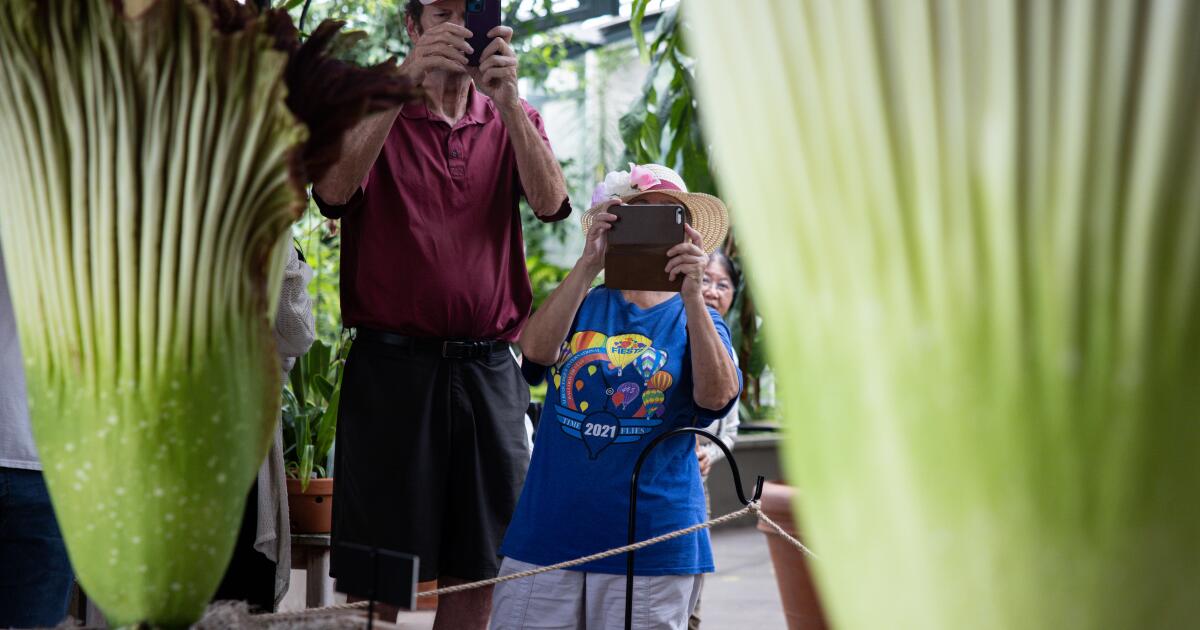
The Huntington’s long-awaited stink has arrived. Two corpse flowers nicknamed Odora and Odorysseus have bloomed at the San Marino conservatory, drawing thousands for the rare occasion and quickly surpassing last year’s numbers.
Corpse flowers have been a staple of the Huntington since 1999, when the garden exhibited its first corpse flower. Native to Sumatra, Indonesia, these plants are endangered in the wild and only bloom for 24 to 48 hours every few years. Once bloomed, they reek of rotting flesh.
As the day goes on, these smelly specimens will close back up and collapse, losing their infamously rotten odor.
The double bloom this summer was “definitely a surprise,” said Brandon Tam, the Huntington’s associate curator of orchids. The last time multiple corpse flowers bloomed on the same day at the Huntington was in 2018.
“We knew that Odorysseus was going to bloom probably Sunday,” Tam said. “But what surprised us was that we saw that Odora was opening just a few hours after.”
As an “inflorescence” — a plant structure containing hundreds of male and female flowers at the base — the plant usually staggers its bloom to avoid self-pollination.
A developmental irregularity caused Odora’s spadix to cave in, but the plant remains healthy, said Brandon Tam, the associate curator of orchids at the Huntington.
(Kayla Bartkowski / Los Angeles Times)

Jaime Holmes from San Gabriel holds her nose in front of the blooming corpse flowers.
(Kayla Bartkowski / Los Angeles Times)
But sometimes, “these plants have a mind of their own,” Tam said.
Climate factors can influence when they bloom. Tam said Southern California’s recent high humidity may have signaled a prime environment for the plants to unfurl.
Visitors may have noticed that Odorysseus’ spadix — the conic protrusion emerging upward from the plant — was much taller than Odora’s, which had caved in. Tam said Odora’s spadix was a developmental irregularity, but emphasized the plant remains healthy.
“It just looks a little different — completely normal,” Tam said. “When it reblooms for us in three to four years, it’ll look just perfectly fine.”
At the time of the bloom, Odorysseus measured 71 inches in height, and Odora measured 41.
As of 8:51 a.m., the Huntington recorded over 5,700 reservations, said Keisha Raines, the Huntington’s assistant director of news and media relations. That number easily surpassed last year’s bloom, which drew about 4,900 visitors. It also excludes walk-ins and any more reservations made throughout the day.
Parking lots quickly filled inside the Huntington, forcing some visitors to park on the streets outside.
Raines thinks the rare double bloom influenced the spike in reservations. She also believes general awareness of the corpse flower increases each summer.
“It’s kind of lore,” Raines said. “It’s just continuing to build, and more people want to see it.”
Inside the conservatory, eager sniffers took selfies and marveled at the plants’ size and smell. Outside, the line ran all throughout the walkways, extending past the exit.
Ventura resident Michelle Shock and her 8-year-old daughter, Fable, initially came to the Huntington for a tea party at the Rose Garden, and dressed for the part in light-colored, semi-formal dresses. They scheduled the party two weeks ago and got lucky when they heard the corpse flowers were in bloom on the same day.
“I’ve always wanted to see one,” Shock said while waiting in line. “I think the last time I knew of one blooming was when I was pregnant with her. We were up in the Bay, and I missed it. So here we are now, together, which is better.”

Gastonia Goodman, 72, peers through the window at the blooming corpse flowers.
(Kayla Bartkowski / Los Angeles Times)
Fable predicted the plants would smell like “rotten flesh from Minecraft.” Shock guessed they’d smell like forgotten meat in a broken freezer or animal remains on a farm.
For spouses Jennifer Kraus and Abigail Cruz, the plants smelled like rotten garbage.
“It was pretty ripe,” Kraus said. “Totally enjoyed it though.”
The couple drove two hours from the Inland Empire to catch the bloom, which had been on Cruz’s bucket list.
“The minute that we saw it on Facebook, [Kraus] started following it and making sure that we’re here when it had bloomed,” Cruz said.
They were among the first to arrive, so the wait was short. “We were here at o-dark-30 this morning, ready to go,” Kraus said.
North Hollywood resident Lilla Saito took two hours off work to witness the corpse flowers for the first time and tracked the livestream every day, “just waiting for it to bloom.” Saito stood in line for about 45 minutes to catch a whiff, which Saito said “smelled like a trash room.”
It was Paige Patino’s first bloom too. Patino lives 10 minutes away from the Huntington and wore a T-shirt with flowers on it for the occasion. It was “really cool” to “see both of them active,” Patino said.
For Tam, this year’s stench ranks in the top three. He thinks each individual plant stinks more than previous blooms, but on top of that, he said: “The fact that we have two in bloom makes it stinkier.”

California Attorney General Rob Bonta is one of several attorneys general seeking to stop the merger of Paramount and Warner Bros. Discovery.
Bloomberg via Getty Images/Bloomberg
hide caption
toggle caption
Bloomberg via Getty Images/Bloomberg
Stay up to date with our Up First newsletter, sent every weekday morning.
A dozen states, led by California, are suing to block Paramount from buying Warner Bros. Discovery in a Hollywood mega-merger that would unite some of the nation’s largest movie studios, television newsrooms, and other entertainment properties.
“The unlawful merger of these two entertainment behemoths would lead to higher prices, lower quality, and less content for film and television, harming movie theaters, basic cable distributors, and ultimately, audiences on every sofa and movie theater seat in the U.S.,” California Attorney General Rob Bonta said in a statement announcing the suit, which was filed in federal court in California’s Northern District.
The deal would give a wealthy family that has taken pains to show its allegiance to President Trump the effective ownership of the companies’ competing movie studios, streamers (Paramount+ and HBO Max), sports programming (CBS Sports and Turner Sports) and news divisions (CBS News and CNN) as well as a suite of cable channels, such as Comedy Central, VH1, MTV, TNT, TBS, HGTV and Discovery, among others.

The president has repeatedly praised Larry and David Ellison, the digital titan and his son who are the controlling owners of Paramount. And he has publicly urged the sale of Warner’s CNN to new owners.
“We’re trying to have CNN go in a normal path,” Trump told CNN anchor Jake Tapper yesterday at the end of an interview about the late Sen. Lindsey Graham.
In his statement Monday, Bonta said, “With this lawsuit, California and our sister states are fighting for free and fair markets, not rigged markets. America has no kings in government or our economy.”

Paramount is inviting in sovereign wealth funds from Saudi Arabia, Qatar and the United Arab Emirates as major investors who will forego voting rights. The financing proposal also envisions that the company will take on $80 billion in new debt. That will assuredly trigger major cuts throughout the combined company. Warner dramatically reduced its own debt after slashing budgets, but is still tens of billions of dollars in the red, which helped set the stage for Paramount’s unsolicited bid.
Bonta sees “red flags”
In late June, Bonta told MS NOW’s Jacob Sobroff that the deal presented “red flags in the air everywhere.” The acquisition is valued at approximately $111 billion, including debt and major (though nonvoting) investment stakes from Saudi and other sovereign wealth funds. Bonta has armed his office for potentially costly legal battles by hiring a new batch of lawyers, including some who left the U.S. Justice Department after Trump took office a second time. He also secured new funds from the state legislature specifically for antitrust enforcement.
The other states involved in the lawsuit are Arizona, Colorado, Connecticut, Massachusetts, Minnesota, Nevada, New Jersey, New Mexico, New York, Oregon, and Washington. An overlapping cadre of Democratic state attorneys general have sued to block the takeover of local TV giant Tegna by Nexstar, the nation’s largest owner of television stations. A federal judge in Sacramento has put the full integration of the two station groups on hold in advance of a trial that is scheduled to be heard a year from now.
Paramount has argued that the entry of streaming giants such as Netflix, Amazon and Apple into entertainment has altered the landscape, rendering such antitrust concerns obsolete. Anticipating the same vast shifts, Disney swallowed up most of Fox’s Hollywood holdings in 2019.
Any delay caused by the attorneys general could prove costly, securities filings show. Starting Oct. 1, Paramount has to pay Warner shareholders a “ticking consideration” of roughly $650 million for every 90 days the deal is set back. If the deal is not consummated by next June 4, Paramount will have to pay Warner $7 billion.
A Silicon Valley titan expands power in Hollywood
Though Paramount’s new chairman and CEO is Hollywood producer David Ellison, a past financial donor to the campaigns of Presidents Barack Obama and Joe Biden, the takeover bid was financed and guaranteed by Ellison’s father: Oracle co-founder Larry Ellison.
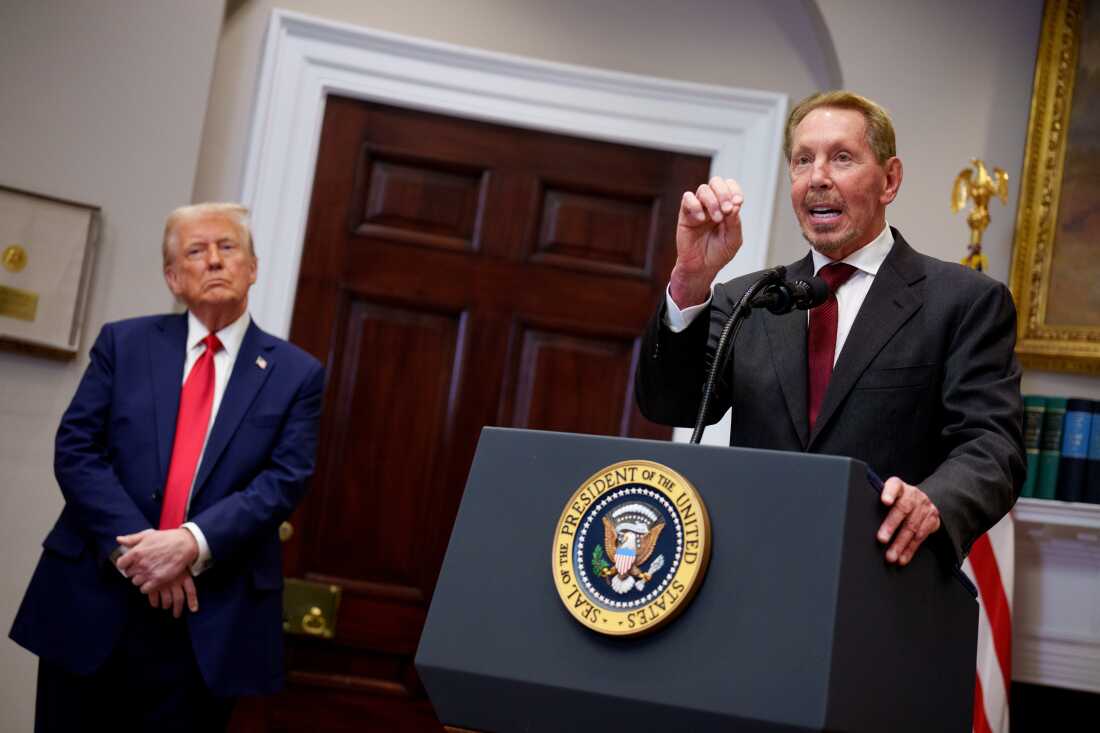
Oracle co-founder Larry Ellison, a friend and adviser of President Trump, is backing Paramount’s $111 billion plan to buy Warner Bros. Discovery.
Andrew Harnik/Getty Images/Getty Images North America
hide caption
toggle caption
Andrew Harnik/Getty Images/Getty Images North America
Larry Ellison is one of the richest people on Earth. He is also a Trump supporter and adviser — both formally and informally — serving, for example, on a board counseling the White House on artificial intelligence. Last fall, Trump made good on his plans to grant Larry Ellison and Oracle a controlling stake in TikTok’s U.S. operations.
The Ellisons took over Paramount just last summer, making concessions to Trump’s chief broadcast regulator and earning the president’s vocal support.
“The Ellison family, two great people, great people,” Trump said in March, ahead of a dinner David Ellison threw in Trump’s honor. “It’s a great family.”
David Ellison hired a new editor in chief for CBS News: Bari Weiss, founder of the center-right The Free Press. She arrived with a record of deeming mainstream media, including CBS News, to be too reflexively “woke” and anti-Trump. Her effort to reshape coverage has been met with a series of controversies, including firings and fiery resignations by CBS journalists accusing her of bias, which the network and Weiss deny. Bonta’s announcement did not focus on the combining of CBS News and CNN.
Given that Oracle provides the software skeleton on which much of the nation’s commerce and government runs, and that the Ellisons now control major media platforms and the digital data they gather, the family has the ability to create a vast reservoir of information about how people act online.
Trump’s remarks on the Paramount-Warner deal — and especially on CNN’s fate —represent a sharp break from past administrations. Predecessors both Republican and Democrat tended to respect the independence of regulators in the antitrust division of the Justice Department and the Federal Communications Commission.
Past Warner deals led to a trail of debt
Makan Delrahim, who is now Paramount’s chief legal officer, ran the Justice Department’s antitrust division during Trump’s first term. He led an ultimately unsuccessful effort to block AT&T’s takeover of TimeWarner, the precursor company to Warner.
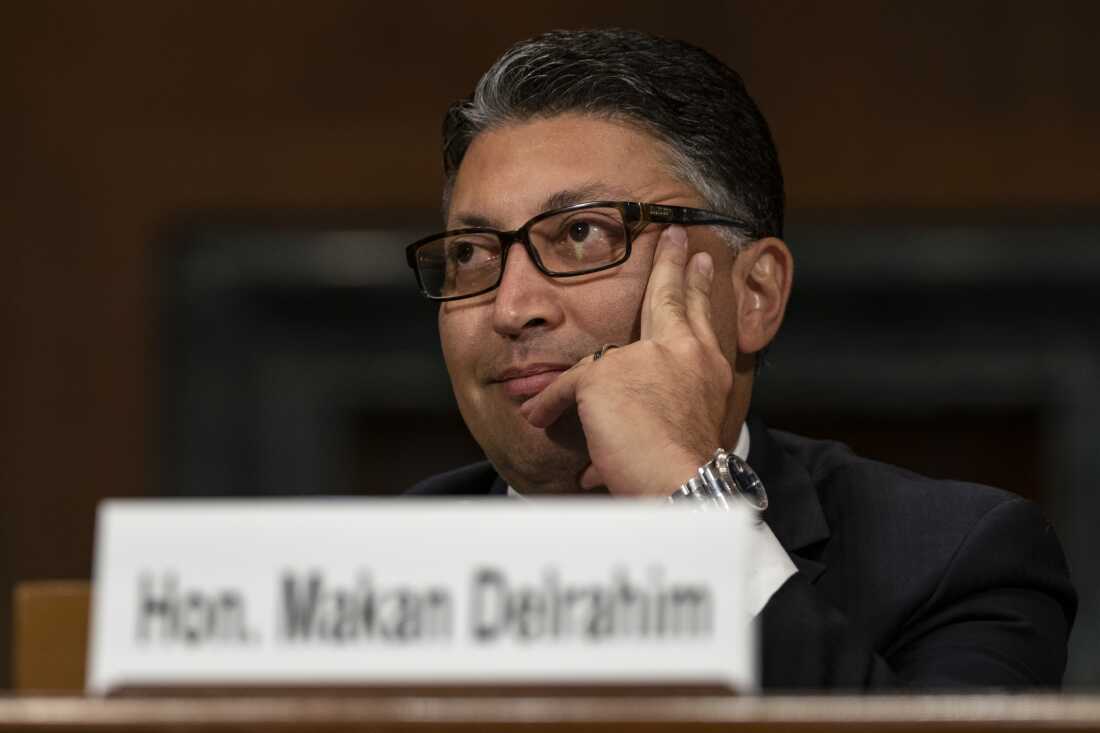
Makan Delrahim was U.S. assistant attorney general for the Justice Department’s antitrust division during President Trump’s first term. He is now the chief legal officer at Paramount.
Bloomberg/Bloomberg via Getty Images/Bloomberg
hide caption
toggle caption
Bloomberg/Bloomberg via Getty Images/Bloomberg
In retrospect, AT&T may have preferred Delrahim to prevail; the deal was brutally panned by analysts and the stock market. The telecom giant unloaded the media properties less than four years later. They were taken over by Discovery in a deal that burdened the new cable TV conglomerate with tens of billions of dollars of debt. Warner CEO David Zaslav was able to reduce it significantly, but not overtake it, and announced plans last summer to split the company in two in seeking to get ahead of an undesired offer from Paramount.
The Warner board initially struck a deal with Netflix valued at nearly $83 billion for much of the company, not including CNN and other basic cable channels. Then Paramount raised its offer for the whole company and Netflix pulled out rather than compete.
While the top British regulator has expressed qualms too, signaling a possible review that could delay the process, Paramount has won approval from the Justice Department and many regulators abroad. The Justice Department approved the acquisition last month after an eight-month review.
The Wall Street Journal reported senior officials at the Justice Department fast-tracked its process for approval before career attorneys, who were weighing filing suit to block the deal, could intercede. The outgoing antitrust chief denied that in an interview with Politico.
The FCC has not yet signed off. It is involved because Paramount holds broadcast licenses for the 28 local television stations it owns. The FCC is led by Brendan Carr, a Trump appointee and vocal ally who has endorsed Paramount’s bid.
“I think this is a good deal, and I think it should get through pretty quickly,” Carr told CNBC back in March.
Paramount has made minor concessions to try to win approval from officials in Europe. The European Union undertook formal reviews of both the consolidation of assets and its reliance on foreign investors, which are set to conclude soon.
The litigation from the states could tie Paramount up for far longer.
-

 Arkansas6 minutes ago
Arkansas Game and Fish Commission: Celebrate America 250 with responsible boating | Northwest Arkansas Democrat-Gazette
-
 California12 minutes ago
The fierce competition to get married at California’s most popular public buildings
-

 Colorado18 minutes ago
Colorado’s Front Range Passenger Rail eyes stops at future Broncos, Summit stadiums
-

 Connecticut24 minutes ago
Why Connecticut’s flag is blue and what its symbols stand for
-

 Delaware30 minutes ago
A Delaware taste of summer since 1957 is now being sold in Hockessin
-

 Florida36 minutes ago
Skunks, warthogs & monkeys, oh my! Here’s what Florida records reveal about 140+ captive animal escapes since 2022
-

 Georgia42 minutes ago
Georgia football defensive depth chart entering fall camp
-

 Hawaii48 minutes ago
Hilo woman killed in Kona traffic crash – West Hawaii Today

