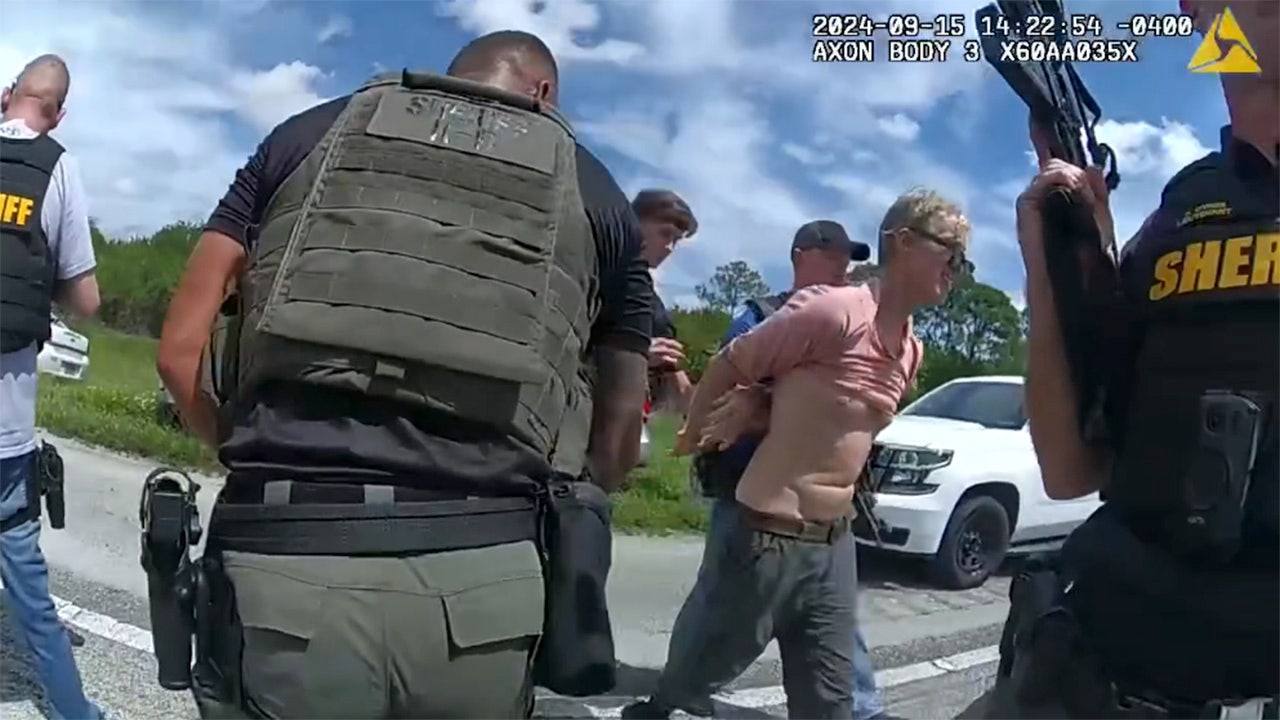
Authorities in a suburban New York county that will host President Trump’s first campaign rally since he survived a second assassination attempt are delivering a security briefing as they prepare for the 2024 Republican candidate’s arrival.
Nassau County Executive Bruce Blakeman and Police Commissioner Patrick Ryder sought to reassure voters of their security measures at a news briefing ahead of the event.
Trump will rally supporters at the Nassau Veterans Memorial Coliseum Wednesday evening – just days after the U.S. Secret Service opened fire on an armed man who pointed a rifle at him from the perimeter of his golf course in West Palm Beach, Florida.
TRUMP ASSASSINATION ATTEMPT SUSPECT LAUGHS, SMILES DURING FIRST COURT APPEARANCE IN FLORIDA
Ryan Routh is accused of aiming an SKS-style rifle at former President Trump while he was golfing at his course in West Palm Beach, Florida, on Sunday. It is being investigated as a second assassination attempt on Trump.(Obtained by Fox News Digital)
Advertisement
The suspect in that case, Ryan Wesley Routh, made his first appearance in federal court earlier Monday. He is facing federal charges of felony possession of a firearm and possessing a gun with its serial number defaced.
More charges could be likely as the investigation continues.
On July 13, another gunman opened fire at the Trump rally in Butler County, Pennsylvania.
WITNESS SAW TRUMP ASSASSINATION SUSPECT FLEE BUSHES, TOOK PHOTO OF GETAWAY CAR
Republican candidate Donald Trump is seen with blood on his face as Secret Service agents rush him off the stage at a campaign event in Butler, Pennsylvania, July 13, 2024.(Rebecca Droke/AFP via Getty Images)
Advertisement
Thomas Matthew Crooks, 20, killed a 50-year-old father of two named Corey Comperatore, critically wounded David Dutch, 57, and James Copenhaver, 74, according to authorities.
He struck the former president in his right ear.
Nassau County Executive Bruce Blakeman speaks to the media on April 22, 2024.(Peter Gerber)
Counter-snipers returned fire and killed him, but the security lapse that allowed him to climb onto a rooftop with a clear line of sight to the former president prompted multiple investigations and a shakeup at the top ranks of the Secret Service.
BOSTON (WHDH) – The You Got This center, run by Children’s Services of Roxbury, helps young adults coping with homelessness, mental health needs, and addiction.
The drop-in center also provides a space to create community.
One of the programs they center offers, freestyle Fridays, held on the first Friday of every month, gives members a chance to test out their rap skills.
Members said programs like these have taught them to be more confident.
Advertisement
“It’s a comforting area,” Deryq Samson-Brown said. “I’ve never felt like an outcast; I don’t think anybody has really felt like an outcast. It’s like a real accepting place.”
Samson-Brown said the center has inpsired him to pursue a career giving back to youth.
(Copyright (c) 2026 Sunbeam Television. All Rights Reserved. This material may not be published, broadcast, rewritten, or redistributed.)
Join our Newsletter for the latest news right to your inbox
“You had to be sure-footed,” he recalls about pickup games on Shadyside’s Roslyn Place, one of the nation’s few surviving wooden streets.
Cohen often talks up Roslyn while chauffeuring movie actors around town. “Inevitably,” he says, “they want to come see the street.” It also draws many walkers, bicyclists, bachelor and bachelorette parties, photographers, artists and people who make rubbings of its oak blocks.
Advertisement
Many other Greater Pittsburgh streets are paved with bricks or stones of various shapes and shades. These old-time toppings seem to be popular but problematic.
They’re considered handsome reminders of Pittsburgh’s past. They’re expensive but durable. They sprout weeds but seldom potholes. Some may reduce runoff and heat.
But they’re bouncy and clattery. They can be slippery when wet or icy. Though many have concrete bases, they tend to develop ruts over time.
Officials often wonder whether to maintain historic pavers or consign them to history. Jacob Russell, Verona’s borough manager, says, “It’s always an ongoing debate.”
The bricks of Allegheny River Boulevard in Oakmont host occasional market nights. Photo by Grant Segall.
Here and there
According to a list of Pittsburgh’s nearly 20,000 official street segments, 623 have bricks, 295 quarried stones (often incorrectly called cobblestones, which are long out of use), and 840 concrete, while the rest are asphalt or “unknown.” But be warned: Some entries on the list are outdated, and one’s been wrong all along. It calls Roslyn asphalt.
Advertisement
Then again, Knoxville’s Brick Way is listed correctly. It’s plain asphalt, at least today. Brian Kell, a chronicler of Pittsburgh’s streets, can find no record of previous surfaces on this tiny street, first known from an 1887 plan.
Pittsburgh’s many brick streets don’t include Knoxville’s Brick Way. Photo by Grant Segall.
Some streets with brick or stone sections are big and bustling, like downtown’s Grant Street. More seem to be small and quiet, like the Hill District’s Hollace Street. Some are fairly level, like Homewood’s Laxton Street. Others are dizzying, like Oakland’s Joncaire Street and Beechview’s Canton Avenue.
Older pavers seem most common in older neighborhoods, such as Hazelwood, but are rather randomly scattered in them. Squirrel Hill’s Murdoch Road has stone, brick and asphalt segments on different blocks. Middle Street on the North Side has a stone one and a brick one on the same block.
Canton Avenue, America’s steepest residential street, is mostly topped with quarried stone. Photo by Grant Segall.
These pavers are also common in older suburbs, such as McKees Rocks, Oakmont and Sewickley. McKeesport once had a Brick Alley, named for its surface, though better known as a red-light district.
Allegheny County also has 26 miles of dirt or gravel roads, historic, but hardly beloved.
Advertisement
Streets through the years
According to several sources, including Robin B. Williams of historicpavement.com, the world’s first roads were unpaved, prone to dust, mud and washouts. American settlers topped “plank roads” with boards and “corduroy roads” with logs. Cobblestones proved tough on wheels. A mix of crushed stones was dubbed macadam for Scottish inventor John McAdam. Tar was added and one of the mixes dubbed tarmac.
Wooden blocks became popular, including an 1850s kind called Nicolson or Nicholson blocks, chunks preserved with creosote. So did granite, limestone or sandstone blocks, variously called sets, setts, blockstones or Belgian blocks. The 1870s brought bricks and asphalt. The 1890s brought concrete.
Pittsburgh resident Ned Schano led a winning drive for historical designation from the city for Roslyn Place and its wooden blocks. Photo by Grant Segall.
According to Joel Tarr in “City at the Point,” 19th-century Pittsburgh was quickest to pave the busiest or wealthiest streets, sometimes charging the property owners. Many other streets remained unpaved into the 20th century.
By the mid-1910s, wooden streets were already quaint, the look Roslyn’s developer apparently wanted for this cozy dead end, lined mostly with brick homes. It helped that his son owned a lumberyard, which supplied about 26,000 blocks.
Over the years, the city has replaced many of those blocks with newer ones. To spare them all, it blows and sweeps snow there instead of plowing it.
Williams says that the nation has just a few other wooden streets left, including Cleveland’s Hessler Court, part of Philadelphia’s South Camac Street, and Chicago’s aptly named Wooden Alley.
Advertisement
Beautiful and bumpy
Most locals praise vintage pavers.
“They’re the coolest things,” Kathy Lutz says of Bridgeville’s several brick streets. “They make me feel nestled in here.” They also remind her of a famous Beatles album cover. “We have Abbey Road in the middle of Bridgeville.”
Crossing Bridgeville’s Gregg Avenue, Kathy Lutz feels like a Beatle crossing Abbey Road. Photo by Grant Segall.
A stone stretch of Bloomfield’s Lima Way is smooth enough for Kelly DiTullio to carry a heaping carton of strawberries home from the neighborhood’s farmers market without spilling any. “It’s charming,” she says, “especially when the greenery starts to grow in between.”
A woman identifying herself just as Kelissa says that her dog, Princess, likes Lima’s stones for relieving herself.
Locals see benefits even in these pavers’ bounces. Drivers slow down, and bystanders hear them coming.
Advertisement
In Mt. Lebanon Magazine last year, Abigail Schade Gary wrote about that suburb’s many brick pavers, “The charm! The distinction that signifies Mt. Lebanon!” Not quite as enthusiastically, she recalled sliding backward down them in her family’s station wagon. She liked them for sledding but not roller-skating. “Even if you could manage to stay on your feet over the bumpy surface, the unevenness made your teeth chatter.”
A few locals would update some retro roads. “Most of them are in such a state that they need to be paved over,” says Mt. Lebanon’s Greg Carvlin.
The Hill District’s Francis Street has stones of several shades. Photo by Grant Segall.
Cara Zlatos recently hit the bricks of Aspinwall’s Delafield Avenue after an appendectomy at UPMC St. Margaret. She says, “Every bump seemed to find its way straight to my sore abdomen.”
Melissa Lang O’Malley, Aspinwall’s borough manager, says that Delafield’s much-needed repairs will resume this summer.
Bicycles bounce too. According to Julie Walsh, spokeswoman for BikePGH, most riders prefer modern pavement for routine rides, but some choose brick or stone at times for fun, especially in challenging events like the Pittsburgh Roubaix and the Pittsburgh Dirty Dozen.
Advertisement
Bicyclist Henry Snyder of Squirrel Hill says that historic pavers “give you a little chance to experience what the Tour de France guys do in Paris. You don’t want to do it too long because it sends vibrations down your arm. For a block or two, it’s great.”
This 1925 photo by Allegheny County shows bricks being laid in Shaler on what was called the Butler Plank Road, now William Flinn Highway. Photo courtesy of Northland Historical Image Collection.
Saving surfaces
A 2018 Pittsburgh ordinance calls for preserving historic pavement where safe, unless 75 percent of the street’s property owners petition for asphalt. Eric Setzler, chief engineer of the Department of Mobility and Infrastructure, says that it costs $30 per square yard to resurface asphalt, versus $170 for brick or $200 for stone. But brick and stone can last for decades, especially on streets with light traffic.
“There are streets that are probably over 100 years old that have had minimal maintenance,” he says. “They will have some dips and bumps, but they are still in service. … The cost can even out a little.”
Aspinwall’s Lang O’Malley says that recent brick repairs cost about $12 per square foot versus barely $2 for asphalt, but might prove better investments over 30 to 50 years. Besides, “While modern infrastructure needs sometimes require difficult decisions, preserving that historic character where possible remains an important part of maintaining Aspinwall’s identity.”
In a 2016 study of Mt. Lebanon’s brick streets, the Pennsylvania Department of Transportation said, “Though costly to install, these streets maintain a good structural condition for decades and add beauty and history to the area.”
Advertisement
In 2020, a Carnegie Mellon University team estimated that Mt. Lebanon would save about $200,000 over 50 years by maintaining a stretch of brick 700 feet long instead of asphalting it. Ninety-six percent of residents surveyed said the bricks added character, and 82 percent would pay to restore them.
Safety matters, though. A steep brick stretch of that suburb’s Spruceton Avenue was asphalted after an official did a 360 on ice there.
Verona, on the other hand, simply closes a steep stone section of South Avenue during wintry weather.
Potholes in asphalt streets often reveal earlier materials, like these bricks on Joncaire Street. Photo by Grant Segall.
PennDOT maintains just 0.2 miles of bricks or stones on state roads in Allegheny County: stretches of Chestnut Street in Coraopolis, Broadway in Stowe Township and Linden Avenue in East Pittsburgh. “Generally,” says PennDOT Press Secretary Alexis Campbell, “we end up paving them with asphalt.”
Old pavers are often buried under asphalt but reappear in potholes. Others are removed and sometimes relocated. A few are part of the landscape of the Children’s Museum of Pittsburgh. Some that PennDOT removed from Castle Shannon Boulevard in Mt. Lebanon are parts of that suburb’s other streets.
Advertisement
Magic and texture
In the 2010s, resident Ned Schano led a campaign that won city landmark designations for Roslyn and specifically its wood. “Every day,” says Schano, “I make sure to step on the wood when I go outside. It has some magical powers.”
Cohen feels like Roslyn’s wood is ingrained in him. “It’s been a great texture for my whole life. To see it’s still here when so many other things have gone away, it’s amazing.”