Sign up for the Today newsletter
Get everything you need to know to start your day, delivered right to your inbox every morning.


Democratic lawmakers on the House task force investigating the attempted assassinations of former President Donald Trump skipped the final portion of the panel’s first hearing Thursday, which featured the two Republicans who have been conducting their own “parallel” investigation into the shooting.
Reps. Eli Crane, R-Ariz., and Cory Mills, R-Fla., two Republicans and both military veterans, took part in the second portion of the hearing, but the Democratic minority fumed behind the scenes that their leadership was not informed of their testimony until late Wednesday afternoon, Fox News sources said. Some Democratic lawmakers were not informed until Thursday morning, however.
The move was seen as the first bipartisan split in what has been a united effort to investigate the incident thus far.
The Trump assassination attempt task force, led by Reps. Mike Kelly, inset left, and Jason Crow, inset right, have formally launched a probe. (Getty Images)
SECRET SERVICE BOSS SAYS VITAL INFO NOT RELAYED OVER RADIO, DELAYING RESPONSE TO WOULD-BE RALLY ASSASSIN
“We did not receive notice of the second panel until late yesterday. We didn’t have an opportunity to present our own witnesses,” Crow said when asked about Mills and Crane. “[Task Force Chairman Mike Kelly, R-Pa.] and I are still very committed to having this be bipartisan, consensus-based, and it’s my hope that we can return to that … approach going forward.”
Kelly similarly told reporters that this would not impede the task force’s bipartisan mission and said that he invited Mills and Crane to testify because of their expertise, welcoming their assessment of the security perimeter for the rally.
He brushed off Democrats’ absence during their portion of the hearing, suggesting that some members may have had flights out of Washington, D.C., per KTLA.
“If you want to participate, you can participate. If you decide not to, you can make that decision too,” Kelly said of the members.
Rep. Jason Crow, D-Colo., the ranking Democrat on the panel, said lawmakers were frustrated, but he made clear that it was not aimed at Thursday’s witnesses.
“We did not receive notice of the second panel until late yesterday,” Crow said. “It’s unclear to us what testimony will be provided by these witnesses that relates to today’s hearing.”
The first portion of the hearing, the panel heard from a former Secret Service agent, as well as local and state law enforcement officials who were present at the July 13 rally in Butler, Pennsylvania, where one attendee was killed and Trump himself was shot in the ear.
Reps. Cory Mills, R-Fla., a military veteran, took part in the second portion of the hearing. (David Dee Delgado)
TRUMP SHOOTING: TIMELINE OF ASSASSINATION ATTEMPT RAISES QUESTIONS ABOUT HOW GUNMAN EVADED SECURITY
Witnesses and lawmakers repeatedly signaled that a lack of clear communication of security plans from the Secret Service helped lead to a 20-year-old gunman, Thomas Matthew Crooks, being able to open fire on the rally from a rooftop just outside the security perimeter.
“In the days leading up to the rally, it was not a single mistake that allowed Crooks to outmaneuver one of our country’s most elite group of security professionals. There were security failures on multiple fronts,” Kelly said.
“The communication between the Secret Service and local and state partners was disjointed and unclear,” Crow said. “It was the fault of the Secret Service, because the Secret Service is ultimately responsible for the protection at events like that. They did not do their job. They did not provide the clarity and the guidance to local law enforcement. That was pretty clear to me,” Crow told reporters.
One bullet grazed Trump’s right ear, while firefighter Corey Comperatore was fatally struck. Rally-goers James Copenhaver and David Dutch were also shot and injured.
One key question has been why there were no law enforcement personnel on top of the AGR building where Crooks eventually climbed up and took his shots, considering that it was so close to the rally stage and afforded a clear line of sight to Trump.
“A 10-year-old looking at that satellite image could have seen that the greatest threat posed to the president that day” was the building near the stage, said Rep. Pat Fallon, R-Texas.
Former President Donald Trump just seconds after the Butler, Pennsylvania, assassination attempt. (AP Photo/Evan Vucci)
The panel — comprised of seven Republicans and six Democrats — has spent the last two months analyzing the security failures at the rally, conducting nearly two dozen interviews with law enforcement and receiving more than 2,800 pages of documents from the Secret Service.
An interim report released Wednesday from the Senate Homeland Security and Governmental Affairs Committee, which is also conducting an investigation, said the Secret Service failed to give clear instructions on how state and local officials should cover the building where the gunman eventually took up position. The report also said the agency didn’t make sure it could share information with local partners in real-time.
Multiple lawmakers indicated that they are looking to hear from Acting Secret Service Director Ronald Rowe again, particularly after Congress recently allocated $230 million in additional funding for the agency.
Fox News’ Elizabeth Elkind and The Associated Press contributed to this report.
Read the full article from Here

NEWYou can now listen to Fox News articles!
The New Hampshire man accused of opening fire inside a country club last year, killing one person, reportedly confessed to the shooting, telling investigators he aimed to kill the rich.
Hunter West Nadeau, 24, told police he carried out the shooting at a steakhouse located at the Sky Meadow Club in Nashua in an effort to retaliate against the rich because “they were not helping the poor,” according to a police affidavit obtained by The Boston Globe.
The affidavit reportedly pointed to surveillance video showing Nadeau entering the club’s main entrance around 7:17 p.m. Sept. 20, wearing a black hoodie and carrying a green backpack.
Nadeau then allegedly walked to Prime steakhouse, put on a face mask and brandished a gun, firing five shots at employee Steve Burtman, according to the affidavit.
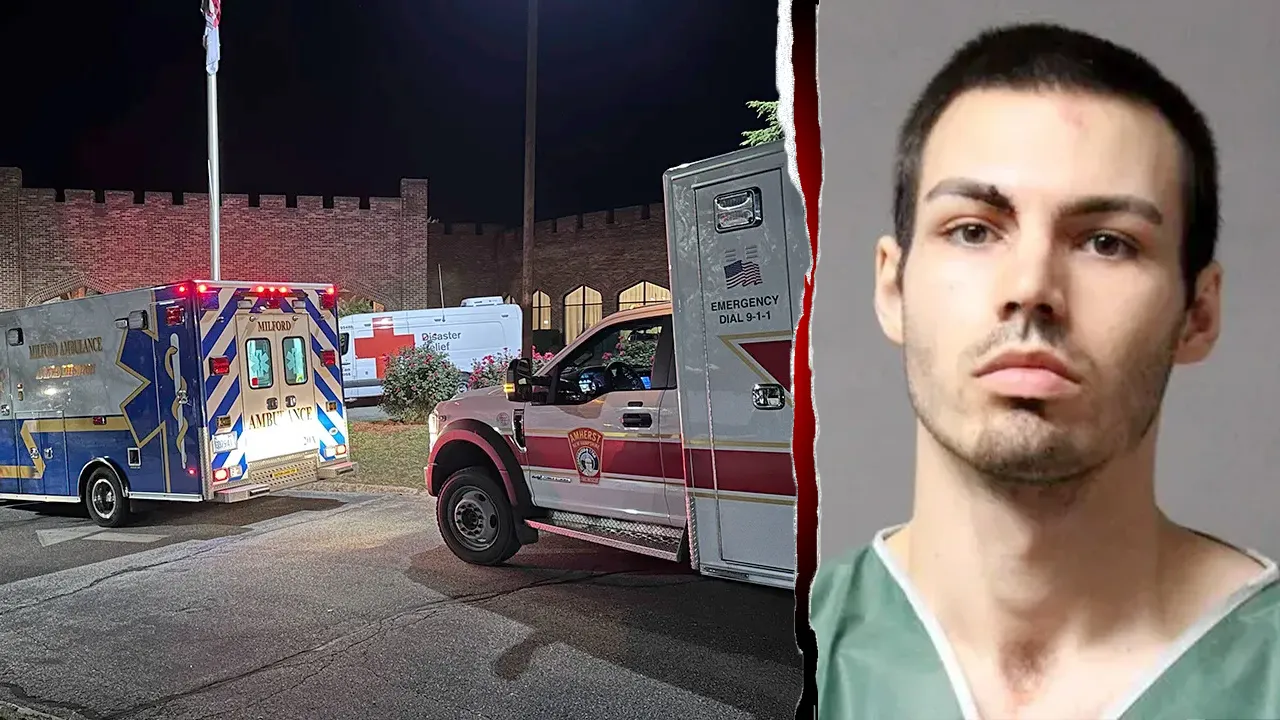
Hunter Nadeau, 24, a former employee of the Sky Meadow Club, was charged with second-degree murder in Robert Steven DeCesare’s killing. (New Hampshire Attorney General)
Burtman, who was reportedly stationed at the front desk, was struck in the face, the outlet reported. He survived his injuries.
Surveillance footage then reportedly shows Nadeau entering the restaurant and firing five more shots toward numerous patrons.
Nadeau allegedly struck and killed 59-year-old Robert Steven DeCesare, who was dining with his wife and daughter. A third patron was also injured as he allegedly fired multiple shots toward a group of individuals.
WITNESS SAYS NEW HAMPSHIRE COUNTRY CLUB SHOOTER YELLED ‘FREE PALESTINE’ DURING WEDDING VIOLENCE: AP
Ambulances are parked outside a hotel acting as a reunification center after a shooting at a country club in Nashua, N.H., Sept. 20, 2025. (AP Photo/Michael Casey)
Nadeau then “continued to shoot until he was attacked by other patrons in the restaurant, and he retreated back through the doors of the steakhouse,” the affidavit said.
A witness previously told The Associated Press Nadeau allegedly yelled “Free Palestine” as the chaos was unfolding.
Police subsequently located Nadeau on the club’s golf course, where he “was bleeding from apparent self-inflicted incised wounds to [his] arms and wrists, and made statements to the effect that he was a ‘bad guy,’” according to the filing.
He then reportedly took responsibility for the shooting, telling officers about his negative feelings toward the affluent.
BODYCAM IMAGES SHOW LUIGI MANGIONE’S MCDONALD’S ARREST AS DEFENSE CHALLENGES EVIDENCE COLLECTION
Robert “Rob” DeCesare Jr., 59, was fatally shot during a wedding at Sky Meadow Country Club in Nashua, N.H. (Charlene DeCesare)
Speaking to authorities from his hospital bed, Nadeau told investigators “he was tired of the ‘elites’ taking all the money,” according to the outlet.
Nadeau also reportedly told investigators he chose Sky Meadow because he had previously worked there and knew members were affluent.
“He said that he settled on Sky Meadow as a location because he worked there about a year ago as a server and knew that you had to have money to have a membership there,” police said, according to the Globe.
POLICE SERGEANT DENIES HEARING LUIGI MANGIONE MOTHER’S ALLEGED DAMNING STATEMENT ABOUT CEO KILLING
“He was not targeting a specific person but did not care whether he killed someone or not,” police reportedly added.
Additionally, Nadeau explained why he targeted a wedding being held at the venue at the time of the shooting, telling police “he did not want to target ‘civilians,’” according to the outlet.
At the time, the shooting came less than one year after Luigi Mangione allegedly opened fire on UnitedHealthcare CEO Brian Thompson in an apparent assassination in midtown Manhattan. Investigators have pointed to similar ideological motives behind Mangione’s alleged crimes.
CLICK HERE TO DOWNLOAD THE FOX NEWS APP
In January, prosecutors filed multiple charges against Nadeau, including first-degree murder and reckless second-degree murder, according to the New Hampshire Department of Justice.
He is being held without bail as he awaits trial.
Fox News Digital was unable to locate an attorney representing Nadeau.
Fox News Digital’s Sarah Rumpf-Whitten contributed to this report.

Read the full article from Here

Nikki Ogunnaike, the editor in chief of Marie Claire magazine, did not grow up the scion of an Anna Wintour or a Marc Jacobs.
But, she said, “my mom and dad are both very stylish people.”
They got dressed up to go to church every week in her hometown Springfield, Va. Her mother managed a Staples; her father, a CVS. “Presentation is important to them,” she said.
Since landing her first internship with Glamour magazine in college, Ms. Ogunnaike, 40, has held editorial roles there and at Elle magazine and GQ. She has been in the top post at Marie Claire since 2023.
She recently spent a Saturday with The New York Times as she prepared for Milan Fashion Week.

Health
Massachusetts health officials have confirmed the state’s first two measles cases of the year, a school-aged child and a Greater Boston adult.
The Department of Public Health announced the cases Friday, marking the first report of measles in Massachusetts since 2024.
According to health officials, the adult who was diagnosed returned home recently from abroad and had an “uncertain vaccination history.” While infectious, the person visited several locations where others were likely exposed to the virus, and health officials said they are working to identify and notify anyone affected
The child, meanwhile, is a Massachusetts resident who was exposed to the virus and diagnosed with measles out-of-state, where they remain during the infectious period. Health officials said the child does not appear to have exposed anyone in Massachusetts to measles.
The two Massachusetts cases come as the U.S. battles a large national measles outbreak, which has seen 1,136 confirmed cases nationwide so far in 2026, according to the Centers for Disease Control and Prevention.
“Our first two measles cases in 2026 demonstrate the impact that the measles outbreaks, nationally and internationally, can have here at home,” Massachusetts Public Health Commissioner Robbie Goldstein said Friday. “Fortunately, thanks to high vaccination rates, the risk to most Massachusetts residents remains low.”
Measles is a highly contagious disease that spreads through the air when an infected person sneezes, coughs, or talks. The virus can linger in the air for up to two hours and may even spread through tissues or cups used by someone who has it, according to the DPH.
Early symptoms occur 10 days to two weeks after exposure and may resemble a cold or cough, usually with a fever, health officials warned. A rash develops two to four days after the initial symptoms, appearing first on the head and shifting downward.
According to the DPH, complications occur in about 30% of infected measles patients, ranging from immune suppression to pneumonia, diarrhea, and encephalitis — a potentially life-threatening inflammation of the brain.
“Measles is the most contagious respiratory virus and can cause life-threatening illness,” Goldstein said. “These cases are a reminder of the need for health care providers and local health departments to remain vigilant for cases so that appropriate public health measures can be rapidly employed to prevent spread in the state. This is also a reminder that getting vaccinated is the best way for people to protect themselves from this disease.”
According to the DPH, people who have had measles, or who have been vaccinated against measles, are considered immune. State health officials offer the following guidance for the Measles-Mumps-Rubella (MMR) vaccine:
Get everything you need to know to start your day, delivered right to your inbox every morning.







Exclusive: DeepSeek withholds latest AI model from US chipmakers including Nvidia, sources say


Mother and daughter injured in Taunton house explosion


2026 MHSA Montana Wrestling State Championship Brackets And Results – FloWrestling


Wildfire near Gum Swamp Road in Livingston Parish now under control; more than 200 acres burned


10 acres charred, 5 injured in Thornton grass fire, evacuation orders lifted


YouTube TV billing scam emails are hitting inboxes


Stellantis is in a crisis of its own making


OpenAI didn’t contact police despite employees flagging mass shooter’s concerning chatbot interactions: REPORT