Plus special access to select articles and other premium content with your account – free of charge.
By entering your email and pushing continue, you are agreeing to Fox News’ Terms of Use and Privacy Policy, which includes our Notice of Financial Incentive.
Please enter a valid email address.
Brooklyn residents say they were blindsided by New York City officials’ decision to open an all-male migrant shelter on the same block as an elementary school.
“We wanted to know when it’s going to happen, what are the logistics, what are the safety measures. We were not given any transparency,” Brooklyn mom of three Irina Edelstein says in the Independent Women’s Forum documentary, “Brooklyn’s Border Crisis.”
Advertisement
The documentary explores how Edelstein’s community has been grappling with safety issues since the opening of a 400-bed migrant shelter in the Gowanus neighborhood of Brooklyn last April. The shelter opened roughly 1,000 feet from City Life Academy, a private Christian K-12 school, where Edelstein’s children attend.
City officials told residents at a public meeting in March that they had “spoken to all the school principals in the area” and they had given their approval for the shelter. City Life Academy Principal Jeffrey Reed, who is also a pastor and father, disputes that comment.
OHIO RESIDENTS IN SMALL TOWN ERUPT OVER HAVOC CAUSED BY MASSIVE INFLUX OF 20,000 HAITIANS
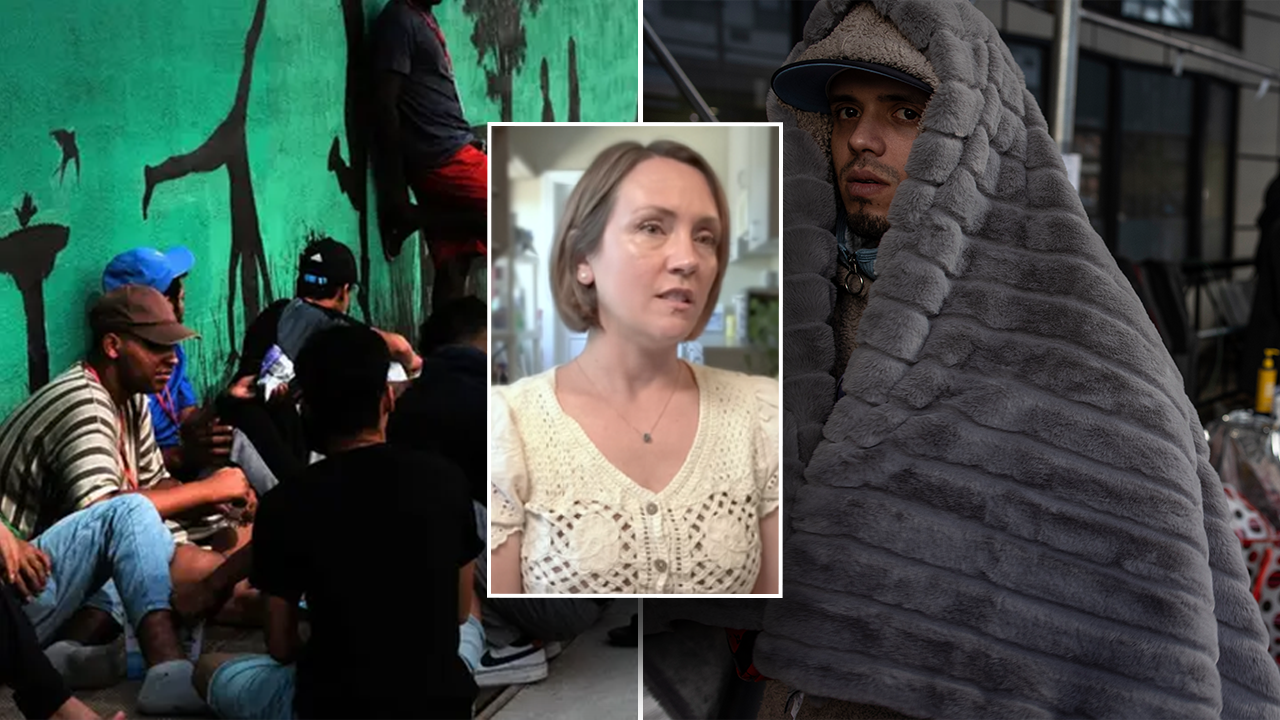
Irina Edelstein, left, and Jeffrey Reed, right, speak about safety concerns and lack of transparency from city officials over a male migrant shelter that opened next to their kids’ school in April.
“I didn’t know about the shelter until two months before that meeting, and it had been in the works for almost a year, I think,” he says in the documentary of learning about the shelter from a neighbor.
Advertisement
The March community meeting was packed to the brim with residents seeking answers about safety protocols and logistics for the shelter. But Edelstein claims that city leaders weren’t transparent about their plans.
The pastor said he believed officials opened the shelter in “secret” because they feared community backlash.
“You make a decision in front of people, and they’re going to chime in. The reason you wouldn’t do that is because you know they’re going to chime in very loudly,” Reed said. “They knew there would be push back, and they knew if they had gone through the proper channels it probably never would’ve happened.”
BROOKLYN RESIDENTS OUTRAGED OVER MIGRANT SHELTER LOCATED FEET AWAY FROM ELEMENTARY SCHOOL: ‘NONE OF US KNEW’
Local politicians and city officials hold an over-packed community meeting to address growing concerns and questions about a plan for a new emergency shelter to house over 400 recently arrived migrants in the neighborhood, March 4, 2024, in the Gowanus section of Brooklyn, New York. (Photo by Andrew Lichtenstein/Corbis via Getty Images)(Getty Images)
Advertisement
A spokesperson for the NYC Department of Social Services told Fox News Digital that proper protocols were followed and local officials were made aware of the emergency shelter “months in advance.”
“Since the spring of 2022, over 215,000 asylum seekers have arrived in New York City in need of shelter and over 62,300 remain in the City’s care while hundreds more continue to arrive each week, placing immense strain on the city’s existing shelter infrastructure. In order to provide appropriate shelter services and essential supports to new arrivals, it was, and continues to be, critical that additional capacity be brought online to meet this growing need. Local elected officials were notified about this facility months in advance and considerable community engagement was conducted prior to opening. DSS-DHS is committed to serving all those in need, long-term New Yorkers and new arrivals alike, and we are dedicated to ensuring the safety of our clients and the community at all times,” the statement read.
Since the shelter’s opening, Edelstein claims that theft has become “almost a daily occurrence” in their neighborhood. In the documentary she describes troubling things she and family members have witnessed from the male migrants.
Reed has strengthened safety measures for the coming school year, including enlisting a group of fathers to monitor outside during the school day for any suspicious behavior and be a deterrence for any one looking to cause trouble.
“We ramped up our security badges,” he said. “Every outside square foot now, that’s unfortunately what you have to do now.”
Advertisement
TOPSHOT – Migrants camp outside a hotel where they had previously been housed, as they resist efforts by the city to relocate them to a Brooklyn facility for asylum seekers, in the Hells Kitchen neighborhood of New York on January 31, 2023. (Photo by Ed JONES / AFP) (Photo by ED JONES/AFP via Getty Images)
The Brooklyn residents are speaking up to draw attention to the migrant crisis that’s affecting their neighborhood and cities across the United States.
“To me, the way I view it, is being in this physically, emotionally abusive relationship, and you just stay silent thinking it’s going to get better,” Edelstein said. “Unless you speak up, get involved or have boldness to point things out speak out, nothing is going to change, it’s only going to get worse.”
The Brooklyn residents said they welcome legal immigration but that the laws need to be enforced. Edelstein is an immigrant herself, who came to the United States from the former Soviet Union as a teenager.
“There’s a difference between immigration and invasion,” she said.
Advertisement
VICTIM OF ILLEGAL IMMIGRANT CRIME UNDER THEN-DA HARRIS WARNS OF ‘SCARY’ SOFT-ON-CRIME AGENDA
Migrants walk along the highway through Suchiate, Chiapas state in southern Mexico, Sunday, July 21, 2024, during their journey north toward the U.S. border. (AP Photo/Edgar H. Clemente)( (AP Photo/Edgar H. Clemente))
Reed says he has compassion for the people who are trying to make a better life for themselves and he ministers to men in the shelter.
“I’ve seen some immigrants come to our church,” Reed says in the documentary. “So my heart reaches out to them. Unfortunately, they’ve said this as well, there’s some bad players in the shelters and in all the shelters, and that’s the problem.”
IWF spokesperson Andrea Mew told Fox News Digital that these residents aren’t anti-immigrant but they feel like New York City officials have prioritized illegal migrants over the safety of their own citizens.
Advertisement
“It’s unfortunate because it feels like from Irina’s perspective, that the city was placing more of an importance on trying to house people who are not here legally than they are trying to protect their own, who have been here, and who might even just be, you know, first- or second-generation Americans,” Mew continued. “New York is such a vibrant, colorful city that there are people from every walk of life. And I think it’s telling that you even have legal immigrants who understand just how bad it is when we lack real border policies.”
Since the shelter’s opening, some residents have questioned the legality of the shelter and the rushed nature in which it came into place.
Locals have filed a lawsuit against the city and the owner of the shelter’s building after an investigation found they did not follow environmental testing protocols and violated other building codes to accelerate the shelter’s opening.
“The lawsuit filed in Brooklyn state Supreme Court claims the city and 130 Third Owner LLC and BHRAGS Home Care Corp, which would run the shelter, failed to conduct an environmental review under state law or give ‘consideration for the long and very well-known history of environmental contamination in this area,’” The New York Post reported.
Residents in the Democratic stronghold of Clinton Hill have also claimed gang-related crime has spiked due to an emergency migrant shelter set up in their neighborhood one year ago. Locals held a protest in July begging Mayor Eric Adams to hear their concerns.
Advertisement
“We have to be heard. Enough is enough,” said Renee Collymore, the Democratic liaison who organized the protest. “It’s not about anti-migrants. It’s about safety first.”
Fox News’ Madeline Coggins and Hannah Grossman contributed to this article.
A man was flown to a Boston hospital after being hit by a vehicle Wednesday evening in Norwood, Massachusetts, and the driver has been arrested.
Norwood police responded shortly after 7:30 p.m. to the intersection of Washington Street and St. John Avenue.
The victim was found seriously injured. Fire crews treated him at the scene before he was taken by ambulance to a landing zone to be airlifted by medical helicopter.
Police said the woman driving the vehicle was taken into custody. She is facing charges including operating under the influence of liquor.
The Parkway East’s Commercial Street Bridge is about to blow – but it’s not happening on Wednesday night.
PennDOT say they were going to bring down the bridge sometime between 7 p.m. and 9 p.m. on Wednesday, but around 8 p.m officials and security said the explosion was postponed.
The demolition will be shown live on PennDOT’s project page or 511 PA, which also has cameras placed along the project’s detour routes.
Watch the live stream here:
Advertisement
A crowd of about 100 people gathered Wednesday evening at the Summerset at Frick Park residential development for a front-row view of the bridge demolition.
The atmosphere felt more like a neighborhood block party than a construction event. Families brought their children and pets, while groups of friends arrived carrying pizzas and coolers of beer. Lawn chairs lined the hillside as people in shorts and sunglasses settled in to wait for the explosion. Some spectators wore earplugs in anticipation of the blast.
A man with a ukulele strummed some folk tunes to liven the expectant atmosphere as police wrapped red caution tape around the edge of the hill, denoting the 800-foot security perimeter around the bridge.
Merav Amos, from Squirrel Hill, brought her family for a picnic, complete with books, lawn chairs and glasses of wine.
Advertisement
Amos said she planned the trip when PennDOT released its expected demolition window, but realized then and there that there was one thing she had forgotten.
“I actually hope it’s not going to be too loud, because we don’t have earplugs,” she said.
Amos lives near the Parkway East’s local detour route, and has had to deal with traffic increasing near her home since the bridge closed on Friday. She hoped watching the demolition live would provide a satisfying payoff.
“The last few days were very rough,” she said. “I want to see some action.”
Advertisement
Jim Christy, of Robinson, parked in the South Side and made the journey over on his bike to watch the explosion.
Christy frequently bikes through the Frick Park trails — some of which were restricted on Wednesday ahead of the demolition.
(WFSB) – The Connecticut Technical Education and Career System is under investigation by the United States Department of Education.
In a letter sent to the superintendent obtained by Channel 3, the nature of the investigation centers around the district’s handling of rape and/or sexual assault cases by school staff.
“Due to the District’s inaccurate responses to the rape and/or sexual assault data elements involving allegations against school staff of OCR’s 2023–24 Civil Rights Data Collection (CRDC), the directed investigation will examine whether the District has policies and procedures in place to ensure accurate data collection and reporting and that its handling of the sexual harassment, including sexual assault, of students by District teachers, administrators, and/or staff members is consistent with the requirements of Title IX of the Education Amendments of 1972 (Title IX) and its implementing regulation,” said the letter in part.
Read it in full below:
Advertisement
The school system issued a statement in response to the investigation.