


⚽ Get the latest World Cup news
Receive updates on the 2026 FIFA World Cup


At his inauguration on Jan. 20, 2021, 78-year-old Joe Biden gave a 21-minute speech crafted by a team of speechwriters that included Pulitzer-winning historian Jon Meacham. Biden called for national unity; referenced Abraham Lincoln, Martin Luther King Jr., and Arlington National Cemetery; quoted St. Augustine and the Bible; and ended by asking God to bless America and our troops.
The address had its eloquent moments, though because inauguration speeches have become largely formulaic, it probably could have been written by the use of artificial intelligence.
Later today, Jan. 20, 2025, 78-year-old Donald Trump will give his Second Inaugural Address. Eight years ago, he gave a 1,433-word speech that lasted 16 minutes. In it, he focused on the “American carnage” that he believed had been caused by “a small group of politicians in the nation’s capital” who had ignored “the forgotten men and women of our country,” failed to prioritize the doctrine of “America first,” and lacked “a total allegiance to the United States of America.” He said his presidency would change all that.
Like Biden and most past presidents, Trump ended by saying he would rely on God in his leadership of the nation and claimed his goal would be to achieve national unity.
As we look back at the last eight years and compare the words in the last two inaugural addresses against the deeds that transpired over the course of the two men’s presidencies, some important questions come to mind.
Will Trump suffer cognitive decline between the ages of 78 and 82 as Biden did?
Will Republicans, with their slim majorities in the House and Senate, be able to achieve Trump’s objectives, or will they be so divided, as congressional Democrats were for much of Biden’s presidency, that they can’t achieve their desired agenda?
Will Trump listen to the advice of others during his second term, or will he be a force only unto himself like he was before?
Does the rest of the world have high hopes, complete dread or something in between for how America’s foreign policy will unfold during Trump’s second term?
Strong, hopeful inaugural messages often become empty promises when a president’s performance fails to hit the mark. Not surprisingly, the best remembered phrases from the prior inaugurations have come from our greatest presidents. Why? Because they had the wherewithal to follow through on their opening-bell aspirations, and their speeches were most definitely not formulaic.
George Washington in 1789, speaking to a fragile new nation that sought to establish a better form of government: “The preservation of the sacred fire of liberty and the destiny of the republican model of government are justly considered, perhaps, as deeply, as finally, staked on the experiment entrusted to the hands of the American people.”
Thomas Jefferson in 1801, speaking to a polarized country reeling in the aftermath of the recently expired Sedition Act and a narrow election result that had required six days and 36 ballots in the House of Representatives before it was resolved: “Every difference of opinion is not a difference of principle. We have called by different names brethren of the same principle. We are all Republicans, we are all Federalists.”
Abraham Lincoln in 1861, when seven states had already seceded from the union and a civil war loomed: “We are not enemies, but friends. We must not be enemies. Though passion may have strained, it must not break our bonds of affection. The mystic chords of memory, stretching from every battlefield and patriot grave to every living heart and hearthstone all over this broad land, will yet swell the chorus of the Union, when touched again, as surely they will be, by the better angels of our nature.”
Franklin D. Roosevelt in 1933, speaking at the height of the Great Depression as he planned to implement his New Deal programs: “First of all, let me assert my firm belief that the only thing we have to fear is fear itself.”
John F. Kennedy in 1961, speaking at the height of the Cold War as he planned to move forward with his creation of the Peace Corps in an effort to build American prestige in developing countries: “And so, my fellow Americans, ask not what your country can do for you; ask what you can do for your country.”
The words from history’s inaugural addresses can only have lasting impact when a president does what it takes to fulfill the promises contained in his opening message, as Washington, Jefferson, Lincoln, Roosevelt and Kennedy succeeded in doing.
As with his and Biden’s prior addresses, Trump’s speech today will be praised by many and criticized by many soon after he delivers it. But his ultimate legacy will be judged by history solely on the basis of his deeds.
We welcome your thoughts in a letter to the editor. See the guidelines and submit your letter here. If you have problems with the form, you can submit via email at letters@dallasnews.com


Local News
Boston is preparing for a significant combination of major events this summer, from the FIFA World Cup to the return of Tall Ships and America’s 250th anniversary celebrations. Millions of visitors are expected to pass through the city, many of them navigating Boston for the first time. Here are answers to some of the most common questions visitors may have before they arrive.

Passengers using a rideshare app can only be picked up in designated areas for ride app vehicles. Look for signs to your terminal’s designated Ride App pickup area before requesting your ride.
Taxis are available at designated stands on the Arrivals level at Terminals A, B, C and E. Taxi dispatchers are located in all terminals to help you. Taxis are priced per mile, according to the Boston Police Department: for the first ⅛ of a mile, you pay $3.80, then, for each ⅛ mile after, you pay $0.40. Passengers also pay a $2.75 toll for all trips from Boston proper to Logan Airport and communities on the North Shore. However, passengers don’t have to pay a toll from Boston proper to East Boston (not including the airport).
No, you don’t need a CharlieCard to ride the train (the T). Most MBTA subway and bus riders can pay directly with a credit card, debit card, smartphone, or smart watch. If you’re riding the Commuter Rail, you’ll need to download the MBTA mTicket app before your trip to purchase and scan Commuter Rail tickets directly from your phone.
However, if you’d like to purchase a CharlieCard, you most certainly can. In fact, the MBTA launched a special edition collectable CharlieCards featuring iconic Boston landmarks to celebrate the summer’s slew of major events. As of Tuesday, cards are available at fare kiosks at Park Street, Downtown Crossing, and Forest Hills stations. Cards will be rolled out at over a dozen more stations throughout the subway system this week.

Boston Stadium (Gillette Stadium) is located in the town of Foxborough, which is about 22 miles (35 km) south of Boston.
The Boston Host Committee for the FIFA World Cup 2026 suggests fans leave plenty of time to travel to the stadium. If you’re driving from Boston, allocate between 60 to 90 minutes to get to the stadium, and 45 to 50 minutes if you’re driving from Providence.
If you’re taking the Commuter Rail to the stadium, you must buy a Boston Stadium train ticket in advance ($80 roundtrip) from the MBTA mTicket app. The train will take you directly to and from each World Cup match. Arrive at South Station at the time shown for your boarding group (you can see all Boston Stadium train ticket schedules here). The train ride is about an hour long. All Boston Stadium train tickets include a return trip after the match, with trains starting to leave Foxboro Station 30 minutes after the final whistle and roughly every 15 minutes until all trains have departed.
If you’re taking the Boston Stadium express bus ($95 roundtrip), you must buy tickets in advance. Bus service starts three to four-and-a-half hours before kickoff. Arrive at your bus pickup (there are over 90 locations across Greater Boston plus from the Rhode Island Convention Center in Providence) no later than 30 minutes before your scheduled departure time. After the match buses will start leaving 30 minutes after the final whistle.
Boston Stadium’s gates open three hours before kickoff. Parking (which must be booked in advance) will be open to fans fours hours before kickoff. FIFA encourages fans to arrive early for security screening, ticket scanning, and entry before kickoff. For more information on getting to and from the stadium, see the Boston Host Committee’s fan travel guide.
There are plenty of World Cup watch parties hosted at local bars and restaurants across Boston’s neighborhoods. Standout spots include Boston’s only Scottish bar, The Haven, which is the de facto home base for Scottish fans; and The Lansdowne Pub in Fenway, which will offer World Cup-themed cocktails and food tied to specific games. There will also be a FIFA Fan Festival at Boston’s City Hall Plaza from June 12 through 27 featuring live match broadcasts and a cultural showcase highlighting local artists, musicians, and performers.
From July 11 through 16, a fleet of tall ships will sail into Boston as part of Sail250, a global gathering of tall ships to celebrate the 250th anniversary of the founding of the United States. Most Sail Boston activities are expected to be concentrated along Boston’s waterfront. If you’re coming from outside of Boston, take the Commuter Rail into South Station. From there, take the Silver Line to the Seaport District and Boston Waterfront, where you can visit the Tall Ships. If you’re coming from North Station, it’s about a 0.6-mile walk to Christopher Columbus Waterfront Park in the North End, where you can enjoy a great view of the ships. Other spots to see the Tall Ships include Castle Island, East Boston and Charlestown. You can find a schedule of free events here, and can use Sail Boston’s interactive harbor map to see the Parade of Sail route through Boston Harbor, recommended viewing locations along the waterfront, and public access to piers and Tall Ship berthing areas.
The Boston Pops Fireworks Spectacular will take place on Saturday, July 4 at the DCR Hatch Shell on the Esplanade from 7 to 9:30 p.m. The event features the Boston Pops led by Keith Lockhart, guest performances by Lainey Wilson and Chance The Rapper, and a fireworks show starting at 9:15 p.m. There are several places to watch the fireworks, including the Charles River Esplanade near the Hatch Memorial Shell; Castle Island Beach in South Boston; and Memorial Drive in Cambridge. The Hatch Shell is accessible via the Arthur Fiedler Footbridge. The Esplanade is accessible via a footbridge at the intersection of Silber Way and Back Street near Boston University’s campus; a footbridge at the intersection of Fairfield and Back Streets in Back Bay; a pedestrian ramp where the Harvard Bridge goes over Storrow Drive; the Frances Appleton Pedestrian Bridge in Beacon Hill; and from the Charles River/MGH T stop on the Red Line.
Walk. Boston was ranked as the second-most walkable city in the world, according to a 2025 Time Out survey. Downtown Boston is approximately 1.5 square miles, making it easy to access many points of interest in a short amount of time.
There are many public restrooms hidden in plain sight in Boston. From libraries and to firehouses, here’s a running list of public restrooms.
Yes. In addition to subway and bus service, the MBTA also operates ferry service from Boston to several coastal neighborhoods, islands, and even Logan airport.
In Boston, the main ferry terminals are located along Atlantic Ave, just outside of the Aquarium Station on the Blue Line. Each MBTA ferry terminal is marked with a T sign. Fares depend on the route you take, but range from $2.40 to $9.75 each way. Ferries operate year-round and include both indoor and outdoor seating. They also offer a fantastic view of Boston and the Boston Harbor Islands. You can find schedules and maps here as well as a beginner’s guide here.
If you see a “Resident Parking Only” sign in a neighborhood, it means you need a resident parking permit sticker for that space. However, metered parking and garage parking is available throughout the city.
Most meters operate from 8 a.m. to 8 p.m. Monday through Saturday (on Sundays and City holidays you can park for free). You can generally only park in a metered spot for two hours before needing to move your car. You can pay your meter with quarters, credit cards, and by using the ParkBoston app (if a ParkBoston decal is on the meter where you parked). Metered parking ranges between $2.50 and $3.75 per hour, depending on the neighborhood.
Downtown Boston has more than 6,300 parking spaces in thirteen public parking garages, according to the Downtown Boston Alliance, with most garages offering discounted parking rates on nights and weekends. Garage parking typically ranges from $10 to $20 for the first hour, with daily maximums up to $75.

Receive updates on the 2026 FIFA World Cup

FIFA World Cup host cities lay out security plans ahead of matches
Host cities ramp up security and anti-human trafficking efforts ahead of FIFA World Cup matches across the U.S.
The FIFA World Cup is coming to Massachusetts, and when it comes to having a place for people to hang out together, there will be a free fan zone where everyone can celebrate the big event.
Seven World Cup matches will take place at Gillette Stadium in Foxborough, MA this summer, and the first one is right around the corner, to be played on June 13, with Scotland taking on Haiti.
Fan Zones are a public space to watch the game for people who don’t have tickets to the actual game. Held in public places, they broadcast the mach on giant screens to offer an immersive experience to watch the game, according to FIFA>
“At the heart of FIFA Fan Festival Boston, (a) Cultural Showcase will ignite the stage with a vibrant celebration of the spirit, creativity, and cultural heartbeat of Boston and communities across the Commonwealth of Massachusetts,” FIFA said.
Where will the fan zone be located when the World Cup games start in just 11 days?
The official FIFA Fan Festival for the 2026 World Cup in Boston will be located at Boston City Hall Plaza at 1 City Hall Sq. Boston, MA.
“The festival will run daily from June 12 through June 27, offering live match broadcasts, cultural showcases, food vendors, and entertainment,” according to FIFA.
The fan zone will open between 11 a.m. and 3 p.m. and will stay open until after dark, between 8:30 p.m. and 12:30 a.m. according to reports.
Here are some of the offerings at the fan zone in Boston, according to the FIFA website:
While the game is free, you do need to register in advance.
“You can select which days and matches you plan to attend through the FIFA World Cup Boston 2026 website or the Meet Boston events page. Up to six people can register on a single application,” the World Cup Boston website says.


Hilton and Becerra lead California’s unsettled governor’s race; Steyer faces elimination
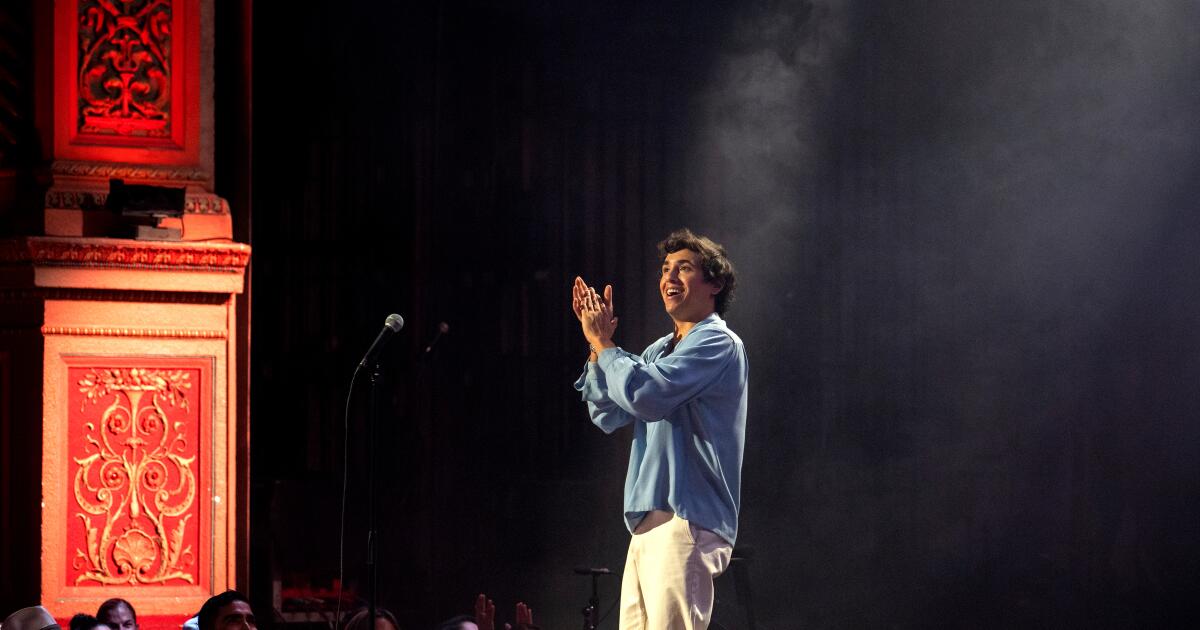
‘SNL’ star Marcello Hernández to host 2026 ESPYs as show leaves L.A. for New York


US House passes Iran war powers resolution in rare moment of Trump backlash


House votes to rein in Trump on Iran as war loses GOP support


Police investigate deadly stabbing in Tarzana; suspect in custody


Detroit Tigers sweep Tampa Bay Rays in win as Dillon Dingler stays hot


Retired San Francisco firefighter dies from lung cancer after Blue Shield denies treatment claims


Trackdown: Dallas 7-Eleven robbery suspect wanted

