California
Trump Won This Latino California District; Now Independents Will Decide Who Holds It


Assembly District 36 covers some of California’s most remote and geographically extraordinary terrain, stretching across all of Imperial County and a large portion of Riverside County, with a small slice of San Bernardino County. The district includes the cities of Indio, Coachella, Blythe, and Needles in Riverside County; portions of the City of Hemet; and the Imperial Valley cities of Calexico, Brawley, El Centro, Imperial, Calipatria, Holtville, and Westmorland.
Few districts can claim three borders. AD36 runs along the Mexico border to the south, the Arizona border to the east, and touches Nevada to the northeast.
Near Blythe, the ancient Blythe Intaglios, enormous figures etched into the desert floor by Indigenous peoples, are the best known of hundreds of geoglyphs found across the American West.
The district encompasses tribal lands belonging to the Quechan Tribe near Winterhaven, the Chemehuevi near Needles, and the Twenty-Nine Palms Band of Mission Indians.
El Centro, one of the few American cities located below sea level, is recognized as the birthplace and early home of the iconic singer, actress, and “Goddess of Pop,” Cher. In a twist that only California rock and roll could produce, the Sonny Bono Salton Sea National Wildlife Refuge sits entirely within AD36.
It’s also the home of the Empire Polo Club, host of the famous Coachella festival.
This year, the festival’s being held April 10-12 & 17-19, 2026, and will feature Sabrina Carpenter and Justin Bieber.
At last year’s festival, US Senator Bernie Sanders and Rep. Alexandria Ocasio-Cortez wrapped up their Fighting Oligarchy Tour on April 16, after a five-day, seven-stop sweep through the West that drew nearly 150,000 people—capping it off with an unexpected appearance at the Coachella music festival.
Sanders and AOC Wrap ‘Fighting Oligarchy’ Tour and Bernie Takes the Mic at Coachella US Senator Bernie Sanders and Rep. Alexandria Ocasio-Cortez wrapped up their Fighting Oligarchy Tour on April 16, after a five-day, seven-stop sweep through the West that drew nearly 150,000 people—capping it off with an unexpected appearance by Sanders at the Coachella music festival.
The climate in AD36 is definitely not for the faint of heart. Temperatures routinely exceed 110 degrees in summer, yet the district’s mild winters are exactly what make the Imperial Valley one of the most productive winter vegetable growing regions in the United States.

When the rest of the country is eating lettuce, broccoli, and carrots in January, there is a good chance it came from AD36.
The farming operations here hold some of the most senior water rights in the United States, and because the district encompasses both the Colorado River basin communities of Blythe and Needles and the intensively irrigated Imperial Valley, the representative for AD36 is a key player in Western water politics, in constant negotiation with the federal government and neighboring states.
The 2024 Imperial County Agricultural Crop and Livestock Report confirms cattle as a top commodity in the district, with a gross value of $546 million.
The Salton Sea, California’s largest lake by surface area, lies entirely within AD36 and sits atop one of the world’s largest known lithium deposits, found in geothermal brine beneath the valley floor. There has been an enormous push to turn the Imperial Valley into a global hub for electric-vehicle battery production, making this region one of the most closely watched economic stories in California.
The district was drawn to protect the political voice of its majority-Latino population under Section 2 of the Voting Rights Act, and its communities share deep concerns about water, the border, and the region’s economic future.
Demographics, Housing, and Cost of Living
According to the 2023 American Community Survey, Assembly District 36 has a total population of 486,764.
The district is 69.7% Latino, making it one of the most heavily Latino districts in California. White residents comprise 20.4%, Black residents 3.5%, and Asian residents 3%.
The citizen voting age population stands at 61.3%, with 26.8% of residents foreign-born and 13.3% classified as non-citizens.
Economic conditions in the district reflect significant hardship. The median household income is $66,802, with a mean household income of $88,932 and a per capita income of $28,343.
Approximately 14.9% of residents live below the poverty line, 7.8% lack health insurance, and 20.9% of households receive food assistance. Educational attainment is relatively low, with 17.7% of residents holding a bachelor’s degree and 5.8% a graduate degree.
Housing is predominantly owner-occupied at 66.4%, with 33.6% of homes renter-occupied. The median home value is $347,100, and the median monthly rent is $1,168.
The district’s 19,652 civilian veterans represent 5.5% of the population, a significant share that reflects both the region’s proximity to military installations and its strong tradition of military service.
23%of Voters Do Not Belong to A Major Party
As of December 30, 2025, Assembly District 36 had 258,071 registered voters. Democrats hold 40.9% of registrations, Republicans 29.1%, and No Party Preference voters 22.9%, with American Independent comprising roughly 4%. Democrats maintain a registration advantage of approximately 11.8 points, but that figure understates how dramatically the partisan landscape has shifted.
The Democratic advantage peaked at 17.3 points in 2022 and has contracted sharply since, falling to 13.6 points by the 2024 general election and further to 11.8 points by the close of 2025. Republican registration has climbed from 26.9% in 2022 to 29.1% today, while the Democratic share has slipped from 44.2% to 40.9% over the same period.
The growth of No Party Preference voters is significant. NPP registrations have nearly doubled in raw numbers since 2008, rising from roughly 22,000 to nearly 59,000, and their share of the electorate has grown from 15.2% to 22.9%. Nearly one in four voters in AD36 now belongs to no party. In a district where the Democratic registration advantage has been shrinking and top-of-ticket results have already flipped Republican, independent voters are not a secondary factor at all in this race.
They are central to the outcome.
The district’s partisan profile also varies considerably by county. Riverside County accounts for 62.4% of registered voters and leans Democratic by just 8.1 points. Imperial County, representing 36.4% of the electorate, carries a wider 19.1-point Democratic advantage. The small San Bernardino County portion, just 1.2% of registrations, actually leans Republican.
Trump and Harris Were Neck and Neck in 2024
The rightward movement in AD36 has been among the most pronounced of any majority-Latino district in California.
Donald Trump carried the district by 1.3% in 2024, winning 49.5% to Kamala Harris’s 48.2%, a striking outcome in a district where Democrats still held a registration advantage exceeding 13 points.
In the 2024 U.S. Senate race, Republican Steve Garvey edged Democrat Adam Schiff by 1.9%, 51% to 49%.
Republican Jeff Gonzalez defeated Democrat Joey Acuña by 3.6%.
The 2026 Race for Assembly
Gonzalez enters the 2026 cycle as the incumbent in a district his party captured just two years ago. Three Democrats have qualified to challenge him in the top-two primary.
Oscar Ortiz, an Indio City Councilmember who challenged Representative Raul Ruiz from the left in the 2024 congressional primary and finished fourth with 10% of the vote, came closest to winning the Democratic Party’s formal backing. He received 60% at the party’s pre-endorsement conference, falling short of the required threshold, and then 45% at the primary endorsement vote, also short of the mark. The California Democratic Party ultimately issued no endorsement in the race.
Tomas Oliva, a former El Centro City Councilmember who placed sixth in the 2024 Assembly primary and serves as a senior field representative for Representative Ruiz, and Ida Obeso-Martinez, an Imperial City Councilmember and cardiovascular nurse practitioner, have also filed.
Gonzalez closed 2025 with a commanding financial advantage, having raised $751,378 for the cycle and reporting $402,837 on hand. Among the Democrats, Ortiz led in total fundraising at $147,874 raised with $61,017 on hand, followed by Oliva at $89,587 raised and $63,569 on hand, and Obeso-Martinez at $73,059 raised and $24,659 on hand.
More About The Candidates
Jeff Gonzalez (Republican, Incumbent)
Jeff Gonzalez, born August 5, 1974, is a Marine veteran, former pastor, small business owner, and self-described first-generation American who became the first Republican to win this district in years when he prevailed in 2024.
Born in New Jersey and raised in Southern California, he enlisted in the Marines at 19 and served in counterintelligence and as an operations manager during deployments to Iraq and Afghanistan, earning the rank of chief warrant officer. He holds a bachelor’s degree in domestic security management from National University and a master’s in theology from Gateway University.
His path to elected office ran through a decade in ministry. Starting in 2007 as a volunteer campus coordinator at Saddleback Church, he moved to Southwest Church in Indian Wells six years later as outreach pastor and public relations director, then returned to Saddleback, serving congregations in San Diego and later Indian Wells. Along the way, he chaired the Marine Corps Counterintelligence Association and served on the board of Habitat for Humanity. He now owns a Spherion Staffing and Recruiting franchise.
Gonzalez first sought the Assembly in 2018, running against Democrat Eduardo Garcia in what was then the 56th district. He advanced out of the primary but lost the general election by a wide margin in a difficult year for Republicans statewide. When Garcia retired in 2024, Gonzalez ran again and won in a race that reflected the district’s dramatic rightward shift.
In the Assembly, he serves on the Aging and Long-Term Care, Agriculture, Arts and Entertainment, Higher Education, and Military and Veterans Affairs Committees, and is vice chair of the Water, Parks, and Wildlife Committee.
His early legislative priorities reflect the economic realities of this sprawling rural district. A bill to suspend the state’s 61-cent-per-gallon gas tax for one year drew on imagery he has used on the campaign trail, contrasting gas prices in Needles with those just across the Arizona border. “In rural and desert communities, a car is not a luxury. It’s a lifeline,” he said. “This is about affordability, this is about fairness, and this is about putting people before politics.”
He recently authored the Rural Farmworker Women’s Health Act, which would require the state health department to partner with local nonprofits to distribute free menstrual products to women in remote agricultural regions. “More than 100,000 women work in California agriculture,” he said. “Many are in rural areas with no easy access to stores or health services. They should not have to go through a full workday without basic hygiene products.”
CA bill aims to provide ‘dignity’ and free menstrual hygiene products to female farmworkers A new state bill looks to fill a crucial healthcare need for female farmworkers in rural agricultural areas across California.
He also authored a bill to expedite environmental review for the Coachella Valley Rail project, a proposed $1.5 billion passenger line between the valley and Los Angeles, potentially cutting its planning timeline by roughly two years if the measure passes.
“AB 1855 removes unnecessary roadblocks to expanding passenger rail on an already existing rail line, especially in communities that depend on driving,” Gonzalez said. The bill attracted bipartisan support, with Democratic Assemblymember Corey Jackson and Republican Assemblymember Greg Wallis among the co-authors.
On public safety, Gonzalez has been outspoken about the lasting harm of violent crime, at times speaking from personal experience. Joining Republican colleagues at a March 2026 press conference urging the parole board to deny release to a convicted child molester, he said, “This issue is not abstract for me. I understand firsthand the lifelong impact the abuse leaves behind. It doesn’t end when the crime ends. It follows you.” When opponents argued that the rising cost of housing aging inmates should factor into the decision, he dismissed the framing: “I don’t give a damn about the rising costs. I give a damn about these victims.”
In February 2025, Gonzalez joined the newly formed California Hispanic Legislative Caucus, which Republican lawmakers created after the Democratic Latino Legislative Caucus declined to admit them over policy differences on immigration.
“Californians want their legislators exchanging ideas across the aisle,” Gonzalez wrote at the time. “No more partisan exclusion!”
His platform also calls for eliminating taxes on groceries, passing what he describes as a major middle-class tax cut, hiring more teachers, and strengthening school safety.
He resides in Indio with his wife, Christine, and their four children.
Oscar Ortiz (Democrat)
Oscar Ortiz, born January 20, 1990, is an Indio City Councilmember, former mayor, and deputy director of Friends of the Desert Mountains, a nonprofit devoted to land conservation and environmental education in the region. Born in Mexicali and raised in Indio after his family immigrated when he was 3, he became a U.S. citizen at 17. He graduated at the top of his class from Indio High School and went on to earn a chemistry degree from Stanford University in 2012, where his coursework included research on bioterrorism defense. He subsequently built a career in the pharmaceutical industry before moving into environmental nonprofit work.
First elected to the Indio City Council in 2018 at 28, Ortiz became the youngest person ever to hold that office, unseating an incumbent in the process. His tenure included serving as mayor in 2023 and steering the city through the COVID-19 pandemic and the damage caused by Tropical Storm Hilary, while advancing affordable housing, bilingual community outreach, and support for small businesses. He was appointed to a second council term in 2022 without opposition and currently chairs the Coachella Valley Association of Governments Energy and Sustainability Commission. In the 2024 congressional primary, he challenged Representative Raul Ruiz from the left, finishing fourth with 10% of the vote.
“I’m running for State Assembly to raise the concerns of workers in our state,” he said when announcing his candidacy. “Our families are struggling to keep up with the rising costs of rent and the ever-increasing costs of health care and insurance rates.” He has also called for new approaches to persistent regional challenges. “We need representatives who are willing to bring bold, innovative solutions to solve the increasingly complex challenges facing our region,” he said.
His platform centers on housing affordability, expanded healthcare access in a district with too few specialists and mental health providers, and building regional economic strength through clean energy and union labor. He has also emphasized the contributions of domestic and care workers.
Upon receiving the endorsement of United Domestic Workers of America, he said:
“Home and child care workers are the backbone of our communities. They show up every single day to care for our children, our seniors, and our neighbors with disabilities, often without the recognition or compensation they deserve. As your Assemblymember, I will fight to ensure these essential workers have the wages, benefits, and respect they have earned.”
His endorsers include the California Federation of Labor Unions, the Inland Empire Labor Council, United Domestic Workers of America, the California Teachers Association, the California Federation of Teachers, SEIU California, the California Legislative Progressive Caucus, IBEW locals 440 and 569, Painters and Allied Trades District Council 36, and California Environmental Voters.
Ortiz is the leading Democratic fundraiser in the field, having raised $147,874 with $61,017 on hand at year-end 2025. He resides in Indio.
Tomas Oliva (Democrat)
Tomas Oliva, born September 11, 1984, is a former El Centro City Councilmember, adjunct professor at Imperial Valley College, and senior field representative for Representative Raul Ruiz.
His family moved to El Centro when he was young to be near relatives in Mexicali, after his father became too ill to work. His mother transitioned from homemaker to breadwinner, earning a graduate degree and spending more than two decades as an elementary school educator in the Imperial Valley.
Growing up on food stamps and public assistance, Oliva has drawn directly on that experience in his campaign.
“I’m not another out-of-touch politician,” he has said. “I’m a kid from El Centro who grew up on food stamps and government assistance. I know firsthand policy is personal.”
Oliva earned a bachelor’s degree in political science from UC San Diego and a master’s in public administration from San Diego State University.
His public service career began as a Polanco Fellow placed in the California Attorney General’s Office and the State Assembly. He subsequently managed Assemblymember Manuel Perez’s 2008 campaign, worked for the Superior Court of California in Imperial County, and served as a regional affairs officer for the Southern California Association of Governments from 2011 to 2015. He has since worked as a field representative in the offices of Representatives Juan Vargas and Raul Ruiz, taught adjunct courses at Imperial Valley College since 2016, including classes for incarcerated students at Centinela State Prison and Calipatria State Prison, and serves as a board trustee at El Centro Regional Medical Center. He chaired the Imperial County Democratic Central Committee in 2021.
Oliva served on the El Centro City Council from 2018 through March 2025, including a term as mayor. He considers his most consequential act in office to be overseeing the merger of the El Centro Regional Medical Center into the Imperial Valley Healthcare District, preserving hospital services for tens of thousands of residents.
His resignation in March 2025 came after he concluded that other council members were taking steps that jeopardized that merger’s future.
“My resignation is the loudest alarm I could ring to make residents aware of the concerning direction this new council is taking, particularly when it comes to the future of our healthcare system,” he said. His departure also came ahead of a likely censure vote.
Oliva placed sixth in the 2024 AD36 primary with 7.5% of the vote.
His priorities include protecting rural hospitals through better Medi-Cal reimbursement rates and expanded physician residency programs, sustaining the Salton Sea mitigation plan, creating an equitable economic framework for the Lithium Valley that channels revenues back to affected communities, and building out transit infrastructure connecting the Coachella Valley and Imperial Valley.
Oliva opposes data centers.
“As an Assemblymember I will call for a statewide moratorium of data center developments across the state…The safety of our people and our neighbors cannot be an afterthought this is unacceptable.”
He has also pushed back against what he considers distorted narratives about border communities and President Trump’s effort to end automatic birthright citizenship. “Our hospitals are not being inundated by Mexican nationals,” he said in May 2025. “If you’re pregnant, you’re probably not going to get a visa. It’s a false narrative.”
Oliva had raised $89,587 with $63,569 cash on hand as of December 31, 2025. He resides in El Centro.
Ida Obeso-Martinez (Democrat)
Ida Obeso-Martinez, born May 6, 1979, is an Imperial City Councilmember, former Mayor Pro-Tem, and cardiovascular nurse practitioner at Imperial Cardiac Center.
A lifelong resident of Imperial County, she completed her nursing education at Imperial Valley College, the University of Phoenix, and ultimately the University of Arizona, where she earned a doctorate in nursing practice.
She spent more than two decades in emergency and intensive care nursing in Imperial Valley hospitals before specializing in cardiovascular care, has contributed to peer-reviewed medical journals, and sees more than 35 patients on a typical day, the majority of whom rely on Medicaid.
Elected to the Imperial City Council in 2022, she has also served as Mayor Pro-Tem and mayor. In September 2024, she was chosen as board director and division representative for the League of California Cities, Imperial County Division.
Her council record reflects a consistent focus on public health and community quality of life. In December 2023, she helped shepherd a smoke-free ordinance through the council that bans tobacco use at city-owned outdoor venues, including parks, playgrounds, and public events.
In February 2026, she announced $1.5 million in federal funding for a new regional park, secured with the assistance of Representative Ruiz and Senator Schiff. “Their dedication to improving quality of life for our residents will leave a lasting legacy,” she said.
She has also led the city’s legal battle against Imperial County’s approval of a data center without environmental review under CEQA, arguing that residents deserve full transparency and enforceable protections. “The City of Imperial remains committed to the pursuit of a concise and public process,” she said. “Residents of this region deserve nothing less.”
In March 2025, Representative Ruiz brought Obeso-Martinez to Washington, D.C. as his guest for President Trump’s Joint Address to Congress, where she advocated against Medicaid cuts.
“As a lifelong advocate for expanding health care access in the Imperial Valley, I am here to stand against Medicaid cuts that would limit the care our health facilities can provide to patients,” she said.
Her endorsements include Assembly Speaker Robert Rivas, Representative Ruiz, and Assemblymember Sharon Quirk-Silva. Obeso-Martinez had $73,059 raised and $24,659 on hand at year-end 2025 and resides in Imperial with her husband, Omar.
Independent Voters and an Unsettled Primary
No Party Preference registrations in AD36 have grown from 15.2% of the electorate in 2008 to 22.9% today, a gain of more than 36,000 voters in raw numbers. These 59,000 unaffiliated voters will play a pivotal role in shaping the outcome of both the June primary and the November general election.
In 2024, NPP voters in the district were part of a broader rightward wave that carried President Trump to a narrow victory here and helped Gonzalez flip the seat from blue to red. The question hanging over 2026 is whether that alignment will hold. Trump’s immigration enforcement policies have had direct and visible consequences in a district that runs along the United States-Mexico border, where many residents have family ties on both sides and where immigrant labor is the backbone of the agricultural economy. Whether the independent voters who supported Gonzalez in 2024 were casting a vote for him specifically, for Trump’s agenda broadly, or simply against the status quo is a question that 2026 may answer.
For Gonzalez, who has tried to cultivate a bipartisan identity and distanced himself from purely partisan messaging, the challenge will be holding NPP voters who may be uneasy with the administration’s direction. For the three Democrats in the field, the opportunity lies in making the case that those same voters have reason to reconsider. With no party endorsement unifying the Democratic side and a crowded primary ballot, how NPP voters distribute their support across the field will be among the defining questions of the race.
About the 2026 California Top Two Primary
The last day to register to vote for the June 2, 2026, Primary Election is May 18, 2026. All active registered voters will receive a vote-by-mail ballot. Ballots will begin mailing on May 4, and drop-off locations will open on May 5. Early in-person voting begins May 23 in Voter’s Choice Act counties. Vote-by-mail ballots must be postmarked by Election Day and received by June 9.
This article draws on publicly available information from the California Secretary of State, the California Target Book, California FPPC campaign finance filings, the U.S. Census Bureau’s American Community Survey, Ballotpedia, the Imperial Valley Press, The Desert Sun, CalMatters, and other local and regional reporting.



California
Forest Service workers held hostage at gunpoint by father, son in CA forest for hours: Authorities

SISKIYOU COUNTY, Calif. — Law enforcement in far Northern California’s Siskiyou County announced the arrests of a father and his adult son in the alleged kidnapping of two U.S. Forest Service workers, who are now safe and free.
The sheriff says they got a call around 10:55 a.m. Thursday from the Forest Service that a man had taken two Forest Service employees hostage in a very remote area.
The 49-year-old suspect had zip-tied the two Forest Service workers, holding them at gunpoint for nearly 15 hours in a trailer near Gumboot Lake in the Shasta-Trinity National Forest, officials said.
The suspect indicated he wanted to speak with the FBI, but it remains unclear why. Officials are still investigating motives for the kidnapping.
A huge contingent of law enforcement moved into the area. The FBI’s Hostage Rescue Team arrived on a Boeing 757 from Quantico as snipers, SWAT teams, bomb units, and drones were deployed.
Dashcam footage shows armed officers in tactical gear hitching a ride from a passing pickup truck.
Eventually, after many hours of negotiating, the two Forest Service workers were released just before 2 a.m. and are now safe at home.
The suspect and his adult son came out and were arrested at around 2:30 a.m.
The father will be charged with kidnapping a federal employee. In the trailer, he had an AR-15, knives, and claimed to have grenades.
It’s unclear if the trailer was his, but it did not belong to the Forest Service.
ABC7 Eyewitness News contributed to this story.
Copyright © 2026 ABC News Internet Ventures.
It lurks ominously beneath California’s many natural wonders, a reminder that nothing in this landscape is truly permanent.
It’s been described as “the mother of all earthquake faults,” the source of both our geological birth and, perhaps, our ultimate undoing.
But the most unnerving thing about the San Andreas fault these days may be its silence. It’s a mystery scientists are still trying to unlock.
The San Andreas is central to any discussion of California. It’s the massive 800-mile spine of the state, trundling up the Coachella Valley to the San Gabriel Mountains, and pushing along the edge of Silicon Valley to beyond the Golden Gate.
There is no simple answer for why California’s longest fault, responsible for some of America’s most powerful earthquakes, has produced so few in the last century.
But it is clear that the quiet period is only increasing strain on the San Andreas, as well as on the state’s second-longest fault, the San Jacinto.
A new study underscores the concern. Researchers estimated that key sections of the fault in Southern California are at their highest level of tectonic strain in the last 1,000 years.
The San Andreas, in other words, is locked, loaded and inevitable.
A red-hot San Andreas
Tectonic stress on these sections of the San Andreas and San Jacinto faults is high — shown in red — a product of no significant quakes on them for more than a century. At the Cajon Pass, sections of the faults are at their highest strain in 1,000 years, calculations suggest.
Average tectonic stress, in megapascals
Liliane Burkhard / University of Bern / University of Hawai’i at Manoa; Statewide California Earthquake Center Community Fault Model
Sean Greene LOS ANGELES TIMES
Ticking tectonics
There are generations of Californians who have never experienced the fury of the San Andreas.
The fault was responsible for a megaquake that ripped through the then-sparsely populated state in 1857 — an event that, if repeated today, would reap mass destruction.
In 1906, “a crack in the edge of the world,” as author Simon Winchester described it, flattened San Francisco.
Modern Californians have been forced to make do with Hollywood’s CGI versions of the fault, which cast it as one of our state’s darkest villains.
But sooner or later, scientists say, California’s earthquake faults will rupture in a way not seen in the modern era. While California has seen sizable temblors since the great San Francisco quake of 1906, the state’s faults are capable of producing intense shaking over a much larger area than seen during more modern events such as the Sylmar, Loma Prieta or Northridge quakes.
“We keep accumulating that earthquake energy, and it has to be released. And the only way it gets released is through large earthquakes,” said U.S. Geological Survey geologist Kate Scharer, one of the new study’s co-authors. “The small ones don’t really do it.”

A section of the California Aqueduct crisscrosses the San Andreas fault dozens of times.

-
Share via
The latest study, published last month in the Journal of Geophysical Research: Solid Earth, set out to create a model that calculated the seismic strain on three key segments of the San Andreas and San Jacinto faults where they intersect at the Cajon Pass in San Bernardino County.
The model is based on a number of factors: the estimated timing of earthquakes on the faults over a record of the last 1,000 years; satellite observations of how fast tectonic plates are moving; and estimates of how rigid Earth’s crust is, which determines how much stress can be accommodated and then released, Scharer said.
The computer model “found that tectonic stress has now reached higher levels than at any point in that entire record. From the model, we see that the conditions that historically preceded large joint ruptures crossing both fault systems are now approaching,” said Liliane Burkhard, the lead author of the study and a scientist at the University of Bern in Switzerland and the Hawaii Institute of Geophysics and Planetology at the University of Hawaii.
The last major temblor to strike urban Southern California, the magnitude 6.7 Northridge earthquake of 1994, resulted in severe damage and the deaths of about 60 people. But it was also mostly limited to a relatively small area of Los Angeles County.
By comparison, a hypothetical magnitude 7.8 earthquake on the southern San Andreas would simultaneously bring violent shaking to L.A., Orange, Riverside, San Bernardino, Ventura and Imperial counties and could result in 1,800 deaths, according to a U.S. Geological Survey estimate published in 2008.
The findings of the latest study don’t change the overall expectation of a big earthquake hitting Southern California. But they underscore the persistent risk — as well as the possible scale of the disaster.
There’s a 60% chance of a magnitude 6.7 or greater earthquake striking the Los Angeles region by 2045, according to USGS estimates published in 2015. There’s about a 1 in 5 chance of such a quake striking on the San Andreas fault within L.A. County and the Inland Empire.
Why the drought?
The decades-long relative earthquake drought “is an unusually long interseismic period, and stress has been accumulating continuously throughout,” Burkhard said.
The authors created a 28-second animation, showing how tectonic strain increased along the faults over the last 1,000 years. Big earthquakes then release that strain, before the cycle starts again.

This animation condenses 1,000 years of the Cajon Pass’s earthquake history into 28 seconds. Tectonic stress, shown in shades of orange and red, builds up along three fault segments. Following an earthquake, that stress is released. (Liliane Burkhard / University of Bern / University of Hawai’i at Manoa)
The study calculated that the San Andreas fault just northwest of the Cajon Pass and the San Jacinto fault just southeast of the pass are at their highest tectonic strain since the year 1100.


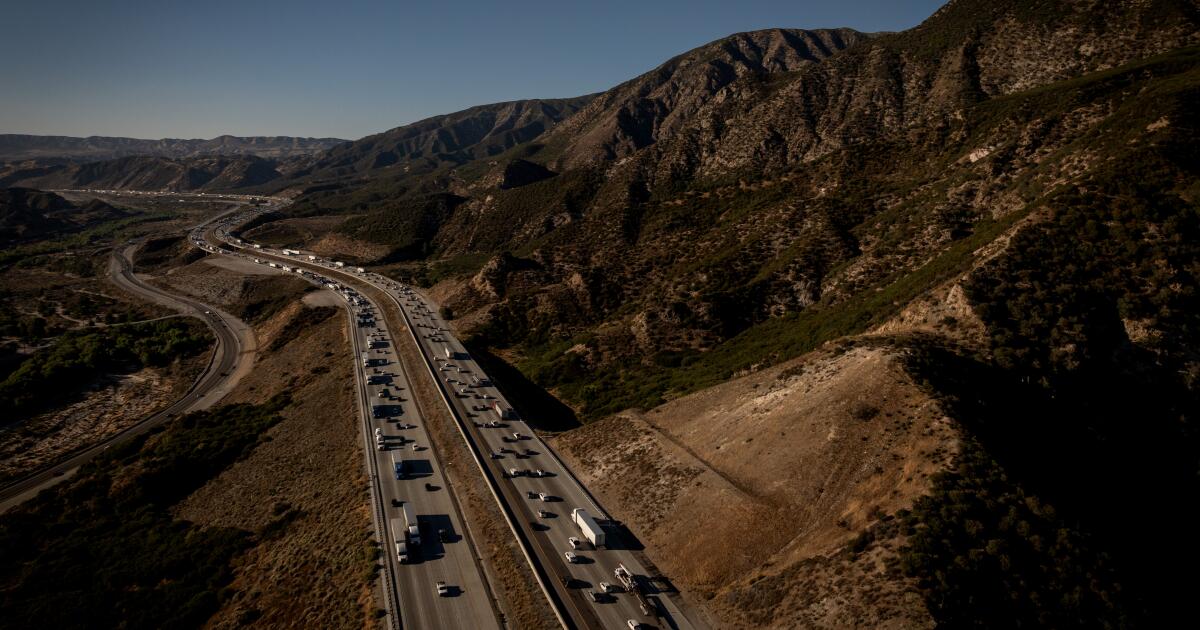
The pass, located roughly 50 miles northeast of downtown Los Angeles, marks the dividing line between the San Gabriel Mountains to the west and the San Bernardino Mountains to the east.
Specifically, the study’s authors calculated that the current tectonic stress was 2.8 megapascals on the San Andreas northwest of the pass, surpassing the previous highs of 2.7 just before big quakes in 1469 and 1691.
For the San Jacinto, the authors calculated a current seismic stress of 3.6 megapascals, surpassing the previous high of 2.9 before an earthquake in the year 1249.
The study noted that it has been an unusually long time since a megaquakes has hit Southern California. The San Andreas fault northwest of the Cajon Pass usually has big quakes every 100 to 150 years, Scharer said, though intervals of about 200 years are not unheard of.
On the San Andreas southeast of the pass, big quakes usually happen every 200 to 250 years. But the most recent quake on the San Andreas along the Salton Sea, close to the Mexican border, was about 300 years ago.
There are some limitations to the study’s model, scientists acknowledge. For instance, the model presumes that when large earthquakes hit, all the tectonic stress that had been accumulated in the fault gets released, “so you start at a ground state of zero and then you accumulate back up until you have that next big event,” Scharer said.
But whether all that stress actually gets released during a big quake is not definitively known.

The Mormon Rocks in Phelan, Calif.
Tectonic risks
Whenever it strikes, a supersized earthquake on the southern San Andreas would be like no earthquake seen in living memory in California.
The 1857 quake, estimated to be a magnitude 7.9, produced 63 times more shaking energy than the 1994 Northridge earthquake, and across a much larger swath of the state.
In 1994, “violent shaking,” or Level 9 on the Modified Mercalli Intensity Scale, causing great damage in substantial buildings, affected only part of the San Fernando Valley.

But a magnitude 7.8 San Andreas quake hypothesized by the USGS in its 2008 ShakeOut scenario would cause that kind of shaking across Southern California.
In 1994, emergency responders from across Southern California were able to focus the bulk of their efforts on especially hard-hit areas. That wouldn’t be possible in a regionwide disaster.


It might be tempting for Californians to tune out talk of the “Big One” after hearing about it for most of their lives. But generational catastrophes do strike — be they an earthquake in San Francisco in 1906, a hurricane in New Orleans in 2005 or tsunamis in the Indian Ocean in 2004 or Japan in 2011.
Tectonic rewards
Earthquakes are part of the bargain of living in California, a product of the same forces that allow people to ski and surf on the same day. The same tectonics that drive earthquakes act as the state’s landscape artists, said Julian Lozos, associate professor of geological sciences at Cal State Northridge.
“Because we are on the edge of the continent, we’re on a plate boundary, and have been a plate boundary for a couple hundred million years. There’s constantly been stuff crashing into North America, and getting stuck to it, and getting uplifted, and erupted through, and slid around,” Lozos said.
The Sierra Nevada, California’s mightiest mountain range, “are the guts of the volcanoes that used to be there when there was a subduction zone … and then when those volcanoes stopped erupting, the guts of them lifted up through the crust,” Lozos said.

Big Pines Highway rises out of a valley to ride a ridge created by the tectonic forces of the San Andreas fault, two miles southeast of the unincorporated Mojave Desert community of Valyermo, home to about 450 residents.
The same forces that produce earthquakes are also what led gold to form in the Sierra foothills, inciting the state’s famous rush.
Tectonic movement also created today’s Central Valley, a highly productive agricultural area that was once part of the ocean, then an inland sea, and then a freshwater lake, Lozos said.
“Everything about what we see here is stuff that formed because of that plate boundary then, and it’s getting moved around by the plate boundary now,” Lozos said. “And so if we didn’t have anything like that, we would be Nebraska.”
But the risks, like the rewards, are significant. The San Andreas runs right through cities in the Inland Empire. The Los Angeles Basin is also at risk.
If an earthquake on the San Andreas comes from the south and heads north, it would shuttle all that shaking energy “right into downtown,” Lozos said, causing shaking that could last two to three minutes.
“Geologically, L.A. is a bowl of Jell-O. It is a hard rock bowl full of really soft, squishy stuff that shakes very easily,” Lozos said.

It is business as usual at the Wrightwood Inn on a recent Tuesday night. According to a recent study, seismic pressure has been gradually building in the area for more than a century.
It’s not certain why it’s been so quiet between earthquakes, said Scharer. Another study, published in 2023, suggested the lack of sudden, major floodwaters funneling into Lake Cahuilla, the larger historical predecessor to the Salton Sea, may have something to do with it.
Scharer said the study’s results are a good reminder to prepare for the next big earthquake.
To be sure, the computer model’s results are not a prediction, and all models have their limitations and uncertainties. Still, its suggestion that the fault systems are “more loaded than at any point in the 1,000-year record,” Burkhard said, “is a finding worth taking seriously.”
“In the end, the most important message is a simple one: Let’s make sure we are prepared,” she said.

A new poll in the race for California Governor shows Democrat Xavier Becerra is leading Republican Steve Hilton by a wide margin — 61% to 36%.
Becerra leads Hilton across several demographics: age, gender, homeownership, income, racial/ethnic groups and across the state’s major regions.
The poll also found 85% of likely voters say that the gubernatorial candidates’ positions on the environment are important — 60% of Democrats call it “very important,” compared to 29% of Republicans.
The poll surveyed 1,578 California adults from June 29 through July 6 and was conducted by the Public Policy Institute of California. The poll was conducted in English and Spanish, and 1,003 of those who were polled were likely voters.
The same poll found that a large majority of Californians do not want new data centers built in their area. Only about a quarter of those surveyed are in favor of the construction of data centers.
The PPIC survey focused on Californians and the environment.
Another key finding was that Californians are most likely to name wildfires as the top environmental issue facing the state today, followed by climate change, government overregulation and water supply. Of those polled, about six in 10 think that the state and local governments are not doing enough to address wildfires.
The California General Election will be held on Nov. 3, 2026.
Copyright © 2026 KABC Television, LLC. All rights reserved.
-

 Dallas, TX4 minutes ago
Cowboys news: Dak Prescott embraces high expectations in Dallas
-

 Miami, FL10 minutes ago
How to watch France vs. England in the third-place FIFA World Cup match: TV channel, streaming, kickoff time
-

 Boston, MA16 minutes ago
Police investigating deadly shooting in Allston – Boston News, Weather, Sports | WHDH 7News
-

 Denver, CO22 minutes ago
Former strip club owner selling Castle Pines mansion for $8M
-

 Seattle, WA28 minutes ago
‘Imagine you crushed a raccoon like a can’: Curley describes viral deformed ‘mutant’ Jimothy – MyNorthwest.com
-

 San Diego, CA34 minutes ago
More than 800 birds rescued from Valley Center property
-

 Milwaukee, WI40 minutes ago
Milwaukee Weather: Chance morning shower, afternoon smoke returns
-

 Atlanta, GA46 minutes ago
This is the world’s No. 1 busiest airport. Here’s why | CNN

