Northeast
'Bling Bishop' lashes out at FBI after being convicted of fraud, attempted extortion, lying to feds

Lamor Whitehead, a Brooklyn preacher nicknamed the “Bling Bishop” for his ostentatious clothes and flashy cars, claimed Tuesday that his conviction for defrauding an elderly parishioner and trying to extort a business owner was part of a larger scheme by the FBI of trying to make him become an informant against New York City Mayor Adams.
Whitehead, 45, posted a video message to his 1.3 million followers on Tuesday from inside his Rolls-Royce, saying he refused to dish on Adams to the FBI. Adams’ campaign has faced a federal corruption investigation.
“This wasn’t about me…. I was not going to be an informant for the FBI against NYC Mayor Eric Adams,” Whitehead wrote in the caption of the video.
“This was politically driven,” Whitehead said. “This was about Mayor Eric Adams.”
BROOKLYN’S ‘BLING BISHOP’ LAMOR WHITEHEAD DENIES STEALING FROM PARISHIONER’S MOTHER ON DAY 1 OF FRAUD TRIAL
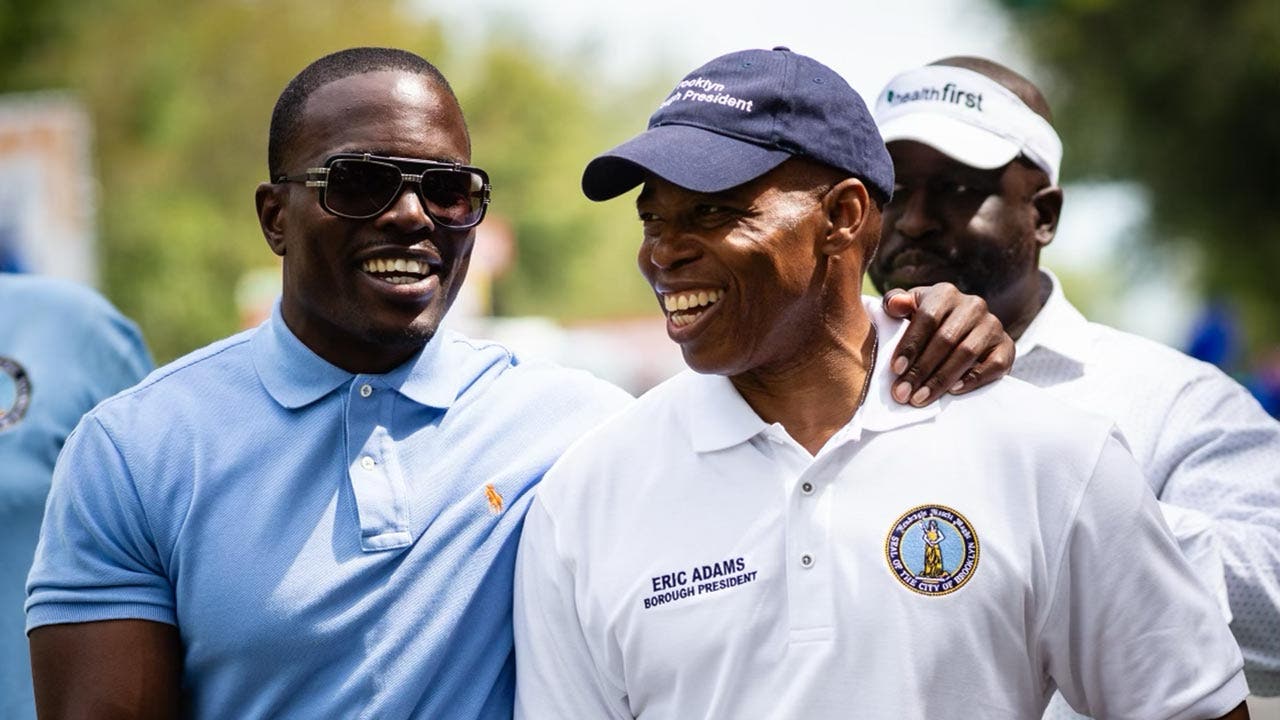
Lamor Whitehead, left, with Eric Adams, then Brooklyn borough president, walking at the West Indian Parade in Crown Heights, Brooklyn, on Sept. 5, 2016. (Stefan Jeremiah)
Whitehead was found guilty on five counts, including wire fraud, attempted extortion and making false statements to federal law enforcement agents, according to the U.S. Attorney’s Office in the Southern District of New York.
Whitehead was convicted of inducing Pauline Anderson to invest around $90,000 of her retirement savings with him by promising to use the money to help her buy a home.
Instead, prosecutors say Whitehead splashed the money on luxury goods from Louis Vuitton and Foot Locker as well as car payments. When Anderson demanded to be paid back, Whitehead lied to avoid returning the money, the U.S. Attorney’s Office said.
Whitehead also extorted Bronx auto body shop owner Brandon Belmonte for $5,000 and then attempted to convince the businessman to lend him $500,000 and give him a stake in certain real estate transactions in return for favorable actions from Adams, even though prosecutors say Whitehead knew he could not obtain the favors he promised, prosecutors said.
NYC BISHOP ROBBED OF $1M IN JEWELRY MID-SERMON FILES $20M LAWSUITS AGAINST SOCIAL MEDIA CRITICS CLAIMING HOAX
Whitehead, of Paramus, New Jersey, faces decades in prison.
“Bling Bishop” Lamor Whitehead, left, was convicted of wire fraud on Monday but claims that the trial arose after he refused to become an FBI informant against Mayor Eric Adams, right. (Instagram/ @iambishopwhitehead)
“As a unanimous jury found, Lamor Whitehead abused the trust placed in him by a parishioner, tried to obtain a fraudulent loan using fake bank records, bullied a businessman for $5,000, tried to defraud him out of far more than that, and lied to federal agents,” U.S. Attorney Damian Williams said.
“Whitehead’s reprehensible lies and criminal conduct have caught up with him, as he now stands convicted of five federal crimes and faces time in prison.”
Whitehead claimed he was “targeted” and vowed to appeal.
He said the FBI showed up to his home on June 8 looking for information on the mayor and told him he was not under arrest but that they had a search warrant to take his phone.
“And what they said to me, was, ‘we don’t want you, we want the mayor of New York [City],’” he said. “And just because I was not going to be a federal informant… the FBI said they [were] going to make my life a living hell, and that’s what you guys are seeing.”
Whitehead said he is innocent. The FBI investigation into Adams burst into the public domain in November when the home of one of his campaign consultants was raided.
The FBI told Fox News Digital it would not be commenting on Whitehead’s claims.
Bishop Lamor Whitehead speaks during a news conference in Brooklyn on July 29, 2022. (Theodore Parisienne/New York Daily News/Tribune News Service via Getty Images)
In a July 2021 Instagram post, Whitehead posted a collage of photographs of himself with Adams before Adams assumed office, writing, “Congratulations to my mentor, friend and someone who I can say really help me become a man!”
Whitehead had sought to follow in Adams’ footsteps by becoming the Brooklyn borough president. But Adams would not endorse Whitehead and admonished him for using his name in a “misleading” campaign ad, according to the New York Times, citing text messages prosecutors showed during the trial.
Whitehead sought Belmonte to give him a loan of $500,000 while promising him access to Adams.
One of Whitehead’s lawyers played down his client’s relationship with Adams at the trial, saying that he could get a meeting with Adams “faster than most people” – and that statement, he contended, was true. But prosecutors also showed messages from Whitehead to Adams in early 2022 that went unanswered, the New York Times reports.
Adams told reporters last month that legal filings by the prosecution “stated that clearly [Whitehead] did not have authorization and there was no connectivity to the actions of [the] mayor or borough president.”
At a press briefing earlier today, Adams said he had no part in the investigation and that prosecutors in the case said there were “no benefits coming from government.”
Pauline Anderson, meanwhile, said she trusted Whitehead to buy her a house since she could not afford one due to low credit.
“He was a man of God,” she said, according to the New York Times. “I believed him as the leader of his church.”
“Bling Bishop” Lamor Whitehead claims that his trial arose after he refused to become an FBI informant against Mayor Eric Adams. (Instagram/@iambishopwhitehead)
Whitehead has previous criminal convictions for identity theft and grand larceny, which resulted in a five-year prison stint.
He became a bishop when he founded the Leaders of Tomorrow International Ministries in 2013.
The Brooklyn preacher owns a $1.6 million home in Paramus, New Jersey, and an apartment in Hartford, Connecticut.
Whitehead has been free on $500,000 bail since his arrest, which came only months after he was the victim of a robbery when $1 million in jewelry was stolen from him by gunmen who surprised him during a church service.
Fox News’ Maria Paronich, Chris Pandolfo and The Associated Press contributed to this report.
Read the full article from Here


For 30 years I have lived in Boston, and for 30 years I have remained baffled by one thing.
Not the rotaries (those make sense). Not the lack of happy hour. Not the unwritten rules of snowstorm space-saving.
The coffee.
Specifically: Dunkin’.
Why does Boston run on coffee that doesn’t taste like coffee? Dunkin’s tastes like burned sweet potatoes. And yet the franchise is so much a part of our local fabric that when Cardi B played TD Garden last week, she addressed the crowd: “Boston! You Dunkin’ Donuts eating [word that definitely can’t be used here], how we doing toniiiiight?” I’m sure Ben Affleck was dancing somewhere in the crowd, wearing a Red Sox jersey.
I grew up in New York, believing that if the Yankees suck, it is only in occasional relation to the Mets, and totally unaware of Dunkin’s regional chokehold just a few hours north. Dunkin’ has a strong presence in my home state, but in Massachusetts it has main character energy. When I moved here, I discovered that this chain appeared to be a religion. A cult? Would that be overstating things? All around me people were chugging iced coffee in the dead of winter (often while wearing shorts), and “regular” coffee came with cream and sugar by default. I had chosen a new home where light and sweet were the palate’s preference, and I had to put my dark and caustic expectations on a shelf.
I understand Dunkin’ was founded here, in Quincy in 1950. That’s history and local pride. But Starbucks got its start in Seattle in 1971. You don’t see Bill Gates appearing in its ads. The general populace doesn’t call it “Starbs.” Last year, in fact, The Seattle Times ran a story with the headline “Starbucks’ popularity has waned the most in hometown Seattle.”
After I had lived in Boston for about a decade, I had a eureka moment: Bostonians don’t like coffee. Bostonians like caffeine, a bargain, and a beverage that tastes like dessert.
With this thought came acceptance, and after that I mostly ignored Dunkin’ discourse — until last month. Then Health Secretary Robert F. Kennedy Jr. called out Dunkin’ for being unhealthy. “We’re going to ask Dunkin’ Donuts and Starbucks, ‘Show us the safety data that show that it’s OK for a teenage girl to drink an iced coffee with 115 grams of sugar in it,’” he said. “I don’t think they’re gonna be able to do it.”

Never mind that the average consumer of such a beverage in Boston is a burly middle-age construction worker. Never mind that I’ve yet to see compelling safety data showing it’s OK for a teenage girl to contract measles after forgoing vaccination. There are only a few drinks on Dunkin’s lengthy menu with at least 115 grams of sugar, according to its easily accessed Nutrition Guide — mostly large frozen coffees that max out at 172 grams, a gobsmacking amount of sugar that would turn me into a gerbil on a wheel if I consumed it one sitting, though I’d probably pass out from brain freeze first.
Each time RFK Jr. brings up the unhealthiness of the American diet, a “see, you can’t dismiss the guy, he’s right about some things!” think piece gets its wings. And each time I read one of these, I lose my schnitzel (fried in tallow, of course). We already know nutrition policy needs reform, and I can’t think of another figure who has gotten so many plaudits for stating the obvious about public health, while taking so many measures that could endanger it.
So I felt a bit salty about this attack on sugar. And Boston felt very salty about this attack on Dunkin’. When Bostonians act extra Boston-y, I often admire the spirit without fully sharing the viewpoint. Not this time. This time I was in perfect agreement.
And then I saw it: On Instagram, Massachusetts Governor Maura Healey had posted an image inspired by a flag from the early days of the Texas Revolution. In place of a cannon, Healey’s post featured a Dunkin’ cup, but the words remained the same: “Come and take it.”
No confiscation without representation. You can pry our iced coffee out of our cold dead hands. I felt a surge of pride. Boston pride. I want to live in a city and state where politicians stand up for what is ours — be it a drink so sugary no mere mortal can withstand it, or legal rights that pertain regardless of immigration status, or trans kids’ ability to determine who they are and live accordingly.
And I felt the perverse urge to transgress.
I walked to the closest Dunkin’, all of three minutes away. I needed all the steps I could get if I was going to drink a vanilla bean Coolata, the sugariest drink on the roster that I could contemplate actually consuming. A large clocks in at 167 grams of total sugar, 150 of them added, which in a more rational moment I believe is an anti-consumer hate crime. That suddenly seemed beside the point.
I placed my order. The Coolata was just the start. I also experienced, for the first time, the thrill of ordering an iced coffee “extra extra.” (For a small, this turns out to include four sugars and four creams.) And, in a nod to moderation, I added a small regular.
I took a sip of the Coolata, a slush as white as the driven snow. (I had ignorantly assumed there would be coffee in there somewhere, but no.) I took another sip, and another. An icy dagger pierced my head. My heart rate skyrocketed. But worst of all, I had to taste the stuff. Nothing should ever, ever be this sweet.
The iced coffee, by comparison, was drinkable. Until my straw touched down in the drift of crunchy sugar strewn over the cup floor. Extra extra is too extra for me.
Then I sipped my small regular. It was still way too sweet. It was also way too creamy. And it still tasted like burned sweet potatoes. It was perfect. I loved it. It tasted like home.
Devra First can be reached at devra.first@globe.com. Follow her on Instagram @devrafirst.


The faulty hydrants after a recent fire in Waterbury are raising questions about how they’re maintained and what the guidelines are.
“It was horrific, because I was sleeping and I was woken out of my sleep,” Michele Philips, a neighbor, said.
It was a scary situation for her, seeing her neighbor’s home on fire on Bennett Street early Tuesday morning, and it was even more frightening when she saw the firefighters struggling to get a nearby hydrant to work.
“No water came out of it at all,” she said.
City officials say multiple hydrants had water flow issues before firefighters found one that was working properly on a different street farther away. That caused a 20-minute delay and is leading to concerns in the community.
“If that happened to us, what would have happened to my own house, and say if the fire had spread,” Philips said.
Waterbury Mayor Paul Pernerewski said the issue likely stemmed from debris stuck in pipes more than 100 years old.
“We have very old pipes underground that eventually build up residue inside that slows the flow,” he said.
“Hydrants have about a 100-year lifespan. So there are a lot of hydrants, especially in your big four cities in Connecticut that are old,” Fire Chief Dan Coughlin with the New Haven Fire Department said.
Coughlin explained that hydrant maintenance varies by location, with no state law requiring a specific number of checks on public hydrants.
“It’s based on their needs, their manpower, for example, as well. So it’s different,” he said.
Coughlin said that in New Haven, hydrants are checked twice a year…and they work with their regional water authority for pressure testing.
“We flush them, we make sure we have good flow coming out of them. We don’t put a gauge on it to see the exact number that we’re getting out of there,” Coughlin said.
The National Fire Protection Association recommends hydrant flow tests every five years. Pernerewski said that he wants to go above that standard. Right now, city workers flush all hydrants every year, but he says they’ll also focus on water pressure testing after realizing that it hadn’t been done for over a decade.
“We’ll now have two folks who can go out and do the testing as well, and we can test while we’re flushing,” he said.
Along with water pressure testing, the mayor said he’s working with the fire department to bring back a color code indicating the pressure at each hydrant.
“Anything 1,500 gallons a minute or higher was painted blue. Green was for those between 1,000 and 1,500, and then red was for those 700 or less,” Pernerewski said.
Philips hopes these changes will mean they’ll have working hydrants.
“We’re talking about people’s lives, and you want to feel good,” she said.

Byron Allen’s “Comics Unleashed” replacing Colbert’s “Late Show”

SoMa residents file complaint with state, accusing SF of pushing unhoused resources to their area

CGY@DAL Postgame: Wyatt Johnston | Dallas Stars

Strong storm topples trees, damages homes in a Miami-Dade neighborhood, with days of cleanup ahead for residents

How RFK Jr. changed my mind about Dunkin’ – The Boston Globe

Florida High School Football Rankings: Top 25 teams – Oct. 21

How old is Bo Nix? What to know about Oregon quarterback ahead of 2024 NFL Draft

Cleary's 21 help Le Moyne down Central Connecticut State 69-64 in OT

99th annual Pony Swim held in Virginia

Indiana Members Credit Union announced as new anchor tenant at Bottleworks District

Democrat swing candidate called Biden’s border handling ‘a huge misstep’ after backing his approach as mayor

‘Policy of abuse’: Women march in Cuba against US energy blockade

Acting AG says ‘Nobody has any idea why’ Pam Bondi was fired except for Trump | CNN Politics

Ilhan Omar calls Trump an ‘unhinged lunatic,’ urges booting him out of office
Between Budapest and Brussels: Péter Magyar’s political tightrope
-

 Atlanta, GA3 days ago
1 teenage girl killed, another injured in shooting at Piedmont Park, police say
-

 South-Carolina1 week ago
South Carolina vs TCU predictions for Elite Eight game in March Madness
-

 Movie Reviews6 days ago
Vaazha 2 first half review: Hashir anchors a lively, chaos-filled teen tale
-

 Vermont1 week ago
Skier dies after fall at Sugarbush Resort
-

 Politics1 week ago
Trump’s Ballroom Design Has Barely Been Scrutinized
-

 Politics1 week ago
JD Vance says he was ‘obsessed’ with UFOs, believes aliens are actually ‘demons’
-

 Atlanta, GA1 week ago
Fetishist ‘No Kings’ protester in mask drags ‘Trump’ and ‘JD Vance’ behind her wheelchair
-
 Entertainment6 days ago
Inside Ye’s first comeback show at SoFi Stadium