


According to ESPN, Boston has emerged as a leading destination in the Giannis Antetokounmpo sweepstakes. No deal is on the table (that we know of), but the mere possibility might raise a few concerns.
Northeast
AI raises the stakes for national security. Here’s how to get it right

NEWYou can now listen to Fox News articles!
Regulating advanced AI isn’t a game of checkers. It’s a game of chess.
Every move matters. You have to think several steps ahead. And if you focus only on the next play — or worse, react after the fact — you risk losing the long game.
Today, the United States finds itself at a turning point on AI, where real policy choices are being made. You can see it in the actions underway in both the states and Washington.
In recent months, leaders in both New York and California have passed landmark AI safety legislation. California’s SB 53 took effect on January 1, while New York’s RAISE Act was signed into law by Democrat Gov. Kathy Hochul in December and will take effect in 2027.
MIKE DAVIS: CONGRESS MUST STOP BIG TECH’S AI AMNESTY SCAM BEFORE IT’S TOO LATE
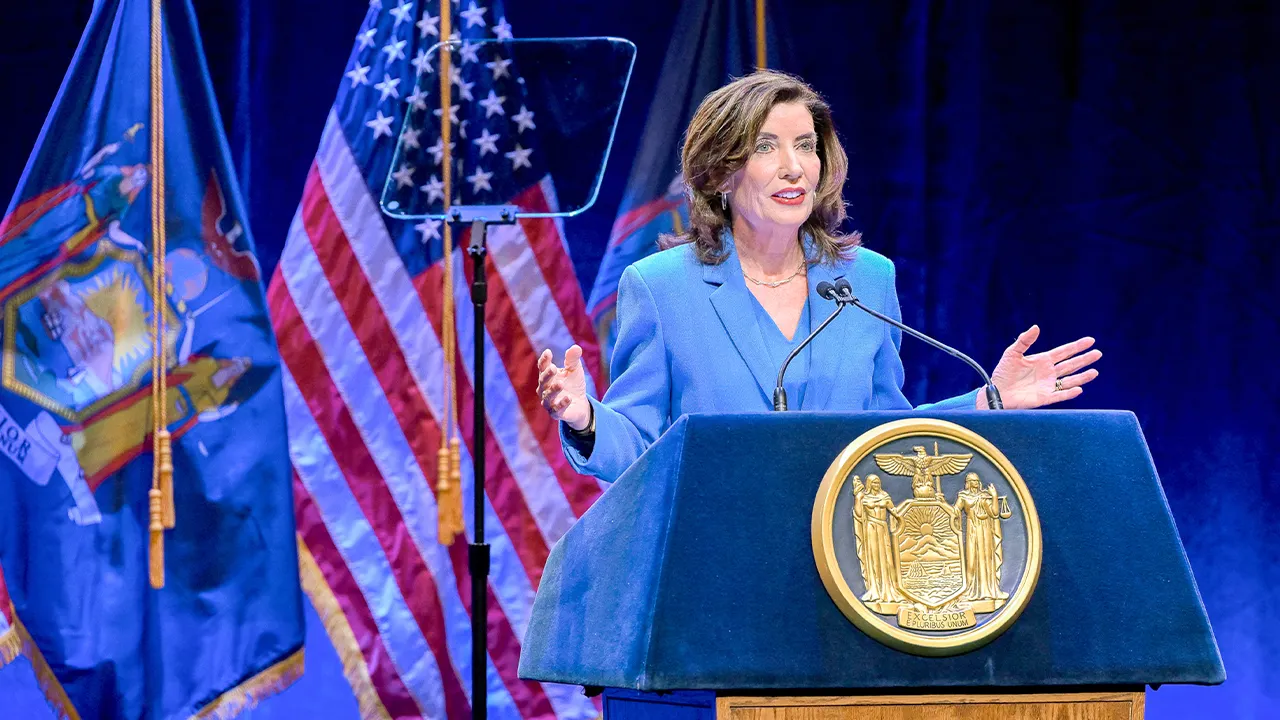
New York Gov. Kathy Hochul delivers her State of the State address at Hart Theatre at The Egg in Albany, New York, Jan. 13, 2026. (Heather Ainsworth/Bloomberg via Getty Images)
Both states are moving toward approaches that align state and federal law — recognizing that a fragmented, state-by-state patchwork isn’t sustainable. Given their size and economic impact, these moves create a clear path forward for federal action while positioning New York and California to lead the nation into the AI era.
There’s a word for this kind of alignment between state and federal action: harmonization. The federal government sets one clear national standard for the most powerful AI systems — the issues that affect national security and the country as a whole. States continue to focus on the issues closest to people’s daily lives: consumer protection, civil rights and how AI is used in schools, workplaces and public services. Each level of government plays to its strengths.
Think of it as one rulebook with two clear roles and one urgent mission: ensuring the United States maintains its competitive advantage in a technology central to national security and global economic leadership. Russian President Vladimir Putin has said bluntly that whoever leads in AI will lead the world. The United States can’t afford to drift — or to divide itself — at this critical moment.
STATE-LEVEL AI RULES SURVIVE — FOR NOW — AS SENATE SINKS MORATORIUM DESPITE WHITE HOUSE PRESSURE
That’s because AI leadership is increasingly an issue of national security — and national security requires prevention, not punishment after the fact.
When states act alone, they are often forced into a liability-only approach — holding companies accountable after harm has already occurred. Preventing the most serious risks requires access to the technical expertise and classified systems that only the federal government possesses.
That is why our North Star must remain clear: deploying frontier models safely and in a way that best positions the United States to maintain its innovation lead.
TRUMP ADMINISTRATION EYES SWEEPING FEDERAL POWER OVER AI, DRAFT ORDER SHOWS
That prevention-first approach already exists in practice. The Center for AI Standards and Innovation — created by the Biden administration and updated by the Trump administration — gives the federal government the ability to test and evaluate advanced AI systems before they are widely deployed. That kind of centralized testing is essential for managing risks that no single state or company can address on its own.
Without harmonization, AI companies would face a confusing patchwork of conflicting state requirements that slows innovation without improving public safety. With it, companies get clarity and consistency, the public gets stronger protections and states are given clear room to act where they add the most value.
Today, the United States finds itself at a turning point on AI, where real policy choices are being made. You can see it in the actions underway in both the states and Washington.
At the same time, states play a vital role, and the recent moves in New York and California show what that balance looks like in practice. By moving away from fragmented approaches and toward alignment, the two largest innovation economies in the country are helping create a de facto national standard that exists alongside, and not instead of, state action.
WHITE HOUSE OFFICIAL PRESSES ALLIES TO FREE AI FROM INNOVATION-KILLING REGULATIONS
This is what harmonization looks like in practice: Washington focuses on the highest-stakes safety issues, while states address kitchen-table ones. It is a third way forward — avoiding both unregulated acceleration and fragmented overreach.
Think about how we handle car safety. We don’t wait for accidents to happen and then rely solely on lawsuits to make cars safer. The federal government sets clear national safety standards. It requires rigorous testing. And it makes seatbelts, airbags, and braking systems mandatory — with strict rules for how well they must perform — before cars ever hit the road. Liability still matters, but prevention comes first, because the stakes are too high to get it wrong.
That balance isn’t new. It’s how the United States has governed aviation, food and drug safety, financial markets and telecommunications. In each case, the federal government set clear national standards for systems that power the entire country, while states continued to play a critical role closer to home. The result wasn’t less innovation or less growth. It was regulatory clarity, economic growth, and American leadership.
CHINA RACES AHEAD ON AI —TRUMP WARNS AMERICA CAN’T REGULATE ITSELF INTO DEFEAT
I saw this dynamic firsthand in 1996, when I was working in the White House just as the internet was beginning to reshape the economy.
Washington faced a choice that feels familiar today: apply old rules to a new technology, or agree on a new national framework built for what was coming next. Democrats and Republicans chose the latter.
CLICK HERE FOR MORE FOX NEWS OPINION
The result was the Telecommunications Act of 1996. It wasn’t perfect, but it got the big things right. It created clear national standards, gave innovators room to build and helped position the United States to lead the internet era that followed.
Think of it as one rulebook with two clear roles and one urgent mission: ensuring the United States maintains its competitive advantage in a technology central to national security and global economic leadership.
The lesson is straightforward. When America sets smart, national standards for emerging technologies, we don’t fall behind — we lead.
CLICK HERE TO DOWNLOAD THE FOX NEWS APP
The chessboard is set. If the United States focuses on prevention, harmonizes state and federal efforts, and keeps its eyes on that North Star, we can once again lead a defining technological era.
That’s how you win the long game: by playing chess, not checkers.
Read the full article from Here


“It’s been 53 years. I’ve been waiting that long.” “It’s been a very long time, a long time coming. And I’m so excited that my Knicks finally brought a championship home.” “Let’s go Knicks.” “I had to wake up at six o’clock.” “Knicks in five.” “Let’s go, Knicks.” “Let’s go, Knicks!” “We just moved to D.C. a few years ago, but we’re so happy to be back in New York, celebrating. Once we won we were like — we’re absolutely coming home. So, we had to bring Chester with us. I mean, he’s the biggest puppy Knicks fan there is. Chester, can you say Knicks in 5? Knicks in five.” “I got hurt a couple weeks ago, but this is the first time they’ve been to the finals since I was a year old. And so to be able to be here, this is a once-in-a-lifetime thing.” “My man’s out here with a boot and a Josh Hart jersey. My man’s got heart.” “It feels so overwhelming but overwhelming in a good way, where, like, I want to be — I want to, like, shoot some balls. I want to, like, just vibe with everyone because everyone’s here for one purpose, and that’s celebrating the Knicks.” “This has been like a uniting situation for New Yorkers, and I just can’t wait to feel the love from everybody.” “I think it’s a great equalizer, right? It brings everyone together. It doesn’t matter if you make $900,000 a year, if you make $50,000 a year. You’re united because of the Knicks.” “So often when this city comes together, it is because we are forced to by a moment of tragedy or adversity. What a gift it is to be brought together by pure, unfiltered joy.” “Most importantly, thank you to the fans. I’m not going to lie though, y’all all are some pretty hard critics, but we appreciate it. At least I do, appreciate it a lot.”

Concern numero uno is obvious. Giannis is one of the handful of players capable of altering the championship picture by himself. Pairing him with Jayson Tatum would create an impressive combination of size, athleticism, versatility, and star power. The question is whether Brad Stevens and the Celtics can actually pull it off without creating a new set of problems for themselves.
Boston’s path to Giannis is narrower than it first appears. The Celtics would almost certainly need to move Jaylen Brown, either directly to Milwaukee or through a third team. Reports indicate Brown has little interest in joining the Bucks (in paraphrase: “Milwaukee?! Yuck!”), which complicates matters further. We start moving from a blockbuster trade to a three-team puzzle involving contracts, draft compensation, and competing agendas.
Even if Boston finds a way through that maze, there’s no guarantee the resulting team will succeed.
Giannis may be a better asset than Brown, but championships are not won by comparing players one-for-one. They’re won by building complete teams (case in point: YOUR WORLD CHAMPION NEW YORK KNICKERBOCKERS ).
Brown averaged more than 28 points per game last season while defending multiple positions. He can create his own offense, punish smaller defenders, and absorb primary scoring responsibilities when Tatum is unavailable (as Tatum was for most of last season, recovering from a torn Achilles). Replacing him with Giannis raises Boston’s ceiling, perhaps, but also changes the structure of the roster.
The Celtics have spent years building an ecosystem around two star wings. Remove one and the supporting cast suddenly becomes more important, which means Stevens would have many more decisions to make before the start of training camp.
What catches me up is, if the Bucks believed that Giannis has more great years ahead of him, would they so quickly offload him to a conference rival? Might he actually be a distressed asset?
Giannis will turn 32 this season. He has generally been durable over his career but has dealt with increasing lower-body issues (especially calves and knees) in recent years, leading to more missed time. To wit:
• 2022–23: 63 GP / 19 missed
• 2023–24: 73 GP / 9 missed
• 2024–25: 67 GP / 15 missed
• 2025–26: 36 GP / 46 missed
Wouldn’t that just be the worst if the Celts parted with Brown to get him, and then Giannis missed extended time due to injury? Like, the absolute worst? (Insert diabolical laughter.)
A healthy Tatum-Giannis pairing would present unique challenges for New York. The Knicks would need to defend relentless downhill pressure while also containing one of the league’s best bucket creators. But, given their depth, New York may be better equipped than most teams to handle it.
So if the Celtics’ pursuit of Giannis causes an initial flutter of worry, you can let that just drift on by. The scenario only noses toward Red Alert if Boston nabs him while somehow also acquiring a guard who makes up for what they’d lose with Brown’s departure.
But wait! This just in: Chris Haynes has pushed back on the idea that a Giannis Antetokounmpo-to-Boston deal is close. He writes that Boston does not appear to be a promising destination and suggested the situation could extend into July. Additionally, Marc Stein reported that the Celtics are frustrated by speculation involving Jaylen Brown, while Brian Windhorst said Brown has not been formally offered in a trade. So, to quote the great William Goldman (also a Knicks fan), “Nobody knows anything.”
It’s worth noting that the Miami Heat are also reportedly in the mix. We’ve heard that the lack of income tax is alluring to the Greek Freak. Plus Florida offers sunny, warm weather, which is not a defining feature of Wisconsin. In the end, though, joining Boston would allow Giannis to keep all his favorite green-themed items in his wardrobe, and shouldn’t looking good be a priority, too?
Pittsburg, PA
SportsNet Pittsburgh parts ways with Penguins rinkside reporter Hailey Hunter after three seasons

Penguins rinkside reporter Hailey Hunter is out at SportsNet Pittsburgh after three seasons.
The network announced the decision on Wednesday evening.
“We are grateful for all of Hailey’s contributions during her time at SportsNet Pittsburgh. We wish her the very best in her future endeavors,” reads a statement from SportsNet Pittsburgh. “We will soon begin a nationwide search for a rinkside reporter for our Penguins coverage.”
The daughter of former NHL player Tim Hrynewich (who played for Pittsburgh between 1982 and 1984), Hunter joined the network during the 2023-2024 NHL season.
Per TribLive’s Rob Owen, Hunter said she wasn’t given a concrete reason for the decision.
“Unfortunately, I was told the Penguins have decided that they simply wanted to move in a different direction with the role,” she wrote to Owen. “I really wasn’t given any details, but I understand that’s the business we are in.”
Hunter added that she “absolutely loved my time with SportsNet Pittsburgh. The network truly felt like family and everyone there will always be great friends of mine. I’ll be having a get-together with many of the people I worked with next week, from cameramen to producers to executives from our network, the Penguins org, and the Pirates org. Sounds like about 60 people are coming, which is so kind, but also speaks to how close friends I became with everyone. We are all pretty shocked, but everyone’s kindness and support has truly meant the world to me.”
Previous to her time with SportsNet Pittsburgh, Hunter worked for Golf Channel and PGA Tour Entertainment as well as a team reporter and host for the New York Islanders during the 2021-22 season.
According to social media posts, Hunter and fiancé Gage Posey got married on May 16.
-

 Sports1 minute ago
2026 World Cup Odds: How Far Can Mexico Go After Winning Group A?
-

 Technology8 minutes ago
6 in 10 identity crimes now begin with a new account
-
 Business11 minutes ago
January 2025 wildfire victims seek tougher penalties against State Farm over claims handling
-
 Entertainment16 minutes ago
Review: ‘Sugar,’ with Colin Farrell as an alien private eye, gets a new and improved second season
-
 Politics26 minutes ago
Political watchdog fines Newsom for failing to report $5.5M in solicited donations on time
-
 Sports38 minutes ago
Goalkeeper Raúl Rangel’s elite play and South Korea’s mistake help Mexico advance
-

 World46 minutes ago
US-Iran talks postponed as Israel attacks Lebanon
-
 News1 hour ago
Luigi Mangione’s lawyers withdraw plans for psychiatric defense

