Connect with us

News

Why men should really be reading more fiction

Published

on

Why men should really be reading more fiction

Unlock the Editor’s Digest for free

A friend sent a meme to a group chat last week that, like many internet memes before it, managed to implant itself deep into my brain and capture an idea in a way that more sophisticated, expansive prose does not always manage. Somewhat ironically, the meme was about the ills of the internet. 

“People in 1999 using the internet as an escape from reality,” the text read, over an often-used image from a TV series of a face looking out of a car window. Below it was another face looking out of a different car window overlaid with the text: “People in 2026 using reality as an escape from the internet.” 

Oof. So simple, yet so spot on. With AI-generated slop — sorry, content — now having overtaken human-generated words and images online, with social media use appearing to have peaked and with “dumb phones” being touted as this year’s status symbol, it does feel as if the tide is beginning to turn towards the general de-enshittification of life. 

Advertisement

And what could be a better way to resist the ever-swelling stream of mediocrity and nonsense on the internet, and to stick it to the avaricious behemoths of the “attention economy”, than to pick up a work of fiction (ideally not purchased on one of these behemoths’ platforms), with no goal other than sheer pleasure and the enrichment of our lives? But while the tide might have started to turn, we don’t seem to have quite got there yet on the reading front, if we are on our way there at all.

Two-fifths of Britons said last year that they had not read a single book in the previous 12 months, according to YouGov. And, as has been noted many times before on both sides of the Atlantic, it is men who are reading the least — just 53 per cent had read any book over the previous year, compared with 66 per cent of women — both in overall numbers and specifically when it comes to fiction.

Yet pointing this out, and lamenting the “disappearance of literary men”, has become somewhat contentious. A much-discussed Vox article last year asked: “Are men’s reading habits truly a national crisis?” suggesting that they were not and pointing out that women only read an average of seven minutes more fiction per day than men (while failing to note that this itself represents almost 60 per cent more reading time).

Meanwhile an UnHerd op-ed last year argued that “the literary man is not dead”, positing that there exists a subculture of male literature enthusiasts keeping the archetype alive and claiming that “podcasts are the new salons”. 

That’s all well and good, but the truth is that there is a gender gap between men and women when it comes to reading and engaging specifically with fiction, and it’s growing.

Advertisement

According to a 2022 survey by the US National Endowment for the Arts, 27.7 per cent of men had read a short story or novel over the previous year, down from 35.1 per cent a decade earlier. Women’s fiction-reading habits declined too, but more slowly and from a higher base: 54.6 per cent to 46.9 per cent, meaning that while women out-read men by 55 per cent in 2012 when it came to fiction, they did so by almost 70 per cent in 2022.

The divide is already apparent in young adulthood, and it has widened too: data from 2025 showed girls in England took an A-Level in English literature at an almost four-times-higher rate than boys, with that gap having grown from a rate of about three times higher just eight years earlier.

So the next question is: should we care and, if so, why? Those who argue that yes, we should, tend to give a few reasons. They point out that reading fiction fosters critical thinking, empathy and improves “emotional vocabulary”. They argue that novels often contain heroic figures and strong, virtuous representations of masculinity that can inspire and motivate modern men. They cite Andrew Tate, the titan of male toxicity, who once said that “reading books is for losers who are afraid to learn from life”, and that “books are a total waste of time”, as an example of whose advice not to follow. 

I agree with all of this — wholeheartedly, I might add. But I’m not sure how many of us, women or men, are picking up books in order to become more virtuous people. Perhaps the more compelling, or at least motivating, reason for reading fiction is simply that it offers a form of pleasure and attention that the modern world is steadily eroding. In a hyper-capitalist culture optimised for skimming and distraction, the ability to sit still with a novel is both subversive and truly gratifying. The real question, then, is why so many men are not picking one up.

jemima.kelly@ft.com

Advertisement

News

Map: Small Earthquake Shakes Northern California

Published

on

Map: Small Earthquake Shakes Northern California

Note: Map shows the area with a shake intensity of 3 or greater, which U.S.G.S. defines as “weak,” though the earthquake may be felt outside the areas shown.  All times on the map are Pacific time. The New York Times

A minor earthquake with a preliminary magnitude of 3.4 struck Northern California on Tuesday, according to the United States Geological Survey.

The temblor happened at 6:48 a.m. Pacific time about 5 miles northeast of Gilroy, Calif., data from the agency shows.

As seismologists review available data, they may revise the earthquake’s reported magnitude. Additional information collected about the earthquake may also prompt U.S.G.S. scientists to update the shake-severity map.

Aftershocks in the region

An aftershock is usually a smaller earthquake that follows a larger one in the same general area. Aftershocks are typically minor adjustments along the portion of a fault that slipped at the time of the initial earthquake.

Advertisement

Quakes and aftershocks within 100 miles

Aftershocks can occur days, weeks or even years after the first earthquake. These events can be of equal or larger magnitude to the initial earthquake, and they can continue to affect already damaged locations.

When quakes and aftershocks occurred

Advertisement

Source: United States Geological Survey | Notes: Shaking categories are based on the Modified Mercalli Intensity scale. When aftershock data is available, the corresponding maps and charts include earthquakes within 100 miles and seven days of the initial quake. All times above are Pacific time. Shake data is as of Tuesday, March 17 at 9:51 a.m. Eastern. Aftershocks data is as of Tuesday, March 17 at 3:03 p.m. Eastern.

Continue Reading

News

Joe Kent, a top counterterrorism official, resigns citing Iran war

Published

on

Joe Kent, a top counterterrorism official, resigns citing Iran war

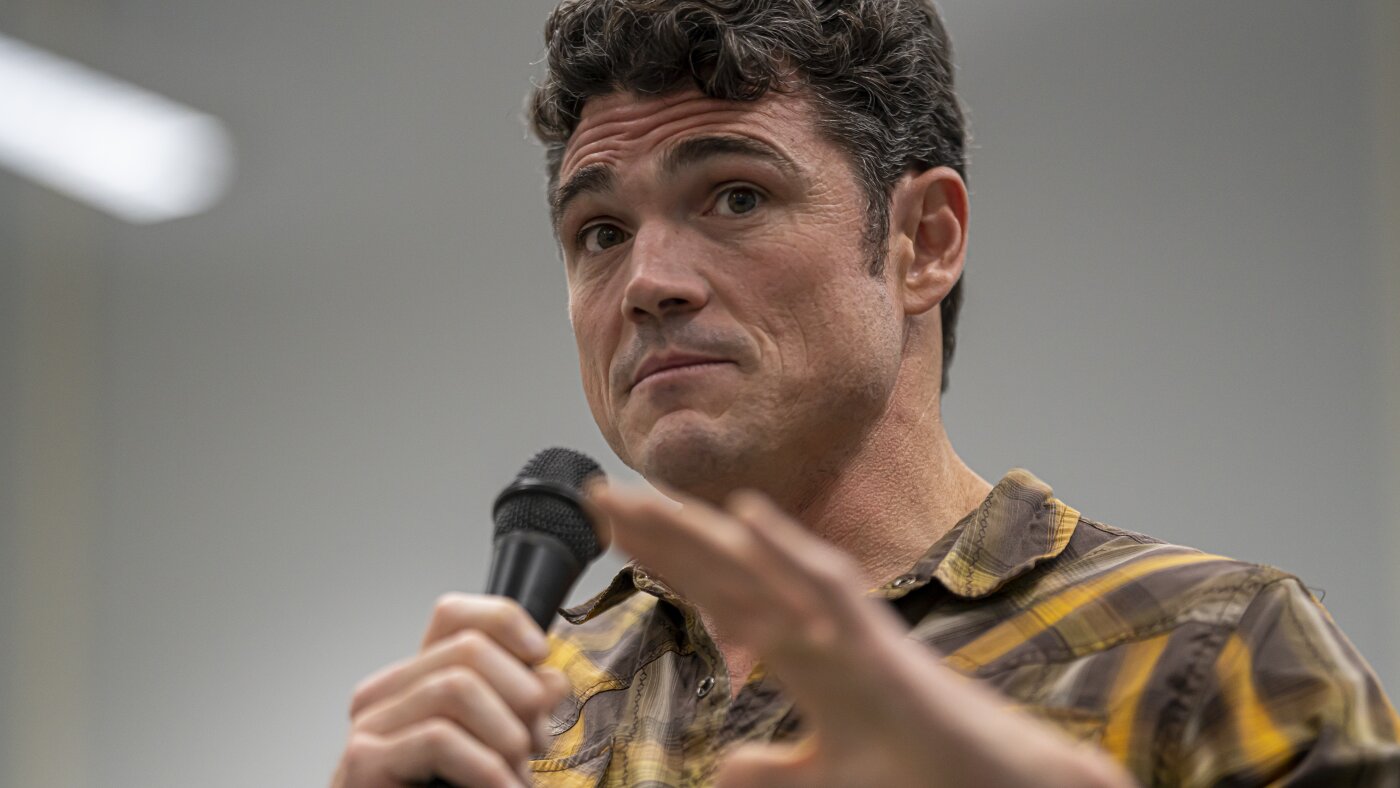
Joe Kent, when he was campaigning as a Republican congressional candidate in 2022, resigned citing his opposition to the Iran war.

Nathan Howard/Getty Images


hide caption

toggle caption

Advertisement

Nathan Howard/Getty Images

The head of the National Counterterrorism Center has resigned in protest over the war with Iran. Joe Kent, an Army veteran who completed 11 combat deployments to the Mideast and elsewhere, said he “cannot in good conscience” support the war.

He said that Israel pushed the U.S. into the conflict with a pressure campaign to “deceive” President Trump, and that Iran “posed no imminent threat to our nation.”

He shared his resignation letter in a social media post.

Advertisement

Kent ran two unsuccessful congressional bids in Washington state as a Republican and Trump loyalist. He said in his resignation letter that he supported “the values and the foreign policy” that Trump campaigned on.

“Until June of 2025, you understood that the wars in the Middle East were a trap that robbed America of the precious lives of our patriots and depleted the wealth and prosperity of our nation,” Kent wrote to Trump in the letter.

Kent’s wife, Navy Senior Chief Petty Officer Shannon Kent, died serving in Syria in 2019.

Kent called on Trump to “reflect upon what we are doing in Iran, and who we are doing it for.” He said Trump could “reverse course and chart a new path for our nation, or you can allow us to slip further toward decline and chaos. You hold the cards.”

In response, Trump said Tuesday he “always thought” Kent was a nice guy but also “was weak on security, very weak on security.”

Advertisement

“I didn’t know him well, but I thought he seemed like a pretty nice guy, but when I read his statement, I realized that it’s a good thing that he’s out because he said that Iran was not a threat. Iran was a threat every country,” Trump said during an Oval Office event.

Trump nominated Kent as director of the National Counterterrorism Center in February 2025. The Senate confirmed him to the position in July 2025, 52-44, without Democratic support. Ahead of his confirmation, numerous reports detailed his links with extremist figures, including to people affiliated with the Proud Boys and Patriot Prayer, both far-right extremist groups.

In 2021, Kent spoke with Nick Fuentes, a neo-Nazi who has become influential within younger ranks of the GOP, about the possibility of assisting with his congressional campaign social media strategy. Kent later tried to distance himself from that call and said he had no further associations with him.

The senior vice president of the pro-Israel political nonprofit J Street, Ilan Goldenberg, said Kent’s warnings of an Israeli conspiracy to deceive the U.S. “plays on the worst antisemitic tropes.”

“Donald Trump is the President of the United States and he is the one ultimately responsible for sending American troops into harms way,” Goldenberg wrote on X, noting his own opposition to the war.

Advertisement

Sen. Mark Warner of Virginia, the top Democrat on the Senate Intelligence Committee, similarly said he agrees with Kent’s opposition to the war, while noting he did not support Kent’s nomination.

NPR’s domestic extremism correspondent Odette Yousef contributed to this report.

Continue Reading

News

Trump predicts US will have ‘honour of taking Cuba’ amid power blackout

Published

on

Trump predicts US will have ‘honour of taking Cuba’ amid power blackout

Donald Trump expects to have “the honour of taking Cuba”, he declared, after a US-imposed oil blockade plunged the country into darkness under a total power blackout.

The US president claimed on Monday that he could do “anything I want” with Cuba, amid US negotiations with Havana over the country’s future.

“You know, all my life I’ve been hearing about the United States and Cuba. When will the United States do it?” Trump told reporters at the White House on Monday.

“I do believe I’ll be … having the honour of taking Cuba,” Trump added. “Whether I free it, take it – think I could do anything I want with it. You want to know the truth. They’re a very weakened nation right now.”

Shortly after he spoke, the New York Times reported that US officials told Cuba to remove its president, Miguel Díaz-Canel, from power during recent talks, citing four unnamed sources familiar with the discussions.

Advertisement

The US has sought to intensify pressure on Cuba, its longtime foe, since seizing the Venezuelan president, Nicolás Maduro – Cuba’s most important foreign benefactor – in January. Trump cut off Venezuelan oil shipments to Cuba and threatened to put tariffs on any country that sold oil to Cuba, strangling its antiquated power grid.

Toppling Díaz-Canel from power would take out a key figurehead, while leaving in place the repressive Communist regime which has run Cuba for almost seven decades.

Cuba has traditionally rejected any interference in its internal affairs and has considered any proposals on that front to be a dealbreaker for any agreement.

Marco Rubio, the US secretary of state and son of Cuban immigrants, has long made it clear he wants regime change in Havana. Trump has also called for a “friendly takeover”, but recently told reporters: “It may not be a friendly takeover.”

Since removing Maduro from power in January and joining Israel in attacking Iran, Trump has openly mused that Cuba would be “next”.

Advertisement

Díaz-Canel, 65, who succeeded the late Fidel Castro and his brother Raúl Castro as president in 2018, said on Friday that he expected talks with the US to take place “under the principles of equality and respect for the political systems of both countries, sovereignty and self-determination”.

with AFP and Reuters

Continue Reading

Trending