Business
Downtown L.A. wants San Francisco’s pop-up secret to get shoppers back

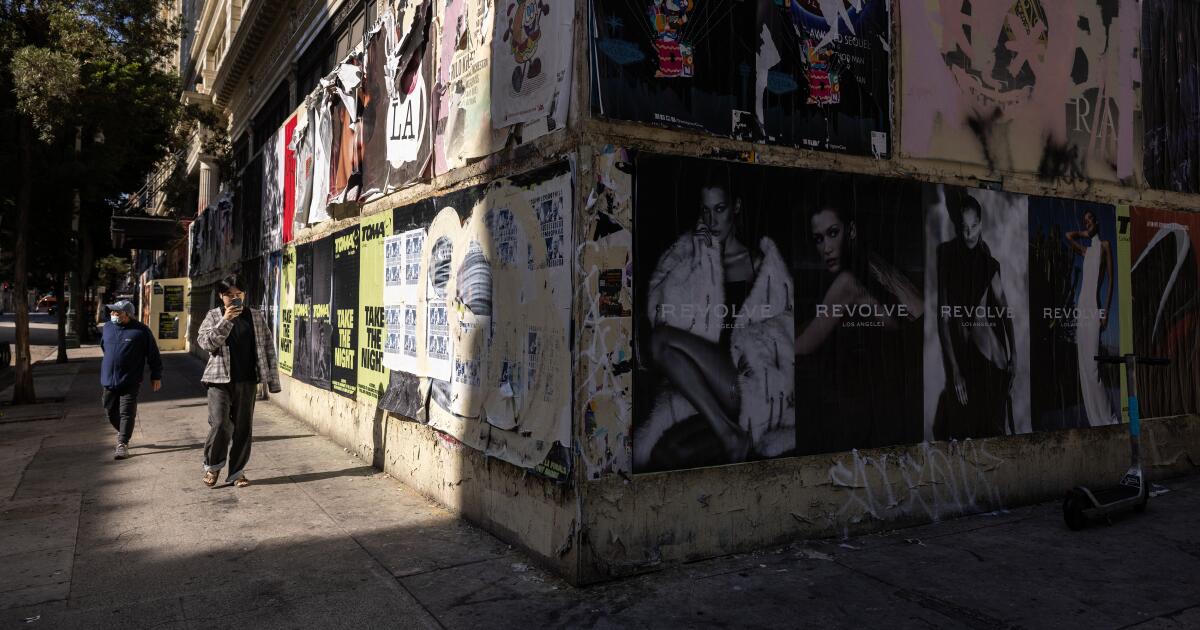
As much of downtown L.A. continues to feel dark and deserted, local businesses want the city to steal San Francisco’s secret for firing up foot traffic.
The tech mecca has slowly begun to emerge from one of the country’s deepest declines in downtown retail, in part through a program that peppered the city with subsidized pop-up shops.
The Vacant to Vibrant program turned abandoned spaces into bakeries, bookstores, cafes, chocolateries, galleries and other things.
Local entrepreneurs were given grants and support from the city and charities, as well as months of free rent to set up shop. The idea is to leverage empty storefronts to build buzz and entice more shoppers to city sidewalks.
While San Francisco is still far from its pre-pandemic peaks, backers say the program has brightened struggling retail areas.
“We’re creating a window on what downtown could look like,” said Simon Bertrang, executive director of SF New Deal, the nonprofit behind Vacant to Vibrant. The hollowing-out created by COVID-19 could be an opportunity to turn downtown San Francisco into a “mixed-use neighborhood with a lot of small businesses and maybe more residential,” he said.
While San Francisco is still far from its pre-pandemic peaks, backers of Vacant to Vibrant say the program has brightened struggling retail areas.
(Justin Sullivan / Getty Images)
Both L.A. and S.F. have grappled with keeping stores and restaurants in their business districts since the pandemic emptied office buildings. While most employees are working from the office again, a significant number are still working from home, and many aren’t coming in every weekday. The diminished presence of workers continues to make it hard on the lunch spots, bars and shops that rely on them to survive.
Though it is difficult to compare how businesses are doing in each downtown, there are some indicators that San Francisco has been growing more in the last year.
Reservation platform OpenTable said online reservations in the Northern Californian city shot up more than 20% compared with most months last year. Reservation growth in L.A. was capped below 10% for most of the same period.
Downtowns across the country need to find solutions, experts warn, as dark storefronts can lead to a downward spiral, with companies hesitant to lease office space in vacant areas.

Looking down Broadway from its intersection with 7th Street in downtown in Los Angeles.
Retailers are already opting out of downtown L.A. due to its slow recovery from the pandemic shutdown, said real estate broker Derrick Moore of CBRE, who helps arrange commercial property leases.
“A lot of operators are just electing to skip over downtown,” he said. “They’re leasing spaces elsewhere, where they feel they have a greater chance at higher sales.”
Brands have headed to more vibrant, nearby neighborhoods such as Echo Park and Silver Lake because of downtown’s weaker business.
Downtown Los Angeles residents, businesses and other city boosters want to try to prime the pump, using a program like San Francisco’s to help small businesses take over vacant storefronts and turn the lights back on, said Cassy Horton, co-founder of the Downtown Residents Assn.
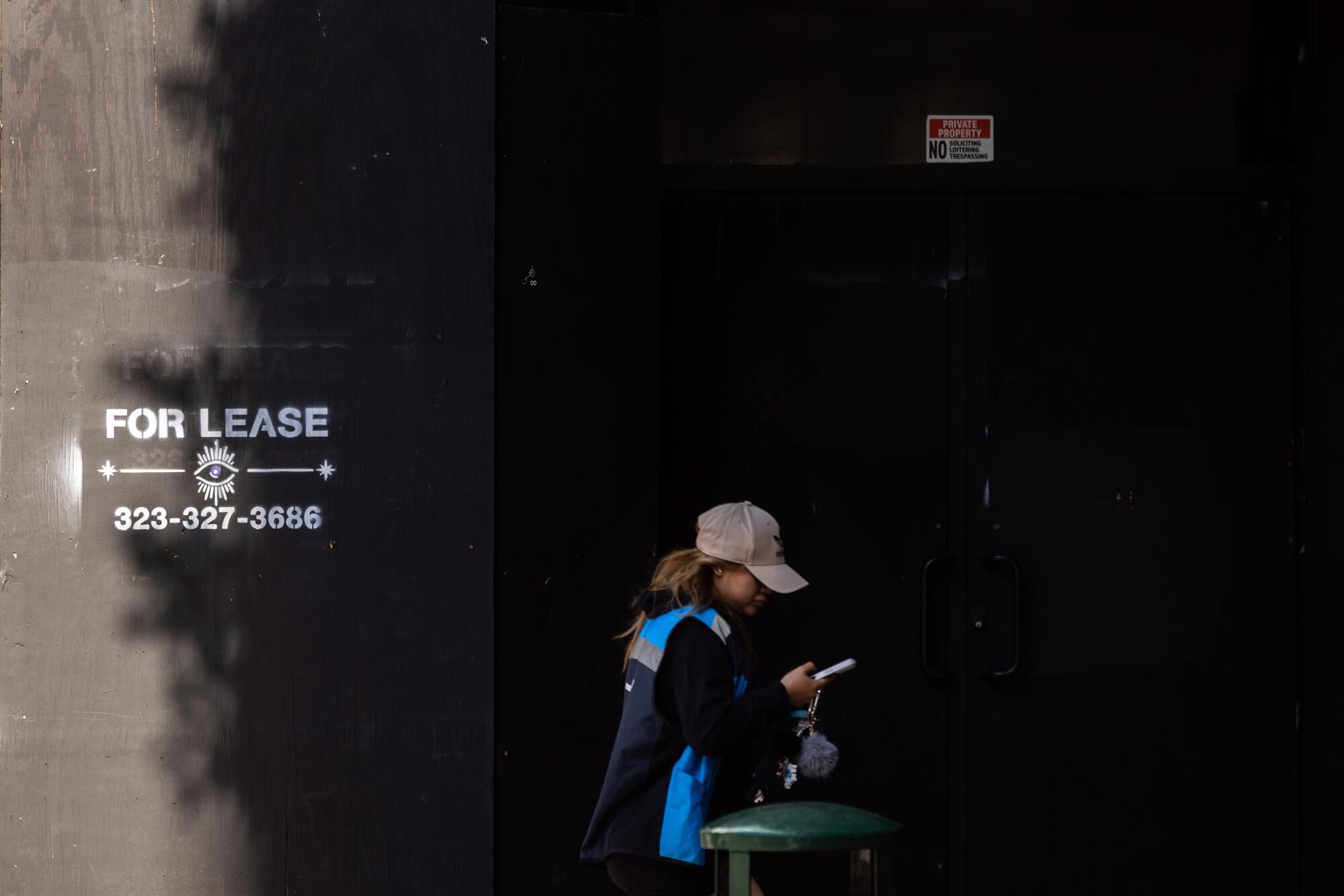
A pedestrian walks past a building for lease on Broadway in downtown Los Angeles.
(Etienne Laurent / For The Times)
Surveys by the group have found that what residents love most about downtown is its walkability, restaurants, bars and coffee shops, she said.
“I love being able to live a lifestyle where I can run all of my core errands within a couple blocks,” Horton said. “I don’t have a car.”
Retail property vacancy downtown could be as high as 40%, Moore said, with some neighborhoods, such as the Historic Core, suffering more than others. Nike recently closed its store on Broadway.
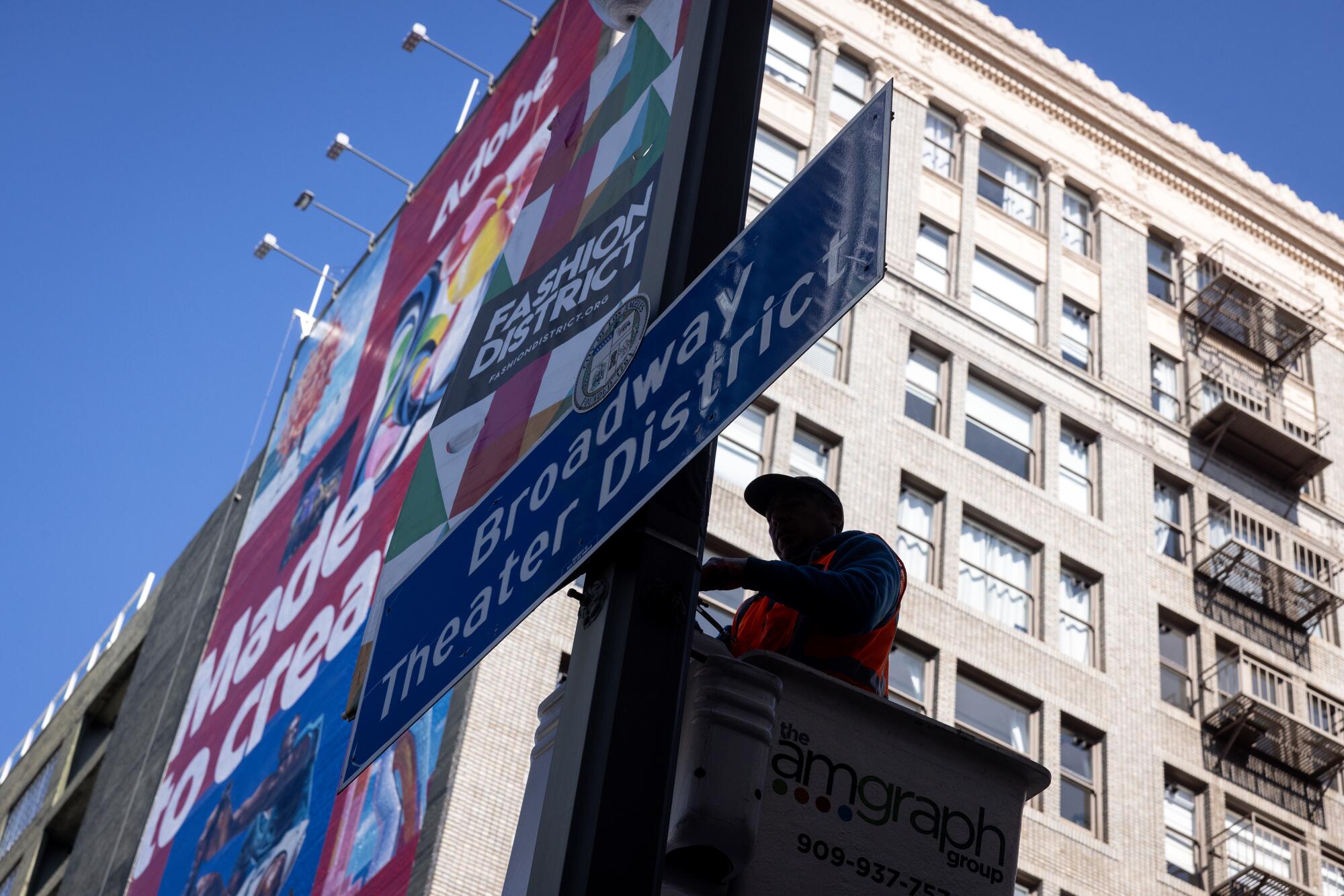
A worker removes a banner on Broadway. Retailers are already opting out of downtown L.A. due to its slow recovery from the pandemic shutdown, a broker said.
(Etienne Laurent / For The Times)
“Downtown’s commercial vacancy crisis is visible on every block,” a recent report by the residents’ group said.
The report called for a “safe sidewalks” public safety campaign to work in tandem with a plan to bring back retail tenants.
In San Francisco, participating businesses can get their feet wet with a three-month pop-up to test the waters in a high-traffic location with low financial overhead and technical support from SF New Deal and the mayor’s office.
Businesses are offered grants to operate, help with lease negotiations, assistance with obtaining city permits, insurance, marketing support, business mentoring, and three to six months of free rent.
The intention is to transition many of the pop-ups into long-term leases, creating permanent fixtures in the downtown landscape. So far, more than 10 of the 40 small businesses that started as pop-ups have moved on to multiyear leases with their landlords.
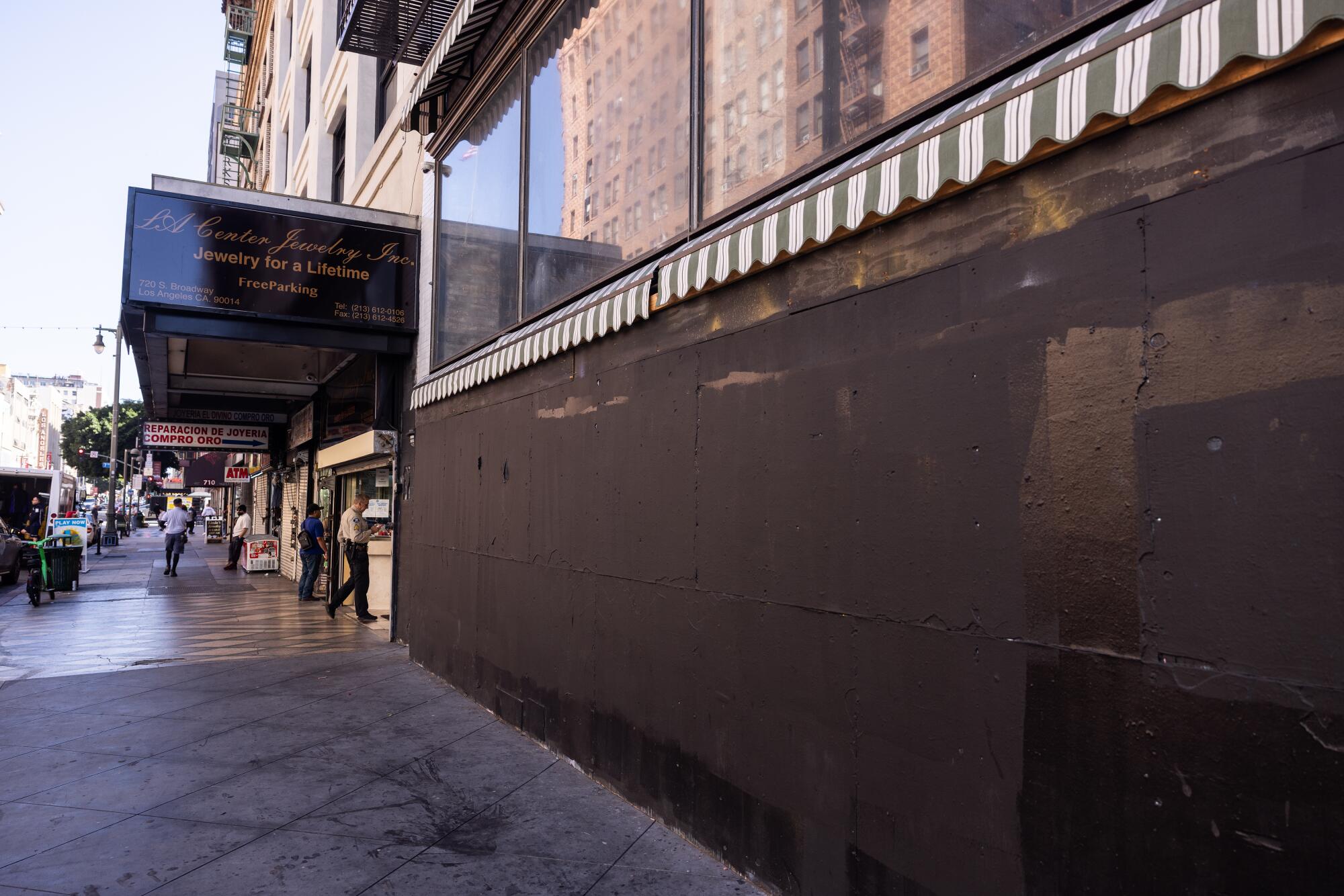
A boarded-up storefront on Broadway. “Downtown’s commercial vacancy crisis is visible on every block,” a recent report by the Downtown Residents Assn. said.
(Etienne Laurent / For The Times)
Property owners with storefronts they need to fill receive funding to cover the cost of preparing the space for tenants and other property expenses, help with city permits and other support.
San Francisco launched the program in 2023 with $700,000 and contracted with SF New Deal, which focuses on supporting small businesses in the city.
The program is also supported by corporate philanthropy from Wells Fargo, JPMorgan Chase, Visa, Gap and others.
Among the first stores to open through the program was Devil’s Teeth Baking Co., a popular bakery in the Outer Sunset neighborhood that established an outpost in the moribund Financial District and brought followers with it.
“Suddenly, there are lines out the door on the weekend” of people waiting for breakfast sandwiches, Bertrang said.
The bakery now has a long-term lease, as do other graduates of the program, including Mello flower shop, arts-and-crafts studio Craftivity and Whack Donuts.
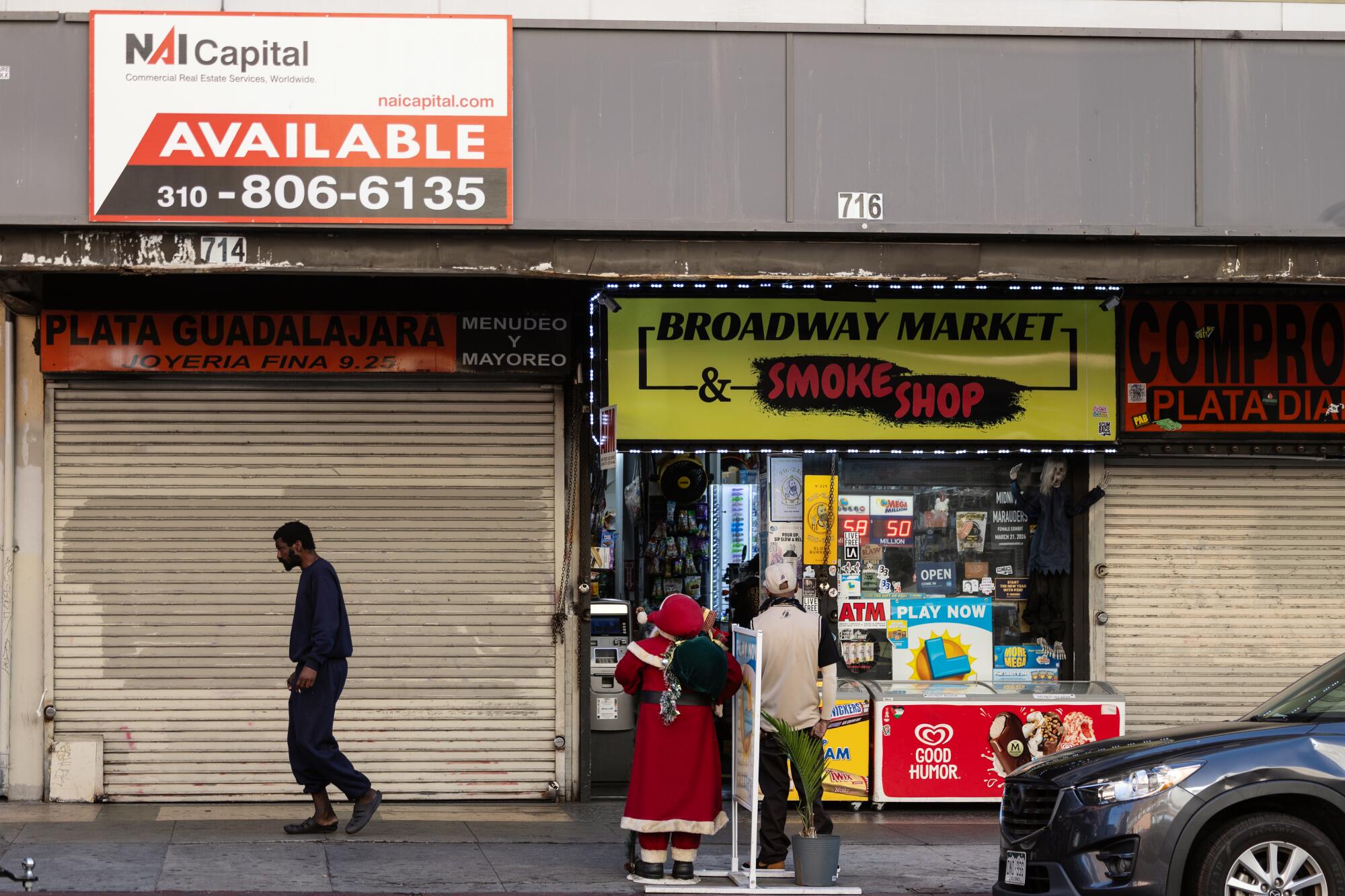
A pedestrian walks past shuttered stores on Broadway in Los Angeles.
(Etienne Laurent / For The Times)
San Francisco’s business centers were particularly hard-hit by the pandemic as its technology companies quickly adapted to remote work and kept at it even as the crisis eased, triggering widespread office and retail vacancies.
“San Francisco had the worst return-to-work situation in the nation,” Bertrang said. “It was the most extreme version of what L.A., New York and other cities in our country are dealing with.”
Representatives of nearly 40 organizations in cities across the country have reached out to him for advice on how similar programs might work in their stricken neighborhoods.
Among them was downtown L.A. business advocacy group Central City Assn., which has called for L.A. to subsidize retailers’ rents to help fill vacant storefronts in key corridors. It is working with city officials, looking into a program like Vacant to Vibrant for Los Angeles.
Adding businesses to the streets while improving public safety would help halt the “downward spiral and turn it into more of a virtuous cycle,” said Nella McOsker, president of the association.
“San Francisco has demonstrated this larger ripple effect of success,” she said. “This is really, really doable in targeted pockets of downtown,” she said.
Nick Griffin of the business improvement district DTLA Alliance said activating storefronts is a worthy goal as long as the city first makes the streets both safe and pleasant for pedestrians.
The city needs to provide clean sidewalks, street lighting and graffiti removal before consumers and businesses return, he said.
“San Francisco was the poster child for the doom loop and has pivoted to downtown recovery,” he said. “ We are building that story right now.”


The electric vehicle company Slate Auto set out in 2022 to make the most affordable electric truck in the country. This week, it unveiled the price tag: $24,950.
At a time when demand for new electric vehicles is cooling and cars are getting harder to afford, Slate’s customizable truck could bring a fresh wave of excitement to the industry.
Deliveries will begin later this year and accelerate in 2027, the company said. Slate’s vehicle is built around a simple concept — pay only for what you actually want.
Buyers will start with a basic truck without power windows or even paint and can then customize it however they like. They can tailor-make their “blank slate” by paying extra for smart phone-compatible screens, speakers, colored wrap or paint. A $5,000 kit even converts the truck into an SUV.
Slate’s design team is based in Los Angeles County and recently moved into a new space in Carson, which employs about 50 workers. The company’s headquarters are in Troy, Mich., and its vehicles will be produced in Warsaw, Ind.
Squeezing out as much cost as possible while making it as easy as Legos to snap on different options has required complex engineering, which is why the company decided to set up its design studio in Southern California. The region is full of experts.
“Slate has done something smart,” said auto industry analyst Brian Moody. “Their EV isn’t only about price, there’s also a strong personalization element. In Southern California, the boxy, retro look will earn it a lot of attention.”


Slate is an EV startup that makes electric trucks and SUVs. Customers buy only the features they want. Photographed on Friday, Dec. 19, 2025. (Myung J. Chun/Los Angeles Times)
The company is building a marketplace of accessories for customers to choose from, including 54 basic wraps that cost less than $500 each. In contrast, a paint job on a car can cost thousands of dollars. The marketplace also offers roof stacks, zip-on seat covers and stereos.
For just under $30,000 total, customers can get a basic SUV in a fastback or squareback style. Whether it’s configured as a truck or SUV, the EV will have an estimated range of 205 miles and will be compatible with Tesla chargers.
“This is the first time in automotive history that consumers are going to get to choose,” said Slate Chief Executive Peter Faricy, who joined the company in March after 13 years with Amazon.
“It started with design, then engineering, and eventually manufacturing, and we figured out innovations in all three of those phases that make the vehicle less expensive,” he said.
For example, Slate vehicles were designed from the beginning to be wrapped instead of painted. The company will offer more than 100 colors of wrap at its launch, or customers can choose a custom color.
Slate did not disclose financial information or how much the vehicles cost to produce. However, Faricy said the company will generate a positive gross margin on its vehicles, meaning they are selling for more than what they cost to make.
“Whether Slate succeeds or fails, it has already influenced the conversation … forcing the industry to ask why affordable vehicles have become so rare,” said Jesse Toprak, an industry analyst and founder of OptiCar.ai. “They are betting on making higher profit margins on the accessories and do-it-yourself angle.”
Slate says it has already received more than 180,000 reservations. The earlier a customer placed their reservation, the sooner they’ll get their vehicle. Pre-orders opened Wednesday for $300, or $250 if the customer has already paid a $50 reservation fee.
Despite the hype, Slate is still a startup that has yet to prove itself in the market. The company has about 750 employees and has raised more than $700 million from Amazon’s Jeff Bezos and others.
“For the vehicle itself, the concept is brilliant,” Toprak said. “I think the execution risk is enormous.”
The EV industry has been under fire from the Trump administration, which has removed incentives for ownership and clean-car goals. Major automakers including Ford and Stellantis have pared back their EV offerings, and other startups have struggled to turn a profit.
The Irvine-based EV company Rivian, which hasn’t reached profitability since its founding in 2009, recently laid off hundreds of workers. It launched its highly anticipated R2 SUV earlier this month, which will eventually be available for less than $45,000.
Lucid, the luxury electric vehicle maker based in Newark, Calif., announced this week that it’s reducing its workforce by 18%. The cuts come just months after it laid off 319 Bay Area employees in February.
Faricy, Slate’s chief executive, said the company’s vehicle will appeal to a wide range of customers.
“There will be a lot of people that are attracted to the affordability but have never had an EV before,” he said.
According to Cox Automotive, the average transaction price for a new EV in the U.S. is $55,000, compared with $49,000 for a gas-powered vehicle.
“The EV market at this point doesn’t have a technology problem anymore,” Toprak said. “It has an affordability problem. Slate is one of the first companies built entirely around solving that.”

Sony Pictures will invest $100 million and take a minority stake in virtual reality venue operator Cosm, as the studio continues to build a business in communal experiences.
As part of the investment, Sony Pictures Chief Executive Ravi Ahuja will also join Cosm’s board of directors, the studio said Wednesday. The size of Sony’s minority stake was not disclosed.
The El Segundo-based Cosm currently operates three venues — one at Hollywood Park in Inglewood, and the others in Dallas and Atlanta. The company plans to open additional venues in Detroit and Cleveland.
Cosm bills itself as a “shared reality venue,” and its facilities center around a massive, wraparound screen that is intended to envelop viewers with additional digital effects. The company has largely focused on sports, though it has also shown Cirque du Soleil shows and done several collaborations with Warner Bros., including recent screenings of 2001’s “Harry Potter and the Sorcerer’s Stone” in honor of the film’s 25th anniversary.
“Cosm sits at the intersection of several trends shaping the future of entertainment,” Ahuja said in a statement. “We’ve followed Cosm since before launch and have been impressed with the quality of the experience and the enthusiasm it’s generating with audiences.”
The investment is Sony’s latest venture into experiential entertainment. In 2024, the Culver City-based studio acquired dine-in theater chain Alamo Drafthouse Cinema.

The Los Angeles City Council on Tuesday unanimously advanced an ordinance to halt new oil and gas drilling and phase out all existing production over the next 20 years. L.A. is home to more than 2,000 active oil wells.
The measure revives a similar ban passed in 2022, which was struck down by a judge following legal challenges from the oil and gas industry.
It must pass a second vote before final adoption later this summer, and would make L.A. the largest city in the United States to phase out existing oil wells.
“Today, Los Angeles is making a decision that aligns with our need to turn the page on urban oil drilling,” Councilmember Katy Yaroslavsky said during Tuesday’s council meeting. “The absence of an enforceable oil ordinance has had real consequences for our communities.”
The ban in 2022 was seen as a historic move for a region built on the petroleum industry.
But in 2024, a Los Angeles County Superior Court judge invalidated the law, ruling that the state, not the city, has jurisdiction over petroleum production. The legal challenge was brought by oil companies including Warren Resources, which operates a large oil field in Wilmington. Much of the field is beneath the city of Long Beach, but it also extends under Los Angeles.
Shortly after that, state legislators advanced Assembly Bill 3233, which reaffirmed city and county authority to regulate oil and gas activity. It was largely seen as the missing piece that made the original ordinance vulnerable.
“It’s now unequivocal that cities have the authority to regulate, limit and prohibit oil and gas operations within our jurisdiction,” Yaroslavsky said.
The new ordinance, written by the Department of City Planning, prohibits new oil and gas extraction, including drilling, redrilling or deepening existing oil wells for the purposes of production. It also designates all existing and active idle wells as “nonconforming uses,” meaning they may only operate during the phaseout period and are no longer compliant with current zoning.
Warren Resources, which led the lawsuit against the previous ban, did not immediately respond to a request for comment. The company previously argued that the 2022 ban was rushed and would lead to more oil imports to the area, causing increased emissions from tankers and trucks and other environmental consequences.
Many wells in the city operate near schools, homes and parks. Most are concentrated in low-income areas and communities of color, such as Wilmington and the harbor district, West L.A. and South L.A., where residents have long reported respiratory issues, headaches, throat irritation and other health problems. Studies have found oil wells can emit carcinogens and are linked to adverse health effects.
“This ordinance is such an important step toward giving every frontline community in Los Angeles access to clean air,” Silvia Esparza, a South L.A. resident and member of environmental justice group Stand-L.A., said in a news conference ahead of Tuesday’s vote.
Ashley Hernandez, a Wilmington resident and organizer with the nonprofit Communities for a Better Environment, said bloody noses and noxious fumes were a regular part of life in the neighborhood growing up.
She noted that in addition to oil drilling, L.A. residents continue to face other environmental hazards, such as the recent oil pipeline rupture that sent crude into the L.A. River or the ongoing cold storage warehouse fire in Boyle Heights that is spewing toxic smoke.
“I’m here to remind L.A. city and these toxic neighbors that Wilmington residents are more important than any ‘black gold’ under their homes,” Hernandez said. “We need our city to protect our families now and to stop the oil industry’s reign of power in our city. A passage of the oil phaseout ordinance today gives the city a chance to correct this wrong.”
Times staff writer Dakota Smith contributed to this report.
-

 Massachusetts5 minutes ago
Gas prices in Massachusetts dip below $4 a gallon for first time in 2 months
-

 Minnesota8 minutes ago
Minnesota sends time capsule photos to US Capitol for America’s 250th birthday
-

 Mississippi13 minutes ago
Where to see fireworks and celebrate Fourth of July in, near Jackson
-
Missouri20 minutes ago
Missouri Lottery Powerball, Pick 3 winning numbers for June 24, 2026
-

 Montana23 minutes ago
‘Hannah Montana’ Alum Mitchel Musso Reveals Why He Missed 20th Anniversary Special With Miley Cyrus
-

 Nebraska28 minutes ago
Scattered severe storms bring large hail, heavy rain to parts of Nebraska
-

 Nevada35 minutes ago
Nevada Secretary of State calls court ruling on Trump election order a ‘big victory’
-

 New Hampshire38 minutes ago
New Hampshire has highest share of adults who identify as atheists

