Connect with us

News

Why is Donald Trump campaigning in California, a state he's almost certain to lose?

Published

on

Why is Donald Trump campaigning in California, a state he's almost certain to lose?

LOS ANGELES (AP) — With the presidency on the line in battlegrounds like Wisconsin and Pennsylvania, why would Donald Trump venture into California, one of the most solidly Democratic states, just weeks before Election Day?

Trump is almost certain to lose California, and that won’t change after his scheduled Saturday stop in Coachella, a desert city east of Los Angeles best known for the annual music festival bearing its name. Still, there are practical reasons for him to visit, despite the Republican nominee’s prospects Nov. 5 in the most populous state.

The former president lost California in a landslide in 2020. He did get 6 million-plus votes, more than any GOP presidential candidate before, and his margins topped 70% in some rural counties that typically favor conservatives on the ballot.

That’s an enormous pool of potential volunteers to work on state races and participate in phone banks into the most contested states. And Trump is likely to draw extensive media coverage in the Los Angeles market, the second-largest in the country.

Trump is visiting Coachella in between stops in Nevada, at a roundtable outside Las Vegas for Latinos earlier Saturday, and Arizona, for a rally Sunday in Prescott Valley. He narrowly lost those two swing states to Democrat Joe Biden in 2020.

Advertisement

Going to California gives Trump the “ability to swoop in and leverage this big population of Trump supporters,” said Tim Lineberger, who was communications director for Trump’s 2016 campaign in Michigan and also worked in the former president’s administration. He’s “coming here and activating that.”

Lineberger recalled Californians making calls to Michigan voters in 2016 on Trump’s behalf and said the campaign’s decision to go into safe, Democratic turf at this point was “an aggressive, offensive play.”

California is also a fountain of campaign cash for both parties, and Trump will be fundraising. Photos with the former president in Coachella were priced at $25,000, which comes with special seating for two. A “VIP Experience” was priced at $5,000.

With congressional races in California in play that could determine which party controls the House, the Coachella rally “is a get-out-the-vote type of thing that motivates and energizes Republicans in California, when they are not as close to what is going on in the national campaign,” Republican consultant Tim Rosales said.

Rosales also said to look for Trump to continue his long-running spat with Democratic Gov. Gavin Newsom.

Advertisement

For Republicans, “It’s motivating when you can pick at California a little bit and the governor … will take the bait,” Rosales said.

Newsom on Wednesday predicted Trump would be denigrating the state at the rally, overlooking its strengths as the world’s fifth-largest economy. The governor said that for the first time in a decade, California has more Fortune 500 companies than any other state.

“You know, that’s not what Trump is going to say,” he predicted.

Jim Brulte, a former chairman of the California Republican Party, said he thinks Trump is angling for something that has eluded him in previous campaigns: winning more total votes than his Democratic opponent.

“I believe Donald Trump is coming to California because he wants to win not only in the Electoral College, but he wants to win the popular vote. There are more registered voters in California than there are residents in 46 of the other 49 states,” Brulte said.

Advertisement

What to know about the 2024 Election

The Trump National Golf Club Los Angeles sits on the Pacific Coast, south of the city. But Trump has long had a conflicted relationship with California, where a Republican has not carried the state since 1988 and Democrats outnumber registered Republicans by about 2-to-1.

California was home to the so-called Trump resistance during his time in office, and Trump often depicts California as representing all he sees wrong in America. As president, he called the homeless crises in Los Angeles and San Francisco disgraceful and threatened to intercede.

He is likely to spend time on Saturday linking California’s problems to Vice President Kamala Harris, the Democratic nominee and a San Francisco Bay Area native who was California’s attorney general and represented the state in the Senate.

His campaign issued a statement alleging that under Harris, “the notorious ‘California Dream’ has turned into a nightmare for everyday Americans.”

Advertisement

Jessica Millan Patterson, chairwoman of the state GOP, said she looked forward to hearing Trump contrast his agenda with a Democratic White House that “has left Californians less safe and with less money in their pockets.”

Republicans, she promised, “will do our part to secure a House majority.”

Advertisement

News

Map: 4.1-Magnitude Earthquake Shakes Southern California

Published

on

Map: 4.1-Magnitude Earthquake Shakes Southern California

Advertisement

Note: Map shows the area with a shake intensity of 3 or greater, which U.S.G.S. defines as “weak,” though the earthquake may be felt outside the areas shown.  All times on the map are Pacific time. The New York Times

Advertisement

A light, 4.1-magnitude earthquake struck in Southern California on Sunday, according to the United States Geological Survey.

The temblor happened at 3:38 a.m. Pacific time about 1 mile southeast of Frazier Park, Calif., data from the agency shows.

Advertisement

U.S.G.S. data earlier reported that the magnitude was 4.4.

As seismologists review available data, they may revise the earthquake’s reported magnitude. Additional information collected about the earthquake may also prompt U.S.G.S. scientists to update the shake-severity map.

Advertisement
Advertisement

Aftershocks detected

Subsequent quakes have been reported in the same area. Such temblors are typically aftershocks caused by minor adjustments along the portion of a fault that slipped at the time of the initial earthquake.

Advertisement

Quakes and aftershocks within 100 miles

Aftershocks can occur days, weeks or even years after the first earthquake. These events can be of equal or larger magnitude to the initial earthquake, and they can continue to affect already damaged locations.

Advertisement

When quakes and aftershocks occurred

 All times are Pacific time. The New York Times

Advertisement

Advertisement

Sources: United States Geological Survey (epicenter, aftershocks, shake intensity); LandScan via Oak Ridge National Laboratory (population density) | Notes: Shaking categories are based on the Modified Mercalli Intensity scale. When aftershock data is available, the corresponding maps and charts include earthquakes within 100 miles and seven days of the initial quake. All times above are Pacific time. Shake data is as of Sunday, July 12 at 11:54 a.m. Eastern. Aftershocks data is as of Sunday, July 12 at 2:24 p.m. Eastern.

Continue Reading

News

Mexico-US relations are already strained, but experts say they’re about to get worse | CNN

Published

on

Mexico-US relations are already strained, but experts say they’re about to get worse | CNN

The death of a Mexican man in Houston at the hands of Immigration and Customs Enforcement is threatening to upend already-strained relations between Mexico and the United States.

Mexican President Claudia Sheinbaum took the unusual step of announcing at a press conference on Thursday that Mexico is seeking civil and criminal investigations in the US related to the deaths of 17 Mexican nationals during immigration enforcement operations or at detention centers.

These investigations aim to “protect the human rights of Mexicans in the United States,” the Mexican government said.

The impetus for the announcement was the ICE shooting death of Lorenzo Salgado Araujo in Texas last week. ICE officials said agents shot Salgado Araujo, whom they said was in the US illegally, after he rammed a law enforcement vehicle and refused to follow verbal commands during a traffic stop.

His family has disputed ICE’s account, telling CNN that the 52-year-old father of three would have stopped if he had known the car that followed him belonged to law enforcement.

Advertisement

At her press conference announcing the request for criminal investigations, Sheinbaum also called for petitions to the Inter-American Commission on Human Rights and the United Nations High Commissioner for Human Rights.

Asked about Sheinbaum’s comments, the US Department of Homeland Security defended ICE’s actions.

“ICE agents are trained to use the minimum necessary force to resolve dangerous situations to prioritize the safety of the public and our officers,” the agency said.

The agency also said that detainees in ICE custody “receive full due process, are provided with adequate food, water, and medical treatment, and have opportunities to communicate with their families and attorneys.”

Analysts who spoke with CNN said that Salgado’s death and Mexico’s response may signal a major rift between Mexican and US authorities.

Advertisement

“This is no minor incident,” said José Luis Valdés Ugalde, academic at the Center for Research on North America at the National Autonomous University of Mexico (UNAM). “It affects the bilateral relationship and the pending issues that Mexico and the United States have before them,” including “security, migration, and trade.”

International affairs expert and newspaper columnist Fausto Pretelin said the relationship between Mexico and the United States was at “its worst moment” in the aftermath of the killing of Salgado Araujo. But he thinks Sheinbaum’s actions will damage relations further, for little more than political points gained within Mexico.

“It’s a performance,” Pretelin said of Sheinbaum’s announcement. “The opportunity to take these issues seriously is lost. And when I say seriously, I mean that diplomatic channels should be used.”

Yet some might argue that diplomatic channels have seen plenty of traffic, especially on this issue. Mexico’s government has already issued 11 diplomatic notes of protest to the US over the deaths of its citizens, Foreign Minister Roberto Velasco told reporters.

Now, his country had to go “beyond the diplomatic realm.”

Advertisement

While Pretelin and Valdés Ugalde have warned that Sheinbaum’s announcement spells trouble for US-Mexico relations, some experts believe that the Mexican president hasn’t gone nearly far enough.

Academic and columnist Tomás Milton Muñoz Bravo, professor of international relations at UNAM, says that this type of response should have come much earlier.

“It’s incredible that 17 deaths had to occur for Mexican authorities to finally announce a strategy that goes beyond the merely diplomatic to the judicial,” said Muñoz Bravo. “Of course, the announcement has been made, but I still want to see the actions that have been stated actually develop.”

Yet Valdés Ugalde points out that the US shows no signs of caring about Mexican criticisms of its immigration policy. Likewise, Valdés Ugalde said, Mexico has not known how to defend the migrant community and has made what he describes as “mistakes” in its foreign policy.

One of these, according to Valdés Ugalde, has been rejecting extradition requests for politicians allegedly linked to drug trafficking on the grounds of national sovereignty. This has given the Trump administration an opening to retaliate in other areas, such as the renegotiation of the US-Mexico-Canada Agreement, which protects many Mexican exports from American tariffs.

Advertisement

“There are no signs of rebuilding the relationship; the relationship is very damaged by the attitudes of both governments and by Mexico’s defensive stance,” Valdés Ugalde said.

Muñoz Bravo said that the November midterm elections in the US could open an opportunity for Mexico if Republicans lose their control of Congress.

“What we’re going to see in November is extremely important,” he said. If Trump “does not have a majority in the chambers, there will be checks and balances that will even allow for room to negotiate with other actors in the United States.”

Until then, tensions between the neighbors remain high, with any further deaths of Mexican migrants threatening to deepen the rift.

Advertisement
Continue Reading

News

Messi and Argentina survive another close call to reach the World Cup semifinals

Published

on

Messi and Argentina survive another close call to reach the World Cup semifinals

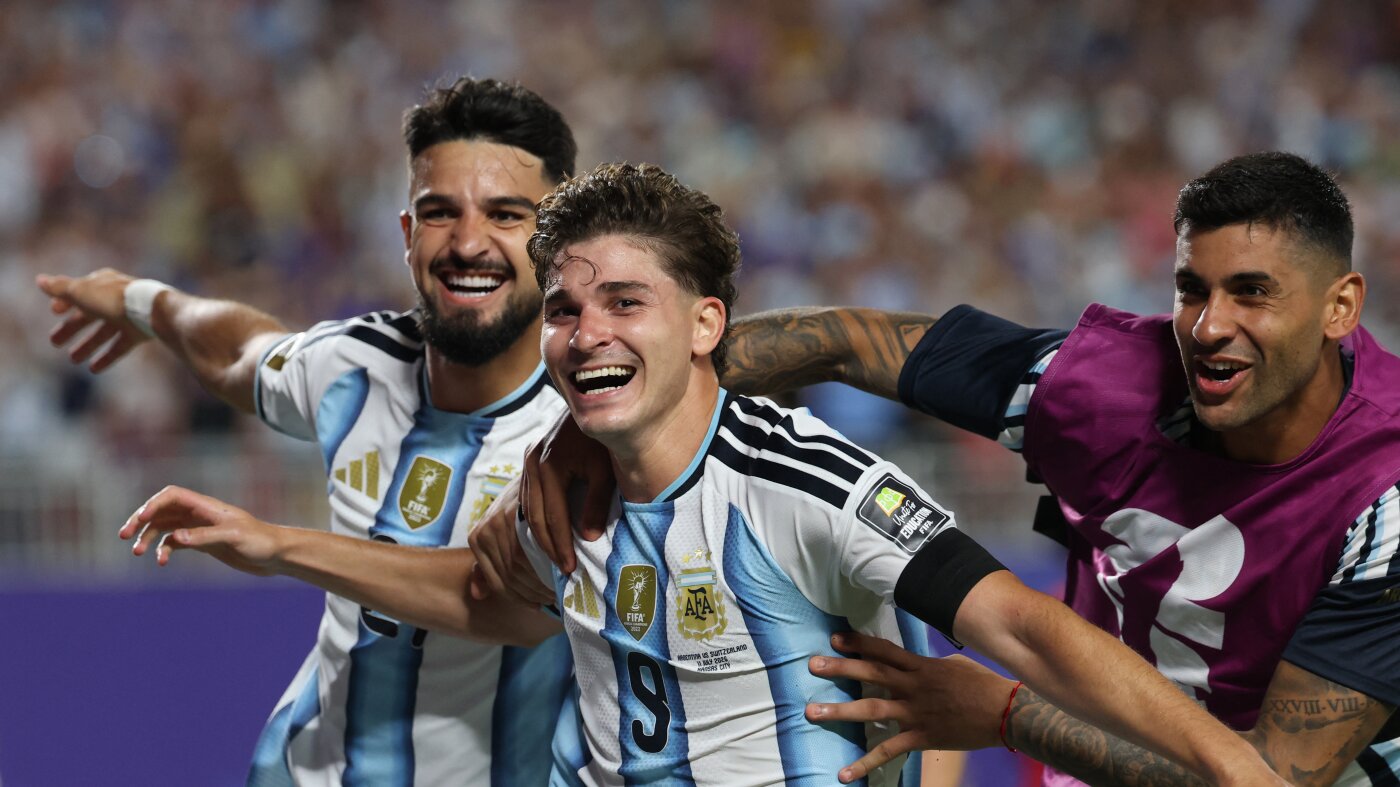
Argentina forward Julián Alvarez (C) celebrates scoring his team’s second goal during the World Cup quarterfinal match against Switzerland in Kansas City on Saturday. Argentina has advanced to the semifinals and will play England on Wednesday.

Odd Andersen/AFP via Getty Images


hide caption


toggle caption

Advertisement

Odd Andersen/AFP via Getty Images

KANSAS CITY, Mo. — This was not the first time Argentina had come to the brink in this FIFA World Cup.

First, the defending champions needed extra time to escape Cape Verde, the Cinderella story of this tournament. Then, they needed a miraculous comeback to overcome a 0-2 deficit to Egypt in the Round of 16.

In Saturday’s quarterfinal in Kansas City, the Albiceleste stood on the edge once again, trapped in a 1-1 tie for much of the second half and extra time against a feisty Switzerland team that would not lie down — even once they were playing down a man and a loss seemed inevitable.

Advertisement

In the end, after 30 minutes of extra time, Argentina prevailed 3-1 to earn a spot in the World Cup semifinals. They will face England (which also needed extra time Saturday to defeat Norway) on Wednesday in Atlanta.

Of the 69,045 people who packed into the stands of Arrowhead Stadium on a hot and humid Missouri night, thousands wore the jersey of the sport’s singular star: Lionel Messi, the 39-year-old forward for Argentina.

But it was forward Julián Alvarez who saved the day for his team and his country, sending a right-footed rocket to the far upper corner of the goal in the 112th minute. Then, in the 121st minute, a cherry on top from Lautaro Martínez, who sealed the game with another strike.

Messi contributed only an early-game assist. He had scored a goal in a record nine straight World Cup games — this is his first game in 10 matches in which he did not.

Switzerland's midfielder Remo Freuler (L) and Argentina midfielder Alexis Mac Allister fight for the ball during the World Cup quarterfinal in Kansas City on Saturday.

Switzerland’s midfielder Remo Freuler (L) and Argentina midfielder Alexis Mac Allister fight for the ball during the World Cup quarterfinal in Kansas City on Saturday.

Juan Mabromata/AFP via Getty Images

Advertisement


hide caption


toggle caption

Juan Mabromata/AFP via Getty Images

Advertisement

Alvarez’s goal capped an increasingly desperate effort by Argentina to keep the game from going to penalty kicks. It had taken an early 1-0 lead in the 10th minute, when midfielder Alexis Mac Allister headed a Messi corner kick into the net. (That was Messi’s 10th career World Cup assist, all of them to different players.)

Continue Reading
Advertisement

Trending