Connect with us

News

Wall Street frets over Big Tech’s $200bn AI spending splurge

Published

on

Wall Street frets over Big Tech’s 0bn AI spending splurge

Big Tech’s capital spending is on track to surpass $200bn this year and rise even further in 2025, as anxiety grows on Wall Street about the returns on soaring investment in artificial intelligence.

The four biggest US internet groups — Microsoft, Meta, Amazon and Google’s parent Alphabet — this week offered investors brief glimpses into the benefits they are seeing from their headlong rush into generative AI, arguing that it was boosting the performance of core services and helping to hold down operating costs.

But the stock market suffered a spasm on Thursday as investors looked past the imprecise benefits to focus instead on another big — and very measurable — jump in spending on chips and data centre infrastructure, as the AI race accelerates.

Capital expenditure at the four biggest hyperscalers grew more than 62 per cent on the year before, to about $60bn during the quarter, according to this week’s financial reports. Meta and Amazon were among those to point to further increases in spending next year.

Analysts at Citi forecast that the quartet’s total capital spending will hit $209bn this year, up 42 per cent on 2023. Citi estimates that data centres account for about 80 per cent of that total.

Advertisement

“What is the real benefit?” said Jim Tierney, a growth stock investor at AllianceBernstein, voicing a common concern. “All of these companies are spending a huge amount of money,” he added, with a resulting hit to profit margins that would become “more noticeable in 2025”.

One sign that demand for generative AI was starting to lift Big Tech’s growth rates came from the accelerating growth in the cloud divisions at Microsoft and Google.

But the optimism quickly dissipated when Microsoft went on to warn that cloud growth would slip back this quarter, largely because of supply constraints. Meanwhile, cloud market leader Amazon Web Services failed to hit the most optimistic hopes for an acceleration in its own growth, even as it lifted investors’ spirits with unexpectedly strong profit margins.

Companies that peppered their earnings calls this week with anecdotal and mostly vague assurances about AI returns included Alphabet, which said the new generative AI features in its search engine were increasing engagement and boosting usage. It also said a quarter of the software it produced was now written by AI.

Despite this, the growth in Google’ search volumes declined from the preceding quarter, said Tierney, raising a question about how strong the AI effect had been.

Advertisement

However, Microsoft said its revenue from AI was on the brink of hitting an annualised $10bn, reaching that milestone faster than any other business in its history. It also said that Copilot — an AI feature for which it charges a monthly fee of $30 per user — had experienced “the fastest growth of a new suite” yet seen in its M365 productivity software.

The $10bn figure was a rare disclosure of a hard revenue number and serves as an early proof-point of the real benefits that could start to flow from generative AI, said Brent Thill, an analyst at Jefferies.

But few other software companies have revealed anything about the effects of AI on their revenue, he added, leaving the stock market to fret. “It’s murky. And investors are freaking out about the costs,” Thill said.

Line chart of Share prices rebased showing Is Big Tech's AI rally running out of steam?

For its part, Meta told investors that AI had boosted returns from its advertising and improved engagement among users, while AWS said its “multibillion-dollar” AI business was growing at a rate of more than 100 per cent.

If anecdotes like this were encouraging but fuzzy, the rapidly rising spending on new data centres and equipment for AI was all too clear.

Facing a grilling from investors, executives at several companies claimed the massive increase in facilities to handle AI was closely tied to demand, and that capital efficiency would improve as the business increased in scale.

Advertisement

Executives at Amazon and Microsoft drew comparisons with the early days of the cloud computing business, when building and equipping fleets of data centres also caused spending to soar.

There are strong advanced buying signals from customers that make it possible to time investment spending closely to actual demand, said Amazon’s chief executive Andy Jassy. Microsoft’s chief financial officer Amy Hood said about half of the software company’s capital spending goes on server purchases, which could be timed closely to increases in demand.

Despite the claims of investment discipline, investors were left with the reality that the higher spending will hit Big Tech’s income statements next year, even as any revenue benefits are uncertain.

Meta, for instance, warned that 2025 would see “significant acceleration in infrastructure expense growth”, as its new fleet of data centres lead to higher depreciation charges and operating costs.

Changes in depreciation policies at Microsoft, Alphabet and Amazon in recent years will lessen the pain. All three have extended the useful lives of their data centre gear for accounting purposes, reducing the amount of depreciation they need to report each year.

Advertisement

Amazon said extending the useful lives of its servers by a year had lifted the profit margin in its cloud division by 2 percentage points in the latest quarter — the second time it has taken this step in two years.

But even after the moves to push depreciation charges further into the future, the pressure on margins from soaring spending on AI will be hard to avoid.

After a powerful two-year rally as earnings expectations for Big Tech have ratcheted steadily higher, this could indicate a turning point. The tech-heavy Nasdaq Composite closed 2.8 per cent lower on Thursday, with Microsoft, Meta and AI chipmaker Nvidia together shedding more than $400bn in value.

On Friday morning, shares in Meta and Alphabet were broadly flat, while Microsoft and Amazon were up, at 1 per cent and 7 per cent, respectively. Nvidia rose 3 per cent.

“Investors are left asking if the ‘beat and raise’ era [in quarterly earnings announcements] is over,” said Tierney. If so, the convulsion that passed through the market on Thursday could be a sign of rockier times ahead.

Advertisement

News

How a Beer Hall Keeps Up With a World Cup Crowd

Published

on

The fans see the games, the crowds, the food and the beer. But behind every World Cup watch party is a team working long before kickoff and well after the final whistle. We go behind the scenes at a beer hall in Brooklyn to see what it takes to serve a room full of soccer fans on game day.

Continue Reading

News

With the white nationalist group Patriot Front, what you see is not what you get

Published

on

With the white nationalist group Patriot Front, what you see is not what you get

Members of the group Patriot Front ride the subway as a commuter looks on, in Washington, D.C., on July 4.

Cheney Orr/Reuters


hide caption


toggle caption

Advertisement

Cheney Orr/Reuters

The sight of hundreds of masked men roaming the streets of Washington, D.C., on July Fourth weekend, wearing khakis, blue shirts and uniform patches, was chilling to some of the city’s residents.

For many Americans, it was the first they heard about Patriot Front, a white nationalist organization that was born out of the deadly 2017 Unite the Right rally in Charlottesville, Va. A now-viral Reuters photo prompted reflections on the experience of a lone African American woman who was photographed in a Metro subway car, surrounded by white supremacists.

The planned demonstration of force was timed to bring a fringe group of extremists into public view as the nation marked 250 years of its independence. Indeed, the stunt succeeded in earning the group media coverage across mainstream outlets, amplifying its brand and potential to reach new recruits. On this occasion, the members refrained from engaging in violence and property damage, projecting an image of law-abiding, orderly activism.

Advertisement

But those who are closely familiar with Patriot Front’s history and operations warn: Don’t believe what you see.

“That is not who they are in private,” said Len Kamdang, director of the Criminal Justice Project at the Lawyers’ Committee for Civil Rights Under Law. “Although they were on their best behavior [last] weekend, this is a dangerous group that commits acts of violence all over the country.”

Patriot Front’s history of violence and property damage

Kamdang’s organization sued members of Patriot Front for vandalizing a public mural dedicated to the tennis legend and Black activist Arthur Ashe in Richmond, Va., in 2021. Ashe, who was inducted into the International Tennis Hall of Fame in 1985, was born in Richmond and his legacy is a continuing source of pride to members of that community.

“A couple of Patriot Front members showed up under cover of night and vandalized the mural,” Kamdang said. “They painted white stencils all over. … They literally tried to whitewash him and they put their symbols of hate all over — their stencils, their slogans. And all the while they were caught on video. And that video leaked using some of the most horrible language that you can imagine.”

In many jurisdictions, law enforcement can seek additional hate crime charges or sentencing enhancements in cases where illegal acts appear to have been motivated by racial bias. But in this case, Kamdang said, Patriot Front members faced no criminal charges and their identities were only revealed when online activists later infiltrated the group and leaked internal records.

Advertisement
Continue Reading

News

Graham Platner makes it official in Maine, submitting paperwork to leave Senate race

Published

on

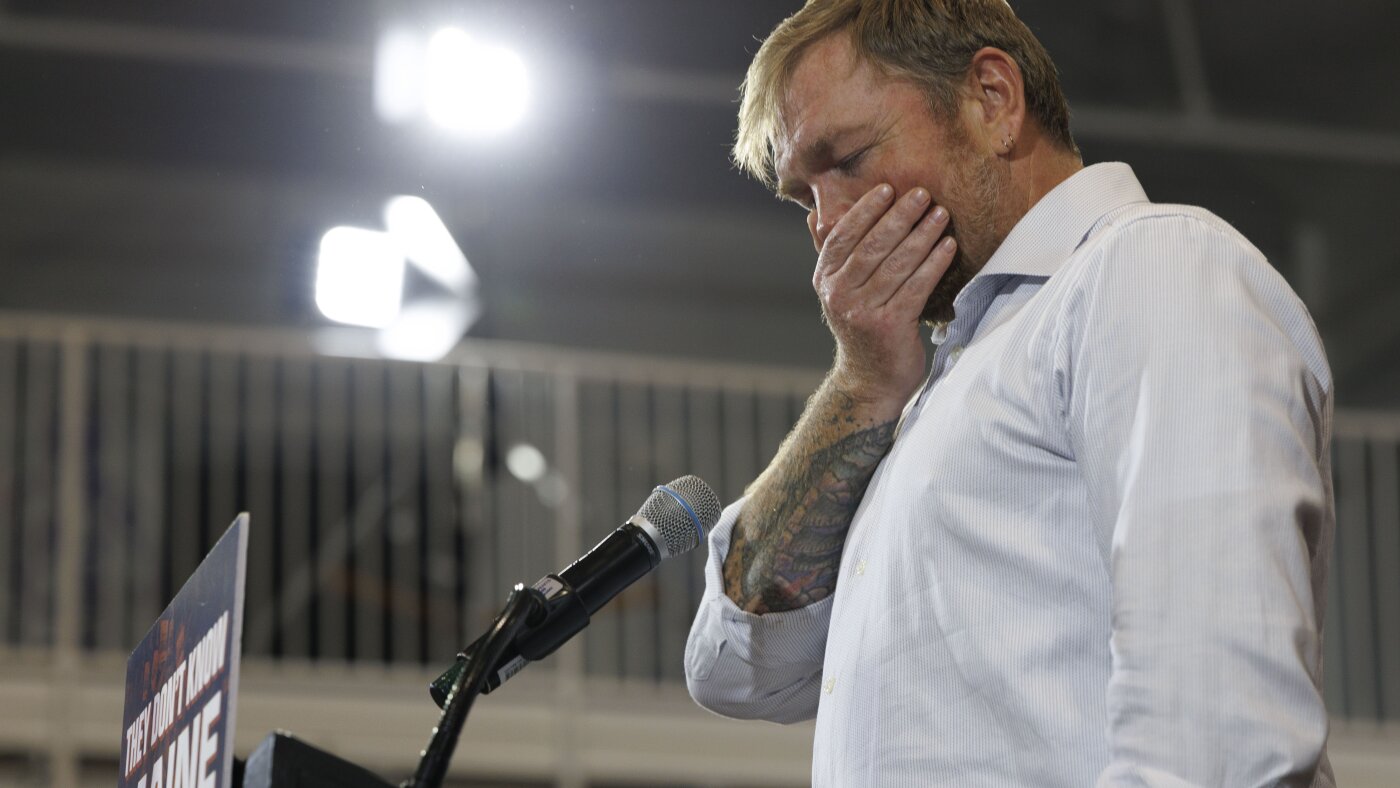
Graham Platner makes it official in Maine, submitting paperwork to leave Senate race

Now-former Democratic Senate candidate Graham Platner speaks at his primary election night event on June 9 in Blue Hill, Maine. Platner officially dropped out of the race July 10 following rape allegations from a former romantic partner that he denies.

CJ Gunther/Getty Images


hide caption


toggle caption

Advertisement

CJ Gunther/Getty Images

Graham Platner, Maine’s Democratic nominee for Senate, is officially out of the race.

The Maine Secretary of State said Platner filed the necessary paperwork to withdraw his candidacy two days after he announced he planned to do so following an accusation of rape by a former romantic partner. Platner denies the allegation.

The Maine Democratic Party has until July 27 to pick Platner’s replacement.

Advertisement

In his withdrawal notice, Platner said “people are desperate for change” and that’s why they voted “for a new kind of politics” by making him the Democratic nominee. He expressed gratitude for those who supported his campaign and said that he will continue to fight for “the movement we have built together and the future we believe in.”

He ended his notice with a strong statement aligned with the progressive platform.

“F*ck ICE. Free Palestine. Up the Hearts.”

Platner announced his plan to withdraw from the race in an 11-minute video he posted to social media on July 8. He said he had no choice but to suspend his campaign, citing it was no longer viable financially.

Advertisement

“We are going to lose our ability to fundraise. We are going to lose our ability to access voter data. We are going to lose all of the things that any campaign needs on the basic level simply to function,” he said.

Platner added that dropping out was not an admission of guilt. Rather, the decision, he said, is to keep the progressive movement in Maine alive to defeat Republican Sen. Susan Collins in November. Platner blamed the “political establishment” for his downfall and argued the goal was to force him out of the race.

“We built a campaign. We engaged in electoral politics. We motivated people. We banded together. We did it the way that we were told we are supposed to make change and we won. And now they are not going to let us have it. Not if it’s me,” he said.

Continue Reading
Advertisement

Trending