News
Trump’s ballroom fight sheds new light on an underground White House bunker


President Trump holds a rendering of the East Wing modernization while speaking to reporters aboard Air Force One on Sunday.
Mandel Ngan/AFP via Getty Images
hide caption
toggle caption
Mandel Ngan/AFP via Getty Images
President Trump’s dreams of a White House ballroom have highlighted what was once a relative secret: the construction of a military bunker beneath the now-demolished East Wing.
The administration started knocking down the East Wing in October to make way for Trump’s long-desired White House ballroom, a project that will cost at least $300 million. The plan has drawn disapproval from members of the public and ire from architectural and conservation groups, one of which sued to block it back in December.

U.S. District Court Judge Richard Leon sided with the National Trust for Historic Preservation this week, when he ruled that construction of the ballroom “must stop until Congress authorizes its completion.”
Yet, as the White House appeals the decision, Leon is allowing construction to continue for “the safety and security of the White House” — a nod to the administration’s argument that the renovation is about more than aesthetics.
That’s backed up in court filings from the case, as well as Trump’s own public comments.

A snapshot of the construction in February, after the East Wing was demolished to make room for a ballroom.
Jose Luis Magana/AP
hide caption
toggle caption
Jose Luis Magana/AP
“The military is building a big complex under the ballroom, which has come out recently because of a stupid lawsuit that was filed,” Trump told reporters on Air Force One over the weekend.
He said the proposed 90,000 square-foot ballroom “essentially becomes a shed for what’s being built under,” adding that the “high-grade bulletproof glass” windows would protect the facility below “from drones and … from any other thing.”
The existence of a World War II-era facility — called the Presidential Emergency Operations Center (PEOC) — has been an open secret for decades, especially after the government released photos in 2015 of White House officials sheltering inside on Sept. 11, 2001.

But little is known about the current status of the bunker, which CNN reported in January had been dismantled in the renovations, or what kind of structure might come to replace it. When asked on Monday to share more about the underground complex, White House press secretary Karoline Leavitt stayed tight-lipped.
“The military is making some upgrades to their facilities here at the White House, and I’m not privy to provide any more details on that at this time,” she said.
Trump was more forthcoming with reporters that same day, as he signed executive orders in the Oval Office, reiterating that the judge’s decision allows him to “continue building as necessary … to cover the safety and security of the White House and its grounds.”
Trump read through a handwritten note listing off the permitted upgrades.
“The roof is droneproof. We have secure air-handling systems,” Trump said. “We have bio-defense all over. We have secure telecommunications and communications all over. We have bomb shelters that we’re building. We have a hospital and very major medical facilities that we’re building … So on that we’re okay.”
For decades, little was known about the FDR-era bunker
The White House built the East Wing with an underground bomb shelter for President Franklin D. Roosevelt during World War II, over concerns that the building could become the target of an aerial attack.
“This secret space featured thick concrete walls and steel-sheathed ceilings with a small presidential bedroom and bath inside,” the White House Historical Association wrote on social media in 2024. “Nearby rooms provided ventilation masks, food storage, and communications equipment.”
It has been upgraded in the decades since. On the day of the 9/11 terrorist attacks, a number of White House officials under George W. Bush — who was in Florida at the time — took shelter there.
Former First Lady Laura Bush recounted the experience in her 2010 memoir, in which she wrote about being “hustled downstairs through a pair of big steel doors that closed behind me with a loud hiss, forming an airtight seal.”

President George W. Bush talks with Vice President Dick Cheney in the Presidential Emergency Operations Center on Sept. 11, 2001.
Eric Draper/The White House/Associated Press
hide caption
toggle caption
Eric Draper/The White House/Associated Press
“I was now in one of the unfinished subterranean hallways underneath the White House, heading for the PEOC,” she wrote. “We walked along old tile floors with pipes hanging from the ceiling and all kinds of mechanical equipment. The PEOC is designed to be a command center during emergencies, with televisions, phones, and communications facilities.”
Key administration officials, including Vice President Dick Cheney and National Security Advisor Condoleezza Rice, were also there, seated at a long conference table in a small room. The government released hundreds of photos of that day — showing officials talking on landline phones and videoconferencing on large screens — in response to a Freedom of Information Act request in 2015.
Bush wrote that the Secret Service suggested the couple spend the night in the bunker: “They showed us the bed, a foldout that looked like it had been installed when FDR was president … we both said no.”
A decade later, when Barack Obama was president, the White House undertook a major, multi-year renovation project that involved digging a massive hole beneath the Oval Office, exposing what appeared to be a tunnel underneath. The General Services Administration (GSA) denied it was bunker-related, calling it a standard revamp of the air-conditioning and electrical systems.

A digging project near the West Wing, pictured in Jan. 2011, looked to many like bunker business.
Charles Dharapak/AP
hide caption
toggle caption
Charles Dharapak/AP
“However, what reporters and photographers saw during the construction appeared to go well beyond that: a sprawling, multistory structure whose underground assembly required truckload after truckload of heavy-duty concrete and steel beams,” the Associated Press wrote towards the end of the project in 2012.
It noted that the White House had tried to keep that work hidden by putting up a fence around the excavation site and “ordering subcontractors not to talk to anyone and to tape over company info on trucks pulling into the White House gates.”

Many people didn’t buy the official explanation for what some media outlets came to call “The White House Big Dig.”
A 2011 New York Times report cited unnamed administration officials speculating that the effort was actually “security-related.” People did not take the GSA’s story at face value, the article added, “despite the size of the hole, the controlled silence of the construction workers and the fact that funds were allocated after Sept. 11, 2001.” A 2011 Washington Post piece put it more bluntly: “It’s a bunker, right?”
Questions about the bunker surfaced again during Trump’s first term, after the New York Times and CNN reported that the Secret Service had rushed him inside and kept him there briefly during a night of Black Lives Matter protests outside the White House in May 2020. Trump later confirmed that he had spent time in the PEOC, but denied that he’d been rushed inside — told Fox News he had gone in briefly during daytime hours “more for an inspection.”
What we know about the new construction
Still, the existence of a bunker — and plans to construct a new one — were not necessarily top of mind for people when Trump began demolishing the East Wing last fall.
Critics were quicker to call out the lack of public input and congressional authorization, the sheer scale of the proposed ballroom and concerns about environmental impact and historical preservation.

In January, as the legal battle unfolded, Trump wrote on Truth Social that the project was being undertaken with “the design, consent, and approval of the highest levels of the United States Military and Secret Service,” without elaborating.
“The mere bringing of this ridiculous lawsuit has already, unfortunately, exposed this heretofore Top Secret fact,” Trump wrote.

The National Capital Planning Commission voted to approve Trump’s ballroom plan on Thursday, days after a federal judge ordered construction to stop without authorization from Congress.
Al Drago/Getty Images
hide caption
toggle caption
Al Drago/Getty Images
In court filings reviewed by NPR, the Secret Service confirmed its involvement but kept details to a minimum.
In one signed declaration, Secret Service Deputy Director Matthew Quinn wrote that his agency was working with the contractor on “temporary security and safety measures around the project’s construction site,” which were not fully complete at the time.
“Accordingly, any pause in construction, even temporarily, would leave the contractor’s obligation unfulfilled in this regard and consequently hamper the Secret Service’s ability to meet its statutory obligations and protective mission,” Quinn wrote, before offering to brief the judge privately on more details, “including law enforcement sensitive and/or classified information.”
In a separate filing, Trump administration officials sought to submit further details in a classified setting so as to keep “the discussion of national security concerns” off a publicly available docket.
Trump allies have been similarly vague in other public settings, including at a National Capital Planning Commission meeting in January, where Josh Fisher, the White House director of management and administration, said: “There are some things regarding this project that are, frankly, of top-secret nature that we are currently working on.”
After a period of soliciting public comments, the commission, a government agency that meets monthly to provide planning guidance for D.C.’s federal land and buildings, held its approval vote on a tweaked version of Trump’s ballroom plan this week. It gave it the green light, despite the judge’s order just days earlier.


At her home in Stanton on Thursday, Leticia Rinker, 71, kept thinking she was smelling gas.
She repeatedly checked the burners on her stove. She threw away an old pan, thinking maybe she had burned some grease on it while cooking chicken that day.
Then, her head started hurting.
The smell was still in the air Friday morning when she went for a walk, she said.
“Now I know why I smelled it and why I got the headache,” Rinker said Friday night after evacuating her home while emergency crews frantically worked to stop a damaged chemical tank at GKN Aerospace in Garden Grove from exploding.
Rinker, who is retired, had a long career in the automotive industry. “I know smells,” she added.
Rinker was staying at the evacuation center at the Garden Grove Sports & Recreation Center, with her two pugs, Lulu and Daisy, and her daughter’s two cats, Cedric and Elvis.
She was walking Friday morning at around 11 a.m. when a neighbor called and told her she needed to get the pets and go.
Her daughter and son-in-law, who live with her, were on a trip out of state, so she spent most of the day in her car at the evacuation center with the pets. The evacuees, she said, were remarkably calm, and relief workers fed them “some delicious spaghetti.”
“Everybody’s very relaxed, just chilling, sitting down,” she said. “A lot of people have their dogs. It’s OK, you know? It’s not a chaos thing.”
Still, she said, she had no idea when she could go home and was upset she had not grabbed food for the pets because she did not think she would be gone so long.
“I’m just hanging out in my car,” she said from the evacuation site. “I see no sense in going anywhere and wasting my gas, as high as it is.”
Rinker said she had friends and neighbors who refused to leave.
Rinker has lived in Stanton, near the aerospace manufacturer, for three decades and said she had never experienced anything like this.
“All I need is for my house to explode,” she said sarcastically.
Then, with a sigh: “I’m trying not to think about it. I love my house.”


THE
OFFICE OF TH
DIRECTOR
*******
OF
NATIONAL
UNITED STATES OF AMERICA
Director of National Intelligence
May 22, 2026
The President
The White House
1600 Pennsylvania Avenue NW
Washington, D.C. 20500
Dear Mr. President,
I am deeply grateful for the trust you placed in me and for the opportunity to lead the Office of the Director of National Intelligence for the last year and a half.
Unfortunately, I must submit my resignation, effective June 30, 2026. My husband, Abraham, has recently been diagnosed with an extremely rare form of bone cancer. He faces major challenges in the coming weeks and months. At this time, I must step away from public service to be by his side and fully support him through this battle.
Abraham has been my rock throughout our eleven years of marriage — standing steadfast through my deployment to East Africa on a Joint Special Operations mission, multiple political campaigns, and now my service in this role. His strength and love have sustained me through every challenge. I cannot in good conscience ask him to face this fight alone while I continue in this demanding and time-consuming position.
While we have made significant progress at the ODNI — advancing unprecedented transparency and restoring integrity to the intelligence community — I recognize there is still important work to be done. I am fully committed to ensuring a smooth and thorough transition over the coming weeks so that you and your team experience no disruption in leadership or momentum.
Thank you for your understanding during this deeply personal and difficult time for our family. I will remain forever grateful to you and to the American people for the profound honor of serving our nation as DNI.
With love and aloha,
Tulsi Gabbul
Tulsi Gabbard
Director of National Intelligence
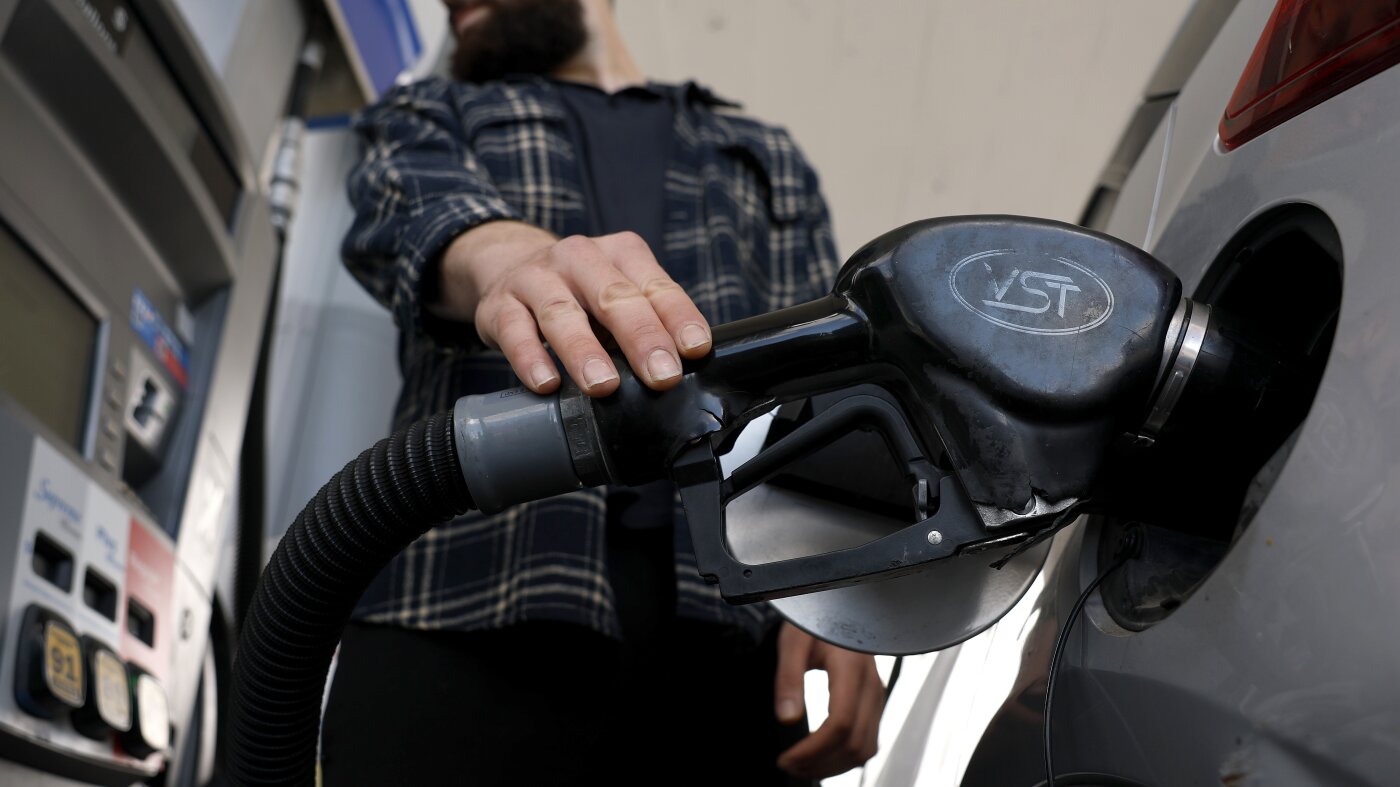
A customer pumps gas into his car at a Chevron station on May 4 in Los Angeles, Calif. Gas prices have surged to a 4-year high, as tensions in the Middle East continue. Gasoline in California is over $6 a gallon.
Justin Sullivan/Getty Images North America
hide caption
toggle caption
Justin Sullivan/Getty Images North America
The national average for a gallon of gasoline is $4.55, according to AAA; that’s a four-year high, unwelcome news for drivers as the U.S. heads into one of the busiest travel weekends of the year.
AAA estimates a record 45 million Americans will travel this weekend, despite high prices for gasoline, diesel and jet fuel.
Gasoline prices have been elevated since the start of the war in Iran, and there’s no sign of relief on the horizon. High prices are angering voters and straining household budgets.
In California, which has the highest gasoline prices in the nation, Gov. Gavin Newsom is openly feuding with the oil giant Chevron, discouraging Californians from filling up at its stations.
Chevron and the state have been in a tense relationship for years; Chevron moved its headquarters out of California in 2024 after complaining about state and local regulations, and is currently buying oil shipped through an offshore pipeline that California has attempted to keep shut down. In the latest salvos, Chevron has posted placards at California gas stations blaming state policies for the high prices, while Newsom’s office is telling Californians they can get cheaper gas at unbranded stations.
Californians, if you’re hitting the road this holiday weekend, be sure to AVOID Chevron.
Pro tip: unbranded gas comes from the same refineries, storage tanks, and pipelines, and it meets the same state standards to keep your engine running clean, even if it doesn’t have a fancy… pic.twitter.com/FMTnNHE0Bn
— Governor Newsom Press Office (@GovPressOffice) May 21, 2026
But where does all this leave drivers? Despite high prices, most Americans are unwilling, or unable, to give up on driving. Americans have been logging more miles since the war with Iran started, according to the analytics company Arity, which tracks driving habits.
What can you do to cut costs? We asked the experts for ideas.
Drive smoothly. Pay less
The key to getting the most miles out of each gallon is driving efficiently. That means smooth acceleration, soft braking and slowing down.


Underinflated tires, heavy boxes in the back seat and an unused ski or luggage rack on the top of the vehicle can also make it less fuel efficient.
Some high-performance vehicles require premium gasoline. But if it’s only recommended, you can skip it without damaging the car, according to Consumer Reports’ deputy auto editor, Jonathan Linkov. “All cars, except the most esoteric supercars or older cars, can run fine on regular,” said Linkov.
Are you considering going electric?
Data suggests that higher gasoline prices have many drivers at least thinking about giving up gas-powered cars altogether.


But the data on sales isn’t so clear-cut. New-EV sales are still depressed following the abrupt end of a $7,500 federal consumer tax credit last fall. It’s also tax refund season, which can push up car sales of all types, compared with the previous month. CarGurus reports that used-EV sales did seem to accelerate in the month of March, and Cox Automotive reports strong prices for used EVs at wholesale auction, noting that rising gas prices “may have positively influenced demand.” On the other hand, data from the sites iSeeCars.com showed no appreciable shift in used-EV sales.
It’s not surprising to see a rise in shoppers’ interest before a rise in actual sales, especially for a purchase as significant as a vehicle. “What consumers are viewing on the site tends to be an earlier indicator than sales,” says Kevin Roberts, the director of economic and market intelligence with CarGurus.
But analysts note that high gasoline prices do motivate shoppers to select for more fuel-efficient or entirely electric vehicles — if prices stay elevated for a long time.
An average driver can save $1,800 a year
The more you drive, the more you stand to save from switching to a battery-powered car, says Janelle London, the co-executive director of a nonprofit called Coltura, which advocates against gasoline. “Across the entire U.S., an average driver doing, say, 15,000 miles a year already is going to save $1,800 a year by switching to an electric car,” London says. “But if you’re talking about a big driver, somebody who does maybe 25,000 miles a year, they’re going to be saving on average $3,000 a year by making the switch.”
And as the cost of gas keeps rising, she says, “we’re seeing the savings just skyrocket up.”
Coltura has an online tool that car shoppers can use to estimate potential savings from going electric.

Those savings vary based not just on how much you drive but also on where you live, thanks to differences in the local prices of gasoline and electricity. Yale Climate Connections recently published a map comparing the price of charging with the price of gasoline, by looking at the cost of enough electricity to take you as far as 1 gallon goes in a similar gas car: In North Dakota, driving an EV is like paying less than a dollar a gallon, but in California it’s more like $2.70 a gallon.
Or you can crunch your personal numbers more precisely by comparing the cost per mile using your own electricity rates, local gasoline prices and the efficiency of the gas and electric vehicles you’re comparing. (The extremely lazy route? Multiply your home’s cost per kilowatt-hour for electricity by 10. That’s very roughly comparable to how many dollars per gallon you’d pay to fuel your car. The national average cost for home electricity is $0.17 right now, so, ballpark, that’s like paying $1.70 for gasoline.)
Consider factors beyond gasoline
If you’re thinking of switching to an EV to save money, there are other factors to weigh as well. Maintenance savings can also be substantial — electric vehicles need new tires and not much else. On the other hand, insurance can be pricey. You might also weigh nonfinancial factors, like how much you value the environmental benefits of an EV or the merits of a quiet ride.

Charging is also crucial. Can you charge at home, which is far more convenient and affordable than charging at stations? If so, will you need to install a dedicated, higher-speed charger, which comes with an installation cost, or can you get by with a standard outlet?
The more you drive and the larger your vehicle is, the more likely it is you’ll need to add a charger. The Environmental Protection Agency has a calculator that can help with that decision.
Could you get by without driving at all?
Another option, of course, is to pursue alternatives to driving.


But data compiled by the app Transit shows that ridership was steady for most of March and actually dropped slightly in the week ending April 4.
That’s no surprise, says Stephen Miller, the policy lead at Transit; the Easter holiday may have pulled ridership down, and gas prices have been elevated only for a few weeks. “Historically, people only make larger changes that show up as a significant shift from driving to public transit if the price of gas goes up — and stays up,” he says. Year over year, transit ridership continues to increase overall, although it has yet to fully recover from the collapse in public transit use at the start of the COVID-19 pandemic.
Jerick White, who lives in Houston, bought his first e-bike in March. There were several reasons explaining why he switched from a car to two wheels, but saving on gasoline was one of them. Between the cost of the car, maintenance and gas, he says, “it just became too unbearable, unmanageable and expensive.”
He hasn’t calculated exactly how much money he’s saving, but, he says, it’s “a lot of money for sure.” One important factor in his decision: White works from home now and lives close to a grocery store and other places where he needs to run errands. Biking around “is very, very reliable if you stay in a neighborhood and you work close by,” he says.
If getting an EV makes the most sense for people with the longest commutes, trading out of a car entirely is for the other end of the spectrum: people who don’t drive much or take a lot of short trips. Veo, the bike and scooter app, reports that its average trip length is 1.9 miles.
If it works for your lifestyle, White says, biking has benefits in addition to savings on gas. “I feel like a kid again when I’m riding it,” he says. “It’s very enjoyable.” And: “Oh, my goodness, I can avoid the traffic.”
Spend more on fuel by cutting more elsewhere
Finally, some folks are willing to spend more at the pump — but cut back elsewhere. High fuel prices were not enough to stop Julie and Vince Rossi from taking their first cross-country road trip in their new recreational vehicle. They sold their house to live in a 22,000-pound RV full time and went on their longest road trip yet, driving from Arizona to Virginia.
Diesel costs even more than gasoline — and its price has gone up faster since the war started — so to afford their now-doubled fuel budget, they’re skipping the museums and amusement parks for free attractions. “If we want to continue on this lifestyle, we either look for the lowest prices or we need to cut spending somewhere else,” Julie Rossi says.
A previous version of this story ran on April 7, 2026.
-

 Dallas, TX1 minute ago
11 Dallas neighbors declared best places to live and more top stories
-

 Miami, FL7 minutes ago
Dolphins 90 in 90: Tight end Greg Dulcich looking to build in 2026
-

 Boston, MA13 minutes ago
Red Sox’s Trade Market Desires Reported By Boston Insider
-

 Denver, CO19 minutes ago
Rookie LB Red Murdock is anything but Irrelevant and gives the Broncos a tackling and fumble forcing machine
-

 Seattle, WA25 minutes ago
Where to watch Seattle Mariners vs Kansas City Royals: TV channel, start time, streaming for May 23
-

 San Diego, CA31 minutes ago
San Diego startup is hacking plant DNA to end farming’s chemical dependence
-

 Milwaukee, WI37 minutes ago
Baby Keem hits the jackpot at ‘Ca$ino’ tour stop in Milwaukee
-

 Atlanta, GA43 minutes ago
Amber alert for 2 missing kids; ‘Operation Lockdown’

