News
Tiktok’s Final Appeal to the Supreme Court Didn’t Go Too Well


Photo: Intelligencer; Photo: Getty Images
The looming TikTok ban is barely a week away and the company is running out of time to do anything about it. On Friday, the Supreme Court heard last-minute arguments about the ban, with TikTok angling for an intervention or, at least, a temporary ruling to buy it a bit more time. They didn’t go especially well for TikTok — even justices who sounded sympathetic to the company’s arguments about free speech seemed satisfied by the government’s core national security argument.
As a matter of law, in other words, it’s looking like the ban is going to happen, and probably right before Donald Trump once again takes office. This is a completely unprecedented event — a massively popular app with a major cultural and economic footprint in the United States might just get switched off — but also something that the incoming president, who effectively originated the ban in the form of an executive order in 2020 but has since become aware that some people on the app actually like him and has also raised a bunch of money from one of its biggest American investors, now says he doesn’t want to happen.
The court was concerned, mostly, with the substance of the law, which requires that TikTok either be sold to an American company or banned entirely, but the justices did briefly touch on the urgent question of what might practically happen next, in the real world. Congress passed a law. Trump can say he doesn’t support it, but it’s still on the books, and it passed with substantial bipartisan support. If he really wants to stop it he’ll have to do something about it, and the available options are all pretty messy.
According to the law he could, as President, temporarily pause the ban if the company demonstrates its intent to imminently sell, but TikTok parent company ByteDance has strongly suggested that this isn’t possible, not least because of tightening Chinese export controls around algorithms and AI. Should ByteDance agree to offload an algorithmically stripped-out version of TikTok — something at least one credible buyer has nonetheless expressed interest in — Trump, who would also be able to unpause the ban, would have a great deal of influence over the terms of the deal. But the app would almost certainly experience an interruption in service and return, eventually, as something fundamentally different.
Near the end of the hearing, though, Justice Kavanaugh floated the possibility that’s most aligned with how Trump is talking about this at the moment: “Could the president say we are not going to enforce this law?” Indeed, this is an approach he’s been implying, it certainly matches his mental model of how government should work — TikTok is unbanned if I say so — and it seems like something that he might at least attempt.
Kavanaugh helped answer his own question: Trump could do this, he noted, but it would create serious practical problems. One way the ban is intended to work is by making it illegal to provide “services to distribute, maintain, or update such foreign adversary controlled application,” meaning that Apple and Google, which between them maintain the app stores on virtually all of America’s smartphones, would be legally required to delist the app. A promise by Trump not to enforce a TikTok ban, or to unilaterally and/or counterfactually declare TikTok in compliance with the law, would leave Apple and Google in a risky position. They could relist an app that’s still technically illegal but which the President says is actually fine in support of a company to which they have no particular reason to help and which is in fact, in Google’s case, a direct competitor.
Or they could just say: Hey, hosting a service that has been declared a “FOREIGN ADVERSARY CONTROLLED APPLICATION” by lawmakers isn’t worth the trouble even if the President says he’s personally totally cool with it. This would be prudent unless, of course, such an action would be interpreted as a slight against the President, and wielded against them publicly or privately, in which case two of American’s largest companies, each facing ongoing antitrust cases, might just have to hire a few dozen more lobbyists and OFAC attorneys and figure out how to make things work. Welcome to the new tech industry.



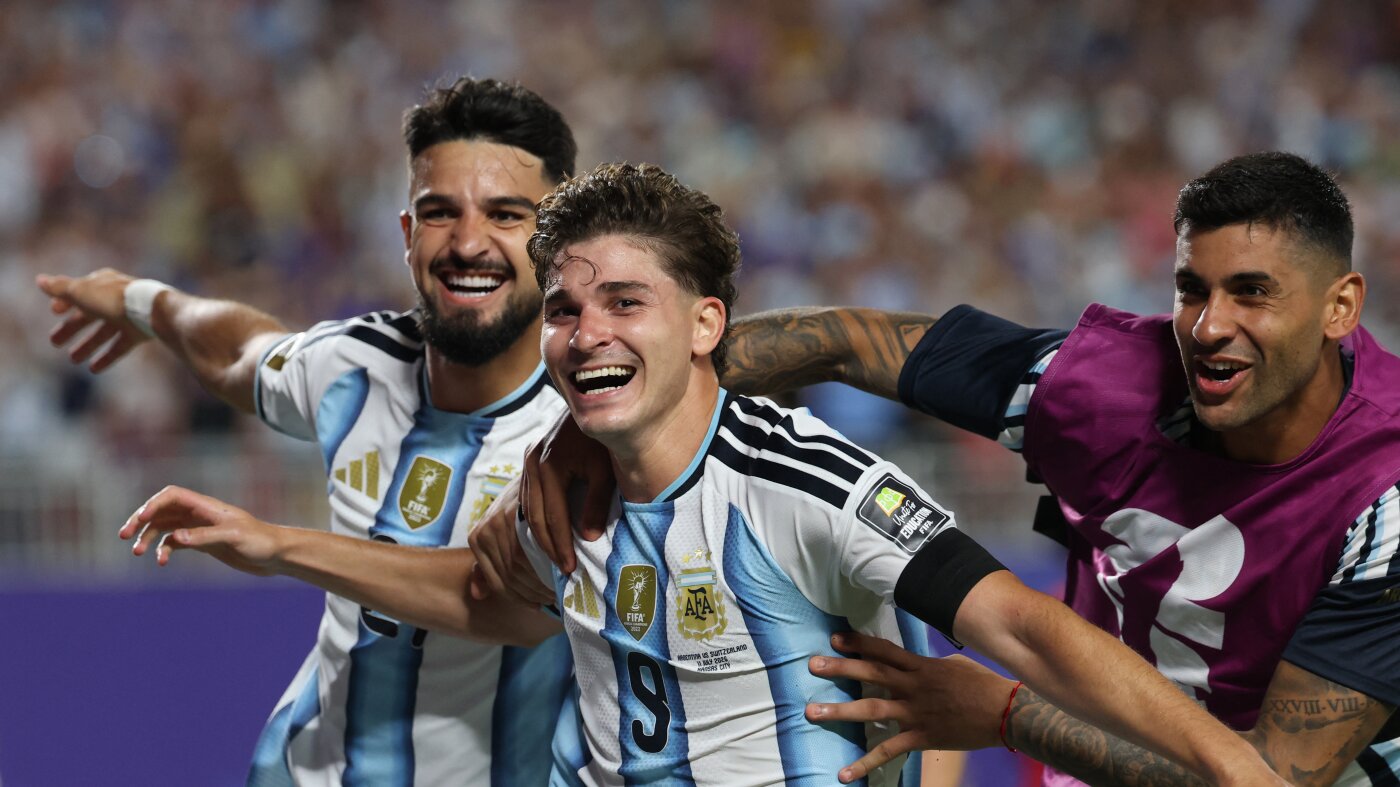
Argentina forward Julián Alvarez (C) celebrates scoring his team’s second goal during the World Cup quarterfinal match against Switzerland in Kansas City on Saturday. Argentina has advanced to the semifinals and will play England on Wednesday.
Odd Andersen/AFP via Getty Images
hide caption
toggle caption
Odd Andersen/AFP via Getty Images
KANSAS CITY, Mo. — This was not the first time Argentina had come to the brink in this FIFA World Cup.
First, the defending champions needed extra time to escape Cape Verde, the Cinderella story of this tournament. Then, they needed a miraculous comeback to overcome a 0-2 deficit to Egypt in the Round of 16.
In Saturday’s quarterfinal in Kansas City, the Albiceleste stood on the edge once again, trapped in a 1-1 tie for much of the second half and extra time against a feisty Switzerland team that would not lie down — even once they were playing down a man and a loss seemed inevitable.
In the end, after 30 minutes of extra time, Argentina prevailed 3-1 to earn a spot in the World Cup semifinals. They will face England (which also needed extra time Saturday to defeat Norway) on Wednesday in Atlanta.
Of the 69,045 people who packed into the stands of Arrowhead Stadium on a hot and humid Missouri night, thousands wore the jersey of the sport’s singular star: Lionel Messi, the 39-year-old forward for Argentina.
But it was forward Julián Alvarez who saved the day for his team and his country, sending a right-footed rocket to the far upper corner of the goal in the 112th minute. Then, in the 121st minute, a cherry on top from Lautaro Martínez, who sealed the game with another strike.
Messi contributed only an early-game assist. He had scored a goal in a record nine straight World Cup games — this is his first game in 10 matches in which he did not.

Switzerland’s midfielder Remo Freuler (L) and Argentina midfielder Alexis Mac Allister fight for the ball during the World Cup quarterfinal in Kansas City on Saturday.
Juan Mabromata/AFP via Getty Images
hide caption
toggle caption
Juan Mabromata/AFP via Getty Images
Alvarez’s goal capped an increasingly desperate effort by Argentina to keep the game from going to penalty kicks. It had taken an early 1-0 lead in the 10th minute, when midfielder Alexis Mac Allister headed a Messi corner kick into the net. (That was Messi’s 10th career World Cup assist, all of them to different players.)
Yet Argentina could not add to that lead in the first half, or the second. Instead, a clinical and determined Swiss side found enough gaps in Argentina’s defense to repeatedly threaten before, finally, forward Dan Ndoye slipped a shot under the leg of Swiss goalkeeper Gregor Kobel to tie the match 1-1.
But soon after Switzerland’s equalizer came the game’s pivotal development: Swiss forward Breel Embolo was sent off after a video review showed he had faked a fall.


It was Embolo’s second yellow card of the game — the first had come late in the first half when he was late to challenge Argentinian midfielder Leandro Paredes — meaning it would be treated as a red card, and Switzerland would have to play the remainder of the game down a man.
The shocked and crying Embolo had to be led off the field, his face crumpled and head in hands, by teammates and into the locker room.
Instantly, the decision sparked debate among analysts and fans. Were both calls fair, and the outcome an acceptable consequence? Or was dooming Switzerland to a shorthanded quarterfinal a punishment that did not match the crime of a single theatrical fall to the ground, something that happens a dozen times a game?
But no debate will keep Argentina from another World Cup semifinal. And for Messi, that means two more chances — the semifinal against England, then either the final or the third-place playoff — to pad his lead in the record for career World Cup goals scored, at 21.

The US congressman Ro Khanna says armed Israeli settlers detained him during a visit to the Israel-occupied West Bank recently, describing the experience as a first-hand view of the realities faced by Palestinians living under occupation.
In an interview with Reuters on Thursday from a Palestinian village, the progressive US House Democrat from California said his detention happened the previous day while his delegation visited an area of the southern West Bank that has experienced repeated attacks by Israeli settlers.
Khanna recounted how settlers carrying US-made M4 rifles surrounded the group’s van.
“We were at a village that Israeli settlers had destroyed – they had destroyed the school, they had destroyed that village, and we were just looking at it,” Khanna said.
Referring to the Israel Defense Forces, which is funded in part by US military aid, Khanna continued: “And these hoodlums … detain us. They block off the road. And then they call the IDF and the IDF is on their side, not on the side of the Americans.”
Khanna also told Reuters, “I saw the arrogance in the eyes of those settlers, 21- and 22-year-olds with guns, laughing that they had detained us, the arrogance of those young IDF soldiers that my tax dollars are funding – having no respect for the fact that they were detaining Americans, no respect that there was an American congressperson in that bus, and laughing when our translator told them that there are Americans there and the American embassy is concerned.”
Khanna aide Cameron Kasky wrote on X that he was there when the congressman’s group was detained, saying: “The IDF showed up to back up the settlers, not the US congressman.”
Khanna added that the encounter illustrated “the arrogance of power – of a power that has had no accountability, total impunity – and it’s created a toxic culture of oppression”.
The New York Times first reported Khanna’s account on Saturday morning. He told the outlet: “I felt powerless in that situation, which is not an easy thing, as I have a lot of privilege in life.
“Imagine how people feel every day, Palestinians under the occupation, if they could make an American congressperson feel powerless for 90 minutes.”
Khanna said he and his group were ultimately able to continue traveling after contacting the US embassy and Israeli police.
The Israeli military said troops and police responded after receiving a report that settlers were obstructing vehicles near Khirbet Zanuta, according to Reuters.
Khirbet Zanuta is a Palestinian hamlet whose residents were forced to leave in the wake of violent settler raids after the Hamas attacks on Israel in October 2023.
Asked by Reuters whether he intends to run for president, Khanna replied: “I’m strongly considering it. And I’m more resolved to consider it after this trip.”
More than 700,000 Israelis reside in settlements across the occupied West Bank including East Jerusalem. The United Nations considers Israeli settlements in the West Bank to be illegal, and Israel has faced repeated criticism over violence and other actions by settlers in the territory.
Since Israel took control of the West Bank in 1967, restrictions imposed there have prevented the territory from developing a self-sustaining economy. Those restrictions intensified significantly after the deadly 7 October 2023 Hamas attacks on Israel.
Nearly 300,000 Palestinians have lost employment in the West Bank and Israel.
A June report issued by a UN independent international commission of inquiry concluded that “Israeli authorities and security forces have deliberately targeted Palestinian children resulting in genocide, crimes against humanity, and war crimes in the Gaza Strip and war crimes in the West Bank”.
According to data from human rights organisation Yesh Din, no Israeli has been indicted for the killing of a Palestinian since October 2023.
Khanna has been one of the most outspoken critics in the US Congress of the war in Gaza and the occupation of the West Bank, often clashing with his own party’s establishment. In May, he released a video criticizing the Democratic National Committee’s incomplete postmortem report on the defeat that the party suffered at the hands of Donald Trump in the 2024 presidential election.
The postmortem did not mention Gaza. In his video, Khanna said: “As someone who campaigned in Michigan and Wisconsin, let me tell you – one of the reasons we lost is our blank check to Israel and [prime minister Benjamin] Netanyahu while they committed genocide in Gaza.
“We must speak and confront hard truths if this party is to win” the 2028 presidential election, he added.
Reuters contributed reporting
The fans see the games, the crowds, the food and the beer. But behind every World Cup watch party is a team working long before kickoff and well after the final whistle. We go behind the scenes at a beer hall in Brooklyn to see what it takes to serve a room full of soccer fans on game day.
-
 Lifestyle1 minute ago
‘The Odyssey’ is the mother of bad-trip tales. Why are we obsessed with travel disasters?
-
 Politics8 minutes ago
Trump slashes wildlife protections, putting endangered California animals at risk
-
 Sports16 minutes ago
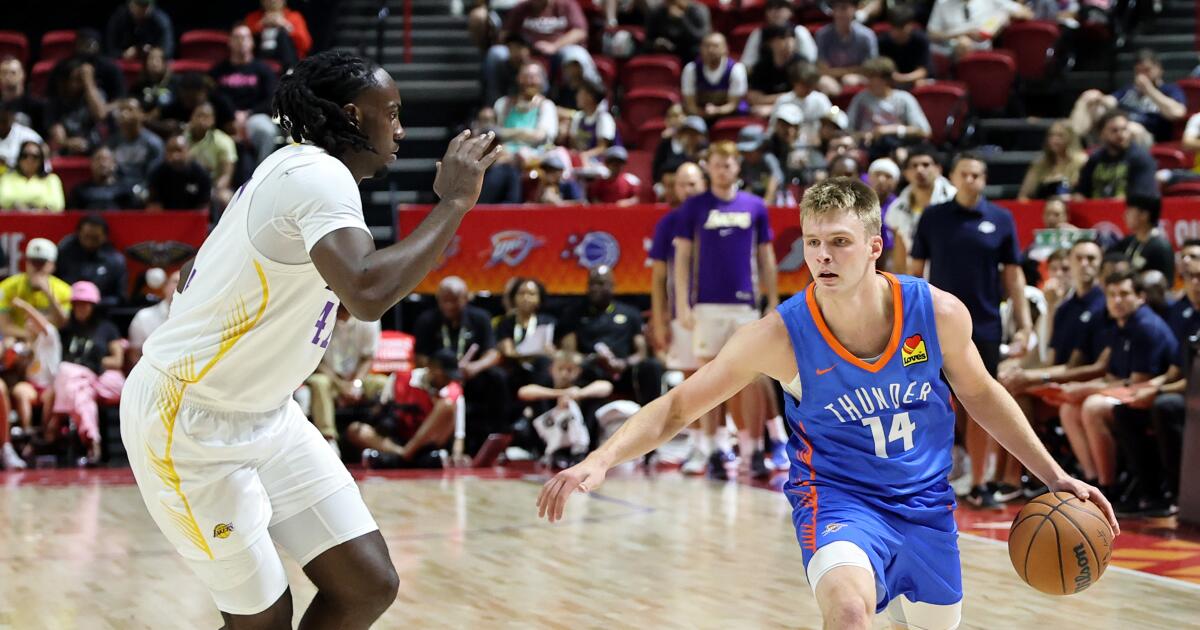
Lakers’ Arthur Kaluma erupts for 34 points in breakout Summer League performance
-

 World26 minutes ago
Sheikh Hamad bin Khalifa Al Thani, architect of modern Qatar
-
News56 minutes ago
Messi and Argentina survive another close call to reach the World Cup semifinals
-

 Los Angeles, Ca2 hours ago
19-year-old arrested, accused of distributing marijuana to minors across Riverside County
-

 Detroit, MI3 hours ago
Phillies end the Tigers’ winning streak at 6 with a 4-2 victory
-

 San Francisco, CA3 hours ago
Giants select Barry Bonds’ nephew Peyton in third round

