News
The U.S. Is Trying to Deport Mahmoud Khalil, a Legal Resident. Here’s What to Know.


The Trump administration invoked an obscure statute over the weekend in moving to deport Mahmoud Khalil, a permanent legal resident of the United States who recently graduated from Columbia University, where he helped lead campus protests against high civilian casualties in Gaza during Israel’s campaign against Hamas.
Mr. Khalil was arrested by immigration officers on Saturday and then sent to a detention center in Louisiana. On Monday, a federal judge in New York, Jesse M. Furman, ordered the federal government not to deport Mr. Khalil while he reviewed a petition challenging the legality of the detention.
Here’s what to know about the administration’s attempt to deport Mr. Khalil.
Who is the Columbia graduate?
Mr. Khalil, 30, earned a master’s degree from Columbia’s School of International and Public Affairs in December. He has Palestinian heritage and is married to an American citizen who is eight months pregnant.
At Columbia last spring, Mr. Khali assumed a major role in student-led protests on campus against Israel’s war efforts in Gaza. He described his position as a negotiator and spokesman for Columbia University Apartheid Divest, a pro-Palestinian group.
What’s the legal basis for his arrest?
The Trump administration did not publicly lay out the legal authority for the arrest. But two people with knowledge of the matter, who spoke on the condition of anonymity to discuss sensitive internal deliberations, said Secretary of State Marco Rubio relied on a provision of the Immigration and Nationality Act of 1952 that gives him sweeping power to expel foreigners.
The provision says that any “alien whose presence or activities in the United States the Secretary of State has reasonable ground to believe would have potentially serious adverse foreign policy consequences for the United States is deportable.”
What is Mr. Khalil being accused of?
That is not very clear.
Mr. Rubio reposted a Homeland Security Department statement that accused Mr. Khalil of having “led activities aligned to Hamas.” But officials have not accused him of having any contact with the terrorist group, taking direction from it or providing material support to it.
Rather, the administration’s rationale is that the protests that Mr. Khalil played a key part in were antisemitic and created a hostile environment for Jewish students at Columbia, the people with knowledge of the matter said. Mr. Rubio’s argument, they said, is that the United States’ foreign policy includes combating antisemitism across the globe and that Mr. Khali’s residency in the nation undermines that policy objective.
Could this happen to more visa or green card holders?
President Trump said Mr. Khalil’s case was “the first arrest of many to come.”
But a lawful permanent resident, or green card holder, is protected by the Constitution, which includes First Amendment free-speech rights and Fifth Amendment due-process rights. The Trump administration’s efforts to deport Mr. Khalil under the I.N.A. provision are likely to face a constitutional challenge, several legal experts said.
What happens next?
There is little precedent for deporting a legal permanent resident based on the provision of the 1952 law that gives the State Secretary a broad power to do so on foreign-policy grounds.
A lawyer for Mr. Khalil, Amy Greer, said her client would “vigorously” challenge the Trump administration’s actions in court. On Monday, Judge Furman, of the Federal District Court in Manhattan, scheduled a hearing for two days later after barring the Trump administration from deporting Mr. Khalil “to preserve the court’s jurisdiction.”
What has President Trump said about pro-Palestinian protesters?
Since 2023, Mr. Trump has repeatedly vowed to revoke visas of international students who participate in pro-Palestinian protests and criticize Israel’s war efforts.
At a rally in Iowa on Oct. 16, 2023, Mr. Trump declared that “in the wake of the attacks on Israel, Americans have been disgusted to see the open support for terrorists among the legions of foreign nationals on college campuses. They’re teaching your children hate.”
He added: “Under the Trump administration, we will revoke the student visas of radical, anti-American and antisemitic foreigners at our colleges and universities, and we will send them straight back home.”
At a speech in Las Vegas on Oct. 28 of that year, Mr. Trump said that “we’ll terminate the visas of all of those Hamas sympathizers, and we’ll get them off our college campuses, out of our cities and get them the hell out of our country.” And at a Nov. 8, 2023, campaign stop in Florida, he said he would “quickly cancel the student visas of all Hamas sympathizers on college campuses, which have been infested with radicalism.”



new video loaded: Search and Rescue Underway After Iran Downs U.S. Fighter Jet

By Jamie Leventhal, Aric Toler, Haley Willis and Artemis Moshtaghian
April 3, 2026

President Trump holds a rendering of the East Wing modernization while speaking to reporters aboard Air Force One on Sunday.
Mandel Ngan/AFP via Getty Images
hide caption
toggle caption
Mandel Ngan/AFP via Getty Images
President Trump’s dreams of a White House ballroom have highlighted what was once a relative secret: the construction of a military bunker beneath the now-demolished East Wing.
The administration started knocking down the East Wing in October to make way for Trump’s long-desired White House ballroom, a project that will cost at least $300 million. The plan has drawn disapproval from members of the public and ire from architectural and conservation groups, one of which sued to block it back in December.

U.S. District Court Judge Richard Leon sided with the National Trust for Historic Preservation this week, when he ruled that construction of the ballroom “must stop until Congress authorizes its completion.”
Yet, as the White House appeals the decision, Leon is allowing construction to continue for “the safety and security of the White House” — a nod to the administration’s argument that the renovation is about more than aesthetics.
That’s backed up in court filings from the case, as well as Trump’s own public comments.
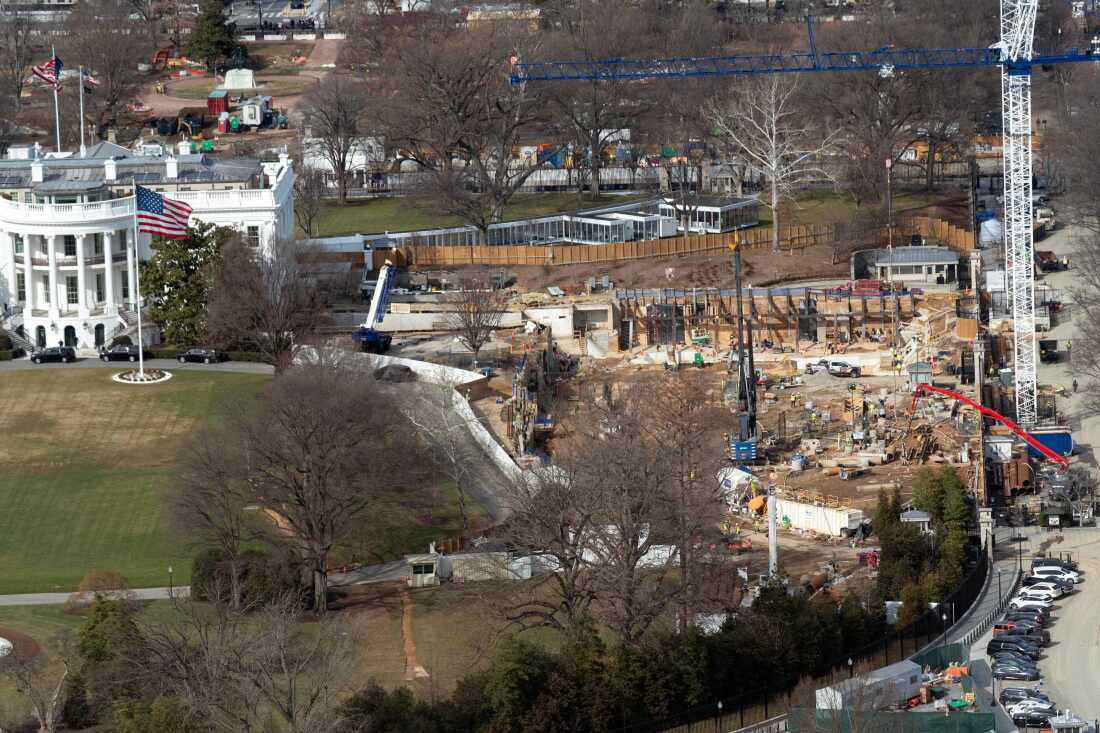
A snapshot of the construction in February, after the East Wing was demolished to make room for a ballroom.
Jose Luis Magana/AP
hide caption
toggle caption
Jose Luis Magana/AP
“The military is building a big complex under the ballroom, which has come out recently because of a stupid lawsuit that was filed,” Trump told reporters on Air Force One over the weekend.
He said the proposed 90,000 square-foot ballroom “essentially becomes a shed for what’s being built under,” adding that the “high-grade bulletproof glass” windows would protect the facility below “from drones and … from any other thing.”
The existence of a World War II-era facility — called the Presidential Emergency Operations Center (PEOC) — has been an open secret for decades, especially after the government released photos in 2015 of White House officials sheltering inside on Sept. 11, 2001.

But little is known about the current status of the bunker, which CNN reported in January had been dismantled in the renovations, or what kind of structure might come to replace it. When asked on Monday to share more about the underground complex, White House press secretary Karoline Leavitt stayed tight-lipped.
“The military is making some upgrades to their facilities here at the White House, and I’m not privy to provide any more details on that at this time,” she said.
Trump was more forthcoming with reporters that same day, as he signed executive orders in the Oval Office, reiterating that the judge’s decision allows him to “continue building as necessary … to cover the safety and security of the White House and its grounds.”
Trump read through a handwritten note listing off the permitted upgrades.
“The roof is droneproof. We have secure air-handling systems,” Trump said. “We have bio-defense all over. We have secure telecommunications and communications all over. We have bomb shelters that we’re building. We have a hospital and very major medical facilities that we’re building … So on that we’re okay.”
For decades, little was known about the FDR-era bunker
The White House built the East Wing with an underground bomb shelter for President Franklin D. Roosevelt during World War II, over concerns that the building could become the target of an aerial attack.
“This secret space featured thick concrete walls and steel-sheathed ceilings with a small presidential bedroom and bath inside,” the White House Historical Association wrote on social media in 2024. “Nearby rooms provided ventilation masks, food storage, and communications equipment.”
It has been upgraded in the decades since. On the day of the 9/11 terrorist attacks, a number of White House officials under George W. Bush — who was in Florida at the time — took shelter there.
Former First Lady Laura Bush recounted the experience in her 2010 memoir, in which she wrote about being “hustled downstairs through a pair of big steel doors that closed behind me with a loud hiss, forming an airtight seal.”
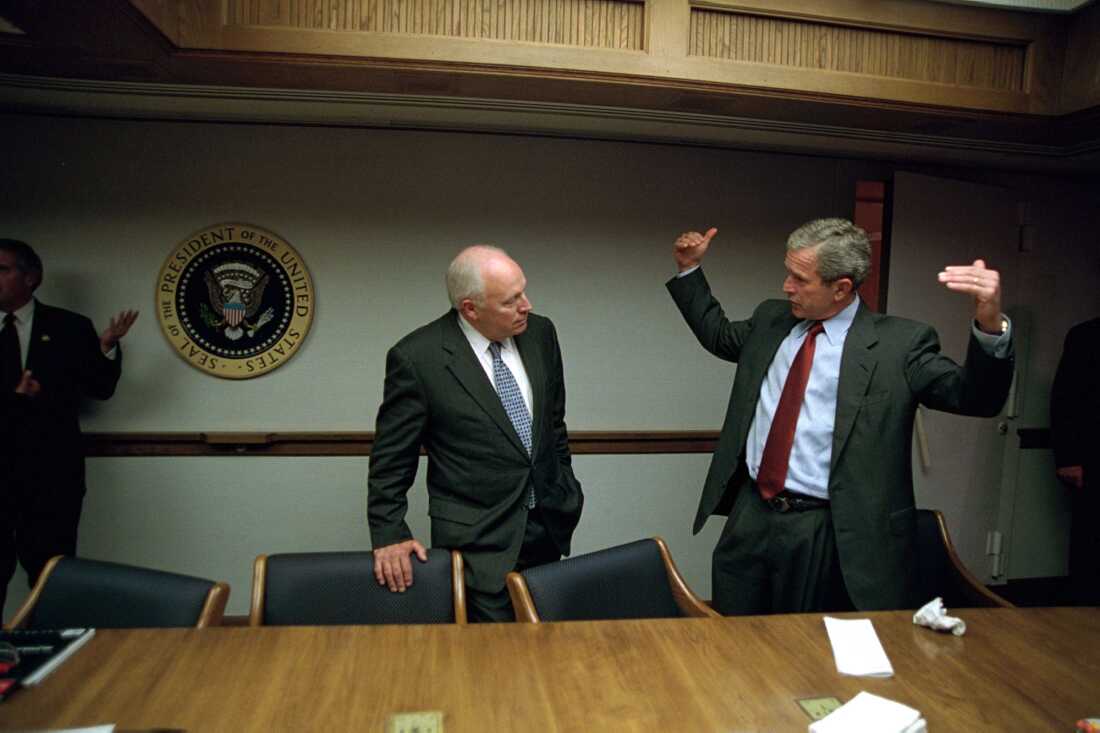
President George W. Bush talks with Vice President Dick Cheney in the Presidential Emergency Operations Center on Sept. 11, 2001.
Eric Draper/The White House/Associated Press
hide caption
toggle caption
Eric Draper/The White House/Associated Press
“I was now in one of the unfinished subterranean hallways underneath the White House, heading for the PEOC,” she wrote. “We walked along old tile floors with pipes hanging from the ceiling and all kinds of mechanical equipment. The PEOC is designed to be a command center during emergencies, with televisions, phones, and communications facilities.”
Key administration officials, including Vice President Dick Cheney and National Security Advisor Condoleezza Rice, were also there, seated at a long conference table in a small room. The government released hundreds of photos of that day — showing officials talking on landline phones and videoconferencing on large screens — in response to a Freedom of Information Act request in 2015.
Bush wrote that the Secret Service suggested the couple spend the night in the bunker: “They showed us the bed, a foldout that looked like it had been installed when FDR was president … we both said no.”
A decade later, when Barack Obama was president, the White House undertook a major, multi-year renovation project that involved digging a massive hole beneath the Oval Office, exposing what appeared to be a tunnel underneath. The General Services Administration (GSA) denied it was bunker-related, calling it a standard revamp of the air-conditioning and electrical systems.

A digging project near the West Wing, pictured in Jan. 2011, looked to many like bunker business.
Charles Dharapak/AP
hide caption
toggle caption
Charles Dharapak/AP
“However, what reporters and photographers saw during the construction appeared to go well beyond that: a sprawling, multistory structure whose underground assembly required truckload after truckload of heavy-duty concrete and steel beams,” the Associated Press wrote towards the end of the project in 2012.
It noted that the White House had tried to keep that work hidden by putting up a fence around the excavation site and “ordering subcontractors not to talk to anyone and to tape over company info on trucks pulling into the White House gates.”

Many people didn’t buy the official explanation for what some media outlets came to call “The White House Big Dig.”
A 2011 New York Times report cited unnamed administration officials speculating that the effort was actually “security-related.” People did not take the GSA’s story at face value, the article added, “despite the size of the hole, the controlled silence of the construction workers and the fact that funds were allocated after Sept. 11, 2001.” A 2011 Washington Post piece put it more bluntly: “It’s a bunker, right?”
Questions about the bunker surfaced again during Trump’s first term, after the New York Times and CNN reported that the Secret Service had rushed him inside and kept him there briefly during a night of Black Lives Matter protests outside the White House in May 2020. Trump later confirmed that he had spent time in the PEOC, but denied that he’d been rushed inside — told Fox News he had gone in briefly during daytime hours “more for an inspection.”
What we know about the new construction
Still, the existence of a bunker — and plans to construct a new one — were not necessarily top of mind for people when Trump began demolishing the East Wing last fall.
Critics were quicker to call out the lack of public input and congressional authorization, the sheer scale of the proposed ballroom and concerns about environmental impact and historical preservation.

In January, as the legal battle unfolded, Trump wrote on Truth Social that the project was being undertaken with “the design, consent, and approval of the highest levels of the United States Military and Secret Service,” without elaborating.
“The mere bringing of this ridiculous lawsuit has already, unfortunately, exposed this heretofore Top Secret fact,” Trump wrote.

The National Capital Planning Commission voted to approve Trump’s ballroom plan on Thursday, days after a federal judge ordered construction to stop without authorization from Congress.
Al Drago/Getty Images
hide caption
toggle caption
Al Drago/Getty Images
In court filings reviewed by NPR, the Secret Service confirmed its involvement but kept details to a minimum.
In one signed declaration, Secret Service Deputy Director Matthew Quinn wrote that his agency was working with the contractor on “temporary security and safety measures around the project’s construction site,” which were not fully complete at the time.
“Accordingly, any pause in construction, even temporarily, would leave the contractor’s obligation unfulfilled in this regard and consequently hamper the Secret Service’s ability to meet its statutory obligations and protective mission,” Quinn wrote, before offering to brief the judge privately on more details, “including law enforcement sensitive and/or classified information.”
In a separate filing, Trump administration officials sought to submit further details in a classified setting so as to keep “the discussion of national security concerns” off a publicly available docket.
Trump allies have been similarly vague in other public settings, including at a National Capital Planning Commission meeting in January, where Josh Fisher, the White House director of management and administration, said: “There are some things regarding this project that are, frankly, of top-secret nature that we are currently working on.”
After a period of soliciting public comments, the commission, a government agency that meets monthly to provide planning guidance for D.C.’s federal land and buildings, held its approval vote on a tweaked version of Trump’s ballroom plan this week. It gave it the green light, despite the judge’s order just days earlier.

“When I saw the new fertilizer price, I’m like, holy crap. Talk about a kick to the gut.” Spring is here, which means it’s planting season in Iowa. For corn farmers preparing to sow their fields, the war with Iran couldn’t have come at a worse time. “So this is the fertilizer. So how much did the price of it go up after the war in Iran erupted?” “It went up about $250 a ton in my neck of the woods.” Iran’s closure of the Strait of Hormuz, a critical transit point for a third of the world’s fertilizer, sent the price soaring. The cost of two widely used nitrogen fertilizers shot up by 20 and 50 percent in the first few weeks of the war. A decade of inflation, low commodity prices and tariffs have squeezed Jolene Riessen’s profit margins. She’s now facing her toughest year yet as a farmer. “Every year is a risk when you farm. But this has kind of been compounding. Our prices have been low. And yet our input costs continue to ratchet up.” With the price of fertilizer already higher than last year, she put off buying until last month, hoping the price would go down. Then the war started and the opposite happened. With the window to plant closing, she had little choice but to buy at a high price. “For the amount of fertilizer I was going to buy, it had gone up about $13,000 in two days. What pot does that come out of? Fertilizer price, we can’t control. Fuel price, we can’t control. Where is it all going to end up? We don’t know.” “This is like the worst I’ve ever seen it. Gambling what our futures are going to look like.” Farmer Lance Lillibridge has been representing Iowa corn growers for 14 years. “The current conflict in Iran is hurting farmers everywhere in Iowa and across the country. If we’re not able to sustain our land with the nutrients that’s needed to grow a crop, then our yields are going to go down. Eventually going to drive up the price of corn, which is what we use to feed chickens, pigs and cattle, amongst other things. And eventually that is going to go back to the consumer at the grocery store.” While it may take some time for shoppers to see the price increase reflected in their groceries, Jolene’s costs continue to climb higher than what she makes for her corn. “This is the corn that we’ve been talking about.” “Yep.” At today’s price of corn, she could lose roughly $110 per acre across her 530 acres. “We just did the math. And so maybe looking at losing $58,000. So what am I going to do to negate that? I have never lost quite that much before.” Still, she has hoped the price of corn will go up this year to offset at least some of that loss. She keeps a close eye on its every move in the market. “Time to check the markets.” “How many times a day are you checking the prices?” “Sometimes you — Half-dozen times a day. And sometimes that isn’t enough. Now you know that at closing at 2 o’clock, they were, they were up 4 cents and now they’re down 2 cents. Which means that was a 6-cent move in the market. Crazy.” “And today, I’m promising to request additional farm relief for our great patriots in the next funding bill.” Last month, the Trump administration lifted sanctions on fertilizer sales from Belarus and Venezuela to try to ease the price surge and promised more aid to farmers. Still, Jolene is making hard calculations to stay on the farm that has been in her family for 85 years. “Those income sources could very well be selling some equipment. There’s a chance that there could be some ground sold. And then what are you left with? For some farmers, it’s a legacy. That’s my legacy that I’m selling. If it was up to me, the war would be done yesterday.”

Video: Search and Rescue Underway After Iran Downs U.S. Fighter Jet

Video: President Trump Makes Contradictory Statements About Strategy for War in Iran

Obsessed With Pistachios? Their ‘Ozempic Effect’ for Weight Loss Explained

George Saunders thinks ambition gets a bad rap : Wild Card with Rachel Martin

NASA did eventually solve Artemis II’s Outlook glitch

Florida High School Football Rankings: Top 25 teams – Oct. 21

How old is Bo Nix? What to know about Oregon quarterback ahead of 2024 NFL Draft

Cleary's 21 help Le Moyne down Central Connecticut State 69-64 in OT

99th annual Pony Swim held in Virginia

Indiana Members Credit Union announced as new anchor tenant at Bottleworks District
Video: Search and Rescue Underway After Iran Downs U.S. Fighter Jet

Nebraska Senate candidate restructures campaign after complaint over payments to family: report

Two dozen Democrat-led states sue Trump over mail-in ballot limits
Trump’s ballroom fight sheds new light on an underground White House bunker

Video: Trump Struck Iran. Now Farmers Are Paying the Price.
-

 Culture1 week ago
Wil Wheaton Discusses ‘Stand By Me’ and Narrating ‘The Body’ Audiobook
-

 South-Carolina5 days ago
South Carolina vs TCU predictions for Elite Eight game in March Madness
-

 Miami, FL1 week ago
Jannik Sinner’s Girlfriend Laila Hasanovic Stuns in Ab-Revealing Post Amid Miami Open
-

 Culture1 week ago
What Happens When We Die? This Wallace Stevens Poem Has Thoughts.
-

 Minneapolis, MN1 week ago
Boy who shielded classmate during school shooting receives Medal of Honor
-

 Education1 week ago
Video: Transgender Athletes Barred From Women’s Olympic Events
-

 Vermont5 days ago
Skier dies after fall at Sugarbush Resort
-

 Politics6 days ago
Trump’s Ballroom Design Has Barely Been Scrutinized