News
Takeaways From Marco Rubio’s Senate Hearing


Marco Rubio, the Republican senator from Florida named by Donald J. Trump to be the next secretary of state, was warmly welcomed by senators from both parties at his confirmation hearing on Wednesday. He has served for years on the Foreign Relations and Intelligence Committees in the Senate, and is known as a lawmaker devoted to the details of foreign policy.
“I believe you have the skills and are well qualified to serve as secretary of state,” Senator Jeanne Shaheen, Democrat of Hampshire, said in her opening remarks.
The notable lack of tension at the hearing indicated that Mr. Rubio would almost certainly be confirmed quickly.
Republican and Democratic senators agree on the biggest U.S. challenges.
From the lines of questioning, it was clear what senators want Mr. Rubio and the Trump administration to focus on: China, Russia, North Korea and Iran. Mr. Rubio himself pointed to those four powers — what some call an “axis” — in his opening remarks.
They “sow chaos and instability and align with and fund radical terror groups, then hide behind their veto power at the United Nations and the threat of nuclear war,” he said. As permanent members of the U.N. Security Council, China and Russia have veto power over U.N. resolutions.
Mr. Rubio repeatedly singled out the Chinese Communist Party for criticism, and, unlike Mr. Trump, he had no praise for any of the autocrats running those nations.
He did say the administration’s official policy on Ukraine would be to try to end the war that President Vladimir V. Putin of Russia started, and that leaders in both Kyiv and Moscow would need to make concessions. U.S. officials say Russia has drawn its allies and partners into the war, relying on North Korea for troops and arms, Iran for weapons and training, and China for a rebuilding of the Russian defense industrial base.
Rubio’s stance on Israel and Gaza is firmly within a foreign policy consensus in Washington.
Mr. Rubio defended Israel’s conduct in the war in Gaza, blaming Hamas for using civilians as human shields and calling the deaths of tens of thousands of Palestinians in Gaza, most of them non-combatants, “one of the terrible things about war.”
He expressed concern about threats to Israel’s security. “You cannot coexist with armed elements at your border who seek your destruction and evisceration, as a state. You just can’t,” he said.
When asked whether he believed Israel’s annexing Palestinian territory would be contrary to peace and security in the Middle East, Mr. Rubio did not give a direct answer, calling it “a very complex issue.”
Mr. Rubio’s hearing was about two hours in when the committee’s chairman announced that Israel and Hamas had sealed an agreement to begin a temporary cease-fire and partial hostage release in Gaza. An initial hostage and cease-fire agreement, reached in November 2023, fell apart after a week.
Rubio supports U.S. alliances, despite Trump’s persistent attacks on them.
Mr. Rubio called the North Atlantic Treaty Organization, which Mr. Trump has repeatedly criticized, “a very important alliance” and insisted that Mr. Trump was a NATO supporter. But he also backed Mr. Trump’s argument that a strong NATO requires Europe to spend more money on its collective defense.
The United States, he said, must choose whether it will serve “a primary defense role or a backstop” to a self-reliant Europe.
Though many Senate colleagues praised him, Rubio has detractors.
Some prominent Trump supporters remain distrustful of Mr. Rubio. They recall his vote to certify the 2020 election results despite Mr. Trump’s false claims of election fraud. And they consider Mr. Rubio’s foreign policy record dangerously interventionist.
Mr. Rubio has long been a hawkish voice on national security issues, often in ways that clash with Mr. Trump’s views, even if the ideas are conventional ones among centrist Republican and Democratic politicians.
In the past, Senator Rand Paul, Republican of Kentucky, has criticized Mr. Rubio for advocating aggressive American intervention overseas. Mr. Paul has been outspoken in pushing for less use of U.S. troops abroad and is skeptical about whether economic sanctions can lead to positive outcomes.
On Wednesday, Mr. Paul pointedly asked Mr. Rubio whether he saw any way to work with China rather then persisting in attacks on Beijing, and he also questioned the wisdom of many American and European policymakers who insisted that Ukraine must be admitted to NATO.



After a nearly 10-day journey that took the Artemis II astronauts around the moon, in front of an eclipse and farther away from Earth than any humans before them, the crew of four have made a dramatic return home.
The Artemis II astronauts share a group hug aboard the Orion capsule.
hide caption
toggle caption
NASA astronauts Reid Wiseman, Victor Glover and Christina Koch and Canadian Space Agency astronaut Jeremy Hansen were ensconced in the Orion space capsule when they dropped into the Pacific Ocean off the coast of San Diego at 8:07 p.m. Friday. The USS John P. Murtha is stationed near the splashdown zone to help recover the crew.

To get back to Earth, the space capsule had to withstand predicted temperatures of about 5,000 degrees Fahrenheit and slow down from nearly 25,000 miles per hour — or more than 30 times the speed of sound — to a gentle 19 mph or so before splashdown.
The roughly 13-minute journey from the top of the atmosphere to the surface is like “riding a fireball through the atmosphere,” NASA astronaut and Artemis II crew member Victor Glover said before the maneuver.
But, he said, it’s also a necessary one.

“We have to get back,” Glover said. “There’s so much data that you’ve seen already, but all the good stuff is coming back with us.”
The crew of four, who looped around the far side of the moon on Monday April 6, took photos and made observations as they passed over the lunar surface. The crew is set to bring that data and more back to the team on the ground.
Nell Greenfieldboyce and Central Florida Public Media’s Brendan Byrne contributed to this report.

President Trump has submitted plans plans to paint the Eisenhower Executive Office Building white to a group that advises on architecture in Washington, D.C.
The French Second Empire-style, slate-gray building houses office space for members of the president’s team, including the National Security Council.
The building sits across a driveway from the West Wing and was completed in 1888. The plans submitted by the president say that the Eisenhower Executive Office Building is an eyesore that has long been criticized and has fallen into disrepair since its completion. The plans say “the color, design, and massing of the existing structure does not align visually with the surrounding architecture and lacks any symbolic cohesion with the White House.” The plan points to examples of cracks and poor exterior maintenance and argues, “The benefit to painting the stone is that it is repeatable.”
“The inability to bring the stone facade back to a baseline color has plagued the maintenance of the [Executive Office Building] in the past, and and will continue to plague it if not addressed,” the plan says.
The plans included renderings of what the building would look like if it’s painted white.

The Executive Office of the President submitted a design proposal to the Commission of Fine Arts, a panel of Trump appointees who advise on public architecture and design in the nation’s capital.
The CFA will hear a presentation on the plan on April 16.

The Labor Department says the vast majority of new jobs created over the last year went to women, most of them in health care.
melitas
hide caption
toggle caption
melitas
In December 2016, as Donald Trump was headed to the White House for the first time, Betsey Stevenson offered the incoming president some economic advice.
Stevenson, a professor of public policy and economics at the University of Michigan, argued in an op-ed that it would be a disservice to encourage men “to cling to work that isn’t coming back.” She cited Trump’s promise to bring an iPhone factory to the U.S.
“If Trump really wants to get more Americans working,” she wrote at the time, “he’ll have to do something out of his comfort zone: make girly jobs appeal to manly men.”

It’s a message she believes is even more relevant today.
For decades, the focus has been on getting more women into male-dominated fields. Some efforts have been more successful than others. But now, with the vast majority of new jobs going to women, it’s clear that men need help, too.
“This is happening at a time where it’s become verboten to talk about diversity, equity and inclusion,” Stevenson says. “And yet the people we need to be talking about right now are men.”
17 times as many jobs filled by women
In the mid-1970s, women held about 40% of jobs in the U.S, not including farm work or self employment. By the early 2000s, women’s share of jobs had grown to just under half. It’s hovered around there since, crossing the 50% threshold just a few times, including during the Great Recession, just before COVID, and now.
That parity masks the significant gains women have recently made in the labor market. Of the 369,000 jobs the Labor Department says were created since the start of Trump’s second term, nearly all — 348,000 of them — went to women, with only 21,000 going to men. That’s nearly 17 times as many jobs filled by women as by men.
The lopsidedness was driven by huge growth in health care, where women hold nearly 80% of jobs. Over the past 12 months, health care alone added 390,000 jobs, more than in the economy overall, making up for job losses elsewhere.
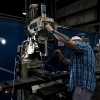
“If we want to see job growth that’s as robust for men as it is for women, we’re going to have to see men embracing those kinds of jobs,” says Stevenson.
So far, that hasn’t happened in any meaningful way. Stevenson believes it’s because men are more likely than women to have an identity tied to a particular occupation, making it harder for them to find work outside that field, much less in one dominated by women.
Meanwhile, in his second term, Trump has not strayed from his message that manufacturing will make the country strong. It’s something he emphasized in his second inaugural address, declaring that “America will be a manufacturing nation once again,” and in his repeated promises that tariffs would “bring factories roaring back.”
When manufacturers added 15,000 jobs in March, the White House called it proof that “the best days for American workers, manufacturers, and families are still ahead,” despite the fact that the sector is still down 82,000 jobs from when Trump took office.
“We have seen a year of a president absolutely fixated [on] growing the manufacturing sector,” Stevenson says. “There’s not enough of those jobs for men as a whole to thrive.”

A push for policies to open doors for men
What’s happening now in the labor market comes as no surprise to Richard Reeves, president of the American Institute for Boys and Men, a nonpartisan think tank.
He says not enough attention has been paid to the scarcity of men in certain professions, and now we’re seeing the consequences.
“There is no cause for panic here,” says Reeves, who’s been studying the decades-long decline in labor force participation among men. “But I do think we should be alert to signs that the labor market might be moving even more quickly in directions that are leaving too many men behind.”
Reeves notes that for years, the country has embraced policies and programs aimed at getting more women into science, technology, engineering and math, and the share of women in STEM jobs has grown.
“But that didn’t happen by itself. It happened as a result of concerted efforts to break down gender stereotypes,” he says.
Still, gaps remain, and some of those efforts have seen their government funding cut under Trump.

Now Reeves says what’s needed are policies and programs to draw male workers into fields such as nursing, teaching and social work.
“Those are occupations that serve people, and they should look like the people that they serve,” he says. “And it’s good for men because it means they won’t lose out on those jobs if that’s where the growth is coming from.”
Framing jobs as more masculine
Stevenson has been thinking about ways to make the fastest-growing sectors of the economy more welcoming to men.
“I think there are ways for us to talk about those jobs as being particularly masculine,” she says.
For instance, many health care jobs could be framed as roles requiring the strength to lift people. Preschools could highlight the need for teachers who serve as positive male role models.
“Kids love to be rough and tumble and build things,” she says.
Stevenson knows some people will be offended by such gender stereotyping.
“But I do want to encourage us to realize that we have to help men understand that they can do caregiving roles and stay masculine,” she says.
Ongoing challenges for women and men
What Stevenson doesn’t want people to conclude is that everything is okay now that women are leading on jobs.
“We know that there is still discrimination that holds people back,” she says.

For women, she says, that discrimination might be preventing them from getting the promotion that they deserve, contributing to the widening gender pay gap. For men, it may mean sitting on the sidelines because they don’t think there’s a role for them in the economy.
“I think we can use this moment to realize that discrimination, occupational segregation… these are things that harm all of us, not just one narrow group,” she says.

Russian propaganda unit targets Hungary’s elections
WATCH: Artemis II astronauts splash down on Earth

How David Cross Gets Ready for a Night of ‘Dangerous’ Comedy

“Moon tree” in Metro Detroit rediscovered following Artemis II mission

San Francisco store created and run by AI

Florida High School Football Rankings: Top 25 teams – Oct. 21

How old is Bo Nix? What to know about Oregon quarterback ahead of 2024 NFL Draft

Cleary's 21 help Le Moyne down Central Connecticut State 69-64 in OT

99th annual Pony Swim held in Virginia

Indiana Members Credit Union announced as new anchor tenant at Bottleworks District
Russian propaganda unit targets Hungary’s elections
WATCH: Artemis II astronauts splash down on Earth

Swalwell’s former female staffer drops bombshell allegations of sexual assault, exposing himself: report

NASA’s Artemis II prepares for splashdown on Earth

Trump proposes painting executive office building white
-

 Atlanta, GA6 days ago
1 teenage girl killed, another injured in shooting at Piedmont Park, police say
-

 Education1 week ago
Video: Toy Testing with a Discerning Bodega Cat
-

 Movie Reviews1 week ago
Vaazha 2 first half review: Hashir anchors a lively, chaos-filled teen tale
-

 Georgia4 days ago
Georgia House Special Runoff Election 2026 Live Results
-

 Pennsylvania4 days ago
Parents charged after toddler injured by wolf at Pennsylvania zoo
-

 Arkansas17 hours ago
Arkansas TV meteorologist Melinda Mayo retires after nearly four decades on air
-
 Milwaukee, WI5 days ago
Potawatomi Casino Hotel evacuated after fire breaks out in rooftop HVAC system
-
 Entertainment1 week ago
Inside Ye’s first comeback show at SoFi Stadium