News
Newsom, Democrats use cuts, reserves and ‘fiscal emergency’ declaration to solve California budget deficit

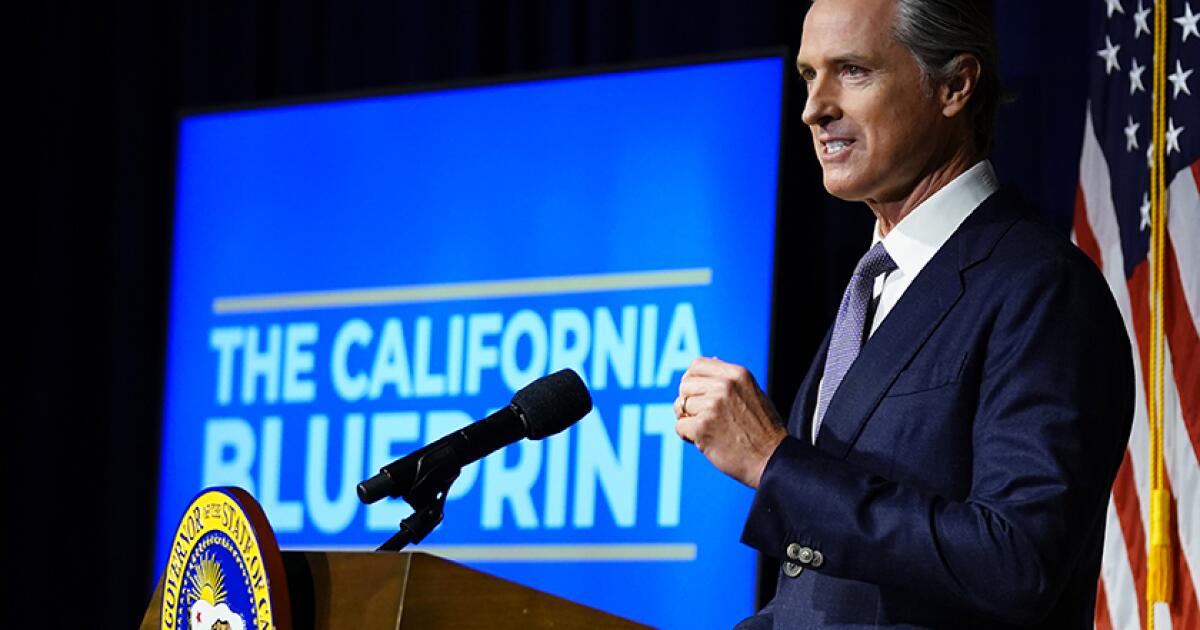
Gov. Gavin Newsom and Democratic lawmakers struck a deal Saturday to make $16 billion in cuts, declare a statewide fiscal emergency and pull money from the state’s rainy-day reserves to balance a $46.8-billion budget deficit in California.
The agreement for a $297.7-billion spending plan is the result of weeks of contentious negotiations with labor unions and business interests after weaker than anticipated revenues forced Newsom and lawmakers to scale back California’s progressive policy agenda. The shortfall inspired a tug-of-war over coveted state dollars that has caused rifts between the governor and some of his closest allies at the Capitol.
Among the more high-profile changes, the 2024-25 budget plan delays a minimum wage increase for healthcare workers until at least October, cuts $1.1 billion for affordable housing and slashes $750 million in funding for the state prison system.
California’s business community also took a hit with the three-year suspension of nearly $15 billion in tax breaks a year earlier than Newsom initially proposed.
“This agreement sets the state on a path for long-term fiscal stability — addressing the current shortfall and strengthening budget resilience down the road,” Newsom said in statement. “We’re making sure to preserve programs that serve millions of Californians, including key funding for education, health care, expanded behavioral health services, and combatting homelessness.”
The deficit marks a dramatic reversal of California’s financial standing from a projected $100-billion surplus two years ago and creates a challenging political narrative for Newsom, who often boasts of the state being an essential economic engine for the nation.
The governor is required by law to declare a statewide budget emergency before he can take money from the reserves to solve the deficit. But an emergency declaration gives fodder to critics who have accused Democrats of mismanaging the state’s finances and overspending.
Despite the shortfall, the California economy remains strong and the state has more revenue to spend than when he took office.
“This is not a revenue problem,” said David Crane, president of Govern for California, a nonprofit that seeks to oppose the influence of labor unions on state government. “The deficit is a result of expenditures.”
In April, Newsom touted the fact that the California economy held its position as the fifth largest in the world, saying the state “continues to punch above its weight.”
The state government’s financial problem can be blamed, in part, on poor revenue projections that led Newsom and lawmakers to allocate more money for programs than they had available to spend.
The state’s progressive tax structure leaves government dependent on revenue from income taxes paid by chief executives and other top Golden State earners, which are subject to stock market fluctuations and difficult to predict. The delay of the 2022 tax filing deadline, from April to November, also forced California leaders to craft the current budget without having a full understanding of how much state tax revenues had dropped.
Newsom anticipated California’s deficit to grow when he signed the budget last year and said he dedicated much of the new money in his spending plan to one-time funding increases that he could easily halt if revenue fell. The cuts include $500 million for a loan program to fund affordable student housing at colleges and a reduction of $485 million for work study programs for students.
Yet the governor and lawmakers have been criticized for choosing to pull money from the state’s rainy-day fund — $5.1 billion in 2024-25 and $7.1 billion planned the following year — to avoid deeper cuts. Democrats also plan to take $900 million from a safety net reserve account next year.
Tapping into the state’s piggy bank now has raised concerns about what could happen to state programs serving California’s neediest if the economy falls into recession and state revenues drop even lower.
Democrats at the state Capitol released a broad overview of some of the cuts the Legislature will vote on next week before the budget takes effect on July 1.
Newsom and lawmakers said the agreement includes proposed legislation requiring the state, in the future, to set aside surplus funds for subsequent budget years as a means to protect against the revenue swings and a constitutional amendment in 2026 to grow the state’s rainy-day fund. Details were not shared with the announcement.
Here’s what we know so far about the agreement:
Pushing off a healthcare minimum wage hike
Newsom signed a bill into law last year to give healthcare workers a minimum-wage increase to $25 per hour. He waited a few weeks to explain that he wouldn’t allow the law to take effect if the state budget crisis worsened.
At the time, the Department of Finance estimated that the law could cost the state $2 billion. Labor unions said the cost was closer to $300 million, if the state required hospitals to cover much of the cost.
Newsom’s concerns, which he said he shared with unions before he signed the law, set off months of private negotiations over when to raise wages and how to pay for the increase.
Those talks finally ended with the budget agreement, which delays the pay hike from taking effect until Oct. 15 at the earliest, instead of this month as originally planned.
The start date for the pay hike hinges on one of two scenarios: state revenues in the first quarter of the fiscal year coming in 3% above projections, or more federal funding for hospitals through a quality-assurance fee. If neither happens, the increase could be delayed beyond October.
Lawmakers and the governor are essentially using the quality-assurance fee as a mechanism to assure hospitals can pay for the increase. Hospitals pay quality-assurance fees, the federal government matches the money and then remits the funding back to hospitals.
The federal increase requested by the state is expected to cover 30% of the cost of the higher wages for hospitals.
The budget pegs the state cost for the program at $600 million in 2024-25.
No solution on battle over MCO tax
The question of how to use the proceeds of a tax on managed care organizations, known as the MCO tax, turned out to be the most difficult to answer in budget negotiations. So challenging, in fact, that talks fizzled out and Newsom threatened to oppose a ballot measure backed by some of his closest allies.
The tax applies to health insurance providers that charge fixed monthly payments for services and acts as a mechanism to allow California to collect billions in additional federal funds for Medi-Cal, California’s healthcare system for low-income residents.
Newsom and lawmakers renewed the tax last June and agreed to use some of the proceeds to raise reimbursement rates to providers who serve Medi-Cal patients. For years, doctors have waged an unsuccessful campaign to raise rates, arguing that the reimbursements are too low, result in a shortage of doctors willing to accept patients and restrict access to care.
But Newsom reversed course and proposed taking more than $6 billion from the Medi-Cal rate increases over multiple years and using the funding instead to avoid cuts to the program.
The change pitted Newsom against a coalition led by the California Medical Assn. and Planned Parenthood, two groups that have supported the governor’s causes and backed his campaigns.
The coalition called for the governor to stick to the agreement he made in 2023 to raise rates for providers. They also are leading a charge to pass a measure on the 2024 ballot that would permanently establish an MCO tax to fund higher reimbursement rates.
The governor wants the coalition to take the measure off the ballot. He wants the funds to be flexible so the state can use the money if necessary to support the Medi-Cal system in the future.
The coalition has so far declined to take the measure off the ballot, afraid Democrats would divert the funding again. The talks ended in a stalemate.
The final state budget includes $6.9 billion next year to support the Medi-Cal system.
Newsom and lawmakers agreed to offer a smaller pot of money for “provider rate increases and investments” from the MCO tax, but far less money than was previously set aside. The budget includes $133 million in 2024-25 and a plan to raise that to $728 million in 2025-26 and $1.2 billion the following year.
Democrats said the MCO funding would become “inoperable,” essentially eliminated, if the measure is approved on the 2024 ballot.
The governor threatened to campaign against the measure as the talks soured, setting up the possibility that Newsom could challenge his supporters in the November election.
A pause on business tax breaks
The budget deal limits total tax credits for businesses in the state to $5 million per filer and pauses a net operating loss tax deduction for businesses with income of more than $1 million in 2024, 2025 and 2026.
In a concession to the business community, Newsom and lawmakers are allowing companies to receive refunds for the tax credits after the limits end.
Newsom originally proposed halting and capping the tax breaks beginning in 2025. But Democrats in the Legislature pushed to apply the changes a year earlier, allowing them to avoid cuts to other programs.
The administration said the changes to the tax breaks will increase revenues by nearly $15 billion through 2026.
The early start could hurt businesses who were planning to deduct losses from their 2024 taxes and now have to scramble to scale back on employees or inventory to cover the cost of an unexpectedly higher bill. The limit also marks the second time in five years that the state has capped tax credits, which could turn away companies that operate in California.
Big cut to prisons
Lawmakers previously proposed an additional $1 billion in cuts to the Department of Corrections and Rehabilitation, which included at least $12 million in reductions to the governor’s project to transform San Quentin. Newsom’s proposed cuts had included $80.6 million in savings from the newly announced deactivation of 46 housing units at 13 state prisons.
The final agreement drops funding for corrections by $750 million total, including cuts to operations and savings from eliminating vacant jobs.
Newsom supports another round of homelessness grants
In late May, Democrats in the Legislature proposed spending $1 billion more than the governor had budgeted on a sixth round of Homeless Housing, Assistance and Prevention grants to local governments to combat the homelessness crisis. At the same time, lawmakers proposed cutting $100 million in funding to clean up homeless encampments in the current budget year.
The final budget deal appears to show a compromise.
The deal includes $1 billion in additional homelessness grants, which the governor and lawmakers said would be tied to new accountability measures to make sure local governments use the funding appropriately. The agreement also provides $150 million next year for encampment grants.
Broadband internet access for all — a little later
The pandemic exposed the need to improve access to broadband internet in homes across California when K-12 education shifted from the classroom to remote learning. Low-income families and those who live in rural areas often lack the same connectivity as more wealthy communities.
Newsom has sought to make internet access more equitable under a “broadband for all” initiative.
The spending plan delays $550 million in funding for “last mile” work, which connects the network to homes, until the 2027 budget year. The budget agreement still offers $250 million next year for a program to expand and improve the fiber-optic network under “middle-mile” projects, and Democrats intend to provide a total of $2 billion for last-mile work over multiple years.
A funding delay for public schools
Under Proposition 98, approved by voters in 1988, California has a minimum funding guarantee for schools and community colleges.
Earlier this year, Newsom proposed an unusual maneuver to go back and recharacterize funding in 2022-23 to reflect the lower-than-expected state revenue.
The California Teachers Assn. said the change would have ultimately reduced funding for schools by about $12 billion over two years. The union ran a television ad criticizing Newsom’s proposal to pressure him to reverse course.
Newsom and teachers ultimately agreed late last month to a complicated solution that suspends the minimum funding guarantee and delays $5.5 billion in funding until future years.



The bombing of an Iranian elementary school that killed some 165 people, many of them schoolgirls, included more targets near the school than has been initially reported, a review of commercial satellite imagery by NPR has found.
The images suggest that the school was hit on Saturday as part of a precision airstrike on a neighboring Iranian military complex — and that it may have been struck as a result of outdated targeting information.
The new images come from the company Planet and are of the city of Minab, located in southeastern Iran. They show that a health clinic and other buildings near the school were also struck. Three independent experts confirmed NPR’s analysis of the additional strike points.
The strike points “look like pretty clean detonation centroids,” said Corey Scher, a postdoctoral researcher at the Conflict Ecology laboratory at Oregon State University.
“These certainly appear like detonation sites,” agreed Scher’s colleague, Oregon State associate professor Jamon Van Den Hoek.
Jeffrey Lewis, a professor at Middlebury College who specializes in satellite imagery, said the imagery was consistent with a precision airstrike.
The images show “very precise targeting,” Lewis told NPR. “Almost all the buildings [in the compound] are hit.”
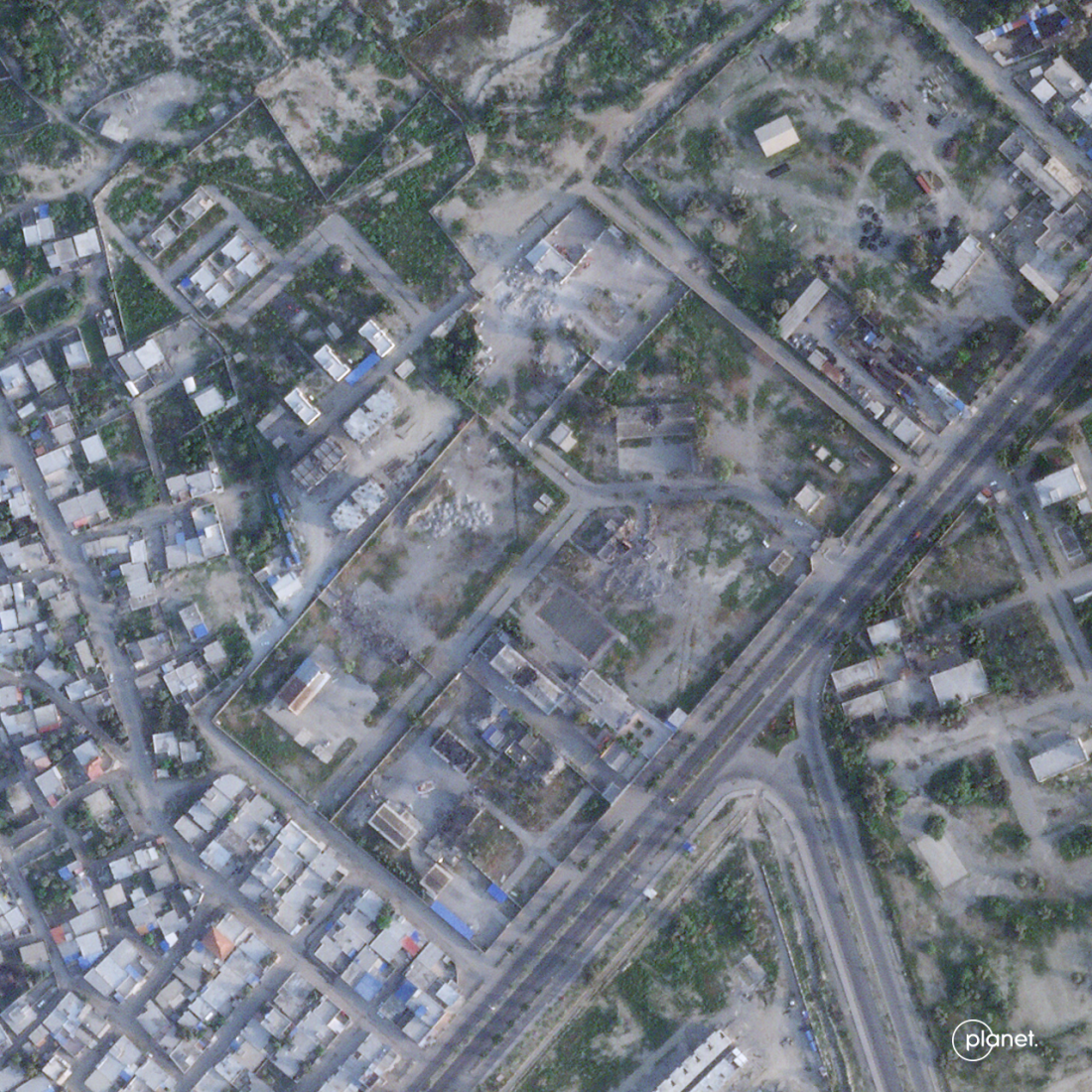
A satellite image of an Iranian Revolutionary Guard compound taken on March 4, several days after an airstrike destroyed a school on the edge of the compound. The image reveals that half a dozen other buildings in addition to the school were struck.
Planet Labs PBC
hide caption
toggle caption
Planet Labs PBC
Iranian state media said 165 people died in the bombing, which struck a girls’ school. The school was located within less than 100 yards of the perimeter of an Iranian Revolutionary Guard naval base, according to satellite images and publicly available information. The clinic was also located within the base perimeter, although both facilities had been walled off from the base.
Israel has denied involvement. “We are not aware at the moment of any IDF operation in that area,” Israel Defense Forces spokesperson Nadav Shoshani told NPR on Monday. “I don’t know who’s responsible for the bombing.”

At a press conference Wednesday morning, U.S. Defense Secretary Pete Hegseth said that the U.S. is looking into what happened at the school. “All I know, all I can say, is that we’re investigating that,” Hegseth said. “We, of course, never target civilian targets.”
Given Minab’s location in the southeastern part of Iran, Lewis believes it’s more likely the U.S. would have conducted the strike than Israel. As one gets farther south and east in Iran, “a strike is much more likely to be a U.S. strike than an Israeli strike because of the type of munitions and the geographic location,” he said.
Esmail Baghaei, the spokesman for Iran’s Foreign Ministry, called the strike “deliberate” and said that the U.S. and Israel bombed the school in part to tie up Iranian forces in the region with rescue efforts. “To call the attack on the girls school merely a ‘war crime’ does not capture the sheer evil and depravity of such a crime,” he said.
But Lewis said it’s more likely that the strike was the result of an error. Satellite images show that the school and clinic buildings were both once part of the base. The school was separated from the base by a wall between 2013 and 2016. The clinic was walled off between 2022 and 2024.
Lewis believes it’s possible American military planners had not updated their target sets.
“There are thousands of targets across Iran, and so there will be teams in the United States and Israel that are responsible for tracking those targets and updating them,” he said. “It’s possible that the target didn’t get updated.”
The Pentagon did not immediately respond to NPR’s request for additional information about the strike.
NPR’s Arezou Rezvani and NPR’s RAD team contributed to this report.

Mojtaba Khamenei, the second son of the assassinated Ali Khamenei, is being heavily tipped to succeed his father as supreme leader of Iran, which would pitch a hardliner into the task of steering the Islamic republic through the most turbulent period in its 48-year history and offer a powerful signal that, for now, it has no intention of changing course.
No official confirmation has been given and the announcement may be delayed until after the funeral of Ali Khamenei, which was on Wednesday postponed.
His son is believed to have been the choice of the Islamic Revolutionary Guard Corps (IRGC), and the Israeli defence minister, Gideon Saar, has warned he will be assassinated.
Ayatollah Seyed Khatani, a member of the Assembly of Experts, the body that chooses the new supreme leader, said the assembly was close to selecting a leader.
Rigid in his anti-western views, Mojtaba Khamenei is not the candidate Donald Trump would have wanted. Marco Rubio, the US secretary of state, said on Tuesday that Iran was run by “religious fanatic lunatics” – and Khamenei’s appointment is hardly likely to dispel that opinion.
The choice of supreme leader is made by the 88-strong Assembly of Experts, who in this case are picking from a field of six possible candidates. His election would be a powerful if unsurprising symbol that the government is not looking to find an accommodation with America.
Trump has said the worst-case scenario would be if Khamenei’s successor was “as bad as the previous person”.
There has been speculation for more than a decade that he would be his father’s successor, which grew when Ebrahim Raisi, the elected president and favourite of Khamenei, was killed in a helicopter crash.
Mojtaba Khamenei was born in 1969 and studied theology after graduating from high school. At the age of 17, he went to serve in the Iran-Iraq war, but it was not until the late 1990s that he came to be recognised as a public figure in his own right.
After the landslide defeat of Khamenei’s preferred candidate, Ali Akbar Nategh Nuri, in the 1997 presidential election, where he won only 25% of the final vote, various conservative Iranian groups realised the need to make changes to their structures and Mojtaba Khamenei was central to that project.
He was also seen as instrumental by reformists in suppressing the protests in 2009 that came after allegations the presidential election had been rigged, with his name chanted in the streets as one of those responsible. Mostafa Tajzadeh, a senior member of Iran’s reformist parties who was imprisoned after the vote, alleged that his and his wife, Fakhr al-Sadat Mohtashamipour’s, legal case was under the direct supervision of Mojtaba Khamenei.
In 2022 he was given the title of ayatollah – essential to his promotion. By then he was a regular figure by his father’s side at political meetings, as well as playing an influential role in the Islamic Republic’s Broadcasting Corporation, the government’s official media outlet often criticised for churning out dull political propaganda that many Iranians reject in favour of overseas satellite channels. He has also played a central role in the administration of his father’s substantial financial empire.
His closest political allies are Ahmad Vahidi, the newly appointed IRGC commander; Hossein Taeb, a former head of the IRGC’s intelligence organisation; and Mohammad Bagher Ghalibaf, the current speaker of the parliament.
His rumoured appointment and its hereditary nature has long been resisted by reformists. The former prime minister Mir Hossein Mousavi, referring to the long history of rumours about Mojtaba Khamenei succeeding his father as leader, wrote in 2022: “News of this conspiracy have been heard for 13 years. If they are not truly pursuing it, why don’t they deny such an intention once and for all?”
The Assembly of Experts, in response, denounced “meaninglessness of doubts” and said the assembly would select only “the most qualified and the most suitable”.
Israel on Tuesday struck the building in the Iranian city of Qom, one of Shia Islam’s main seats of power, where the assembly was scheduled, but the building was empty, according to IRGC-affiliated media.

new video loaded: Senators Question Kristi Noem on ICE Immigration Tactics
transcript
transcript
Senators Question Kristi Noem on ICE Immigration Tactics
Homeland Security Secretary Kristi Noem repeatedly refused to apologize for suggesting that Alex Pretti and Renee Good, two U.S. citizens shot and killed by agents, were domestic terrorists.
-
What we’ve seen is a disaster under your leadership, Ms. Noem. A disaster. What we’ve seen is innocent people getting detained that turn out are American citizens. I could talk about the culture that’s been created here. After the killings of Renee Good and Alex Pretti, when I spoke to Alex’s parents, they told me that you calling him a domestic terrorist — this was directly from them — the day after he was killed, a nurse in our V.A., Alex — one of the most hurtful things they could ever imagine was said by you about their son. Do you have anything you want to say to Alex Pretti’s parents? Ma’am, I did not call him a domestic terrorist. I said It appeared to be an incident of — I think the parents saw it for what it was. In a hearing — recent hearing before the HSGAC committee, C.B.P. and ICE officials testified under oath that their agencies did not inform you that Pretti was a domestic terrorist — during that hearing, stated during that hearing, I was getting reports from the ground, from agents at the scene, and I would say that it was a chaotic scene. How did you think that calling them domestic terrorists at that scene was somehow going to calm the situation? The fact that you can’t admit to a mistake, which looks like under investigation, it’s going to prove that Ms. Good and Mr. Pretti probably should not have been shot in the face and in the back. Law enforcement needs to learn from that. You don’t protect them by not looking after the facts.

By Christina Kelso and Jackeline Luna
March 3, 2026

Several Ohio schools placed under lockdown after threat

Texas Plans Second Execution of the Year

Alabama Baseball Ties Stolen Base Record In Win Over Hornets

Dunleavy, EPA visit UAF to discuss regulations in the arctic environment

Haitian man detained at Arizona ICE facility dies in US custody, brother says

Florida High School Football Rankings: Top 25 teams – Oct. 21

Cleary's 21 help Le Moyne down Central Connecticut State 69-64 in OT

How old is Bo Nix? What to know about Oregon quarterback ahead of 2024 NFL Draft

99th annual Pony Swim held in Virginia

Indiana Members Credit Union announced as new anchor tenant at Bottleworks District

DHS defends McLaughlin against allegations husband’s company profited millions from ad contracts: ‘Baseless’

Sánchez defies Trump in political gamble as Madrid say no to war
Satellite images show Iran school strike hit more buildings than earlier reported

US submarine sinks Iranian warship by torpedo in a first since World War II

Which oil and gas facilities in the Gulf have been attacked?
-

 World1 week ago
Exclusive: DeepSeek withholds latest AI model from US chipmakers including Nvidia, sources say
-

 Massachusetts1 week ago
Mother and daughter injured in Taunton house explosion
-

 Wisconsin3 days ago
Setting sail on iceboats across a frozen lake in Wisconsin
-

 Maryland4 days ago
AM showers Sunday in Maryland
-

 Denver, CO1 week ago
10 acres charred, 5 injured in Thornton grass fire, evacuation orders lifted
-

 Florida4 days ago
Florida man rescued after being stuck in shoulder-deep mud for days
-

 Oregon6 days ago
2026 OSAA Oregon Wrestling State Championship Results And Brackets – FloWrestling
-

 Massachusetts2 days ago
Massachusetts man awaits word from family in Iran after attacks