News
Missouri judge overturns murder conviction of man imprisoned for over 30 years

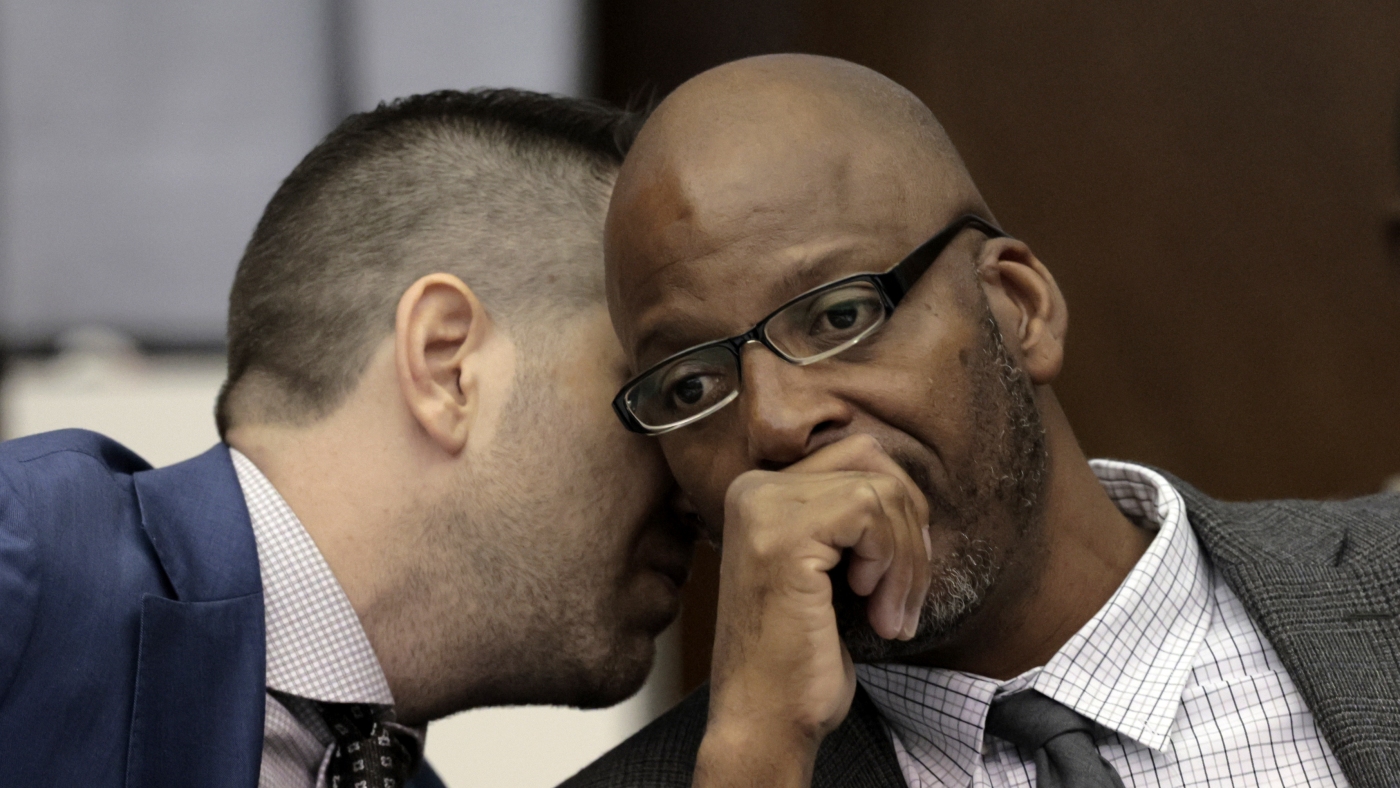
FILE – Christopher Dunn, right, listens to his attorney Justin Bonus from New York City during the first day of his hearing to decide whether to vacate his murder conviction, Tuesday, May 21, 2024, at the Carnahan Courthouse in St. Louis. A Missouri judge on Monday, July 24, 2024, overturned the conviction of Dunn, who has spent more than 30 years in prison for a killing he has long contended he didn’t commit.
Laurie Skrivan/Pool St. Louis Post-Dispatch
hide caption
toggle caption
Laurie Skrivan/Pool St. Louis Post-Dispatch
ST. LOUIS — A Missouri judge on Monday overturned the conviction of Christopher Dunn, who has spent more than 30 years in prison for a killing he has long contended he didn’t commit.
The ruling is likely to free Dunn from prison, but it wasn’t immediately clear when that would happen. He has been serving a sentence of life without parole.
St. Louis Circuit Judge Jason Sengheiser’s ruling came several weeks after he presided over a three-day hearing on Dunn’s fate.
Dunn, now 52, was convicted of first-degree murder in the 1990 shooting of 15-year-old Ricco Rogers. St. Louis Circuit Attorney Gabe Gore filed a motion in February seeking to vacate the guilty verdict. A hearing was in May.

Sengheiser, in his ruling, wrote that the “Circuit Attorney has made a clear and convincing showing of ‘actual innocence’ that undermines the basis for Dunn’s convictions because in light of new evidence, no juror, acting reasonably, would have voted to find Dunn guilty of these crimes beyond a reasonable doubt.”
Dunn’s attorney, Midwest Innocence Project Executive Director Tricia Rojo Bushnell, said she was “overjoyed” by the judge’s ruling.
“Now, Chris looks forward to spending time with his wife and family as a free man,” Bushnell said in a statement.
The Missouri Attorney General’s Office opposed the effort to vacate Dunn’s conviction. Lawyers for the state said at the May hearing that initial testimony from two boys at the scene who identified Dunn as the shooter was correct, even though they later recanted as adults.
“That verdict was accurate, and that verdict should stand,” Assistant Attorney General Tristin Estep said at the hearing.
Spokesperson Madeline Sieren said the Attorney General’s Office will appeal.
The decision in Dunn’s case came days after Sandra Hemme was freed from a western Missouri prison after serving 43 years for a murder that a judge determined she didn’t commit. Bailey’s office also opposed Hemme’s release.
A Missouri law adopted in 2021 lets prosecutors request hearings when they see evidence of a wrongful conviction. While Bailey’s office is not required to oppose such efforts, he also opposed another effort in St. Louis that resulted in Lamar Johnson being freed last year after serving 28 years for a murder case in which a judge ruled he was wrongfully convicted.
Rogers was shot May 18, 1990, when a gunman opened fire while he was with a group of other teenage boys outside a home. DeMorris Stepp, 14, and Michael Davis Jr., 12, both initially identified Dunn as the shooter.
In a recorded interview played at the hearing, Davis said he lied because he thought Dunn was affiliated with a rival gang.
Stepp’s story has changed a few times over the years, Gore said at the hearing. Most recently he has said he did not see Dunn as the shooter. Gore said another judge previously found Stepp to be a “completely unreliable witness” and urged Sengheiser to discount him altogether.
Dunn has said he was at his mother’s home at the time of the shooting. Childhood friend Nicole Bailey testified that she spoke with him by phone that night and he was on a phone at his mother’s house.
Estep, the assistant attorney general, said that alibi could not be trusted and Dunn’s story has shifted multiple times over the years. Dunn did not testify at the hearing.
The 2021 law has resulted in the the release of two men who each spent decades in prison. In addition to Johnson, Kevin Strickland was freed in 2021 after more than 40 years for three killings in Kansas City after a judge ruled he was wrongfully convicted in 1979.
Another hearing is next month for Marcellus Williams, who narrowly escaped lethal injection and is now facing another execution date.
St. Louis County Prosecuting Attorney Wesley Bell filed a motion in January to vacate the conviction of Williams, who was convicted in the fatal stabbing of Lisha Gayle in 1998. Bell’s motion said three experts determined that Williams’ DNA was not on the handle of the butcher knife used in the killing.
Williams was hours from execution in 2017 when then-Gov. Eric Greitens halted it and appointed a board of inquiry to examine his innocence claim. The board never issued a ruling, and Gov. Mike Parson, like Greitens a Republican, dissolved it last year.
The Missouri Supreme Court ruled this month that Parson had the authority to dissolve the board and set a new execution date of Sept. 24.



Note: Map shows the area with a shake intensity of 4 or greater, which U.S.G.S. defines as “light,” though the earthquake may be felt outside the areas shown. The New York Times
A light, 4.9-magnitude earthquake struck in Louisiana on Thursday, according to the United States Geological Survey.
The temblor happened at 5:30 a.m. Central time about 6 miles west of Edgefield, La., data from the agency shows.
U.S.G.S. data earlier reported that the magnitude was 4.4.
As seismologists review available data, they may revise the earthquake’s reported magnitude. Additional information collected about the earthquake may also prompt U.S.G.S. scientists to update the shake-severity map.
Source: United States Geological Survey | Notes: Shaking categories are based on the Modified Mercalli Intensity scale. When aftershock data is available, the corresponding maps and charts include earthquakes within 100 miles and seven days of the initial quake. All times above are Central time. Shake data is as of Thursday, March 5 at 8:40 a.m. Eastern. Aftershocks data is as of Thursday, March 5 at 10:46 a.m. Eastern.

To read this article for free
Register now
Once registered, you can:
• Read free articles
• Get our Editor’s Digest and other newsletters
• Follow topics and set up personalised events
• Access Alphaville: our popular markets and finance blog
News
Man accused of plot to assassinate Trump testifies Iran pressured him, says Biden and Haley were other possible targets

The allegation sounded like the stuff of spy movies: A Pakistani businessman trying to hire hit men, even handing them $5,000 in cash, to kill a U.S. politician on behalf of Iran ‘s powerful paramilitary Revolutionary Guard.
It was true, and potential targets of the 2024 scheme included now-President Donald Trump, then-President Joe Biden and former presidential candidate and ex-U.N. Ambassador Nikki Haley, the man told jurors at his attempted terrorism trial in New York on Wednesday. But he insisted his actions were driven by fear for loved ones in Iran, and he figured he’d be apprehended before anything came of the scheme.
“My family was under threat, and I had to do this,” the defendant, Asif Merchant, testified through an Urdu interpreter. “I was not wanting to do this so willingly.”
Merchant said he had anticipated getting arrested before anyone was killed, intended to cooperate with the U.S. government and had hoped that would help him get a green card.
U.S. authorities were, indeed, on to him – the supposed hit men he paid were actually undercover FBI agents – and he was arrested on July 12, 2024, a day before an unrelated attempt on Trump’s life in Butler, Pennsylvania. During a search, investigators said they found a handwritten note that contained the codewords for the various aspects of the plot, CBS News previously reported.
Merchant did sit for voluntary FBI interviews, but he ultimately ended up with a trial, not a cooperation deal.
“You traveled to the United States for the purpose of hiring Mafia members to kill a politician, correct?” Assistant U.S. Attorney Nina Gupta asked during her turn questioning Merchant Wednesday in a Brooklyn federal court.
“That’s right,” Merchant replied, his demeanor as matter-of-fact as his testimony was unusual.
The trial is unfolding amid the less than week-old Iran war, which killed Iranian Supreme Leader Ayatollah Ali Khamenei in a strike that Trump summed up as “I got him before he got me.” Jurors are instructed to ignore news pertaining to the case.
The Iranian government has denied plotting to kill Trump or other U.S. officials.
Merchant, 47, had a roughly 20-year banking career in Pakistan before getting involved in an array of businesses: clothing, car sales, banana exports, insulation imports. He openly has two families, one in Pakistan and the other in Iran – where, he said, he was introduced around the end of 2022 to a Revolutionary Guard intelligence operative. They initially spoke about getting involved in a hawala, an informal money transfer system, Merchant said.
Merchant testified that his periodic visits to the U.S. for his garment business piqued the interest of his Revolutionary Guard contact, who trained him on countersurveillance techniques.
The U.S. deems the Revolutionary Guard a “foreign terrorist organization.” Formally called the Islamic Revolutionary Guard Corps, the force has been prominent in Iran under Khamenei.
Merchant said the handler told him to seek U.S. residents interested in working for Iran. Then came another assignment: Look for a criminal to arrange protests, steal things, do some money laundering, “and maybe have somebody murdered,” Merchant recalled.
“He did not tell me exactly who it is, but he told me – he named three people: Donald Trump, Joe Biden and Nikki Haley,” he added.
In 2024, multiple sources familiar with the investigation told CBS News Merchant planned to assassinate current and former government officials across the political spectrum.
Merchant allegedly sketched out the plot on a napkin inside his New York hotel room, prosecutors said, and told the individual “that there would be ‘security all around’ the person” they were planning to kill.
“No other option”
After U.S. immigration agents pulled Merchant aside at the Houston airport in April 2024, searched his possessions and asked about his travels to Iran, he concluded that he was under surveillance. But still he researched Trump rally locations, sketched out a plot for a shooting at a political rally, lined up the supposed hit men and scrambled together $5,000 from a cousin to pay them a “token of appreciation.”
He even reported back to his Revolutionary Guard contact, sending observations – fake, Merchant said – tucked into a book that he shipped to Iran through a series of intermediaries.
Merchant said he “had no other option” than to play along because the handler had indicated that he knew who Merchant’s Iranian relatives were and where they lived.
In a court filing this week, prosecutors noted that Merchant didn’t seek out law enforcement to help with his purported predicament before he was arrested. He testified that he couldn’t turn to authorities because his handler had people watching him.
Prosecutors also said that in his FBI interviews, Merchant “neglected to mention any facts that could have supported” an argument that he acted under duress.
Merchant told jurors Wednesday that he didn’t think agents would believe his story, because their questions suggested “they think that I’m some type of super-spy.”
“And are you a super-spy?” defense lawyer Avraham Moskowitz asked.
“No,” Merchant said. “Absolutely not.”

22-year-old arrested in Utah in connection to Las Vegas double-homicide

Vermont high school playoff scores, results, stats for Thursday, March 5

Obama calls on voters to help Democrats’ Virginia redistricting ahead of midterm elections

Police finish DoorDash delivery after arresting driver in New Jersey

Wisconsin man accused of setting fire to congressman’s office over TikTok ban gets 7 years in prison

Florida High School Football Rankings: Top 25 teams – Oct. 21

Cleary's 21 help Le Moyne down Central Connecticut State 69-64 in OT

How old is Bo Nix? What to know about Oregon quarterback ahead of 2024 NFL Draft

99th annual Pony Swim held in Virginia

Indiana Members Credit Union announced as new anchor tenant at Bottleworks District

Map: 4.9-Magnitude Earthquake Shakes Louisiana

Paxton vows he’s ‘staying in this race’ even if Trump backs Cornyn in Texas GOP clash

Which Kurdish groups is the US rallying to fight Iran?

Man accused of plot to assassinate Trump testifies Iran pressured him, says Biden and Haley were other possible targets

DHS defends McLaughlin against allegations husband’s company profited millions from ad contracts: ‘Baseless’
-

 World1 week ago
Exclusive: DeepSeek withholds latest AI model from US chipmakers including Nvidia, sources say
-

 Massachusetts1 week ago
Mother and daughter injured in Taunton house explosion
-

 Wisconsin4 days ago
Setting sail on iceboats across a frozen lake in Wisconsin
-

 Maryland4 days ago
AM showers Sunday in Maryland
-

 Florida4 days ago
Florida man rescued after being stuck in shoulder-deep mud for days
-

 Denver, CO1 week ago
10 acres charred, 5 injured in Thornton grass fire, evacuation orders lifted
-

 Massachusetts2 days ago
Massachusetts man awaits word from family in Iran after attacks
-

 Oregon6 days ago
2026 OSAA Oregon Wrestling State Championship Results And Brackets – FloWrestling