Your guide to what Trump’s second term means for Washington, business and the world
Japan has cancelled a top-level meeting with the US after the Trump administration abruptly told Tokyo to spend more on defence, sparking anger in Washington’s closest Asian ally.
US secretary of state Marco Rubio and defence secretary Pete Hegseth were due to meet Japan’s defence minister Gen Nakatani and foreign minister Takeshi Iwaya in Washington on July 1 for annual security talks known as the “2+2”.
But Tokyo scrapped the meeting after the US asked Japan to boost defence spending to 3.5 per cent, higher than its earlier request of 3 per cent, according to three people familiar with the matter, including two officials in Tokyo.
Advertisement
The new, higher demand was made in recent weeks by Elbridge Colby, the third-most senior official at the Pentagon, and sparked anger in Tokyo.
The tension over security issues comes as the allies hold tough trade talks after President Donald Trump in April imposed “reciprocal” tariffs on Japan.
One senior Japanese official said the decision to cancel the July 1 meeting was also related to the July 20 Upper House elections where the ruling Liberal Democratic party is expected to suffer a loss of seats.
Christopher Johnstone, a former senior US government Japan expert, said Tokyo viewed 2+2 meetings as a “very high priority” because they provided “politically valuable opportunities to showcase the strength of the US-Japan alliance”. He said postponing the meeting until after the Japanese election signalled “significant unease in Tokyo about the state of the bilateral relationship and its outlook”.
“Tokyo appears to have concluded that the political risk of a meeting before the election was higher than the potential gain — a pretty extraordinary assessment, if true,” said Johnstone, partner at The Asia Group, a consultancy.
Advertisement
The friction between Washington and Tokyo comes as the US puts pressure on European and Asian allies to boost defence spending.
Speaking at the IISS Shangri-La Dialogue defence forum in Singapore last month, Hegseth urged Asia-Pacific allies to follow the “newfound example” of Europeans pledging to spend more and cited the threats in the region from China and North Korea.
“The US is now playing hardball with allies in the Asia-Pacific,” said one defence official.
Colby has been at the forefront of that push. In his US Senate confirmation hearing in March, his calls for Tokyo to increase defence spending drew a rebuke from Prime Minister Shigeru Ishiba, who said Tokyo would decide its own budget.
“The Trump administration’s inconsistent and unrealistic message on its expectations for allied defence spending levels in Asia risks backfiring and undermining those officials and experts who are most supportive of the United States in some key foreign capitals,” said Zack Cooper, an Asia security expert at the American Enterprise Institute.
Advertisement
Colby has taken other positions that have raised anxiety among US allies. The Financial Times recently revealed that he was conducting a review of Aukus, the landmark security agreement between the US, UK and Australia designed to help Canberra procure a fleet of nuclear-powered submarines.
The FT also reported in May that he had told European countries that they should focus their militaries on the Euro-Atlantic region and less on the Asia-Pacific. The stance marked a shift from the Biden administration’s push to involve European allies in Asia to send a unified message of deterrence to China.
In another example of the shift, the Trump administration is not pushing Nato allies to reference the Indo-Pacific in the communiqué at the alliance’s summit in The Hague next week.
At the 2024 summit, members said the Indo-Pacific was “important for Nato”. But three people familiar with the draft of the communiqué that will be released next week said it did not mention the region.
Former president Joe Biden had invested heavily in securing the language, arguing that the European and Indo-Pacific theatres were linked.
Advertisement
Japan’s defence ministry did not comment on whether the talks had been cancelled, and said no decision had been made on the timing of the next meeting. The state department and Pentagon did not comment.
The blizzard blew so fierce that the skier at the head of the line kept disappearing into a whiteout. The winds were gusting over 50 miles per hour. Almost four feet of fresh powder had piled up and more was falling every minute.
At the back of the line was Anton Auzans, trudging behind 12 other backcountry skiers climbing through a clearing high in California’s Sierra Nevada. He had his hood pulled low against the pelting wind.
Advertisement
Then came a single word yelled by a ski guide somewhere ahead: “Avalanche!”
Mr. Auzans looked up in time to see a wall of white dotted with strange blurs of color. In the moment before it reached him, he realized that the colors were the tumbling skis and clothing of the other skiers.
He dove behind a dead tree for protection, but the snow was surging down the mountain like a raging river. It poured around the trunk, dragged him away and swallowed him in darkness.
Advertisement
Hundreds of thousands of pounds of snow rushed into the clearing, slowing as it spilled over flatter ground, and settled into a dense pile and a terrible silence. The slide had buried everyone in the group. Almost.
Two men from the group had fallen behind.
Advertisement
Back in the woods, Jim Hamilton was struggling with a sticky ski binding that had refused to lock onto his boot and caused him to fall behind. He was cursing his bad luck.
He was hustling to catch the group, following their ski track through the woods. With him was a ski guide. Mr. Hamilton expected to catch sight of the others at the next clearing. Instead, their track abruptly ended at a rough berm of snow debris, as if a giant plow had driven through.
Mr. Hamilton had been too far behind to hear the warning or the rush of snow. For a second he was mystified. Where was everybody?
Advertisement
Then he heard Mr. Auzans yell. “Major avalanche! Major avalanche! We have people buried!” Mr. Auzans’s head had just poked out of the snow.
Anton Auzans and Jim Hamilton are two survivors of the deadliest avalanche in modern California history. This account is based on a number of interviews with the two men conducted over several hours, in which they offered the first eyewitness telling of what happened.
Advertisement
Advertisement
Jim HamiltonMax Whittaker for The New York Times
Advertisement
Anton AuzansLauren Segal for The New York Times
The Feb. 17 avalanche killed nine skiers who were among 15 people on a guided trip high in the mountains near Lake Tahoe, including six women who were all close friends.
Advertisement
The two men, both lifelong skiers who had never met before the trip, said that as the storm beat down, conditions steadily grew worse, but their guides largely stuck to an itinerary laid out long before the storm, and led the group beneath steep terrain where a massive slide buried nearly everyone. The few skiers who were free dug desperately to save the others, but were overwhelmed by the number of people trapped, and by the unrelenting blizzard that threatened to cause another deadly slide.
In the days since, many in the public, including some veteran backcountry skiers, have raised questions about why four experienced guides left a protected backcountry hut during a historic storm and led their group across avalanche terrain, while not spreading skiers out so that one avalanche would not take out the whole group.
Advertisement
Those questions remain largely unanswered. The Nevada County Sheriff’s Office and California’s workplace safety agency, Cal-OSHA, are investigating whether there were safety violations or criminal negligence by the company that led the trip, Blackbird Mountain Guides. No findings have been announced.
There were four other survivors: One ski guide, two women in the group and a third man who had signed up for the trip. The surviving women declined to comment through a spokeswoman, as did the other ski client. The guide, a man, could not be reached for comment.
In a statement after the accident, Blackbird Mountain Guides, asked people not to speculate, adding, “It’s too soon to draw conclusions, but investigations are underway.”
Advertisement
A Welcome Forecast of Heavy Snow
The trip started on a blue-sky day.
Advertisement
Mr. Auzans and Mr. Hamilton arrived at Donner Pass, where Interstate 80 cuts through a gap in the mountains, on the morning of Sunday, Feb. 15. The weather was mild and snowy peaks were shining under a clear sky.
Advertisement
Sunday: Groups skied to huts
The plan was to ski three miles over a high mountain ridge east of the highest summit in the area, Castle Peak, to a hidden subalpine basin called Frog Lake. There, at 7,600 feet, sat a cozy collection of backcountry huts that would provide the skiers with hot meals, warm beds and a launching point for human-powered climbs up remote mountains to ski untracked slopes.
A monster winter storm was set to move in that night and drop up to eight feet of snow over four days. The local avalanche forecasting office warned of possible “widespread avalanche activity” and slides large enough to bury people in the days ahead. But the skiers viewed the weather not as a concern, but as a stroke of good luck.
Advertisement
For six weeks the region had gone without a significant storm, leaving the snow thin and crusty and not much fun to ski. The storm promised to bring what the skiers had hoped for, what they had each paid almost $1,500 for: bottomless fresh powder.
At the pass, the two clients were greeted by their guides from Blackbird Mountain Guides, — Andrew Alissandratos, 34, and the guide who survived — and by the third man.
Advertisement
A second group had also hired Blackbird to head to the huts that day: Eight friends, all women in their 40s or early 50s, who had been taking backcountry trips together for years. Many of them also liked to surf. Most had high-powered jobs and impressive résumés. Both groups were led by Blackbird, and had signed up for the same hut trip, but each group had their own pair of guides.
The four guides from Blackbird all had extensive experience and formal training. They checked that everyone had the required safety gear — an avalanche beacon for locating people who are buried; a long, folding probe to pinpoint them under the snow; and a shovel for digging them out. Mr. Auzans and Mr. Hamilton had both taken basic avalanche safety classes, but neither had experienced an avalanche before.
When the topic of the impending storm came up, Mr. Hamilton said the guides told him not to worry, they knew how to pick safe terrain. They would have to stay on treed slopes and avoid the steep inclines that many skiers love, but he said one guide told him there would be so much powder that no one would care.
Advertisement
The groups put climbing skins on the bottom of their skis to grip the snow and climbed up to a ridge on the side of Castle Peak, about 1,700 feet above the freeway.
Mr. Hamilton snapped pictures of views that spilled out seemingly forever. He was 65, a software engineer and grandfather, and had moved to California from Massachusetts a year before. He had only been backcountry skiing four times and would never have attempted a trip like this without expert guides. But he wanted to experience the renowned deep Lake Tahoe backcountry powder, so he had looked online and found the Frog Lake trip on Blackbird’s website. There was one slot left.
Advertisement
“Wow,” he had said to himself, “it’s meant to be.”
On the ridge, the skiers took off their climbing skins for a long ski down an open bowl to a steep snow gully called Frog Lake Notch that cut beneath a granite summit called Perry’s Peak.
Advertisement
On a big powder day, Frog Lake Notch would be a natural avalanche path, but that Sunday, the old snow was firm and safe. By early afternoon, they had reached the huts at Frog Lake.
It was just the kind of experience Mr. Auzans was hoping for.
A 37-year-old electrician in the Bay Area with a young son, he had grown up snowboarding at nearby resorts and in recent years had grown increasingly interested in the backcountry.
Advertisement
He loved the serenity and beauty of the mountains. In summer he backpacked and camped. In winter, backcountry skiing offered the same solitude and grandeur, with the added bonus of primo powder.
At the same time, he knew there was added danger. On the handful of backcountry day trips he had taken, he always went with guides because he did not completely trust himself.
Advertisement
A Rising Danger
Frog Lake’s main hut had a fully stocked kitchen and big leather chairs set in front of a crackling fire. After a dinner of ravioli, the men settled in by the hearth.
Mr. Auzans cracked open the book he had brought on the history of the Donner Party. He was, by his own admission, obsessed with stories of disaster and survival, and wanted to learn about the group of pioneers, who in 1846, tried to cross the Sierra Nevada and got trapped by heavy snowfall. Nearly half of them died and some, stranded for months by deep snow, resorted to cannibalism. Donner Pass still bears their name.
Advertisement
The book sparked a discussion around the fire about the disaster, then other historic disasters.
As they talked, one of the men observed that most disasters aren’t caused by just one thing, but by a series of small events that led to a catastrophe.
Advertisement
On Sunday night it started to snow hard. By the next morning, the huts were covered by nearly a foot of fresh powder and it was still dumping.
The three male clients and the group of women gathered in the main hut for breakfast. While they ate, the four guides met in a separate room to make a plan for the day.
Early Monday, the Sierra Avalanche Center, which forecasts backcountry snow conditions in the region, posted an update: “Avalanche danger is rising. Backcountry travelers could easily trigger large avalanches today.” The center added: “Consider avoiding avalanche terrain in areas where clues to unstable snow are present.”
Advertisement
The forecast now said that the hazard, on a scale of 1 to 5, had increased to Level 3, with “considerable” danger, up from Level 2, with “moderate” danger, on Sunday. But the center continued to warn that, by Monday night, the hazard could increase to Level 4, with “high” danger.
Whether the guides checked those forecasts or conferred with Blackbird headquarters is unclear, the two men said in interviews, because the guide meeting happened behind closed doors. Mr. Hamilton said that the huts did have an internet connection. Blackbird Mountain Guides said in a statement, “Guides in the field are in communication with senior guides at our base, to discuss conditions and routing based upon conditions.”
Advertisement
Most avalanches occur on slopes between 30 and 45 degrees. The guides told the group that they would climb about 800 feet through the trees on the east side of another nearby summit, called Frog Lake Peak, and ski a 25-degree slope that would be safe.
The guides did not ask for feedback or if anyone had misgivings, Mr. Hamilton and Mr. Auzans said, and no one spoke up.
Avalanche prediction has improved dramatically since the 1980s, but knowing when snow is likely to slide has not led to a drop in fatalities. Many backcountry users continue to go into dangerous terrain, even when advised of the risk.
Advertisement
That has caused avalanche safety experts in recent decades to recognize that accidents have as much to do with failures in human decisions as they do with failures in snow layers. In response they have shifted education toward helping people spot human factors that push them to take dangerous risks.
Backcountry users are taught to recognize a group of human decision-making traps that can make getting caught in an avalanche more likely, said Sara Boilen, a psychologist in Montana, an avid backcountry skier and a snow safety researcher who regularly gives an avalanche safety talk.
Advertisement
People skiing familiar terrain — such as experienced guides on home turf — are more likely to assume a familiar route is safe. Skiers who see an opportunity as scarce or fleeting — such as a long-awaited trip or fresh powder — are more likely to downplay the danger. Individuals wanting to fit in with the group may be reluctant to speak out. Novices are prone to defer to someone they see as an expert, and not question their decisions.
In groups of six to 10, statistics show, the risk grows substantially, as numbers give the illusion of safety and unspoken competition pushes the tolerance for risk.
Over time, Dr. Boilen said, taking risks can become normalized.
Advertisement
“It’s very hard to avoid. I’ve seen it in my friends, I’ve seen it in myself,” she said. “You can creep past a red line you would never intentionally step across.”
The ski from the Frog Lake huts on Monday turned out to be fantastic. The guides chose enjoyable runs. The snow was deep and soft. There were no signs of avalanches. Both groups returned to the huts wet, tired and happy, Mr. Hamilton said.
Advertisement
“It was everything you thought it would be. Just epic. And I never once felt like we were in danger,” he said. “I remember watching the women fly by me and they are having a blast.”
Fleeing Into a Storm
By Monday night the snow was hitting harder than ever.
Advertisement
At midnight, the wind started blowing steadily from the southwest, gusting over 40 m.p.h. It howled through the trees and shook the huts.
Advertisement
Monday: Strong winds caused snow to drift
The wind drove snow across the bare peaks above Frog Lake, depositing tons of loose powder on northern slopes in deep, unstable piles. On Perry’s Peak, just above the huts, a pile started to accumulate on a bare slope with an angle of about 35 degrees. It was prime avalanche terrain. It was also right above the path the skiers would take to try to get back to their cars on Donner Pass.
Advertisement
When the skiers woke on Tuesday, the chance of avalanches had increased from possible to likely, according to the Sierra Avalanche Center forecast.
The guides once again held a morning planning meeting in a separate room while their clients had breakfast. When they came out, they told the skiers the groups had to cancel a planned ski lap and leave before conditions got worse.
“‘We have to get out of here now,’” Mr. Auzans recalled them firmly telling the groups.
Advertisement
Returning the way they came in, through Frog Lake Notch, was a no go. The steep slopes were now too dangerous. That left several alternatives, some seemingly riskier than others.
The website for the Frog Lake Huts offered an alternative path down a tree-covered slope to the southeast. There was also a one-lane road to the huts, closed in winter, that went east through safe terrain. Both routes were longer, and would have left the skiers far from their cars.
Advertisement
Tuesday: Skiers returned to trail
Advertisement
A third possibility was to stay in the huts, which had food and water and plenty of room. But the guides never mentioned the option, the men said. Instead, a fourth alternative was chosen by the guides. The groups would head for the cars, retracing much of their path in, but would avoid Frog Lake Notch by going around the back of Perry’s Peak.
Why the guides chose that course of action was not clear to the two men. There was no discussion with clients, Mr. Hamilton and Mr. Auzans said, and no clients openly raised concerns.
“I didn’t say anything,” Mr. Auzans recalled. “I’m not an expert and so I decided to trust the plan.”
Advertisement
An Attempt to Get Out
Winds were gusting at over 50 m.p.h. when they left. At times the skiers could not see more than a few feet.
Advertisement
The women’s and men’s groups combined into one party with four guides, and started zigzagging up a gentle slope to the ridge of Perry’s Peak, 500 feet above the huts.
The snow was hip deep without skis on. The guides took turns in the lead, packing a trail for the others to follow, but it was slow going. An hour later, they had covered less than a mile.
As they trudged uphill, skiers naturally bunched up behind the leader. At points on the climb the guides stopped the group and sent skiers one at a time across steeper slopes.
Advertisement
At around 10 a.m. they reached the ridge, stopped in the howling wind to pull off their climbing skins, and skied down the north side.
Mr. Hamilton watched the women, all veteran powder skiers, slip along effortlessly. He was not as graceful. He fell and struggled to get up. By the time they regrouped at the bottom, it was about 10:45 a.m.
Advertisement
The group now faced a mile-long climb up a gentle valley beneath Perry’s Peak. Beyond it was a long downhill glide to the cars. No part of the path crossed steep slopes. The group appeared to be home free.
The women put on their climbing skins ahead of the men and left with the lead guide to break trail. Mr. Auzans and the third client soon followed.
Mr. Hamilton tried to hurry, but could not get his boot into his binding. The guide at the rear of the group waited with him. Finally, they heard it click into place and moved up the trail.
Advertisement
Tuesday: Minutes before avalanche
Advertisement
A Scream, and Then Silence
At about that moment, the wind-piled mass of snow on the north side of Perry’s Peak failed. Untold tons rushed down like a tsunami, picking up speed as it tumbled the equivalent of 40 stories.
Advertisement
What triggered the avalanche may never be determined. The careful investigation that might provide answers, experts say, would be difficult because the storm and efforts by rescuers to stop further avalanches likely covered signs in the snow that could have provided clues. But the impact was immediately clear.
Directly in the path of the avalanche, the other 13 skiers were climbing a gentle slope through a clearing. Nearly all of them were bunched up behind the lead guides who were breaking trail. Mr. Auzans was last in line.
Advertisement
The skiers were not spread out to cross avalanche terrain. The clearing did not pose an obvious danger. The slope was only about 20 degrees — not steep enough for snow to slide. It remains unknown if, in the blowing snow, the guides realized that a steep slope towered just above them to the left.
“Avalanche!” was all Mr. Auzans heard.
By the time he looked up, the rest of the group had already been swallowed. The snow pushed him over and dragged him down. As he was being buried, the survival stories he loved to read flashed in his mind and he put his hands over his face to try to make an air pocket.
Advertisement
Everything went black. He was packed too tightly to move. He knew from his training that he had to get out soon or he would likely die.
If people buried in an avalanche are rescued within 20 minutes, accident data shows, 90 percent live. But in the next 15 minutes, carbon dioxide from their own breathing builds up in the snow, the heat of their breath can form an ice shield that blocks all air, and the survival rate drops to 30 percent. It then drops steadily as time goes on.
Advertisement
Trapped in the snow, Mr. Auzan thought about his 3-year-old son and never seeing him again. He said a rage built up inside him and gave him the strength to push his hands free. Suddenly, he was looking at daylight.
He struggled to make the hole bigger, broke through and sat up. He was expecting to see a commotion of rescue activity. There was only silence.
“This is bad,” he thought.
Advertisement
Moments later, Mr. Hamilton and the guide that was at the rear came through the trees.
“We have people buried!” Mr. Auzans shouted. He pointed to the last spot he had seen anyone.
Advertisement
The guide pulled his avalanche beacon from his jacket, unfolded his probe and hurried toward the signal.
Mr. Auzans was stuck — his boots were still attached to his skis, which were buried in the snow. He dug to work himself free.
Mr. Hamilton spotted a ski pole sticking up from the debris. It started to wave. He skied over and saw an arm of the third male client. He had made an airway with one arm, and was able to talk through the hole.
Advertisement
Don’t worry about me, I’m OK, Mr. Hamilton remembers him saying. Go look for other people.
Minutes were ticking by. Mr. Auzans dug himself out, grabbed his shovel and went to help the guide whose probe had found a skier about four feet under the snow.
Advertisement
The digging was hard. The slide had compacted the snow into something less like powder and more like cement. It took a number of minutes to get down to the skier.
They uncovered the face of a woman. As they brushed away the snow they kept asking if she was OK. She only moaned, but that meant she was breathing. The guide and Mr. Auzans immediately moved to try to find more skiers, leaving all but the area around the woman’s face still buried.
A few feet away the probe found a second skier. They dug steadily, hacking at the hard snow. As they dug, Mr. Hamilton went back to the other male client and began to dig him out, hoping he could help with the rescue.
Advertisement
About four feet down, the guide and Mr. Auzans found a second woman. Brushing the snow from her face, they saw her eyes blink. She moaned. Breathing. They told her they needed to go look for more survivors.
Somewhere in the blur of digging, Mr. Auzans called 911. It was 11:30 a.m. He reported a slide with multiple people buried. Rescuers immediately went into action.
Advertisement
At least 30 minutes had passed since the slide, Mr. Auzans estimated. Time was running out.
While shoveling to the second woman, they had encountered someone’s leg and another person’s backpack. The group seemed to all be buried close together.
Within minutes they had uncovered the head of a third skier. It was one of the male guides. But when they tried to revive him, they got no response.
Advertisement
Without stopping, they dug down to a fourth skier. A woman. She, too, appeared lifeless.
‘We Had to Save the People We Knew Were Alive’
Advertisement
Now the men above the snow faced a bleak decision.
It was about noon. About an hour had passed since the slide. There were seven people still unaccounted for, but the chances of finding them alive seemed slim.
The storm was still hitting with savage force. Another avalanche could hit at any moment. The two women who were alive were still mostly buried. They seemed to drift in and out of consciousness as snow blew in on their faces.
Advertisement
The men knew if they did not rescue the women and move to safety that they all might die. They made the decision to stop the search.
“We were all in danger. We did as much as we could. We pushed until we started finding people that were deceased. Making the decision to stop the search was one of the hardest things I’ve ever had to do,” Mr. Auzans said afterward. “What are our priorities? We had to save the people we knew were alive.”
Advertisement
The group turned their efforts to freeing the women. When they pulled the first one up to the surface, she slumped over and mumbled that she just needed to sleep. Mr. Auzans got her standing, but found that she could barely walk.
The guide pulled the second woman out, and she started to cough up blood.
They knew they had to move out of the avalanche path. They led the women into the woods, leaving the clearing and the people buried there.
Advertisement
The decision has weighed on both men in the days since.
“I honestly tried my best. I tried my best,” Mr. Auzans said in an interview from his home on Monday, less than a week after the avalanche. “I was buried. I helped to save three people.”
Advertisement
He said he wished they could have saved them all, adding, “My heart goes out to all the families of the deceased.”
Advertisement
Tuesday: Waiting for rescue
At about 12:30 p.m., Mr. Auzans texted 911 that they were moving to safety. The guide dug a snow pit, then laid a tarp over the top to make a crude shelter and put the women inside in sleeping bags. They began a long wait.
Rescuers knew where the group was, but with the storm, a helicopter was not an option. Snowmobiles and snowcats could not reach them. The group thought there was a good chance they would have to spend the night.
Advertisement
They put their water in their jackets to keep it from freezing. They built a larger snow pit where everyone could stay warm.
Advertisement
After the avalanche, the group made a shelter for the two women who survived.Jim Hamilton
For hours they waited in the storm. Some kept their emotions at bay by keeping busy, others broke down, overwhelmed by the enormous loss and the thought of the devastation ahead for the many loved ones of the dead.
At about 5:30 p.m., just as it was getting dark, about a dozen rescuers arrived on skis.
Advertisement
With avalanche conditions still high and daylight fading, the rescuers decided the priority was to get the survivors out.
The only way was on skis. The women had regained enough strength to move on their own. The rescuers found skis for them in the pile of debris.
Advertisement
In the dark, using headlamps, the rescuers led the five survivors back over to the ridge on Perry’s Peak, and down to the huts, where snowcats and an army of other rescuers were waiting.
Left behind on the dark mountain were the six friends who traveled together: Carrie Atkin, Liz Clabaugh, Danielle Keatley, Kate Morse, Caroline Sekar and Kate Vitt. And the three veteran guides: Andrew Alissandratos, Nicole Choo and Michael Henry.
It would be days before the storm relented and rescuers could return to retrieve them.
Advertisement
A view from the shelter to the avalanche area, which was behind the trees.Jim Hamilton
Advertisement
Advertisement
Methodology
The positions of the skiers and the extent of the avalanche path are approximate based on survivor accounts, an avalanche report from the Sierra Avalanche Center and avalanche experts. New York Times journalists built the 3-D model of the area using a 2021-2022 laser scan from the United States Geological Survey.
Hours after a bitter feud between the Pentagon and Anthropic ended with the Trump administration cutting off the artificial intelligence startup, Anthropic CEO Dario Amodei told CBS News in an exclusive interview Friday night he wants to work with the military — but only if it addresses the firm’s concerns.
“We are still interested in working with them as long as it is in line with our red lines,” he said.
The conflict centers on Anthropic’s push for guardrails that explicitly prevent the military from using its powerful Claude AI model to conduct mass surveillance on Americans or to power autonomous weapons. The Pentagon wants the ability to use Claude for “all lawful purposes,” and says it isn’t interested in either of the uses that Anthropic was concerned about.
The military gave Anthropic a Friday evening deadline to either meet its demands or get cut off from its lucrative Defense Department contracts. With the two sides still seemingly still far apart, President Trump on Friday ordered federal agencies to “immediately” stop using Anthropic’s technology. Then, Defense Secretary Pete Hegseth declared the company a “supply chain risk,” directing military contractors to also stop working with the AI startup.
In his interview later Friday, Amodei stood by the guardrails sought by Anthropic, which is the only company whose AI model is deployed on the Pentagon’s classified networks.
Advertisement
“Our position is clear. We have these two red lines. We’ve had them from day one. We are still advocating for those red lines. We’re not going to move on those red lines,” Amodei later said. “If we can get to the point with the department where we can see things the same way, then perhaps there could be an agreement. For our part and for the sake of U.S. national security, we continue to want to make this work.”
Amodei told CBS News that Anthropic has sought to deploy its AI models for military use because “we are patriotic Americans” and “we believe in this country.” But the company is worried that some potential uses of AI could clash with American values, he said.
Mass surveillance is a risk, Amodei argued, because “things may become possible with AI that weren’t possible before,” and the technology’s potential is “getting ahead of the law.” He warned that the government could buy data from private firms and use AI to analyze it.
In theory, artificial intelligence could also be used to power fully autonomous weapons that select targets and carry out strikes without any human input. Amodei said his company isn’t categorically opposed to those kinds of weapons, especially if U.S. adversaries develop them, but “the reliability is not there yet” and “we need to have a conversation about oversight.”
The Free Press:Will AI Doom Us All? The Market Can’t Decide
Advertisement
Since AI technology is still unpredictable, Amodei is concerned that autonomous weapons could target the wrong people by mistake. And unlike with human-powered weaponry, it’s not clear who is responsible for the decisions made by fully autonomous weapons.
“We don’t want to sell something that we don’t think is reliable, and we don’t want to sell something that could get our own people killed or that could get innocent people killed,” he said.
Amodei called the guardrails around surveillance and autonomous weapons “narrow exceptions,” and said the company has no evidence that the military has run into either of them.
The Pentagon’s position is that federal law already prevents it from surveilling Americans en masse, and fully autonomous weapons are already restricted by internal military policies, so there is no need to put restrictions on those uses of AI in writing.
Emil Michael, the Pentagon’s chief technology officer, told CBS News in an interview Thursday: “At some level, you have to trust your military to do the right thing.”
Advertisement
“But we do have to be prepared for the future. We do have to be prepared for what China is doing,” Michael said, referring to how U.S. adversaries use AI. “So we’ll never say that we’re not going to be able to defend ourselves in writing to a company.”
As a compromise, Michael said the military had offered written acknowledgements of the federal laws and military policies that restrict mass surveillance and autonomous weapons — though Anthropic said that offer was “paired with legalese” that allowed the guardrails to be ignored.
As the conflict between Anthropic and the Pentagon escalated this week, top military officials accused the company and Amodei of trying to impose their values onto the government. Hegseth called Anthropic “sanctimonious” and arrogant, Michael said that Amodei has a “God-complex” and Mr. Trump called the AI startup a “radical left, woke company.”
“Their true objective is unmistakable: to seize veto power over the operational decisions of the United States military. That is unacceptable,” Hegseth alleged.
Said Mr. Trump: “Their selfishness is putting AMERICAN LIVES at risk, our Troops in danger, and our National Security in JEOPARDY.”
Advertisement
Asked if weighty questions about AI guardrails should be left up to Anthropic rather than the government, Amodei told CBS News that “one of the things about a free market and free enterprise is, different folks can provide different products under different principles.”
He also said: “I think we are a good judge of what our models can do reliably and what they cannot do reliably.”
In the long run, he said, Congress should probably weigh in on AI safeguards.
“But Congress is not the fastest moving body in the world. And for right now, we are the ones who see this technology on the front line,” said Amodei.
With Anthropic and the Pentagon unable to reach a deal by Friday, the military is now expected to phase out its use of Anthropic’s AI technology within six months and transition to what Hegseth called “a better and more patriotic service.”
Advertisement
Hegseth also labeled Anthropic a “supply chain risk” and said all companies that do business with the military are now expected to cut off “any commercial activity with Anthropic.”
Amodei called that an “unprecedented” move for an American firm rather than a foreign adversary, and he said the government’s statements have been “retaliatory and punitive.” And he argued that Hegseth doesn’t have the legal authority to bar all military contractors from working with Anthropic, and can only stop them from using Anthropic for government contracts.
He also said that Anthropic hasn’t formally received any information from the Pentagon informing it of a supply chain risk designation, but “when we receive some kind of formal action, we will look at it, we will understand it and we will challenge it in court.”
Asked if he has a message for the president, Amodei said “everything we have done has been for the sake of this country” and “for the sake of supporting U.S. national security.”
“Disagreeing with the government is the most American thing in the world,” he said. “And we are patriots. In everything we have done here, we have stood up for the values of this country.”
Getty Images, Dept. of Homeland Security and The White House via X/Collage by Emily Bogle/NPR
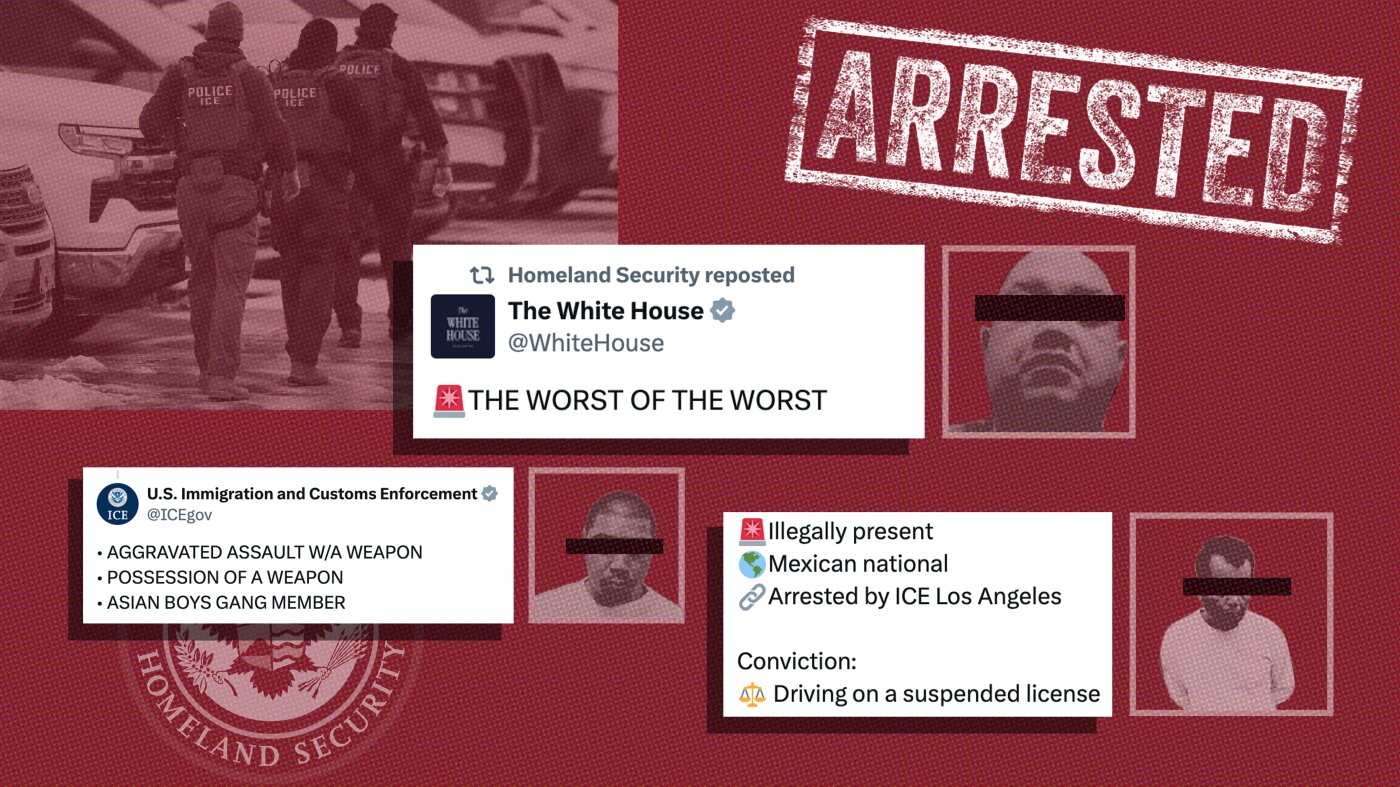
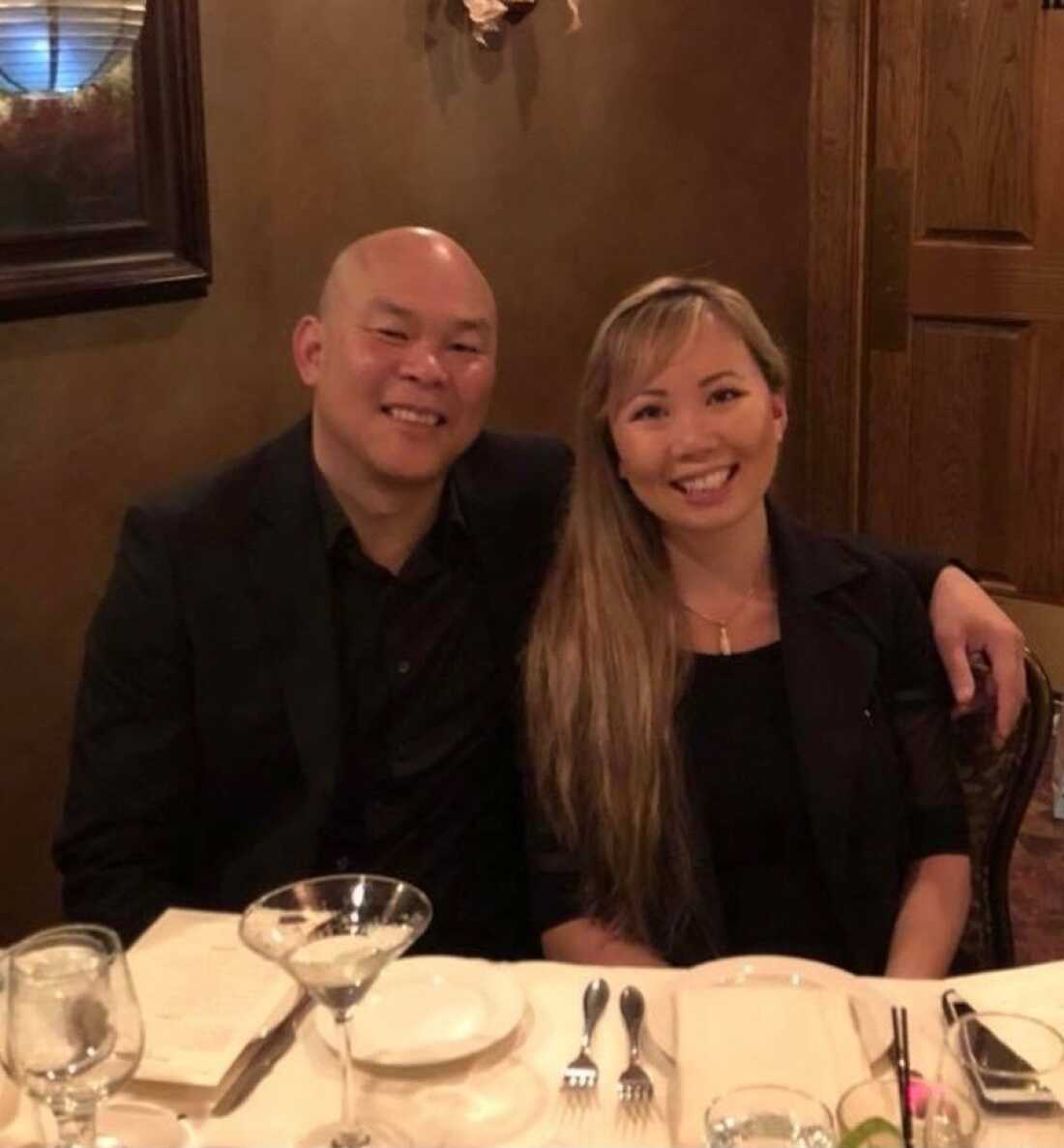
Two days after At Chandee, who goes by Ricky, was arrested by U.S. Immigration and Customs Enforcement, the White House’s X account posted about him, calling the 52-year-old the “WORST OF WORST” and a “CRIMINAL ILLEGAL ALIEN.”
Except that the photo the White House posted was of a different person. The post also incorrectly claimed Chandee had multiple felony convictions — he has one, for second-degree assault in 1993 when he was 18 years old. He shot two people in the legs and served three years in prison.
Advertisement
At “Ricky” Chandee with his wife, Tina Huynh-Chandee.
Via the Chandee family
hide caption
toggle caption
Via the Chandee family
Advertisement
Chandee, who came to the U.S. as a child refugee, was ordered to be deported back to his home country, Laos. But Laos had not been accepting all of the people the U.S. wanted it to, so the federal government determined that it was likely infeasible to deport him, his lawyer Linus Chan told NPR. Chandee therefore was granted permission to stay in the U.S. and work so long as he checked in with immigration authorities periodically. He has not missed a check-in in over 30 years and has not had another criminal incident.
People who know Chandee do not see him as “worst of the worst.”
After Chandee completed his prison sentence, he finished school and became an engineering technician. He worked for the City of Minneapolis for 26 years, became a father, and his son grew up to join the military.
In his free time, Chandee enjoys hiking and foraging for mushrooms, Minnesota Public Radio reported.
Advertisement
“We are proud to work alongside At ‘Ricky’ Chandee,” said Tim Sexton, Director of Public Works for the City of Minneapolis in a statement. “I don’t understand why he would be a target for removal now, why he was brutally detained and swiftly flown to Texas, or how his removal benefits our city or country.” Chandee is petitioning for his release in federal court.
Chandee’s case is not unique
Social media accounts from the White House, the Department of Homeland Security and other immigration agencies have spent much of the past year posting about people detained in the administration’s immigration crackdown, typically portraying them as hardened, violent criminals. That’s even as over 70% of the people detained don’t have criminal records according to ICE data.
NPR’s research of cases in Minnesota shows that while many of the people who have been highlighted on social media do have recent, serious criminal records, about a quarter are like Chandee, with decades-old convictions, minor offenses or only pending criminal proceedings. Scholars of immigration, media and criminal law say such a media campaign is unprecedented and paints a distorted picture of immigrants and crime.
A year into President Trump’s second term, the X accounts of DHS and ICE have posted about more than 2,000 people who were targets of mass deportation efforts. Starting late last March, DHS and ICE began posting on X on a near daily basis, often highlighting apprehensions of multiple people a day, an NPR review of government social media posts show.
Advertisement
Among the 2,000 people highlighted by the agencies, NPR identified 130 who were arrested by federal agents in Minnesota and tried to verify the government’s statements about their criminal histories.
In most of the social media posts, the government did not provide the state where the conviction occurred or the person’s age. Public court records do not tend to include photos so definitive identification can be a challenge.
NPR derived its findings from cases where it was able to locate a name and matching criminal history in the Minnesota court and detention system, in nationwide criminal history databases, sex offender databases, and in some cases, federal courts and other state courts.
In 19 of the 130 cases, roughly 1-in-7, public records show the most recent convictions were at least 20 years ago.
Seventeen of the 19 cases with old convictions did include violent crimes like homicide and first-degree sexual assault. ICE provided some of those names to Fox News as key examples of the agency’s accomplishments. “It’s the most disturbing list I’ve ever seen,” said Fox News reporter Bill Melugin on X, highlighting the criminal convictions of each person on the list.
Advertisement
For seven people, their only criminal history involved driving under the influence or disorderly conduct.
ICE agents approach a house before detaining two people in Minneapolis on Jan. 13.
Stephen Maturen/Getty Images
hide caption
toggle caption
Advertisement
Stephen Maturen/Getty Images
Six of the 130 Minnesota cases highlighted by the administration involved people with no criminal convictions. The government’s social media posts for those six instead rely upon the charges and arrests as evidence of their criminality, even though arrests don’t always lead to charges and charges can be dismissed.
In yet another case, the government highlighted a criminal charge even while noting it had been dismissed. (The person did have other existing convictions.)
For 37 of the 130 people, NPR was unable to confirm matching criminal history after consulting the databases and news coverage. Some of the names turned up no criminal history at all. The government said these people committed crimes ranging from homicide and assault to drug trafficking, and cited one by name to Fox News. NPR tried to reach out to all 37 people and their families for comment but did not receive a response from any.
Advertisement
In a statement to NPR, DHS’s chief spokesperson Lauren Bis did not dispute NPR’s findings or provide documentation where NPR wasn’t able to confirm matching criminal history.
“The fact that NPR is defending murderers and pedophiles is gross,” Bis wrote. “We hear far too much about criminals and not enough about their victims.” before listing four of the people with old convictions of homicide and sexual assault, underlining the date of deportation order for three of them.
Images designed to trigger emotion
The stream of social media posts with photos of mostly nonwhite people are meant to draw an emotional response, says Leo Chavez, an emeritus professor of anthropology at the University of California, Irvine. They “have been used repeatedly over and over to get people to buy into, really drastic, drastic and draconian actions and policies,” he said.
Chavez, whose most recent book is The Latino Threat: How Alarmist Rhetoric Misrepresents Immigrants, Citizens, and the Nation, recalls how political campaigns in past decades presented images of Latinos — often men — without context. “Just by showing their image, showing brown people, particularly brown men, it’s supposed to be scary.”
The fact that the government’s social media posts come with statements about criminal history as well as photos reinforces that emotional response, Chavez said. DHS has previously acknowledged inaccuracies on their website. But even if the department issues corrections, Chavez said, “the goal was actually achieved, which was to reinforce the criminality and the visualization.”
Advertisement
CNN’s analysis of DHS’s “Arrested: Worst of the Worst” website showed that for hundreds out of about 25,000 people posted on the website, the crimes listed were not violent felonies. Instead, DHS listed people with records that included traffic offenses, marijuana possession or illegal reentry. DHS said the website had a “glitch” that it will fix but also that the people in question “have [committed] additional crimes.”
“I’ve never seen anything like this when it comes to immigration enforcement in the modern era,” said Juliet Stumpf, a professor at Lewis & Clark Law School who studies the intersection of immigration and criminal law. She said the drumbeat of social media posts focused on specific individuals was like “FBI’s most wanted posters” or “like reality TV shows.”
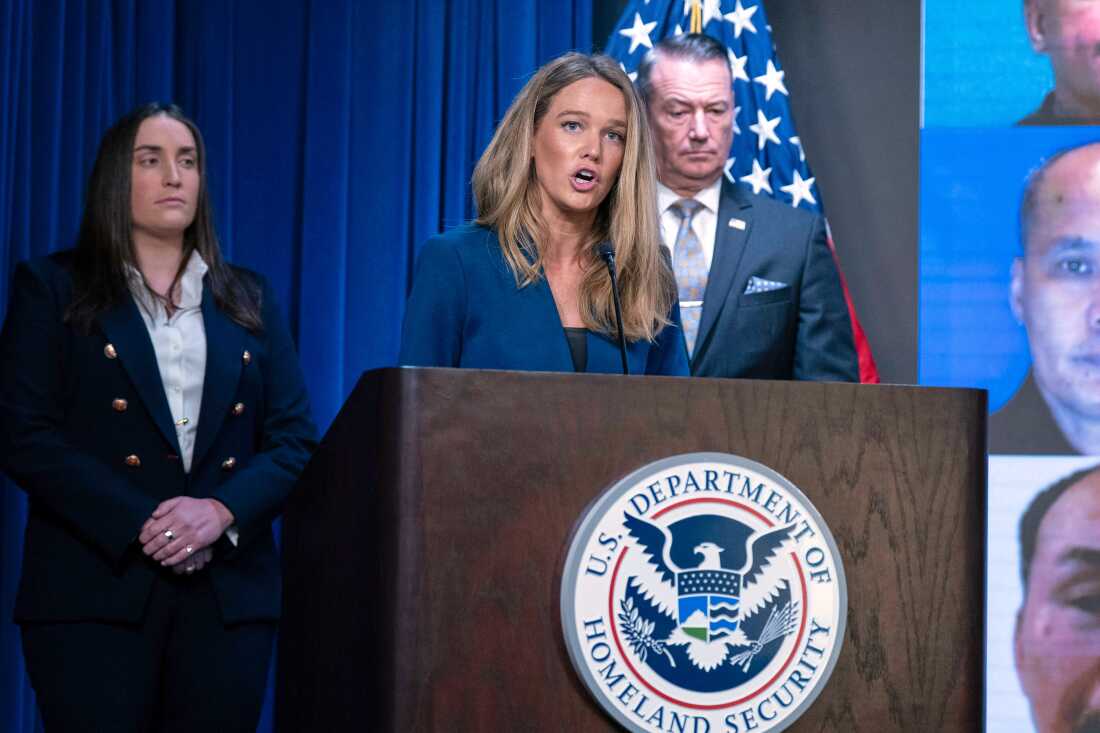
Then-DHS Assistant Secretary for Public Affairs Tricia McLaughlin, flanked by deputy director of U.S. Immigration and Customs Enforcement Madison Sheahan (left), and Acting director of U.S. Immigration and Customs Enforcement Todd Lyons, speaks during a news conference at ICE Headquarters, in Washington, D.C., on May 21, 2025.
Jose Luis Magana/AP
hide caption
Advertisement
toggle caption
Jose Luis Magana/AP
Stumpf drew a parallel with an incident from the 1950s when the U.S. government deported two permanent residents suspected of being communists. “The government was kind of proclaiming and celebrating their deportation because getting rid of these communists was making the country safer,” said Stumpf, “Maybe that’s comparable to something like [this].”
An analysis by the Deportation Data Project shows a dramatic increase in arrests of noncitizens without criminal records during President Trump’s current term compared to President Biden’s term.
Advertisement
“If you look at research, immigrants actually tend to commit fewer crimes than even U.S. citizens do. And that’s true of immigrants who have lawful status here and immigrants who don’t,” said Stumpf. “If we have a number of social media posts that are painting immigrants as the worst of the worst…it’s actually really putting out a distorted version of reality about who immigrants actually are.”
Some claims are disputed by other authorities
In some posts, DHS and ICE have also used photos of people and statements about their criminal histories to burnish the federal government’s accomplishments, defend their agents and criticize states like Minnesota. State and local authorities have in turn pushed back, and some of the federal government’s claims about the people it has detained have been met with setbacks in the courts.
DHS accused Minnesota’s Cottonwood County of not honoring detainers, written requests by ICE to hold prisoners in custody for a period of time so ICE can pick them up. In one post, the agency identified a person who was charged with child sexual abuse, writing “This is who sanctuary city politicians and anti-ICE agitators are defending.”
The Cottonwood County sheriff’s office said DHS’s post “misrepresented the truth” in their own post on Facebook. According to their account, the county did honor the detainer but ICE said it was unable to pick up the person before the order expired and the county had to release the suspect.
The Minnesota Department of Corrections wrote in a blog post that dozens of people DHS listed on its “Worst of the Worst” website were not arrested as DHS described, but were transferred to ICE by the state because they were already in state custody. The Corrections Department has since launched a page dedicated to “correct the Department of Homeland Security’s (DHS) repeated false claims.”
Advertisement
The “Worst of the Worst” website has some overlap with the department’s social media posts, but it contains a much larger number of people — over 30,000 nationally. It included a Colombian soccer star who was extradited to the U.S., tried in Texas, convicted of drug trafficking and served time in federal prison. The website incorrectly describes him as being arrested in Wisconsin. The soccer player, Jhon Viáfara Mina, recently finished his sentence early and returned to Colombia, according to Spanish newspaper El Diario Vasco.
In some instances, DHS and ICE wrote about incidents where they ran into conflict when carrying out arrests. In those posts, they named the arrestees and posted their photos. But in one case where the incident went to court, the government’s account of the events shifted. After a federal agent shot Julio C. Sosa-Celis in Minneapolisin January, DHS claimed he was lodging a “violent attack on law enforcement.” Assault charges against Sosa-Celis fell apart in court as new evidence surfaced, and the officers involved were put on leave.
Despite the fact that the charges were dropped, DHS’s post profiling Sosa-Celis remains online.