News
It’s been a rollercoaster few years for Six Flags. Can Travis Kelce help?


Kansas City Chiefs tight end Travis Kelce says he grew up going to Six Flags parks and wants to help make them special for the next generation of families.
Reed Hoffmann/AP
hide caption
toggle caption
Reed Hoffmann/AP
Travis Kelce, the Kansas City Chiefs tight end and fiance of Taylor Swift, sparked jokes and hopes this week when he announced his investment in the embattled amusement park company Six Flags Entertainment.
The football star, alongside two corporate executives, teamed up with JANA Partners to purchase a combined stake of about 9% of Six Flags’ shares, making them one of its largest shareholders, according to Tuesday’s news release.

JANA Partners is an activist investment firm, meaning it buys a substantial stake in a company’s equity in order to push for changes — both operational and managerial — it believes will benefit that company.
“Couldn’t pass up the opportunity to continue the tradition and make Cedar Point and Six Flags even more special for the next generation of families!” Kelce wrote on Instagram. “So crazy to even imagine this is real, but you gotta love it when life comes full circle.”
Kelce also shared home video clips of himself as a child enjoying the rides at Cedar Point, the 364-acre amusement park in Sandusky, Ohio, that he and his brother (and retired pro footballer) Jason grew up going to every year, as the two enthusiastically reminisced in an episode of their New Heights podcast. Kelce, who grew up in a suburb of Cleveland, calls himself a “lifelong Six Flags fan.”
Cedar Point’s former operator, Cedar Fair, merged with Six Flags in 2024 to become the largest amusement park operator in North America, touting 42 parks across the U.S., Canada and Mexico.

At the time, many amusement parks — and Six Flags especially — were struggling to increase attendance in the wake of the COVID-19 pandemic. Park analysts and enthusiasts hoped the merger would lower ticket costs, raise revenue and make it more competitive against industry heavyweights like Disney and Universal.
But that hasn’t been the case, says Dennis Speigel, CEO of the consulting firm International Theme Park Services.
“As this merger occurred, I think the due diligence was probably done a little too quickly and it had a lot of flaws in it,” he told NPR. “And then it was also impacted by what I call the external factors: weather, economy, uncertainty of what’s happening in geopolitical areas.”
Six Flags now has $5.3 billion in debt. Its CEO, Richard Zimmerman, is set to step down by the end of the year, after it reported a net loss of $100 million for the second quarter of 2025 and combined attendance down 9% year-over-year. It is shuttering one of its parks — Six Flags America in Bowie, Md. — in early November and is expected to close another in Santa Clara, Calif., in 2027.

Speigel is hopeful the new shareholders will get Six Flags back on track. And while he was initially surprised to learn of Kelce’s involvement, he says it makes sense because “he’s at the zenith of his career in football … and in love.”
“Having a name like that be associated with Six Flags at this point in time, when they’ve gone through quite a few years recently of negativity, speaks well to their future and what they’re looking to do,” he says. “Obviously, he’s a younger person. He speaks to the teens, the young adults and the young adults with families. And that’s the Six Flags audience.”
Kelce’s fame — and high-profile love story — have boosted businesses before. Swift is credited with increasing female NFL viewership and ticket sales as their relationship unfolded. And, in recent days, his social media announcement has been flooded with fans’ pleas for a Swift-themed park, or at least a rollercoaster.
Six Flags’ rocky ride
Six Flags opened with the “Six Flags Over Texas” park in 1961, and for years was one of America’s most iconic theme park companies (along with Disney). But for the last decade, Speigel says, it has been “a ship at sea without a captain.”
“I would have to say [out of] the top five or six operators during the last couple of years, Six Flags has suffered the most,” he says.
Six Flags has had four CEOs since 2015.

It shifted its pricing strategy in 2022 to target a more affluent demographic, confusing and alienating core customers in the process. And in recent years, a number of high-profile ride malfunctions have stranded and even injured visitors. This year, extreme temperatures and economic uncertainty drove attendance down even further.
“To see Six Flags have fallen off the precipice and down to where it is now, it’s sad,” Speigel says. “And everybody in the industry, competitors and alike, are all rooting for their return and their comeback.”

Visitors arrived to a “Welcome Back” sign at Six Flags Magic Mountain in Valencia, Calif., when it reopened after the COVID-19 pandemic in April 2021.
Jae C. Hong/AP
hide caption
toggle caption
Jae C. Hong/AP
What might change?
JANA Partners said in its announcement that it plans to engage with Six Flags’ management and board of directors “regarding opportunities to enhance shareholder value and improve the guest experience.”
NPR has reached out to Jana Partners for more information about its goals but did not hear back by publication time.
The Wall Street Journal reports that the investment firm wants to “modernize technology, refresh leadership and evaluate a potential sale as ways to boost the company’s share price.”
In a statement shared with NPR, a Six Flags spokesperson said it appreciates the perspectives of shareholders and takes their feedback seriously.
Speigel says Six Flags’ debt could force the new investors to take “some drastic measures,” like selling some of its parks, either to commercial real estate or even private equity groups. And he stresses that foot traffic is key in the industry.
“We live on repeat visitation, and repeat visitation is driven by capital improvements, new rides and attractions, dark rides, the new technologies,” he says. “So we have to hopefully see the growth from that.”
Speigel says even though U.S. amusement parks may not be experiencing the same rate of growth that they did several decades ago, they still attract some 400 million visitors each year — most of whom don’t care who owns a park as long as their experience is clean, fun and safe.
He hopes JANA recognizes Six Flags, and the industry in general, as “the last real bastion of family fun in the United States, in fact globally, where a family can go as a total unit. And I hope they put their capital behind that and lift it out of the ashes where it is now.”



News
Trump says he’s been assured Tehran has stopped killing protesters as Iran reopens its airspace – live

Opening summary
Welcome to our continuing live coverage of the crisis in Iran.
Donald Trump says he has been assured that the killing of Iranian protesters has been halted, adding when asked about whether the threatened US military action was now off the table that he will “watch it and see”.
The president said at the White House that “very important sources on the other side” had now assured him that Iranian executions would not go ahead. “They’ve said the killing has stopped and the executions won’t take place,” Trump said. “There were supposed to be a lot of executions today and that the executions won’t take place – and we’re going to find out.”
Earlier, Iranian foreign minister Abbas Araghchi told Fox News that executions executions were not taking place and there would be “no hanging today or tomorrow”. “I’m confident that there is no plan for hanging.”
The family of Erfan Soltani, the first Iranian protester sentenced to death since the current unrest began, has been told his execution has been postponed.
Here are some of the other latest developments:
-
Trump said Iranian opposition figure Reza Pahlavi “seems very nice” but expressed uncertainty about whether Pahlavi would be able to muster support within Iran to eventually take over. “I don’t know how he’d play within his own country,” Trump told Reuters in the Oval Office. “And we really aren’t up to that point yet. I don’t know whether or not his country would accept his leadership, and certainly if they would, that would be fine with me.”
-
Iran has reopened its airspace after a near-five-hour closure that forced airlines to cancel, reroute or delay some flights.
-
The United Nations security council is scheduled to meet on Thursday afternoon for “a briefing on the situation in Iran”, according to a spokesperson for the Somali presidency. The scheduling note said the briefing was requested by the US.
-
Some US and UK personnel have been evacuated as a precaution from sites in the Middle East. The British embassy in Tehran has also been temporarily closed.
-
Spain, Italy and Poland advised their citizens to leave Iran. It followed a call by the US urging its citizens to leave Iran, suggesting land routes to Turkey or Armenia.
-
Araghchi insisted the situation was “under control” and urged the US to engage in diplomacy. “Now there’s calm,” the Iranian foreign minister said. “We have everything under control, and let’s hope that wisdom prevails and we don’t end up in a situation of high tension that would be catastrophic for everyone.”
-
The death toll in Iran from the regime’s crackdown stands at 2,571 people, according to the US-based Human Rights Activists news agency. More than 18,100 have been arrested, it said.
-
Foreign ministers from the G7 group said they were “prepared to impose additional restrictive measures” on Iran over its handling of the protests, and the “deliberate use of violence, the killing of protesters, arbitrary detention and intimidation tactics”.
Key events
AI-generated videos purportedly depicting protests in Iran have flooded the web, researchers say, as social media users push hyper-realistic deepfakes to fill an information void amid the country’s internet restrictions.
US disinformation watchdog NewsGuard said it identified seven AI-generated videos depicting the Iranian protests – created by both pro- and anti-government actors – that had collectively amassed about 3.5m views across online platforms.
Among them was a video shared on Elon Musk’s X showing women protesters smashing a vehicle belonging to the Basij, the Iranian paramilitary force deployed to suppress the protests, reports Agence France-Presse.
One X post featuring the AI clip – shared by what NewsGuard described as anti-regime users – garnered nearly 720,000 views. Anti-regime X and TikTok users in the US also posted AI videos depicting Iranian protesters symbolically renaming local streets after Donald Trump.
The AI creations highlight the growing prevalence of what experts call “hallucinated” visual content on social media during major news events, often overshadowing authentic images and videos.
Tensions between the US and Iran have appeared to ease as Donald Trump adopted a more measured tone towards Tehran and suggested a pause in his decision on threatened US military action. As you can read in our fresh full report, Trump had spoken repeatedly in recent days about coming to the aid of the Iranian people over the ruling regime’s crackdown on protests that a human rights group says has now killed at least 3,428 people and led to the arrest of more than 10,000.
But as mentioned earlier, Trump said in a surprise announcement at the White House that he had received assurances from “very important sources on the other side” that Tehran had now stopped the use of lethal force on protesters and that executions would not go ahead.
Asked if US military action was now off the table, Trump responded: “We’re going to watch it and see what the process is.”
You can read the full report here:
Moving for a moment to Australia, protesters have staged a rally outside the Iranian embassy in Canberra to demand regime change in Iran. About 100 demonstrators chanted “democracy for Iran” and “King Reza Pahlavi”, a reference to the last Iranian shah’s exiled son – a key figure in the anti-government protests.
James Younessi, a Sydney doctor who spoke at the demonstration, said he would happily move back to his home country if the regime was overthrown, Australian Associated Press has reported.
But he was hesitant about more American intervention in the Middle East, saying:
I don’t want Iran to be indentured to any foreign nation the moment anybody interferes. But if it means saving one life for it, we want a measured response that we can have this bloodshed ended.
Another protester, Omid Fakhri, who hadn’t heard from his family in Iran because of the internet blackout, was more positive about US military action.
“We don’t care which military, just a military is fine, as long as they can go in and stop the massacre,” he said. Foreign minister Penny Wong said Australia continued to urge people not to travel to Iran, and warned the security situation could deteriorate rapidly.
A little more now on Iran’s reopening of its airspace to flights after a near-five-hour closure that forced airlines to cancel, reroute or delay some flights.
Iran closed its airspace to all flights except international ones to and from Iran with official permission at 10.15pm GMT on Wednesday, according to a notice on the US Federal Aviation Administration website.
The notice was removed shortly before 3am GMT, according to tracking service Flightradar24, which showed five flights from Iranian carriers Mahan Air, Yazd Airways and AVA Airlines were among the first to resume over the country.
The price of oil dropped on Thursday after concerns over instability in Iran were eased by comments from Donald Trump, and gold and silver prices also dipped.
West Texas Intermediate fell 3.0% to $60.16 a barrel while Brent crude was down 2.93% to $64.57.
The plunge came after the US president said he had been told the killings of protesters in Iran had been halted.
Reaction across Asian markets has been mixed as trading got under way on Thursday. Hong Kong, Shanghai, Taipei, Wellington, Mumbai and Kuala Lumpur fell, while Sydney, Seoul, Bangkok and Manila posted minimal gains. Concern that the Iran situation could restrict supplies of crude had caused oil prices to rise about 1.5% on Wednesday.
India has advised its citizens to leave Iran by any transport possible.
The Indian embassy in Tehran said in a post on X: Indian nationals who are currently in Iran (students, pilgrims, business persons and tourists) are advised to leave Iran by available means of transport, including commercial flights.
The embassy also advised its citizens to be cautious and “avoid areas of protests or demonstrations”.
The US, Germany and Spain are among the counties reported to have earlier advised their citizens to leave Iran.
Welcome to our continuing live coverage of the crisis in Iran. Donald Trump says he has been assured that the killing of Iranian protesters has been halted, adding when asked about whether the threatened US military action was now off the table that he will “watch it and see”.
The president said at the White House that “very important sources on the other side” had now assured him that Iranian executions would not go ahead. “They’ve said the killing has stopped and the executions won’t take place,” Trump said. “There were supposed to be a lot of executions today and that the executions won’t take place – and we’re going to find out.”
Earlier, Iranian foreign minister Abbas Araghchi told Fox News that executions executions were not taking place and there would be “no hanging today or tomorrow”. “I’m confident that there is no plan for hanging.”
The family of Erfan Soltani, the first Iranian protester sentenced to death since the current unrest began, has been told his execution has been postponed.
Here are some of the other latest developments: Trump said Iranian opposition figure Reza Pahlavi “seems very nice” but expressed uncertainty about whether Pahlavi would be able to muster support within Iran to eventually take over. “I don’t know how he’d play within his own country,” Trump told Reuters in the Oval Office. “And we really aren’t up to that point yet. I don’t know whether or not his country would accept his leadership, and certainly if they would, that would be fine with me.”
Iran has reopened its airspace after a near-five-hour closure that forced airlines to cancel, reroute or delay some flights.
The United Nations security council is scheduled to meet on Thursday afternoon for “a briefing on the situation in Iran”, according to a spokesperson for the Somali presidency. The scheduling note said the briefing was requested by the US.
Some US and UK personnel have been evacuated as a precaution from sites in the Middle East. The British embassy in Tehran has also been temporarily closed.
Spain, Italy and Poland advised their citizens to leave Iran. It followed a call by the US urging its citizens to leave Iran, suggesting land routes to Turkey or Armenia.
Araghchi insisted the situation was “under control” and urged the US to engage in diplomacy. “Now there’s calm,” the Iranian foreign minister said. “We have everything under control, and let’s hope that wisdom prevails and we don’t end up in a situation of high tension that would be catastrophic for everyone.”
The death toll in Iran from the regime’s crackdown stands at 2,571 people, according to the US-based Human Rights Activists news agency. More than 18,100 have been arrested, it said.
Foreign ministers from the G7 group said they were “prepared to impose additional restrictive measures” on Iran over its handling of the protests, and the “deliberate use of violence, the killing of protesters, arbitrary detention and intimidation tactics”.
Oil prices plunge as Iran instability fears ease
India latest country to urge its citizens to leave Iran
Opening summary
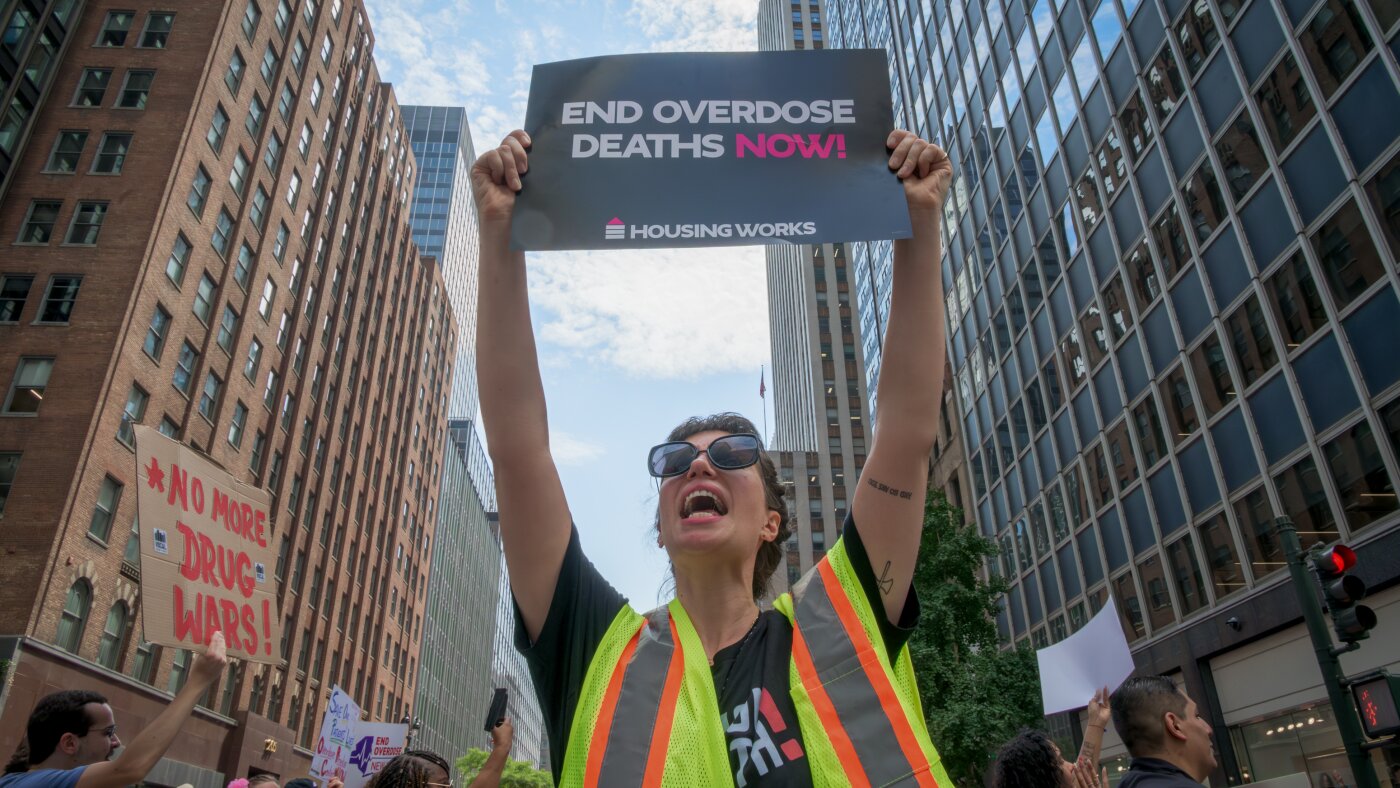
A demonstrator holds a sign during International Overdose Awareness Day on Aug. 28, 2024 in New York City.
Erik McGregor/LightRocket via Getty Images
hide caption
toggle caption
Erik McGregor/LightRocket via Getty Images
The Trump administration sent shockwaves through the U.S. mental health and drug addiction system late Tuesday, sending hundreds of termination letters, effective immediately, for federal grants supporting health services.

Three sources said they believe total cuts to nonprofit groups, many providing street-level care to people experiencing addiction, homelessness and mental illness, could reach roughly $2 billion. NPR wasn’t able to independently confirm the scale of the grant cancellation. The U.S. Substance Abuse and Mental Health Services Administration (SAMSHA) didn’t respond to a request for clarification.
“We are definitely looking at severe loss of front-line capacity,” said Andrew Kessler, head of Slingshot Solutions, a consultancy firm that works with mental health and addiction groups nationwide. “[Programs] may have to shut their doors tomorrow.”
Kessler said he has reviewed numerous grant termination letters from “Salt Lake City to El Paso to Detroit, all over the country.”
Ryan Hampton, the founder of Mobilize Recovery, a national advocacy nonprofit for people in and seeking recovery, told NPR his group lost roughly $500,000 “overnight.”
“Waking up to nearly $2 billion in grant cancellations means front-line providers are forced to cease overdose prevention, naloxone distribution, and peer recovery services immediately, leaving our communities defenseless against a raging crisis,” Hampton said. “This cruelty will be measured in lives lost, as recovery centers shutter and the safety net we built is slashed overnight. We are witnessing the dismantling of our recovery infrastructure in real-time, and the administration will have blood on its hands for every preventable death that follows.”
Copies of the letter sent to two different organizations and reviewed by NPR signal that SAMHSA officials no longer believe the defunded programs align with the Trump administration’s priorities.
The letter points to efforts to reshape the national health system in part by restructuring SAMHSA’s grant program, which “includes terminating some of its … awards.”
According to the letter, grants are terminated as of Jan.13, adding that “costs resulting from financial obligations incurred after termination are not allowable.”
The National Association of County Behavioral Health and Developmental Disability Directors sent a letter to members saying it believes “over 2,000 grants [nationwide] with a total of more than $2 billion” are affected. The group said it’s still working to understand the “full scope” of the cuts.
This move comes on top of deep Medicaid cuts, passed last year by the Republican-controlled Congress, which affect numerous mental health and addiction care providers.
Kessler told NPR he’s hearing alarm from care providers nationwide that the safety net for people experiencing an addiction or mental health crisis could unravel.
“In the short term, there’s going to be severe damage. We’re going to have to scramble,” he said.
Regina LaBelle, a Georgetown University professor who served as acting head of the Office of National Drug Control Policy during the Biden administration, said the SAMHSA grants pay for lifesaving services.
“From first responders to drug courts, continued federal funding quite literally save lives,” LaBelle said. “The overdose epidemic has been declared a public health emergency and overdose deaths are decreasing. This is no time to pull critical funding.”
Requests for comment from SAMHSA and the Department of Health and Human Services were not immediately returned.
This is a developing story.

new video loaded: Clashes With Federal Agents in Minneapolis Escalate
transcript
transcript
Clashes With Federal Agents in Minneapolis Escalate
Fear and frustration among residents in Minneapolis have mounted as ICE and Border Patrol agents have deployed aggressive tactics and conducted arrests after the killing of Renee Good by an immigration officer last week.
-
“Open it. Last warning.” “Do you have an ID on you, ma’am?” “I don’t need an ID to walk around in — In my city. This is my city.” “OK. Do you have some ID then, please?” “I don’t need it.” “If not, we’re going to put you in the vehicle and we’re going to ID you.” “I am a U.S. citizen.” “All right. Can we see an ID, please?” “I am a U.S. citizen.”

By Jamie Leventhal and Jiawei Wang
January 13, 2026

Forcing an early wake-up time could harm your health, sleep doctors warn

Mike Tomlin’s exit was unexpected as Steelers begin rare coaching search, team president says

Malicious Mac extensions steal crypto wallets and passwords
Disney names Asad Ayaz as chief marketing and brand officer

Timothy Busfield faces new sex abuse accusation as he appears in court

Florida High School Football Rankings: Top 25 teams – Oct. 21

Cleary's 21 help Le Moyne down Central Connecticut State 69-64 in OT

How old is Bo Nix? What to know about Oregon quarterback ahead of 2024 NFL Draft

99th annual Pony Swim held in Virginia

Video: ‘It Didn’t Have to Happen This Way:’ U.Va. Faculty Call for Review of Police Response to Protests

Iran reopens airspace after closure to most flights amid US attack threats

Trump says he’s been assured Tehran has stopped killing protesters as Iran reopens its airspace – live

Republicans light cigars, cigarettes on burning photos of Khamenei to show support for Iranian protesters

EU Parliament questions defence loan’s ‘€17 billion gift’ to Hungary
Trump administration sends letter wiping out addiction, mental health grants
-

 Montana4 days ago
Service door of Crans-Montana bar where 40 died in fire was locked from inside, owner says
-

 Technology1 week ago
Power bank feature creep is out of control
-

 Delaware6 days ago
MERR responds to dead humpback whale washed up near Bethany Beach
-

 Dallas, TX6 days ago
Anti-ICE protest outside Dallas City Hall follows deadly shooting in Minneapolis
-

 Dallas, TX1 week ago
Defensive coordinator candidates who could improve Cowboys’ brutal secondary in 2026
-

 Education1 week ago
Video: This Organizer Reclaims Counter Space
-

 Virginia4 days ago
Virginia Tech gains commitment from ACC transfer QB
-

 Iowa1 week ago
Pat McAfee praises Audi Crooks, plays hype song for Iowa State star