Connect with us

News

Israel pounds Lebanon in fierce wave of strikes

Published

on

Israel pounds Lebanon in fierce wave of strikes

Unlock the Editor’s Digest for free

Israel continued to pound Lebanon with a fierce wave of air strikes overnight, as Israeli forces stepped up their air campaign against Hizbollah, hitting what they said were targets linked to the militant group.

The bombardment lit up Beirut’s skyline on Sunday, as powerful blasts rocked the city throughout the night. Targets included a building near the road to Beirut’s airport, where the strikes set off huge fires. Smoke was still seen rising from the area in the morning. 

The explosions began around midnight, after Israel’s military warned residents to evacuate neighbourhoods in Beirut’s southern suburbs, which Hizbollah dominates, including Haret Hreik and Choueifat. Another powerful blast was heard on Sunday morning.

Advertisement

The more intense bombing followed a day of sporadic air strikes and the constant buzz of reconnaissance drones, both of which have become almost routine for residents of the capital. 

Israel’s military said it had struck weapons storage facilities and other infrastructure linked to Hizbollah in Beirut. It also said Hizbollah launched projectiles across the border, some of which were intercepted.

Hizbollah said it successfully struck a group of Israeli soldiers with a salvo of rockets. It is not possible to verify the battlefield claims on either side. 

Some content could not load. Check your internet connection or browser settings.

Israel has intensified its assault against Hizbollah over the past two weeks as it has shifted its focus from Gaza to the northern front. It has killed Hizbollah leader Hassan Nasrallah, launched air strikes across Lebanon and sent troops into Lebanon’s south for the first time in almost two decades.  

Advertisement

More than 2,000 people have been killed in Lebanon in the conflict, the majority in the past two weeks, according to data from the Lebanese health ministry. More than 1.2mn people have also been displaced from their homes because of the fighting. 

This includes about 375,000 people who fled to Syria in recent days, some of whom made the journey on foot. Israel bombed one of the roads leading up to a major crossing point, saying it was targeting Hizbollah’s supply routes from Syria.

Foreigners have also continued to flee Lebanon, with multiple nations chartering planes to help repatriate their citizens in recent days. 

Israel on Saturday struck a Palestinian refugee camp in the northern city of Tripoli for the first time, targeting a Hamas commander. There were also indications that Israel was widening its offensive to include Hizbollah’s civil infrastructure. 

Lebanese authorities said Israeli bombardment had killed 50 health workers in the past four days, as Israeli fighter jets continued to attack medical facilities, mosques and other buildings it says are used by Hizbollah militants. 

Advertisement
People standing on a street near damaged buildings following an Israeli air strike in the  Dahieh district in Beirut, Lebanon on October 6 2024
A street with damaged buildings following an Israeli air strike in the Dahieh district in Beirut © STR/EPA-EFE/Shutterstock

The WHO’s director-general warned that the capacity of Lebanon’s health system — already on the brink after five years of a dire economic crisis — was deteriorating and that the UN agency’s “medical supplies cannot be delivered due to the almost complete closure of Beirut’s airport”.

While Lebanon’s only airport remained open, most airlines have suspended flights in and out of the country because of the heavy bombardment in the nearby southern suburbs. 

Israel has issued multiple evacuation orders in recent days, warning people in towns and villages across the south to move north. It gave similar orders during its war against Hamas in Gaza ahead of big offensives. 

The escalation has pushed the Middle East closer to all-out war. The region is bracing for Prime Minister Benjamin Netanyahu’s response to an Iranian missile barrage fired at Israel on Tuesday. 

Tehran said the missile attack was in response to the assassination of Nasrallah and the killing of Hamas’s political leader Ismail Haniyeh in Tehran in July.

Israel also carried out further strikes in Gaza overnight, including bombing a mosque and a school in Deir al-Balah. Palestinian health officials said 26 people had been killed and “dozens” had been injured in the strikes. The Israeli military said it had targeted Hamas militants using the sites to direct operations against its forces.

Advertisement

Israel also launched a new offensive in Jabalia in the north of the enclave, with warplanes carrying out a heavy bombardment of the area before it was encircled by ground forces. The military said it had launched the assault because militants had regrouped in the vicinity.

French President Emmanuel Macron on Saturday renewed his calls for a ceasefire in Gaza, saying weapons shipments to Israel for its campaign in the enclave should be suspended, and warning against further escalation in Lebanon.

“The Lebanese people must not in turn be sacrificed, Lebanon cannot become another Gaza,” he said in an interview with the France Inter radio station.

Netanyahu hit back, branding those supporting an arms embargo a “disgrace”. “Shame on them,” he said. “Israel will win with or without their support. But their shame will continue long after the war is won.”

Advertisement

News

How a Beer Hall Keeps Up With a World Cup Crowd

Published

on

The fans see the games, the crowds, the food and the beer. But behind every World Cup watch party is a team working long before kickoff and well after the final whistle. We go behind the scenes at a beer hall in Brooklyn to see what it takes to serve a room full of soccer fans on game day.

Continue Reading

News

With the white nationalist group Patriot Front, what you see is not what you get

Published

on

With the white nationalist group Patriot Front, what you see is not what you get

Members of the group Patriot Front ride the subway as a commuter looks on, in Washington, D.C., on July 4.

Cheney Orr/Reuters


hide caption


toggle caption

Advertisement

Cheney Orr/Reuters

The sight of hundreds of masked men roaming the streets of Washington, D.C., on July Fourth weekend, wearing khakis, blue shirts and uniform patches, was chilling to some of the city’s residents.

For many Americans, it was the first they heard about Patriot Front, a white nationalist organization that was born out of the deadly 2017 Unite the Right rally in Charlottesville, Va. A now-viral Reuters photo prompted reflections on the experience of a lone African American woman who was photographed in a Metro subway car, surrounded by white supremacists.

The planned demonstration of force was timed to bring a fringe group of extremists into public view as the nation marked 250 years of its independence. Indeed, the stunt succeeded in earning the group media coverage across mainstream outlets, amplifying its brand and potential to reach new recruits. On this occasion, the members refrained from engaging in violence and property damage, projecting an image of law-abiding, orderly activism.

Advertisement

But those who are closely familiar with Patriot Front’s history and operations warn: Don’t believe what you see.

“That is not who they are in private,” said Len Kamdang, director of the Criminal Justice Project at the Lawyers’ Committee for Civil Rights Under Law. “Although they were on their best behavior [last] weekend, this is a dangerous group that commits acts of violence all over the country.”

Patriot Front’s history of violence and property damage

Kamdang’s organization sued members of Patriot Front for vandalizing a public mural dedicated to the tennis legend and Black activist Arthur Ashe in Richmond, Va., in 2021. Ashe, who was inducted into the International Tennis Hall of Fame in 1985, was born in Richmond and his legacy is a continuing source of pride to members of that community.

“A couple of Patriot Front members showed up under cover of night and vandalized the mural,” Kamdang said. “They painted white stencils all over. … They literally tried to whitewash him and they put their symbols of hate all over — their stencils, their slogans. And all the while they were caught on video. And that video leaked using some of the most horrible language that you can imagine.”

In many jurisdictions, law enforcement can seek additional hate crime charges or sentencing enhancements in cases where illegal acts appear to have been motivated by racial bias. But in this case, Kamdang said, Patriot Front members faced no criminal charges and their identities were only revealed when online activists later infiltrated the group and leaked internal records.

Advertisement
Continue Reading

News

Graham Platner makes it official in Maine, submitting paperwork to leave Senate race

Published

on

Graham Platner makes it official in Maine, submitting paperwork to leave Senate race

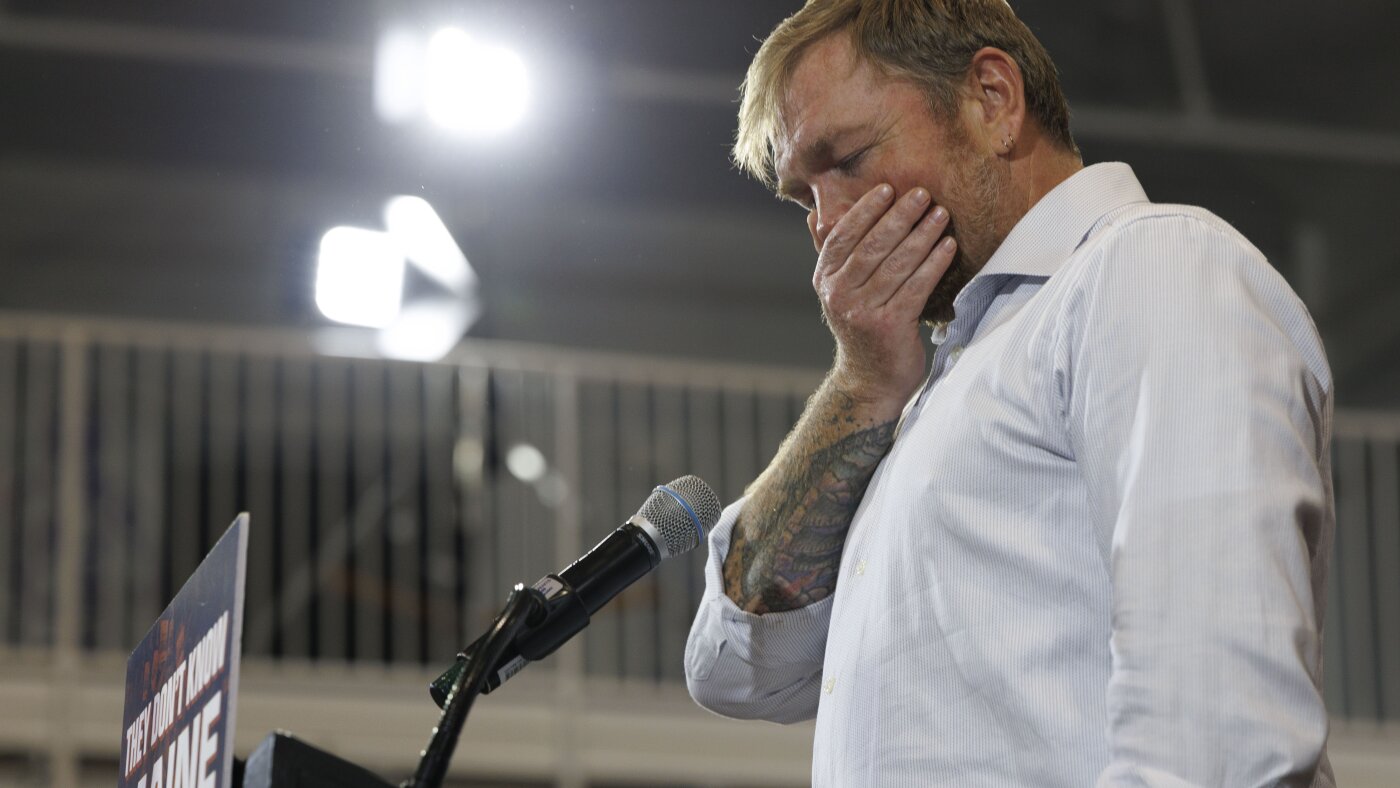
Now-former Democratic Senate candidate Graham Platner speaks at his primary election night event on June 9 in Blue Hill, Maine. Platner officially dropped out of the race July 10 following rape allegations from a former romantic partner that he denies.

CJ Gunther/Getty Images


hide caption


toggle caption

Advertisement

CJ Gunther/Getty Images

Graham Platner, Maine’s Democratic nominee for Senate, is officially out of the race.

The Maine Secretary of State said Platner filed the necessary paperwork to withdraw his candidacy two days after he announced he planned to do so following an accusation of rape by a former romantic partner. Platner denies the allegation.

The Maine Democratic Party has until July 27 to pick Platner’s replacement.

Advertisement

In his withdrawal notice, Platner said “people are desperate for change” and that’s why they voted “for a new kind of politics” by making him the Democratic nominee. He expressed gratitude for those who supported his campaign and said that he will continue to fight for “the movement we have built together and the future we believe in.”

He ended his notice with a strong statement aligned with the progressive platform.

“F*ck ICE. Free Palestine. Up the Hearts.”

Platner announced his plan to withdraw from the race in an 11-minute video he posted to social media on July 8. He said he had no choice but to suspend his campaign, citing it was no longer viable financially.

Advertisement

“We are going to lose our ability to fundraise. We are going to lose our ability to access voter data. We are going to lose all of the things that any campaign needs on the basic level simply to function,” he said.

Platner added that dropping out was not an admission of guilt. Rather, the decision, he said, is to keep the progressive movement in Maine alive to defeat Republican Sen. Susan Collins in November. Platner blamed the “political establishment” for his downfall and argued the goal was to force him out of the race.

“We built a campaign. We engaged in electoral politics. We motivated people. We banded together. We did it the way that we were told we are supposed to make change and we won. And now they are not going to let us have it. Not if it’s me,” he said.

Continue Reading
Advertisement

Trending