News
Hurricane Milton reaches Category 4 strength days before it's poised to hit Florida

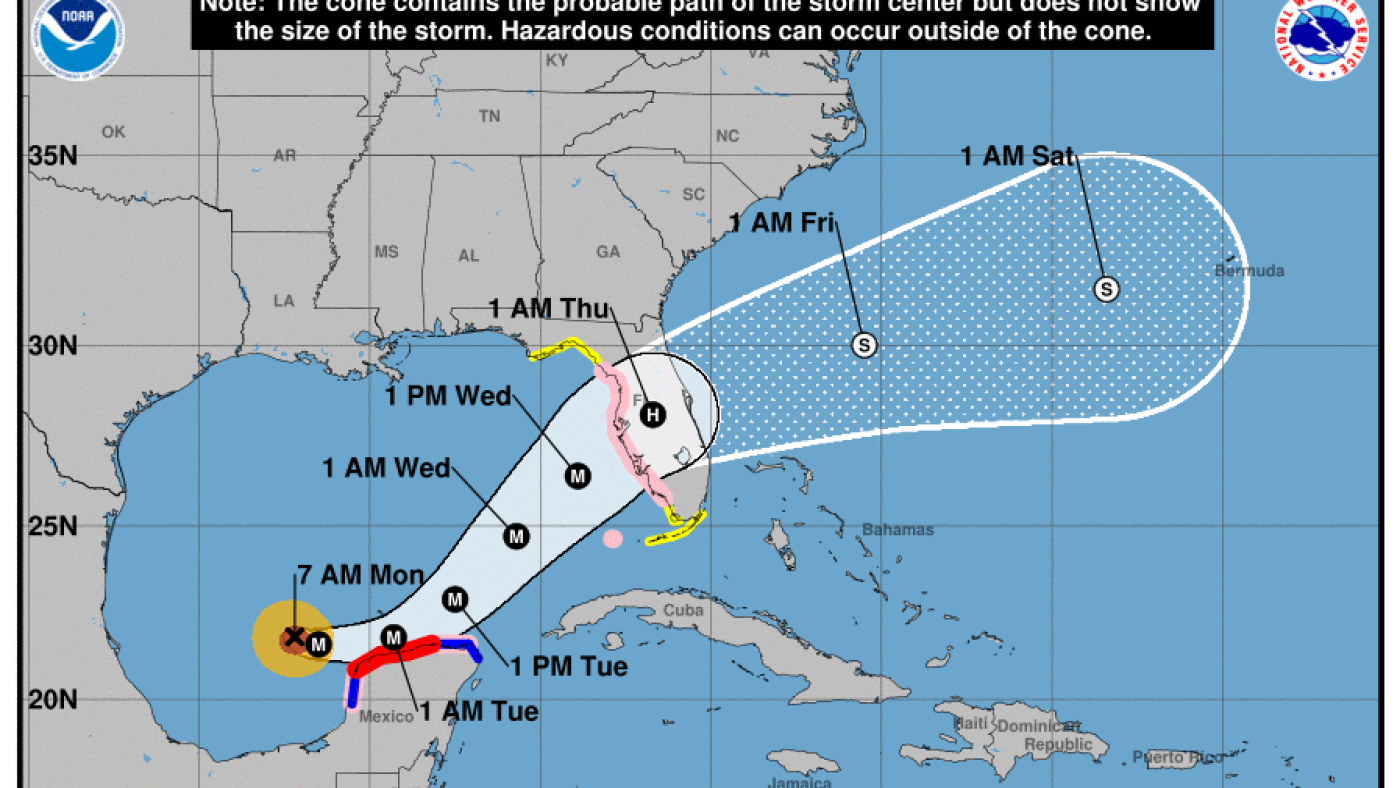
Early models show Milton making landfall in Florida midweek before exiting into the Atlantic Ocean, sparing many of the states hardest hit by Helene.
National Hurricane Center
hide caption
toggle caption
National Hurricane Center
Less than two weeks after Hurricane Helene slammed into Florida’s Gulf Coast and wreaked a path of destruction across the southeastern U.S., the state is again on high alert for another rapidly intensifying storm.
Forecasters upgraded Milton from a tropical storm to a hurricane on Sunday, a day earlier than expected, and warn that it is poised to reach Category 4 strength before making landfall in Florida midweek.
It strengthened into a “major” Category 3 hurricane early Monday morning when its maximum sustained winds started nearing 125 mph. It quickly intensified to Category 4 status with maximum sustained winds of 150 mph, the National Hurricane Center said just after 9 a.m. ET.
8:05 AM CDT Monday Update: Milton rapidly intensifies into a category 4 hurricane. The maximum sustained winds have now increased to 150 mph (240 km/h) and the minimum pressure has fallen to 940 mb. pic.twitter.com/wlJXbB5lkr
— National Hurricane Center (@NHC_Atlantic) October 7, 2024
At that point, the storm was about 150 miles west-northwest of Progreso, Mexico, and about 735 miles west-southwest of Tampa. The coast of the Yucatan Peninsula is under a hurricane warning, while hurricane watches, storm surge watches and tropical storm watches and warnings are in effect for parts of the west coast of the Florida Peninsula.
Milton is expected to move just north of the Yucatan Peninsula on Monday and Tuesday before crossing the eastern Gulf of Mexico and approaching Florida’s west coast by Wednesday.

The NHC says most models agree that Milton will cross the Florida Peninsula, though people “should not focus on the exact track” because models still disagree about the exact location and timing of landfall.
Even so, forecasters warn that it is likely to be a “large and powerful hurricane at landfall in Florida, with life-threatening hazards along portions of the coastline.”
They say areas of heavy rainfall will impact portions of Florida on Monday, and again on Tuesday through Wednesday night, bringing “the risk of considerable flash, urban and areal flooding,” as well as the potential for moderate to major river flooding.

Parts of the Florida Peninsula and Keys could see 5 to 10 inches of rain through Wednesday night, with localized totals up to 15 inches in some areas.
There is also a growing risk of life-threatening storm surge and damaging winds for parts of Florida’s west coast beginning late Tuesday or early Wednesday. Forecasters say it could raise water levels to as high as 8 to 12 feet in coastal areas of Florida, including Tampa Bay.
“Residents in that area should follow any advice given by local officials and evacuate if told to do so,” the NHC said, referring to the west coast of the peninsula.
Floridians are bracing for evacuations and impact
Florida Gov. Ron DeSantis has already expanded an emergency declaration to cover 51 of the state’s 67 counties and is warning people across the peninsula to prepare.
“Do not get wedded to the cone,” he tweeted on Sunday. “Floridians should prepare now for potential impacts, even if you live outside of the forecast cone. We recommend following all evacuation orders from your local officials.”

Florida Emergency Management Director Kevin Guthrie said on Sunday that the state is preparing “for the largest evacuation that we have seen most likely since 2017 Hurricane Irma,” when nearly 6.8 million Floridians left their homes, resulting in statewide traffic jams.
But he also cautioned inland residents who don’t live in an evacuation zone or depend on electricity for medical needs that “it may be better for you to just stay in place.”
Several Florida counties have ordered evacuations starting as early as Monday morning.
Manatee County and Pasco County have ordered the evacuation of residents in certain low-lying areas, mobile homes and RVs, while Pinellas County ordered the evacuation of all residential healthcare facilities within certain zones.
Emergency officials are urging Floridians to look up their zone, plan an evacuation route and leave as soon as they’re ordered to do so.

Guthrie also said Floridians should take into account that many are still recovering from Helene: Did they use up their reserves of water, food, pet food? Do they need to buy fresh batteries? Have they restocked their supply kits to last each family member up to seven days?
“Please make sure you’re doing that today,” he said.

Lines started forming at gas stations on Sunday as people stocked up on fuel, water and other supplies, member station WGCU reported.
It notes that public school districts in many counties will be closed from Monday through at least Wednesday and that Florida Gulf Coast University — near Fort Myers — will close its campus Tuesday and Wednesday, after shifting to remote operations.
The St. Pete-Clearwater International Airport has already announced the cancellation of all Allegiant Air flights on Wednesday and Thursday.
Milton is forecast to spare other states submerged by Helene
Milton is poised to strike an area still recovering from Helene’s Category 4 winds and rains.
But it is expected to exit into the Atlantic Ocean, sparing many of the southeastern states that were hit hardest by Helene, including Georgia and the Carolinas.

More than 220 people were killed by Helene, one of the deadliest hurricanes to hit the mainland U.S. since Katrina in 2005. The Associated Press reports that about half of the victims were in North Carolina, where historic flooding destroyed entire communities.
Abnormally warm water in the Gulf of Mexico, fueled by human-caused climate change, has made it easier for hurricanes to strengthen rapidly and bring even more wind and rain ashore.
Milton is the ninth hurricane to form in the 2024 Atlantic hurricane season, which runs from June through November. It’s the fifth to form since Sept. 25 alone, breaking a previous record of two during that period.
And this is officially the first time three simultaneous hurricanes have been recorded in the Atlantic Ocean after September, according to storm researcher Philip Klotzbach. In addition to Milton, Hurricanes Kirk and Leslie are also brewing.



The fans see the games, the crowds, the food and the beer. But behind every World Cup watch party is a team working long before kickoff and well after the final whistle. We go behind the scenes at a beer hall in Brooklyn to see what it takes to serve a room full of soccer fans on game day.

Members of the group Patriot Front ride the subway as a commuter looks on, in Washington, D.C., on July 4.
Cheney Orr/Reuters
hide caption
toggle caption
Cheney Orr/Reuters
The sight of hundreds of masked men roaming the streets of Washington, D.C., on July Fourth weekend, wearing khakis, blue shirts and uniform patches, was chilling to some of the city’s residents.
For many Americans, it was the first they heard about Patriot Front, a white nationalist organization that was born out of the deadly 2017 Unite the Right rally in Charlottesville, Va. A now-viral Reuters photo prompted reflections on the experience of a lone African American woman who was photographed in a Metro subway car, surrounded by white supremacists.
The planned demonstration of force was timed to bring a fringe group of extremists into public view as the nation marked 250 years of its independence. Indeed, the stunt succeeded in earning the group media coverage across mainstream outlets, amplifying its brand and potential to reach new recruits. On this occasion, the members refrained from engaging in violence and property damage, projecting an image of law-abiding, orderly activism.
But those who are closely familiar with Patriot Front’s history and operations warn: Don’t believe what you see.
“That is not who they are in private,” said Len Kamdang, director of the Criminal Justice Project at the Lawyers’ Committee for Civil Rights Under Law. “Although they were on their best behavior [last] weekend, this is a dangerous group that commits acts of violence all over the country.”
Patriot Front’s history of violence and property damage
Kamdang’s organization sued members of Patriot Front for vandalizing a public mural dedicated to the tennis legend and Black activist Arthur Ashe in Richmond, Va., in 2021. Ashe, who was inducted into the International Tennis Hall of Fame in 1985, was born in Richmond and his legacy is a continuing source of pride to members of that community.
“A couple of Patriot Front members showed up under cover of night and vandalized the mural,” Kamdang said. “They painted white stencils all over. … They literally tried to whitewash him and they put their symbols of hate all over — their stencils, their slogans. And all the while they were caught on video. And that video leaked using some of the most horrible language that you can imagine.”
In many jurisdictions, law enforcement can seek additional hate crime charges or sentencing enhancements in cases where illegal acts appear to have been motivated by racial bias. But in this case, Kamdang said, Patriot Front members faced no criminal charges and their identities were only revealed when online activists later infiltrated the group and leaked internal records.


In another civil case, Patriot Front was ordered to pay almost $2.76 million to an African American musician whom they assaulted in Boston in 2022, at another July flash rally they staged. Despite a police detective concluding that the attack “appeared to be more likely than not motivated in whole or in part by Anti-Black bias,” nobody was criminally prosecuted.
Neo-Nazi ideology in patriotic colors
In 2020, Kristofer Goldsmith said that a fellow veteran invited him to partner up on infiltrating Patriot Front. Goldsmith, who later established the Task Force Butler Institute to recruit Army veterans to counter fascist groups through open source online research, was not closely familiar with the group at the time.
“Frankly, when my friend used the term ‘neo-Nazi,’ I thought he was using hyperbole,” Goldsmith said. “It wasn’t until I saw them doing things like debating the merits of national socialism versus fascism versus monarchy that I truly understood that neo-Nazi was not hyperbole, that these people actually praise Hitler. … These people have dedicated their lives to promoting white nationalist, fascist and genocidal ideology.”
Patriot Front’s founder, Thomas Rousseau, was formerly a leader of a group called Vanguard America, which was prominent in planning and a presence at the 2017 Unite the Right rally. That gathering, the largest public white nationalist event in generations, turned fatal when one extremist drove a car through a crowd of counterprotesters, killing Heather Heyer. Ultimately, Goldsmith said that rally further smeared public perception of the white nationalist movement as violent and un-American — lessons that Rousseau took to heart.
“Rousseau needed to rebrand Vanguard America,” Goldsmith said. “So he basically stole all of its assets, its digital assets … and made it into Patriot Front and literally painted everything in red, white and blue so that it would be more attractive.”
The group has also shown up at natural disaster sites, namely in Central Texas last summer, ostensibly to assist local residents. Goldsmith said these missions and the group’s outward aesthetic are meant to project an idea of patriotism and service. He said the group maintains a strict code of conduct. Among other things, they do not display swastikas or give Hitler salutes in public.
“The goal of their propaganda, of their public actions like this, is to beat MAGA and conservatives and Republicans into defending them and to saying, ‘I don’t see anything wrong with this group. They clearly love America,’” he said.
Patriot Front described as a “cult” and a “pyramid scheme”
The show of force in D.C. has raised questions about the group’s financing, and whether members’ travel was sponsored by outside individuals or groups. In fact, Goldsmith and Kamdang said that members of Patriot Front appear almost entirely to shoulder the cost of operations and Rousseau’s lifestyle. They said it’s most likely that those who traveled to D.C. had to cover their costs themselves.
“All of them funnel resources to the top,” Kamdang explained about the group’s general financial structure. “In order to be a Patriot Front member, you have to engage in acts of what they call ‘activism.’ And usually what that means is vandalism: putting up banners, spreading the slogans of hate all over the country. And in order to do that, they will have stickers, stencils, branding. All of that has to be approved from the top down, and all of it has to be purchased from the top down. So all the members who do this multiple times a month send cash to Thomas Rousseau for essentially stickers and stencils.”

Goldsmith said that from his time infiltrating the group, the costs could run up to hundreds of dollars a month per member. Kamdang, who said that attorneys are actively seeking to collect judgment in the settlement over the Arthur Ashe mural, noted that Rousseau appears not to hold any additional paying jobs.
“This seems to be what he’s doing full time,” Kamdang said. “So he appears to be being propped up full time by his members.”
Goldsmith likened the financial operation to a pyramid scheme. But he said even more substantial than the financial investment that Patriot Front members are required to make to retain membership is the control they give up over their time and personal choices.
“I describe it as a cult, not to be offensive, but because it is like Rousseau needs to have complete control of all of his members,” Goldsmith said. “[The group] requires its members to give up all of their lives, all of their relationships. All of their priorities in life need to be focused towards growing the organization or continuing the organization [and] enriching its leadership. So, it’s costly.”
NPR reached out to Patriot Front for comment. The group did not respond by deadline.
Goldsmith also noted that Rousseau often gives lengthy speeches that members are expected to listen to, via online platforms.
To Kamdang, the publicity that Patriot Front earned through the group’s D.C. stunt presents a danger: It amplified a presentation of the group that was deliberately crafted to make Patriot Front appear orderly and patriotic.
“I think the reason why it got a lot of attention is because Patriot Front was very careful in their language,” he said. “They try to mask their replacement theory, the white supremacy and in ‘Americana’ terms and patriotism. But that is not who these guys are.”
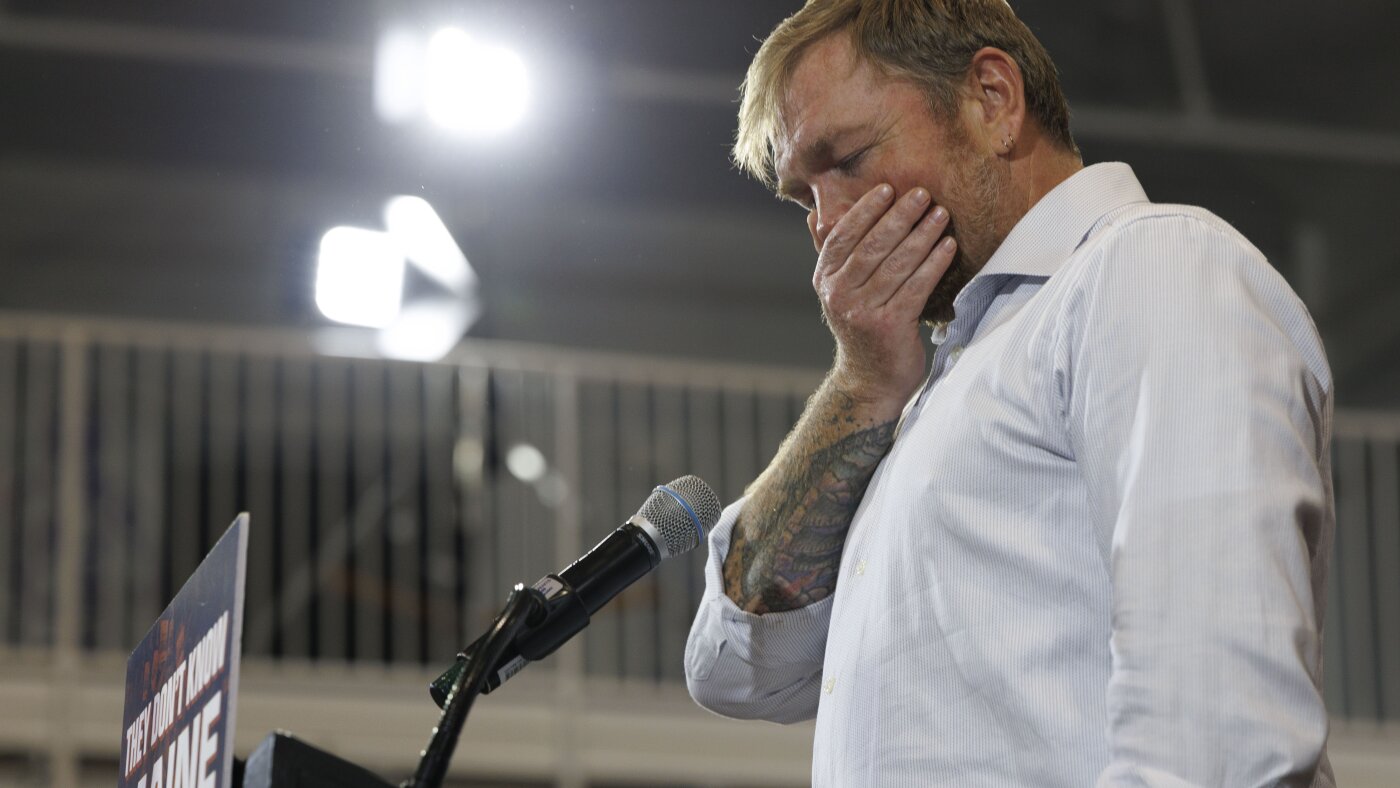
Now-former Democratic Senate candidate Graham Platner speaks at his primary election night event on June 9 in Blue Hill, Maine. Platner officially dropped out of the race July 10 following rape allegations from a former romantic partner that he denies.
CJ Gunther/Getty Images
hide caption
toggle caption
CJ Gunther/Getty Images
Graham Platner, Maine’s Democratic nominee for Senate, is officially out of the race.
The Maine Secretary of State said Platner filed the necessary paperwork to withdraw his candidacy two days after he announced he planned to do so following an accusation of rape by a former romantic partner. Platner denies the allegation.
The Maine Democratic Party has until July 27 to pick Platner’s replacement.
In his withdrawal notice, Platner said “people are desperate for change” and that’s why they voted “for a new kind of politics” by making him the Democratic nominee. He expressed gratitude for those who supported his campaign and said that he will continue to fight for “the movement we have built together and the future we believe in.”
He ended his notice with a strong statement aligned with the progressive platform.
“F*ck ICE. Free Palestine. Up the Hearts.”
Platner announced his plan to withdraw from the race in an 11-minute video he posted to social media on July 8. He said he had no choice but to suspend his campaign, citing it was no longer viable financially.
“We are going to lose our ability to fundraise. We are going to lose our ability to access voter data. We are going to lose all of the things that any campaign needs on the basic level simply to function,” he said.
Platner added that dropping out was not an admission of guilt. Rather, the decision, he said, is to keep the progressive movement in Maine alive to defeat Republican Sen. Susan Collins in November. Platner blamed the “political establishment” for his downfall and argued the goal was to force him out of the race.
“We built a campaign. We engaged in electoral politics. We motivated people. We banded together. We did it the way that we were told we are supposed to make change and we won. And now they are not going to let us have it. Not if it’s me,” he said.
Many powerful Democrats and progressives, including Sen. Bernie Sanders, an independent, urged Platner to step down.
Platner has had to answer to a waterfall of scandals since he launched his Senate bid. Despite those, he ran away with the nomination in the June 9 primary, securing more than 150,000 votes — more than any other Democratic Senate candidate in Maine’s history.
Platner ran on a progressive platform centered on affordability, universal health care and getting corporate money and influence out of politics. During his campaign, he generated an undeniable amount of enthusiasm, something the Maine Democratic Party will have to harness if it hopes to beat Collins in the general election.
Multiple people have already launched campaigns to replace Platner, including former state Sen. Troy Jackson and former CDC official Nirav Shah, who both ran unsuccessful bids for governor.
Platner called on the replacement process to reflect “the Mainers who on June 9 turned out and showed that they are desperate for a different kind of politics.”
“We were asking for real democracy, and we did it the right way. And we won. But now the ball is in the court of the Democratic establishment,” he added.
The Maine Democratic Party said that it intends to hold a new nominating convention where around 600 delegates will select Platner’s successor. Candidates have until July 15 to declare their intent to seek the nomination and gather signatures from at least 8 of Maine’s 16 counties. Party leadership added they will make the nomination process public and transparent.
-

 Alaska1 minute ago
Delegation Welcomes Corps Permit for King Cove Road
-

 Arizona6 minutes ago
2026 MLB Draft: Arizona likely to be minimally impacted after down season
-

 Arkansas13 minutes ago
ARKANSAS A-Z: Band formed by faculty members of what is now UCA | Arkansas Democrat Gazette
-
 California16 minutes ago
Disneyland turns to cheaper evening passes and the internet speculation explodes
-

 Colorado21 minutes ago
Colorado mountains could see near-record temperatures as heat dome develops over the West
-
Connecticut28 minutes ago
I moved from Connecticut to the South chasing a cheaper, simpler life. It wasn’t at all what I expected, so I moved back.
-

 Delaware29 minutes ago
New information on “sophisticated cybercriminal attack” against Delaware County
-

 Florida36 minutes ago
NW Florida authorities make two more arrests in murder case

