Connect with us

News

Hong Kong stocks outperform mainland China by most since 2008

Published

on

Hong Kong stocks outperform mainland China by most since 2008

Unlock the Editor’s Digest for free

Hong Kong shares have outperformed their mainland peers by the largest margin in nearly two decades, as money pours in from China due to worries about the domestic economy and enthusiasm for the territory’s technology stocks.

The benchmark Hang Seng index is up 16.4 per cent this year compared with a 1.2 per cent decline in mainland China’s CSI 300 index — the biggest outperformance year to date since 2008.

The rally has been boosted by the rise of DeepSeek, the Chinese start-up that claims artificial intelligence advances using far less computing power than US rivals, which has encouraged investor appetite for Hong Kong-listed technology stocks.

Advertisement

The territory’s stocks, which plummeted more sharply than mainland equities after US President Donald Trump’s “liberation day” tariff announcement in April, have also been helped by easing tensions in the US/China trade war.

The rally comes as money from mainland China flows into Hong Kong at record high levels.

“The majority of the strong outperformance this year from Hong Kong has been driven by southbound flows [from the mainland],” said James Wang, head of China equity strategy at UBS.

“A lot of that has been driven by the AI trade,” he added, pointing to the higher proportion of AI stocks in Hong Kong than the mainland.

Some content could not load. Check your internet connection or browser settings.

Advertisement

Hong Kong’s outperformance also “stems from fundamental differences in market composition”, said Wei Li, head of multi-asset investments for China at BNP Paribas.

“The Hang Seng index’s heavy weighting towards globally liquid sectors — such as technology and finance — has allowed it to capitalise on the Federal Reserve’s dovish pivot and renewed appetite for Chinese tech stocks.”

Chinese technology companies such as Tencent and Alibaba are listed in Hong Kong and the US but not on the mainland. Alibaba first became available to mainland investors in September after the company upgraded its listing in Hong Kong.

A meeting between Chinese President Xi Jinping and the country’s technology companies in February was also seen as positive for both mainland and Hong Kong stocks, but particularly for the latter.

“Investors feel the government is giving the green light for the tech sector to grow again,” said Tai Hui, chief Asia market strategist at JPMorgan Asset Management.

Advertisement

China’s economy has been hit hard by the collapse in the property market and the trade war with the US, which has helped Hong Kong’s outperformance.

“There has generally been concern about the domestic economy in China being weak,” said Andrew Tilton, chief Asia-Pacific economist and head of EM economic research at Goldman Sachs.

Some content could not load. Check your internet connection or browser settings.

Hong Kong is likely to benefit from any moves out of US equities into other markets and from further Fed rate cuts in the second half of the year, said JPMorgan’s Hui.

“Hong Kong is gathering capital both from Chinese investors and international investors” as it is easier for overseas investors to buy equities in the city than in mainland China, Hui added.

International money flowing into Hong Kong appears to be from shorter-term investors, such as hedge funds, rather than longer-term market participants such as pension funds, according to UBS’s Wang.

Advertisement

“I wouldn’t say there’s a huge influx of long-only money coming back into the China equity market just yet,” he added. “Investors have been burned for quite a long time in China.”

News

Peace plans ready to be presented to Russia in days, says Zelenskyy

Published

on

Peace plans ready to be presented to Russia in days, says Zelenskyy

Volodymyr Zelenskyy says proposals negotiated with US officials on a peace deal to end Russia’s war in Ukraine could be finalised within days, after which American envoys will present them to the Kremlin.

After two days of talks in Berlin, US officials said on Monday they had resolved “90%” of the problematic issues between Russia and Ukraine, but despite the positive spin it is not clear that an end to the war is any closer, particularly as the Russian side is absent from the current talks.

In the early hours of Tuesday morning the Ukrainian president said the US Congress was expected to vote on security guarantees and that he expected a finalised set of documents to be prepared “today or tomorrow”. After that, he said, the US would hold consultations with the Russians, followed by high-level meetings that could take place as soon as this weekend.

“We are counting on five documents. Some of them concern security guarantees: legally binding, that is, voted on and approved by the US Congress,” he said in comments to journalists via WhatsApp. He said the guarantees would “mirror article 5” of Nato.

On Monday, US officials declined to give specific details of what the security package was likely to include, and what would happen if Russia attempted to seize more land after a peace deal was reached. They did, however, confirm that the US did not plan to put boots on the ground in Ukraine.

Advertisement

Leaders of the UK, France, Germany and eight other European countries said in a joint statement that troops from a “coalition of the willing” could “assist in the regeneration of Ukraine’s forces, in securing Ukraine’s skies, and in supporting safer seas, including through operating inside Ukraine”.

They stopped short, however, of suggesting these would be guarantees that would match Nato’s article 5, and in any case there is little sign that Russia is anywhere close to agreeing to the kind of package under discussion between Washington and Kyiv.

On Tuesday, the Kremlin said it had not seen the details of proposals on security guarantees. “We have seen newspaper reports so far, but we will not respond to them. We have not seen any texts yet,” its spokesperson, Dmitry Peskov, told reporters.

Peskov added that Moscow, which has in the past demanded Kyiv cede territories Russia claims as its own and ruled out the presence of any foreign troops in Ukraine, had not changed its stance on the conflict and the achievement of its military goals.

“Our position is well known. It is consistent, it is transparent and it is clear to the Americans. And, in general, it is clear to the Ukrainians as well,” Peskov said.

Advertisement

Russia’s deputy foreign minister, Sergei Ryabkov, said Russia would not agree to troops from Nato countries operating in Ukraine “under any circumstances”. It was unclear whether that formulation also included troops drawn from Nato countries operating under a separate non-Nato command.

The German chancellor, Friedrich Merz, said on Monday that peace was closer than at any time since the beginning of Russia’s full-scale invasion. But privately, European officials say that at this stage the talks are more about keeping the Trump White House onboard with supporting Ukraine than about reaching a lasting deal between Moscow and Kyiv.

The main sticking point between the Ukrainian team and US negotiators remains the issue of land. Trump wants Ukraine to give up the parts of the Donbas region it still holds, while Ukraine wants to freeze the lines at the current point of contact. “We are discussing the territorial issue. You know it is one of the key issues. At this point, there is no consensus on it yet,” Zelenskyy said after the Berlin talks.

The US negotiation team, led by Steve Witkoff and Jared Kushner, has proposed a compromise solution whereby Ukraine would withdraw, but Russia would not advance and the demilitarised area would become “a free economic zone”. Russia has suggested that they could use police and national guard formations rather than the military, implying they would still expect to control the territory.

“I want to stress once again: a ‘free economic zone’ does not mean under the control of Russia. Neither de jure nor de facto will we recognise Donbas – its temporarily occupied part – as Russian. Absolutely,” said Zelenskyy.

Advertisement

It is not clear how the two sides will proceed on the territorial issue, with Zelenskyy previously suggesting that a compromise solution such as a free economic zone could be theoretically possible if the Ukrainian people voted for it in a referendum. The critical stumbling block is likely to be when the plans are put to the Russian president, Vladimir Putin, who has given no sign he is willing to compromise on his war aims.

“If Putin rejects everything, we will end up with exactly what we are experiencing on our plane right now – turbulence,” said Zelenskyy, recording the comments after his plane took off from Berlin for the Netherlands for a series of meetings on Tuesday.

“I believe the United States will apply sanctions pressure and provide us with more weapons if he rejects everything. I think that would be a fair request from us to the Americans,” he said.

Continue Reading

News

Video: Brown Student Has Survived Two School Shootings

Published

on

Video: Brown Student Has Survived Two School Shootings

new video loaded: Brown Student Has Survived Two School Shootings

transcript

transcript

Brown Student Has Survived Two School Shootings

Mia Tretta, a Brown student, survived a deadly shooting at her high school in 2019 and another attack on Saturday. As the authorities search for the gunman in the latest attack, she is coping with trauma again.

“The F.B.I. is now offering a reward of $50,000 for information that can lead to the identification, the arrest and the conviction of the individual responsible, who we believe to be armed and dangerous.” “It was terrifying and confusing, and there was so much misinformation, generally speaking, that I think everyone on Brown’s campus didn’t know what to do. This shooting does still impact my daily life, but here at Brown I felt safer than I did other places. And it felt like of course it won’t happen again. You know, it already did. But here we are. And it’s because of years, if not decades, of inaction that this has happened. Unfortunately, gun violence doesn’t — it doesn’t care whether you’ve been shot before.” “It is going to be hard for my city to feel safe going forward. This has shaken us.”

Advertisement
Mia Tretta, a Brown student, survived a deadly shooting at her high school in 2019 and another attack on Saturday. As the authorities search for the gunman in the latest attack, she is coping with trauma again.

By Jamie Leventhal and Daniel Fetherston

December 15, 2025

Continue Reading

News

Australia announces strict new gun laws. Here’s how it can act so swiftly

Published

on

Australia announces strict new gun laws. Here’s how it can act so swiftly

Mourners gather at the Bondi Pavilion as people pay tribute to the victims of a mass shooting at Bondi Beach.

Izhar Khan/Getty Images


hide caption

toggle caption

Advertisement

Izhar Khan/Getty Images

At least 15 people were killed at a beach in Sydney, Australia, on Sunday when a father and son opened fire on a crowd celebrating the beginning of Hanukkah. At least 42 people were hospitalized.

Prime Minister Anthony Albanese described the shooting as a “terrorist incident” targeting Jewish Australians.

Mass shootings are rare in Australia, which has historically strict gun laws. But Sunday’s deadly massacre has prompted Albanese and other Australian officials to revisit those laws and call for further restrictions to prevent more mass shootings in the future.

Advertisement

Here’s what Australian officials are proposing, and why the country’s politics and culture might allow for it.

Australia already has strict gun laws

The origin of Australia’s notoriously strict gun laws dates back to 1996, when a gunman killed 35 people in an attack in Tasmania.

The April 28 mass shooting came to be known as the Port Arthur massacre, and almost immediately the bloodshed prompted Australia’s political leaders to unite behind an effort to tighten the country’s gun laws. That effort was led by conservative prime minister John Howard.

The result was the National Firearms Agreement, which restricted the sale of semi-automatic rifles and pump-action shotguns and established a national buyback program that resulted in the surrender of more than 650,000 guns, according to the National Museum of Australia. Importantly, it also unified Australia’s previously disjointed firearms laws — which had differed among the states and territories before 1996 — into a national scheme, according to the museum.

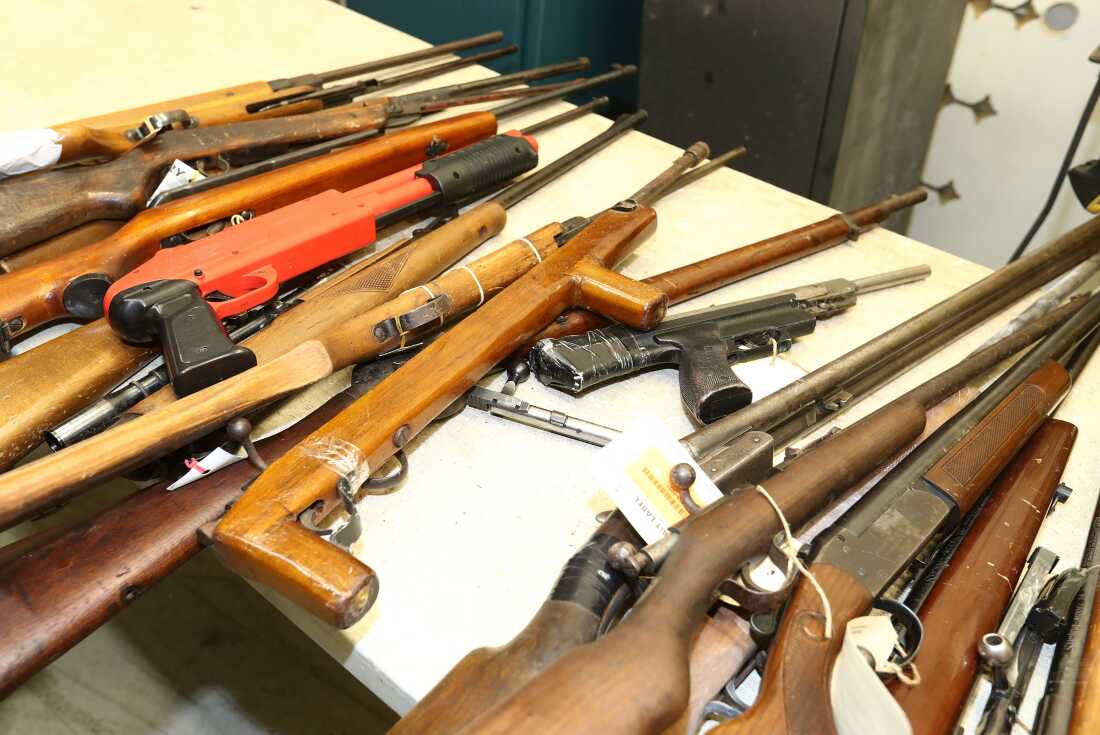
Guns handed into Victoria Police in Australia in 2017 as part of a round of weapons amnesty.

Guns handed into Victoria Police in Australia in 2017 as part of a round of weapons amnesty.

Robert Cianflone/Getty Images

Advertisement


hide caption

toggle caption

Robert Cianflone/Getty Images

Advertisement

The agreement has been cited internationally, including by the likes of former President Barack Obama, as a model for greater gun control and is credited with dramatically reducing firearms deaths in Australia. The country had zero mass shootings in the more than two decades that followed the agreement, one paper found.

Albanese said in a press conference Monday that the “Howard government’s gun laws have made an enormous difference in Australia and are a proud moment of reform, quite rightly, achieved across the parliament with bipartisan support.”

But Australian firearm ownership has been on the rise again in recent years. The public policy research group The Australia Institute wrote in a January report that there were more than 4 million guns in the country, which is 25% higher than the number of firearms there in 1996. Certain provisions of the National Firearms Agreement have been inconsistently implemented and in some cases “watered down,” the group said.

Graham Park, president of Shooters Union Australia, told supporters in a member update over the summer that Australian firearms owners are “actually winning,” The Guardian reported.

What the proposed gun measures will do

The prime minister and regional Australian leaders agreed in a meeting on Monday to work toward even stronger gun measures in response to Sunday’s shooting. Here’s what they include:

Advertisement
  • Renegotiate the National Firearms Agreement, which was enacted in 1996 and established Australia’s restrictive gun laws.
  • Speed up the establishment of the National Firearms Register, an idea devised by the National Cabinet in 2023 to create a countrywide database of firearms owners and licenses.
  • Use more “criminal intelligence” in the firearms licensing process. 
  • Limit the number of guns one person can own. 
  • Limit the types of guns and modifications that are legal.
  • Only Australian citizens can hold a firearms license. 
  • Introduce further customs restrictions on guns and related equipment. The Australian government could limit imports of items involving 3D printing or accessories that hold large amounts of ammunition.

Albanese and the regional leaders also reaffirmed their commitment to Australia’s national firearms amnesty program, which lets people turn in unregistered firearms without legal penalties.

While not specifically referenced by the National Cabinet, some of the proposals address details related to Sunday’s shooting.

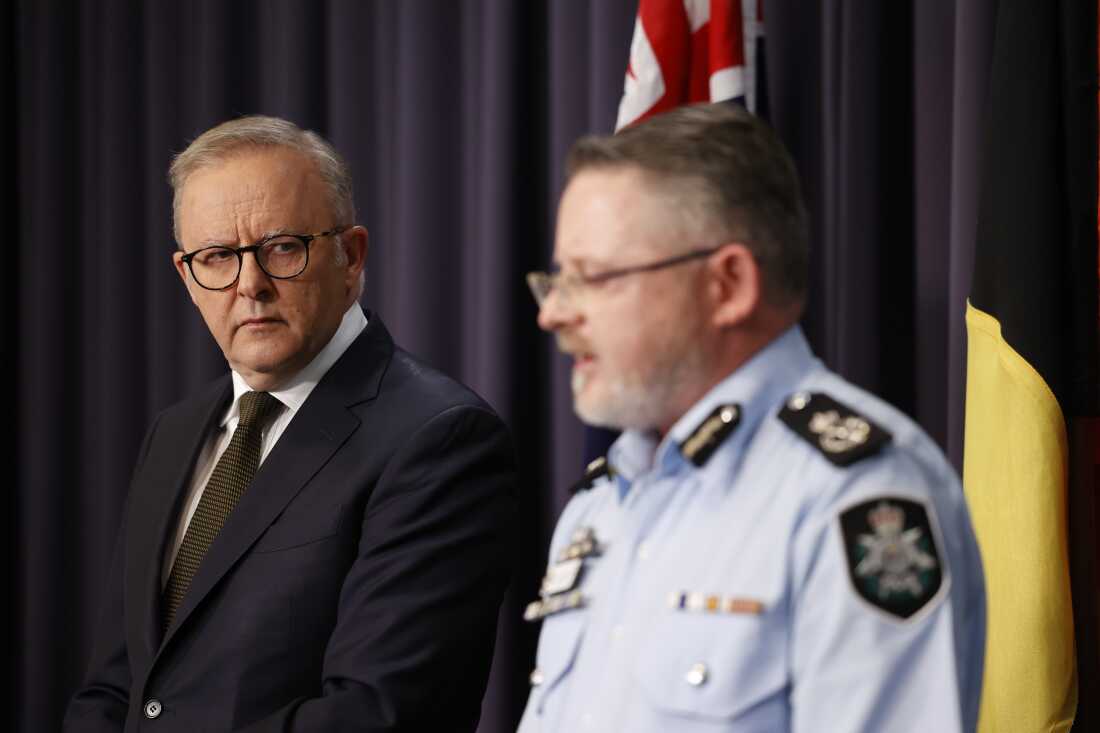
Australia's prime minister, Anthony Albanese, (left) at Parliament House with AFP Acting Deputy Commissioner for National Security Nigel Ryan speak after the Bondi Beach shooting.

Australia’s prime minister, Anthony Albanese, (left) at Parliament House with AFP Acting Deputy Commissioner for National Security Nigel Ryan speak after the Bondi Beach shooting.

Hilary Wardhaugh/Getty Images


hide caption

toggle caption

Advertisement

Hilary Wardhaugh/Getty Images

Albanese said Monday the son came to the attention of the Australian Security Intelligence Organisation in 2019. ABC Australia reported that he was examined for his close ties to an Islamic State terrorism cell based in Sydney.

Minister for Home Affairs Tony Burke said the son is an Australian-born citizen. Burke added that the father arrived in Australia on a student visa in 1998, which was transferred to a partner visa in 2001. He was most recently on a “resident return” visa.

How Australia’s political system enables swift legal changes

Part of the reason Australia’s government can act so quickly on political matters of national importance is because of something called the National Cabinet.

Advertisement

The National Cabinet is composed of the prime minister and the premiers and chief ministers of Australia’s six states and two territories.

It was first established in early 2020 as a way for Australia to coordinate its national response to the COVID-19 pandemic. Since then, the group has convened to discuss a number of national issues, from a rise in antisemitic hate crimes to proposed age restrictions on social media use.

The National Cabinet doesn’t make laws, but its members attempt to agree on a set of strategies or priorities and work with their respective parliaments to put them into practice.

Australians wanted stronger gun laws even before Sunday

Gun control efforts in Australia inevitably draw comparisons to the U.S., where the Second Amendment dominates any discussion about firearms restrictions.

John Howard, the prime minister during the Port Arthur massacre, said in a 2016 interview with ABC Australia that observing American culture led him to conclude that “the ready availability of guns inevitably led to massacres.” He added: “It just seemed that at some point Australia ought to try and do something so as not to go down the American path.”

Advertisement

In fact, the National Firearms Agreement avows that gun ownership and use is “a privilege that is conditional on the overriding need to ensure public safety.”

Robust gun laws remain popular among Australians today. A January poll by The Australia Institute found that 64% of Australians think the country’s gun laws should be strengthened, while just 6% believe they should be rolled back. That is in a country where compulsory voting means that politics “generally gravitates to the centre inhibiting the trend towards polarisation and grievance politics so powerfully evident in other parts of the globe,” Monash University politics professor Paul Strangio wrote last year.

Now, there are renewed calls to further harden Australia’s gun laws in the wake of Sunday’s deadly shooting.

“After Port Arthur, Australia made a collective commitment to put community safety first, and that commitment remains as important today as ever,” Walter Mikac said in a statement on Monday.

Mikac is founding patron of the Alannah & Madeline Foundation, which is named for his two daughters who were killed in the 1996 shooting. His wife, Nanette, was also killed.

Advertisement

“This is a horrific reminder of the need to stay vigilant against violence, and of the importance of ensuring our gun laws continue to protect the safety of all Australians,” Mikac added.

Continue Reading

Trending