News
Hawaii's high court cites 'The Wire' in its ruling on gun rights


People walk past a gun club on June, 23, 2022, in Honolulu. A ruling by Hawaii’s high court saying that a man can be prosecuted for carrying a gun in public without a permit uses pop culture references in an apparent rebuke of a U.S. Supreme Court decision that expanded gun rights nationwide.
Marco Garcia/AP
hide caption
toggle caption
Marco Garcia/AP

People walk past a gun club on June, 23, 2022, in Honolulu. A ruling by Hawaii’s high court saying that a man can be prosecuted for carrying a gun in public without a permit uses pop culture references in an apparent rebuke of a U.S. Supreme Court decision that expanded gun rights nationwide.
Marco Garcia/AP
HONOLULU — A ruling by Hawaii’s high court saying that a man can be prosecuted for carrying a gun in public without a permit cites crime-drama TV series “The Wire” and invokes the “spirit of Aloha” in an apparent rebuke of a U.S. Supreme Court decision that expanded gun rights nationwide.
“The thing about the old days, they the old days,” the unanimous Hawaii Supreme Court ruling issued Wednesday said, borrowing a quote from season four, episode three of the HBO series to express that the culture from the founding of the country shouldn’t dictate contemporary life.
Authored by Justice Todd Eddins, the opinion goes on to say, “The spirit of Aloha clashes with a federally-mandated lifestyle that lets citizens walk around with deadly weapons during day-to-day activities. “
The ruling stems from a 2017 case against Christopher Wilson, who had a loaded pistol in his front waistband when police were called after a Maui landowner reported seeing a group of men on his property at night.
The handgun was unregistered in Hawaii, and Wilson had not obtained or applied for a permit to own the gun, the ruling said. Wilson told police he legally bought the gun in Florida in 2013.
Wilson’s first motion to dismiss the charges argued that prosecuting him for possession of a firearm for self-defense violated his right to bear arms under the Second Amendment of the U.S. Constitution. It was denied.
Then in 2022, a U.S. Supreme Court decision known as New York State Rifle & Pistol Association v. Bruen upended gun laws nationwide, including in Hawaii, which has long had some of the strictest gun laws in the country — and some of the lowest rates of gun violence.
Just as the Bruen decision came out, Wilson filed a second motion to dismiss the case. A judge granted the dismissal, and the state appealed.
Handguns are displayed at a gun shop on June 23, 2022, in Honolulu. A ruling by Hawaii’s high court saying that a man can be prosecuted for carrying a gun in public without a permit uses pop culture references in an apparent rebuke of a U.S. Supreme Court decision that expanded gun rights nationwide.
Marco Garcia/AP
hide caption
toggle caption
Marco Garcia/AP
Handguns are displayed at a gun shop on June 23, 2022, in Honolulu. A ruling by Hawaii’s high court saying that a man can be prosecuted for carrying a gun in public without a permit uses pop culture references in an apparent rebuke of a U.S. Supreme Court decision that expanded gun rights nationwide.
Marco Garcia/AP
Ben Lowenthal of the Hawaii public defender’s office, Wilson’s attorney, said Thursday his office is “taking stock of our options,” including seeking review from the U.S. Supreme Court.
Wilson denied trespassing and said he and his friends “were hiking that night to look at the moon and Native Hawaiian plants,” according to the recent ruling.
Hawaii Attorney General Anne Lopez hailed the ruling as a “landmark decision that affirms the constitutionality of crucial gun-safety legislation.”
The ruling reflects a “culture in Hawaii that’s very resistant to change” and a judiciary and government that has been “recalcitrant” in accepting Bruen, said Alan Beck, an attorney not involved in the Wilson case.
“The use of pop culture references to attempt to rebuke the Supreme Court’s detailed historical analysis is evidence this is not a well-reasoned opinion,” said Beck, who has challenged Hawaii’s gun restrictions.
Beck represents three Maui residents who are challenging a Hawaii law enacted last year that prohibits carrying a firearm on the beach and in other places, including banks, bars and restaurants that serve alcohol.
A federal judge in Honolulu granted a preliminary injunction, which prevents the state from enforcing the law. The state appealed, and oral arguments are scheduled for April before the 9th U.S. Circuit Court of Appeals.
Bruen set a new standard for interpreting gun laws, such that modern firearm laws must be consistent with the nation’s historical tradition of firearm regulation.
“We believe it is a misplaced view to think that today’s public safety laws must look like laws passed long ago,” Eddins, of the Hawaii high court, wrote. “Smoothbore, muzzle-loaded, and powder-and-ramrod muskets were not exactly useful to colonial era mass murderers. And life is a bit different now, in a nation with a lot more people, stretching to islands in the Pacific Ocean.”
The Bruen ruling “snubs federalism principles,” Eddins wrote, asserting that under Hawaii’s constitution, there is no individual right to carry a firearm in public.
Dating back to the 1800s, when Hawaii was a kingdom, weapons were heavily regulated, Eddins wrote. He noted that in 1833 King Kamehameha III “promulgated a law prohibiting ‘any person or persons’ on shore from possessing a weapon, including any ‘knife, sword-cane, or any other dangerous weapon.’”



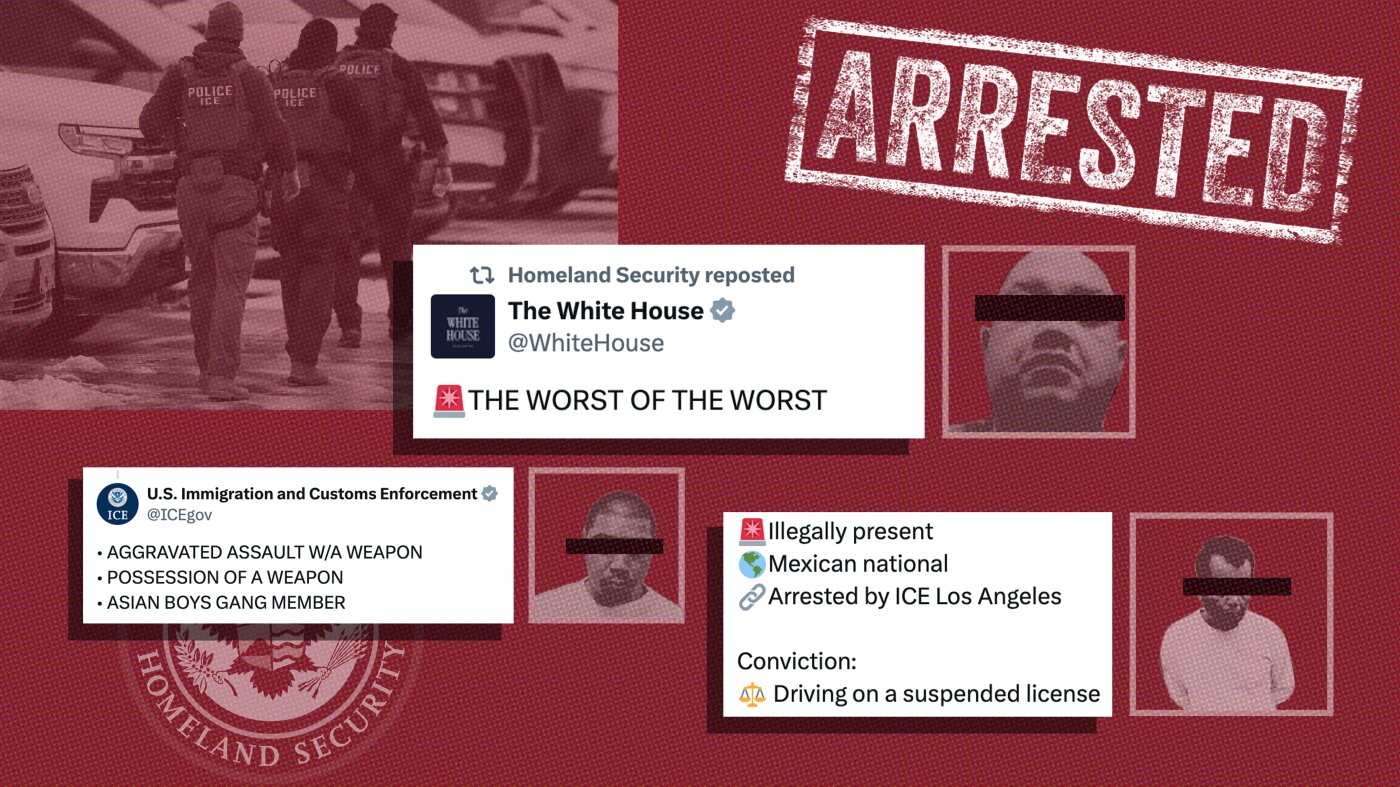
Getty Images, Dept. of Homeland Security and The White House via X/Collage by Emily Bogle/NPR
Two days after At Chandee, who goes by Ricky, was arrested by U.S. Immigration and Customs Enforcement, the White House’s X account posted about him, calling the 52-year-old the “WORST OF WORST” and a “CRIMINAL ILLEGAL ALIEN.”
Except that the photo the White House posted was of a different person. The post also incorrectly claimed Chandee had multiple felony convictions — he has one, for second-degree assault in 1993 when he was 18 years old. He shot two people in the legs and served three years in prison.

At “Ricky” Chandee with his wife, Tina Huynh-Chandee.
Via the Chandee family
hide caption
toggle caption
Via the Chandee family
Chandee, who came to the U.S. as a child refugee, was ordered to be deported back to his home country, Laos. But Laos had not been accepting all of the people the U.S. wanted it to, so the federal government determined that it was likely infeasible to deport him, his lawyer Linus Chan told NPR. Chandee therefore was granted permission to stay in the U.S. and work so long as he checked in with immigration authorities periodically. He has not missed a check-in in over 30 years and has not had another criminal incident.
People who know Chandee do not see him as “worst of the worst.”
After Chandee completed his prison sentence, he finished school and became an engineering technician. He worked for the City of Minneapolis for 26 years, became a father, and his son grew up to join the military.
In his free time, Chandee enjoys hiking and foraging for mushrooms, Minnesota Public Radio reported.
“We are proud to work alongside At ‘Ricky’ Chandee,” said Tim Sexton, Director of Public Works for the City of Minneapolis in a statement. “I don’t understand why he would be a target for removal now, why he was brutally detained and swiftly flown to Texas, or how his removal benefits our city or country.” Chandee is petitioning for his release in federal court.
Chandee’s case is not unique
Social media accounts from the White House, the Department of Homeland Security and other immigration agencies have spent much of the past year posting about people detained in the administration’s immigration crackdown, typically portraying them as hardened, violent criminals. That’s even as over 70% of the people detained don’t have criminal records according to ICE data.
NPR’s research of cases in Minnesota shows that while many of the people who have been highlighted on social media do have recent, serious criminal records, about a quarter are like Chandee, with decades-old convictions, minor offenses or only pending criminal proceedings. Scholars of immigration, media and criminal law say such a media campaign is unprecedented and paints a distorted picture of immigrants and crime.
A year into President Trump’s second term, the X accounts of DHS and ICE have posted about more than 2,000 people who were targets of mass deportation efforts. Starting late last March, DHS and ICE began posting on X on a near daily basis, often highlighting apprehensions of multiple people a day, an NPR review of government social media posts show.
Among the 2,000 people highlighted by the agencies, NPR identified 130 who were arrested by federal agents in Minnesota and tried to verify the government’s statements about their criminal histories.
In most of the social media posts, the government did not provide the state where the conviction occurred or the person’s age. Public court records do not tend to include photos so definitive identification can be a challenge.
NPR derived its findings from cases where it was able to locate a name and matching criminal history in the Minnesota court and detention system, in nationwide criminal history databases, sex offender databases, and in some cases, federal courts and other state courts.
In 19 of the 130 cases, roughly 1-in-7, public records show the most recent convictions were at least 20 years ago.
Seventeen of the 19 cases with old convictions did include violent crimes like homicide and first-degree sexual assault. ICE provided some of those names to Fox News as key examples of the agency’s accomplishments. “It’s the most disturbing list I’ve ever seen,” said Fox News reporter Bill Melugin on X, highlighting the criminal convictions of each person on the list.
For seven people, their only criminal history involved driving under the influence or disorderly conduct.

ICE agents approach a house before detaining two people in Minneapolis on Jan. 13.
Stephen Maturen/Getty Images
hide caption
toggle caption
Stephen Maturen/Getty Images
Six of the 130 Minnesota cases highlighted by the administration involved people with no criminal convictions. The government’s social media posts for those six instead rely upon the charges and arrests as evidence of their criminality, even though arrests don’t always lead to charges and charges can be dismissed.
In yet another case, the government highlighted a criminal charge even while noting it had been dismissed. (The person did have other existing convictions.)
For 37 of the 130 people, NPR was unable to confirm matching criminal history after consulting the databases and news coverage. Some of the names turned up no criminal history at all. The government said these people committed crimes ranging from homicide and assault to drug trafficking, and cited one by name to Fox News. NPR tried to reach out to all 37 people and their families for comment but did not receive a response from any.
In a statement to NPR, DHS’s chief spokesperson Lauren Bis did not dispute NPR’s findings or provide documentation where NPR wasn’t able to confirm matching criminal history.
“The fact that NPR is defending murderers and pedophiles is gross,” Bis wrote. “We hear far too much about criminals and not enough about their victims.” before listing four of the people with old convictions of homicide and sexual assault, underlining the date of deportation order for three of them.
Images designed to trigger emotion
The stream of social media posts with photos of mostly nonwhite people are meant to draw an emotional response, says Leo Chavez, an emeritus professor of anthropology at the University of California, Irvine. They “have been used repeatedly over and over to get people to buy into, really drastic, drastic and draconian actions and policies,” he said.
Chavez, whose most recent book is The Latino Threat: How Alarmist Rhetoric Misrepresents Immigrants, Citizens, and the Nation, recalls how political campaigns in past decades presented images of Latinos — often men — without context. “Just by showing their image, showing brown people, particularly brown men, it’s supposed to be scary.”
The fact that the government’s social media posts come with statements about criminal history as well as photos reinforces that emotional response, Chavez said. DHS has previously acknowledged inaccuracies on their website. But even if the department issues corrections, Chavez said, “the goal was actually achieved, which was to reinforce the criminality and the visualization.”
CNN’s analysis of DHS’s “Arrested: Worst of the Worst” website showed that for hundreds out of about 25,000 people posted on the website, the crimes listed were not violent felonies. Instead, DHS listed people with records that included traffic offenses, marijuana possession or illegal reentry. DHS said the website had a “glitch” that it will fix but also that the people in question “have [committed] additional crimes.”
“I’ve never seen anything like this when it comes to immigration enforcement in the modern era,” said Juliet Stumpf, a professor at Lewis & Clark Law School who studies the intersection of immigration and criminal law. She said the drumbeat of social media posts focused on specific individuals was like “FBI’s most wanted posters” or “like reality TV shows.”
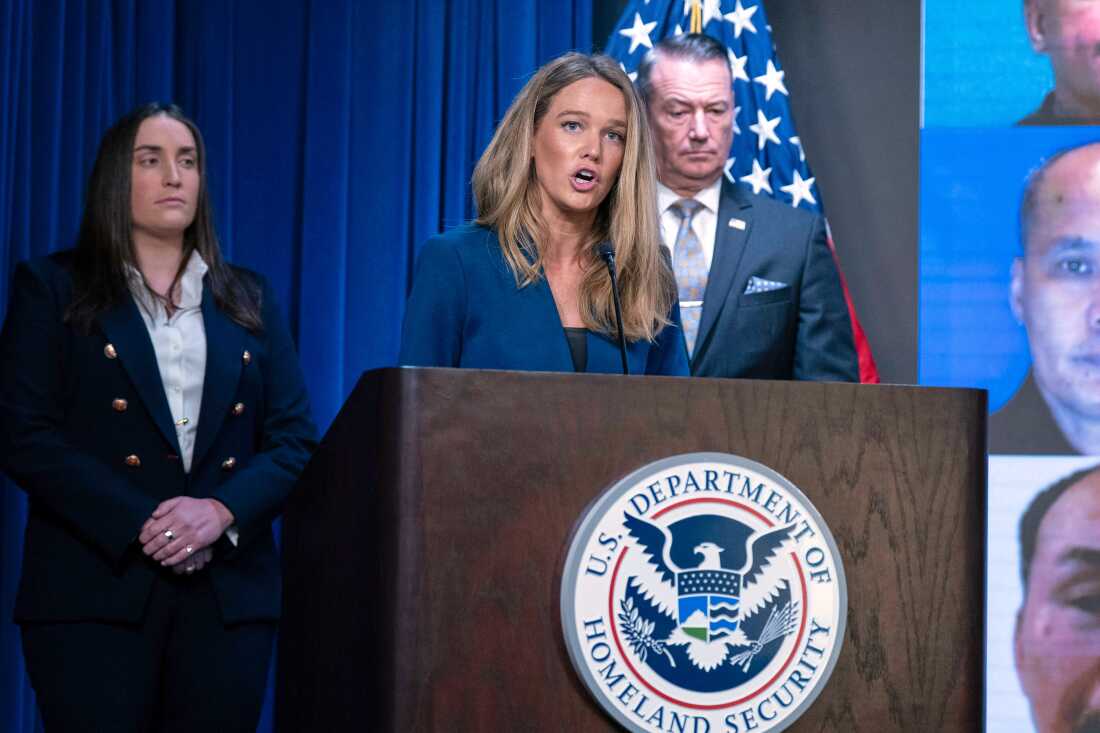
Then-DHS Assistant Secretary for Public Affairs Tricia McLaughlin, flanked by deputy director of U.S. Immigration and Customs Enforcement Madison Sheahan (left), and Acting director of U.S. Immigration and Customs Enforcement Todd Lyons, speaks during a news conference at ICE Headquarters, in Washington, D.C., on May 21, 2025.
Jose Luis Magana/AP
hide caption
toggle caption
Jose Luis Magana/AP
Stumpf drew a parallel with an incident from the 1950s when the U.S. government deported two permanent residents suspected of being communists. “The government was kind of proclaiming and celebrating their deportation because getting rid of these communists was making the country safer,” said Stumpf, “Maybe that’s comparable to something like [this].”
An analysis by the Deportation Data Project shows a dramatic increase in arrests of noncitizens without criminal records during President Trump’s current term compared to President Biden’s term.
“If you look at research, immigrants actually tend to commit fewer crimes than even U.S. citizens do. And that’s true of immigrants who have lawful status here and immigrants who don’t,” said Stumpf. “If we have a number of social media posts that are painting immigrants as the worst of the worst…it’s actually really putting out a distorted version of reality about who immigrants actually are.”
Some claims are disputed by other authorities
In some posts, DHS and ICE have also used photos of people and statements about their criminal histories to burnish the federal government’s accomplishments, defend their agents and criticize states like Minnesota. State and local authorities have in turn pushed back, and some of the federal government’s claims about the people it has detained have been met with setbacks in the courts.
DHS accused Minnesota’s Cottonwood County of not honoring detainers, written requests by ICE to hold prisoners in custody for a period of time so ICE can pick them up. In one post, the agency identified a person who was charged with child sexual abuse, writing “This is who sanctuary city politicians and anti-ICE agitators are defending.”
The Cottonwood County sheriff’s office said DHS’s post “misrepresented the truth” in their own post on Facebook. According to their account, the county did honor the detainer but ICE said it was unable to pick up the person before the order expired and the county had to release the suspect.
The Minnesota Department of Corrections wrote in a blog post that dozens of people DHS listed on its “Worst of the Worst” website were not arrested as DHS described, but were transferred to ICE by the state because they were already in state custody. The Corrections Department has since launched a page dedicated to “correct the Department of Homeland Security’s (DHS) repeated false claims.”
The “Worst of the Worst” website has some overlap with the department’s social media posts, but it contains a much larger number of people — over 30,000 nationally. It included a Colombian soccer star who was extradited to the U.S., tried in Texas, convicted of drug trafficking and served time in federal prison. The website incorrectly describes him as being arrested in Wisconsin. The soccer player, Jhon Viáfara Mina, recently finished his sentence early and returned to Colombia, according to Spanish newspaper El Diario Vasco.
In some instances, DHS and ICE wrote about incidents where they ran into conflict when carrying out arrests. In those posts, they named the arrestees and posted their photos. But in one case where the incident went to court, the government’s account of the events shifted. After a federal agent shot Julio C. Sosa-Celis in Minneapolis in January, DHS claimed he was lodging a “violent attack on law enforcement.” Assault charges against Sosa-Celis fell apart in court as new evidence surfaced, and the officers involved were put on leave.
Despite the fact that the charges were dropped, DHS’s post profiling Sosa-Celis remains online.

Former president Bill Clinton is scheduled to give deposition Friday to a congressional committee investigating his links to Jeffrey Epstein, one day after Hillary Clinton testified before the committee and called the proceedings “partisan political theatre” and “an insult to the American people”.
During remarks before the House oversight committee, Hillary Clinton, the former secretary of state, insisted on Thursday that she had never met Epstein.
The former Democratic president, however, flew on Epstein’s private jet several times in the early 2000s but said he never visited his island.
Clinton, who engaged in an extramarital affair while president and has been accused of sexual misconduct by three women, also appears in a photo from the recently released files, in a hot tub with Epstein and a woman whose identity is redacted.
Clinton has denied the sexual misconduct claims and was not charged with any crimes. He also has not been accused of any wrongdoing connected to Epstein.
Epstein visited the White House at least 17 times during the early years of Clinton’s presidency, according to White House visitor records cited in news reports. Clinton said he cut ties with him around 2005, before the disgraced financier, who died from suicide in 2019, pleaded guilty to solicitation of a minor in Florida.
The House committee subpoenaed the Clintons in August. They initially refused to testify but agreed after Republicans threatened to hold them in contempt.
The Clintons asked for their depositions to be held publicly, with the former president stating that to do so behind closed doors would amount to a “kangaroo court”.
“Let’s stop the games + do this the right way: in a public hearing,” Clinton said on X earlier this month.
The committee’s chair, James Comer, did not grant their request, and the proceedings will be conducted behind closed doors with video to be released later.
On Thursday, Hillary Clinton’s proceedings were briefly halted after representative Lauren Boebert leaked an image of Clinton testifying.
During the full day deposition, Clinton said she had no information about Epstein and did not recall ever meeting him.
Before the deposition, Comer said it would be a long interview and that one with Bill Clinton would be “even longer”.

CASE 0:26-cv-00107-PJS-DLM
Doc. 12-1 Filed 02/26/26
Page 5 of 17
and to file a status update by 11:00 am on January 20. ECF No. 5. Respondents never provided a bond hearing and did not release Petitioner until January 21, ECF Nos. 10, 12, after failing to file an update, ECF No. 9. Further, Respondents released Petitioner subject to conditions despite the Court’s release order not providing for conditions. ECF Nos. 5, 12–13.
Abdi W. v. Trump, et al., Case No. 26-CV-00208 (KMM/SGE)
On January 21, 2026, the Court ordered Respondents, within 3 days, to either (a) complete Petitioner’s inspection and examination and file a notice confirming completion, or (b) release Petitioner immediately in Minnesota and confirm the date, time, and location of release. ECF No. 7. No notice was ever filed. The Court emailed counsel on January 27, 2026, at 10:39 am. No response was provided.
Adriana M.Y.M. v. David Easterwood, et al., Case No. 26-CV-213 (JWB/JFD)
On January 24, 2026, the Court ordered immediate release in Minnesota and ordered Respondents to confirm the time, date, and location of release, or anticipated release, within 48 hours. ECF No. 12. Respondent was not released until January 30, and Respondents never disclosed the time of release, instead describing it as “early this morning.” ECF No. 16.
Estefany J.S. v. Bondi, Case No. 26-CV-216 (JWB/SGE)
On January 13, 2026, at 10:59 am, the Court ordered Respondents to file a letter by 4:00 pm confirming Petitioner’s current location. ECF No. 8. After receiving no response, the Court ordered Respondents, at 5:11 pm, to immediately confirm Petitioner’s location and, by noon on January 14, file a memorandum explaining their failure to comply with the initial order. ECF No. 9. Respondents did not file the memorandum, requiring the Court to issue another order. ECF No. 12. On January 15, the Court ordered immediate release in Minnesota and required Respondents to confirm the time, date, and location of release within 48 hours. ECF No. 18. On January 20, having received no confirmation, the Court ordered Respondents to comply immediately. ECF No. 21. Respondents informed the Court that Petitioner was released in Minnesota on January 17, but did not specify the time. ECF No. 22.
5

Couple sentenced for selling faulty fire extinguishers to Mississippi daycares, businesses – SuperTalk Mississippi
Missouri Lottery Mega Millions, Pick 3 winning numbers for Feb. 27, 2026

Montana cowboys help build trauma ranch for Israeli soldiers

How to Watch No. 12 Nebraska Basketball at USC with Preview, Breakdown, TV Channel

Nye County Sheriff urges caution after deadly month on rural Nevada roads

Florida High School Football Rankings: Top 25 teams – Oct. 21

Cleary's 21 help Le Moyne down Central Connecticut State 69-64 in OT

How old is Bo Nix? What to know about Oregon quarterback ahead of 2024 NFL Draft

99th annual Pony Swim held in Virginia

Indiana Members Credit Union announced as new anchor tenant at Bottleworks District

ICE blasts Washington mayor over directive restricting immigration enforcement

Did the EU bypass Hungary’s veto on Ukraine’s €90 billion loan?
How the federal government is painting immigrants as criminals on social media

Where Iran’s ballistic missiles can reach — and how close they are to the US

Has India’s influence in Afghanistan grown under the Taliban?
-

 World2 days ago
Exclusive: DeepSeek withholds latest AI model from US chipmakers including Nvidia, sources say
-

 Massachusetts3 days ago
Mother and daughter injured in Taunton house explosion
-

 Montana1 week ago
2026 MHSA Montana Wrestling State Championship Brackets And Results – FloWrestling
-

 Louisiana5 days ago
Wildfire near Gum Swamp Road in Livingston Parish now under control; more than 200 acres burned
-

 Denver, CO2 days ago
10 acres charred, 5 injured in Thornton grass fire, evacuation orders lifted
-

 Technology7 days ago
YouTube TV billing scam emails are hitting inboxes
-

 Technology7 days ago
Stellantis is in a crisis of its own making
-

 Politics7 days ago
OpenAI didn’t contact police despite employees flagging mass shooter’s concerning chatbot interactions: REPORT