News
'Golden Dome' Missile Shield To Be 1st US Weapon In Space. All About It


Washington:
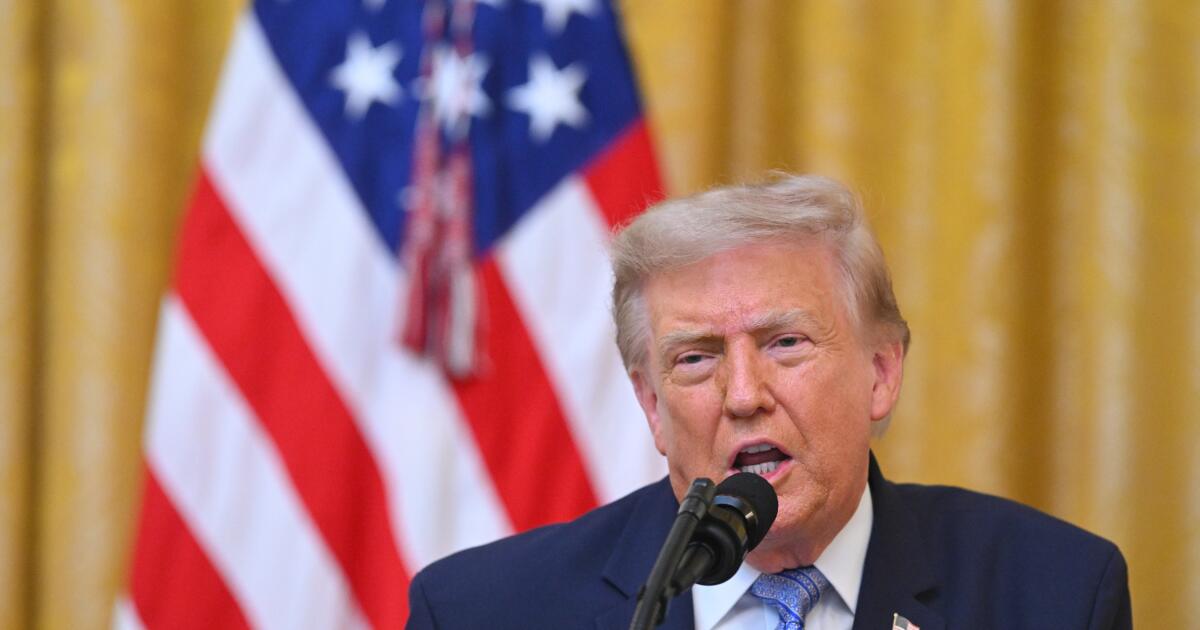
United States President Donald Trump on Tuesday unveiled new details on his plan for a missile defence system known as “Golden Dome”, which is estimated to cost a total of some $175 billion. The “Golden Dome” will be the first weapon the US puts in space, and it should be operational in about three years, by the end of his time in office, the President said.
Trump said his team has officially finalised the architecture of the futuristic defence system that he announced just days after returning to the White House in January. At the time, the Republican said the system would be aimed at countering “next-generation” aerial threats to the US, including ballistic and cruise missiles.
“In the campaign, I promised the American people I would build a cutting-edge missile defence shield…Today, I am pleased to announce we have officially selected architecture for this state-of-the-art system,” Trump said at the White House.
What Is The Golden Dome System?
The Golden Dome will be a ground- and space-based missile shield system that will detect, track and stop missiles at multiple stages of flight, potentially destroying them before takeoff or intercepting them in mid-air. Calling the new system “very important for the success and even survival” of the United States, Trump said that once fully constructed, it will be capable of intercepting missiles even if they are launched from other sides of the world, and even if they are launched from space.
Golden Dome has more expansive goals, with Trump saying it “will deploy next-generation technologies across the land, sea and space, including space-based sensors and interceptors.”
Pentagon chief Pete Hegseth, speaking alongside Trump, said the design for the Golden Dome will integrate with existing ground-based defence capabilities and is aimed at protecting “the homeland from cruise missiles, ballistic missiles, hypersonic missiles, drones, whether they’re conventional or nuclear.”
How Much Will It Cost?
The system will cost over $500 billion, according to estimates from the Congressional Budget Office. However, Trump has, so far, announced $25 billion in initial funding for the plan, which he said could eventually cost a total of some $175 billion.
When Will It Be Completed?
Trump said the system will be operational in about three years, by the end of his time in office. However, Forbes reported that the cost of the project will be absorbed over 20 years.
Who Will Lead The Project?
Trump said US Space Force General Michael Guetlein will lead the effort. A four-star general, Guetlein had a 30-year career in the Air Force before he joined the Space Force in 2021. He reportedly specialises in missile defence and space systems.
Countries Covered Under the Golden Globe
The System is meant to protect the United States from all kinds of missile or drone attacks, but Trump said that Canada has expressed interest in being part of it as “they want to have protection also.”
Idea Behind The Golden Globe
The plan’s Golden Dome name stems from Israel’s Iron Dome air defence system that has intercepted thousands of short-range rockets and other projectiles since it went into operation in 2011. The United States faces various missile threats from adversaries, but they differ significantly from the short-range weapons that Israel’s Iron Dome is designed to counter.
The 2022 Missile Defence Review pointed to growing threats from Russia and China.
Who Opposes The Plan?
Russia and China earlier this month slammed the Golden Dome concept as “deeply destabilising,” saying it risked turning space into a “battlefield.”
It “explicitly provides for a significant strengthening of the arsenal for conducting combat operations in space,” said a statement published by the Kremlin after talks between the two sides.



A person views the Guadalupe River after flash flooding occurred along its banks on July 16, 2026 in Center Point, Texas. Flash floods swept across parts of Central Texas, prompting evacuations and triggering multiple water rescues.
Brandon Bell/Getty Images
hide caption
toggle caption
Brandon Bell/Getty Images
Dangerous floods are hitting South Central Texas — a region that just marked one year since more than 130 people died in catastrophic flooding. Gov. Greg Abbott says at least two people have died in the current emergency.
More than 230 rescues have been made, the governor said Thursday evening, adding that more than 2,350 responders and 1,400 vehicles have been deployed.
A wide swath of Texas is under flood alerts, from the Kerrville area south to Uvalde and beyond to Laredo. In parts of Uvalde County, muddy floodwaters covered roads and fields and rose nearly as high as houses’ rooftops, according to a video posted by Texas Department of Public Safety.
With heavy rains expected to continue into Friday, Abbott said Uvalde and Johnson City are at the greatest risk of life-threatening floods overnight.
“The people in that area need to be very cautious,” Abbott said.
In some cases, communities that endured flooding on Wednesday are being deluged once again.
“Showers and thunderstorms continue developing and moving into areas that are currently experiencing dangerous flooding conditions,” the National Weather Service office in San Antonio and Austin said.
NPR member stations in Texas are covering the floods. In some cases, residents tell reporters that flooding exceeds levels they saw in 2025.
In Kerrville, the city police department said in a noon update that while high water had mostly receded, the emergency is ongoing, with numerous road and bridge closures. The agency urged residents not to venture out.
“There is a lot of people driving around to take a look and that is not helpful,” the police said.
At least one summer camp has evacuated, according to the Texas Newsroom, and state lawmakers say they’re seeing an improved safety response to the floods, thanks to an increase in disaster resources such as funding for warning systems and flood mitigation.
The Guadalupe River rose at terrifying speed near Comfort, Texas, Thursday morning — from 5.46 feet at 5 a.m. CT to 37.05 feet at 8:05 a.m. — according to the U.S. Geological Survey.
Flood sirens blared Thursday morning in the town, northwest of San Antonio that’s some 35 miles east of Camp Mystic.
“We have already had several vehicles swept away,” the Comfort Volunteer Fire Department said on social media, urging people to stay off the roads. It posted a video of fast-moving high water moving through a neighborhood.
“Even if the rain has stopped where you are, water levels are likely to continue surging throughout the day as runoff from upstream moves through our creeks and rivers,” the department said.
Gov. Greg Abbott warned that the flood will likely break records, in an area that’s historically prone to flooding.
“I want to give you a comparison: The Fourth of July floods last year had rainfall of 20.29 inches,” Abbott said, according to the Texas Newsroom. “The expected rainfall during this rainstorm is expected to be more than 30 inches.”
Camp Mystic, a Christian summer camp, remains shut down after 25 campers and two counselors died last year — the result of a wall of water rushing down the Guadalupe River. They were among the more than 130 people who died across the Hill Country region.
More excessive rainfall is forecast across the Texas Hill Country Thursday, with the storm moving westward toward the Big Bend region on Friday, according to the National Weather Service.
News
Trump’s ‘American Flag Blue’ in the Lincoln Memorial pool is already gray — and the Olympic canoer ‘vandal’ is fighting his arrest | Fortune

The newly drained Lincoln Memorial Reflecting Pool’s bottom surface has noticeably faded since it was lined with a protective coating in a color President Donald Trump called “American flag blue” this spring.
An Associated Press reporter and photographer viewed the fenced-off Reflecting Pool on Wednesday from the top of the Washington Monument. The new liner appears grayer than when the pool was repainted and refilled with water in early June. Debris that had been visible earlier this week after the pool was drained is now largely gone, after work crews removed it.
Trump’s problem-plagued effort to revamp the landmark has stretched well past his initial goal of having the Reflecting Pool ready by July 4 for the nation’s 250th birthday.
The president at first suggested his renovations would cost $1.5 million, but the bill ballooned to more than $16 million by June.
Trump had said the repairs would last a century, but within days of the project’s initial completion last month, the water was beset by an algae bloom and pieces of the new coating appeared to be peeling off the bottom.
Ohio-based Green Water Solutions, also known as Greenwater Services, was given a $1.7 million contract to install a water-purification system in the Reflecting Pool, while Virginia-based Atlantic Industrial Coatings was awarded $14.7 million to repaint and waterproof the pool’s concrete floor.
Vandalism charges were levied against a former Olympic canoeist
Trump has repeatedly blamed vandals for the peeling paint, though critics allege it’s from shoddy repair work.
Trump has said, without citing evidence, that vandals made a “350-foot gash” in the liner and caused other problems. No large slash marks were immediately visible Wednesday from the Washington Monument view. It was not possible to do a more up-close inspection of the entire pool due to a dark fence surrounding the perimeter.
Interior Secretary Doug Burgum, whose agency oversees the National Park Service, said that after the water is drained and debris is cleaned from Independence Day fireworks, the plan for the pool is straightforward: “Repair the vandalism that was done. Fill it back up again.” He was speaking with conservative podcaster Katie Miller.
Court documents show that the National Park Service reported to the U.S. Park Police a June 9 incident in which a sharp knife or razor was said to have cut the pool’s new liner.
Former Olympic canoe racer David Hearn pleaded not guilty last week in D.C. Superior Court to deliberately damaging the Reflecting Pool. Hearn has said he reached inside the pool to examine the peeled sealant and let go of a chunk when he was told to by a park worker.
His attorneys and other Trump administration critics have derided the case as an abuse of prosecutorial power and maintain he is being scapegoated for the poor job done fixing up the Reflecting Pool.
At least three other people have been charged in the same court with misdemeanors for allegedly removing pieces of paint from the pool, court records show. All three pleaded not guilty during initial court appearances.
The work on the Reflecting Pool is just one of a number of projects Trump has spearheaded across the nation’s capital. Most prominently, he demolished the White House’s East Wing to build a $400 million ballroom and plans to build a towering arch. between the Lincoln Memorial and Arlington National Cemetery.

Argentina’s Lionel Messi celebrates the team’s second goal by Lautaro Martínez during their World Cup semifinal against England on Wednesday in Atlanta. Argentina defeated the English 2-1 to advance to Sunday’s final against Spain.
Shaun Botterill/Getty Images
hide caption
toggle caption
Shaun Botterill/Getty Images
ATLANTA — Argentina, the death-defying defending World Cup champion, will play for a second consecutive title after scoring two late goals to beat England in the semifinal, 2-1.

For a fourth straight knockout game, Argentina survived a heart-stoppingly close call. First was Cape Verde, the African island nation underdog, who took the champions to extra time. Then was the furious miracle comeback after Egypt took a 2-0 lead. Then, in the quarterfinal, a shorthanded Switzerland squad forced extra time despite a 72nd-minute red card.
This gutsy Argentina squad prevailed in all three games, and Wednesday, they pulled it off yet again. In the 55th minute, England took a 1-0 lead when forward Anthony Gordon tapped in a cross.
But, as the clock ticked up, Argentina turned up the intensity. A relentless onslaught yielded near miss after near miss before finally midfielder Enzo Fernández scored off a rocket from outside the penalty area to equalize the game at 1-1 in the 85th minute.
Then, in stoppage time, forward Lautaro Martínez sent the Argentina crowd into delirium with a header off a cross from 39-year-old superstar Lionel Messi, who assisted on both goals.
“I think that this team plays the best when we are facing a difficult situation, with adversity, ” said Argentina coach Lionel Scaloni afterward. “We had a challenging game, a challenging situation. There was blood in the water, and we went for it.”
In Sunday’s final they will face Spain, which defeated France on Tuesday 2-0 to contend for their second-ever title.

England’s Anthony Gordon celebrates scoring his team’s first goal during the World Cup semifinal against Argentina on Wednesday in Atlanta.
Justin Setterfield/Getty Images
hide caption
toggle caption
Justin Setterfield/Getty Images
Wednesday’s game, the sixth meeting between these two teams at the men’s World Cup, was the newest chapter in their storied rivalry. That history includes the infamous “Hand of God” goal scored by Diego Maradona in the 1986 World Cup, four years after a war between the two countries over the Falkland Islands. The British won the war, but the sovereignty of the territory is still under dispute.
(Asked Tuesday about the “Hand of God,” which was the first of two goals scored by Maradona, coach Scaloni slyly deflected. “I think all of the world remembers that game, remembers Diego’s performance, remembers above all the second goal,” he said.)
To hear England’s coach, none of that mattered on Wednesday. “We respect our opponent, but we don’t dip in historic events, and we don’t make it bigger than it is,” Thomas Tuchel told reporters the day before the match.
Yet from the opening kick, both teams eagerly played a physical game: Collisions, jersey tugs, tough tackles, bodies flying to the ground. Referee Ismail Elfath, the first American man to work a World Cup semifinal, awarded a yellow card to each team before halftime.

And after the game, as Argentina’s players celebrated on the field, midfielder Giovani Lo Celso, who did not play in the match, unfurled a white banner bearing the words “Las Malvinas son Argentinas,” or “the Malvinas are Argentine,” a reference to the Argentine name for the Falkland Islands. The banner appeared to have been first held by Argentina fans in the stands.
For England fans, the pain is a familiar one as they watched the team fall short in yet another major tournament knockout game. England lost in the Euros final in both 2024 and 2020, and the last time they reached the World Cup semifinal in 2018, they lost by the same score as Wednesday’s match, 2-1, despite scoring first.

England’s forward Harry Kane (#9) and teammates react after losing their World Cup semifinal match 2-1 against Argentina.
Odd Andersen/AFP via Getty Images
hide caption
toggle caption
Odd Andersen/AFP via Getty Images
“It’s a similar story to what’s happened in previous tournaments,” England Captain Harry Kane conceded afterward. “We’d done so well for that 60 minutes. We scored. We deserved to be ahead. And then, for one reason or another, we struggled to keep the ball. We struggled to put pressure on the ball and it just allowed them to create more momentum.”
The atmosphere inside Mercedes-Benz Stadium in Atlanta was raucous and ear-splitting. Argentine fans by the thousands wore the white and sky blue striped jerseys bearing the name of their star Messi. The English celebrated their team wearing all-white or all-red jerseys of their scoring sensations: Kane and Jude Bellingham.
But neither star could save England from another defeat, extending what has already been an agonizing 60-year wait to return to the final.
NPR’s Russell Lewis contributed reporting from Atlanta
-
 Business3 minutes ago
Netflix reports higher profits as investors worry about growth
-
 Entertainment9 minutes ago
Kris Jenner’s mom, beloved matriarch Mary Jo ‘MJ’ Shannon, dies at 91
-
 Politics21 minutes ago
Trump repeats debunked claims about voting vulnerabilities in prime-time speech
-
 Science27 minutes ago
Bass administration quietly replaced chief heat officer a month ago
-
 Sports33 minutes ago
UCLA women embrace new players, tougher standards in bid to repeat as champs
-

 World45 minutes ago
China rebukes UK over nationalisation of British Steel
-
News1 hour ago
Flood sirens blare in South Central Texas as rivers reach perilous heights
-

 Los Angeles, Ca3 hours ago
Arrest made in deadly shooting at 4th of July gathering in Compton; search for 2nd suspect continues

