News
Georgia student’s death emerges as touchstone in immigration battle


The death of a Georgia student has taken center stage in Washington’s battles over immigration, as former President Trump and his allies lean into the issue to attack President Biden and Democrats over the border.
Trump, whose signature issue is border security, has repeatedly criticized Biden’s policies over the death of 22-year-old Laken Riley.
Riley, a nursing student at Augusta University’s Athens campus, was found dead last Thursday after her roommate reported that she did not return from a run in the wooded area of the University of Georgia campus. A 26-year-old Venezuelan citizen named Jose Ibarra was arrested in connection to her death and charged with murder.
U.S. Customs and Border Enforcement has said Ibarra entered the country illegally in September 2022 near El Paso, Texas, from Mexico and was released for further processing after being detained.
“We have a new category of migrant crime, and it’s going to be more severe than violent crime and crime as we know it,” Trump said during his speech at the Conservative Political Action Conference last week.
Democrats have criticized Republicans for linking Riley’s death to Biden’s handling of the border, arguing that the issues of immigration and crime should not be conflated.
A series of Cato Institute papers have found that immigrants – including undocumented immigrants – commit murders at a lower rate than native-born Americans.
Rep. Katie Porter (D-Calif.) said a “sense of outrage” is normal following violent crime, but it shouldn’t change broader policy.
“I think the important thing to focus on is any one instance shouldn’t shape our overall immigration policy, which has so many different facets, including economic choices about what workers to allow and how to create prosperity in America,” she said during an interview on CNN’s “Erin Burnett OutFront” on Monday.
The White House and Democrats also have been blistering in criticizing Speaker Mike Johnson (R-La.) and other Republicans for rejecting a bipartisan Senate bill aimed at tightening border security.
Republicans opposed to that compromise argued it didn’t go far enough, but the White House is leaning into the argument that Trump and the GOP, by politicizing the border bill, have actually prevented the government from taking steps to tighten security at the border.
Trump and Republicans see a political advantage in highlighting Riley’s death as emblematic of what they see as chaos at the border.
Both Trump and Biden visited spots on the border on Thursday, but the former president noted that he called Riley’s parents the day before and directly blamed Biden for Ibarra entering the country.
“I spoke to her parents yesterday. They’re incredible people that are devastated beyond belief,” he said.
Numerous GOP officials, from allies of Trump such as Sen. Tim Scott (R-S.C.) to GOP officials who have clashed with the former president, such as Georgia Gov. Brian Kemp, have linked the student’s death to immigration policies they say are too lenient.
Kemp, who had a falling out with Trump over the governor’s opposition to overturning the results of the 2020 election in the state, argued that the country has a “nightmare” with “mass migration.”
“That is inexcusable in any absence of any real effort by the Biden administration to step up and address this crisis, as they continue to ignore the calls for meaningful policy change that governors like me had made for well over two years,” he said.
The Georgia case gives Trump a dramatic story to point to, even as the investigation into exactly what happened continues.
“Any time that you can put a face, especially a child or a young person’s face, and attach it to a policy, whether it’s good or bad, it’s going to have a much more outsized impact,” said Georgia-based Republican strategist Jay Williams. “And the more personal you can make it, the more effective it becomes.”
GOP strategist Brady Smith said the incident will make for an “extremely effective” attack for Republicans.
“It’s going to be that inflection point where this is going to be the one that especially stands out, and everything else is going to harken back to Laken Riley,” he said.
Polls have shown immigration overtaking the economy as the top issue on voters’ minds. A Gallup poll released Tuesday showed it ranked as most important for the first time since 2019.
Biden is seeking to go on offense himself on the border. It’s one reason he went to the border on Thursday, and it’s reflected in the White House attacks on Johnson over the border bill.
A senior Democratic operative argued that the assertion Biden is to blame for the killing is an “absurdity.” This operative said Kemp is more responsible for the incident as the governor overseeing the people of the state.
“I didn’t know Joe Biden was a beat cop in Athens, Ga.,” the operative said. “Why is it that anytime anything happens with illegal immigrants that they have no responsibility? Why is it that they have no responsibility for crime?”
Republicans have often argued that allowing migrants to continue across the border only increases the chances of crime or potentially an attack on U.S. soil.
However, several studies have found those who enter the country illegally are not more likely to commit other crimes than U.S. citizens.
Cato analyzed Texas Department of Public Safety (DPS) figures because that agency keeps track of immigration status for people arrested and convicted of crimes in the state. DPS’s figures from 2015 to 2019 consistently show a lower murder rate among undocumented immigrants.
“Few people are murderers, and illegal immigrants are statistically less likely to be murderers. Still, some illegal immigrants do commit homicide, and that statistical fact is no comfort to victims and their families. More importantly, nobody should expect the statistics to comfort individuals affected by violent crime,” wrote Alex Nowrasteh, author of the Cato papers.
Williams, the GOP strategist, said the specific details of the case further add to Republicans’ argument, given that Ibarra was previously arrested in New York City a few months ago.
ICE has said Ibarra was charged with acting in a manner to injure a child less than 17 and a motor vehicle license violation, but New York officials released him before immigration officials could detain him.
Democrats have pointed to Rep. Tom Suozzi’s victory in the special election for New York’s 3rd congressional district last month as an example of how they can still win races that are tied to the issue of immigration.
Suozzi flipped a seat for Democrats this month following a successful campaign in which he made his position on immigration clear and challenged his Republican opponent for her opposition to the bipartisan Senate border bill that Trump also opposed.
“We need to do what Tom Suozzi did, which is to address the issue head on,” the operative said.
Brett Samuels contributed.
Copyright 2024 Nexstar Media Inc. All rights reserved. This material may not be published, broadcast, rewritten, or redistributed.



By Hamed Aleaziz, Sutton Raphael, Thomas Vollkommer, Gilad Thaler, Whitney Shefte and Alexandra Ostasiewicz
March 27, 2026

Seth Bodnar, the former president of the University of Montana, is now running for Senate as an independent
Kirk Siegler/NPR
hide caption
toggle caption
Kirk Siegler/NPR
BUTTE, Mont. – It’s long been an adage in Montana politics that if you’re running for office, you’d better have a float in the Butte St. Paddy’s Day Parade, which draws thousands to the mining city’s historic uptown, soaking up the nostalgia – and the Guiness.
Here, you’re just steps from the towering old mining headframes and the one mile long and half mile wide Berkeley Pit. Now shuttered, it was once one of the world’s largest copper deposits.
Larry Carden, in a Notre Dame sweatshirt, never misses the parade.
“You’ll see a lot more boos for the Republicans than you will the Democrats, I can guarantee you that,” he says.
That’s a nod to Butte’s long history of Democratic politics and a strong labor movement going back to around 1900, when the “Copper King” mine owners ruled Montana business and media, and bribed their way into political office. Today, Carden, who’s retired, is worried that the mega rich are again influencing politics here, and how expensive life is in his home state.
“Between health care and gas and food, and you go to the store the other day, there’s rib steaks $19.99 a pound, you know,” Carden says.
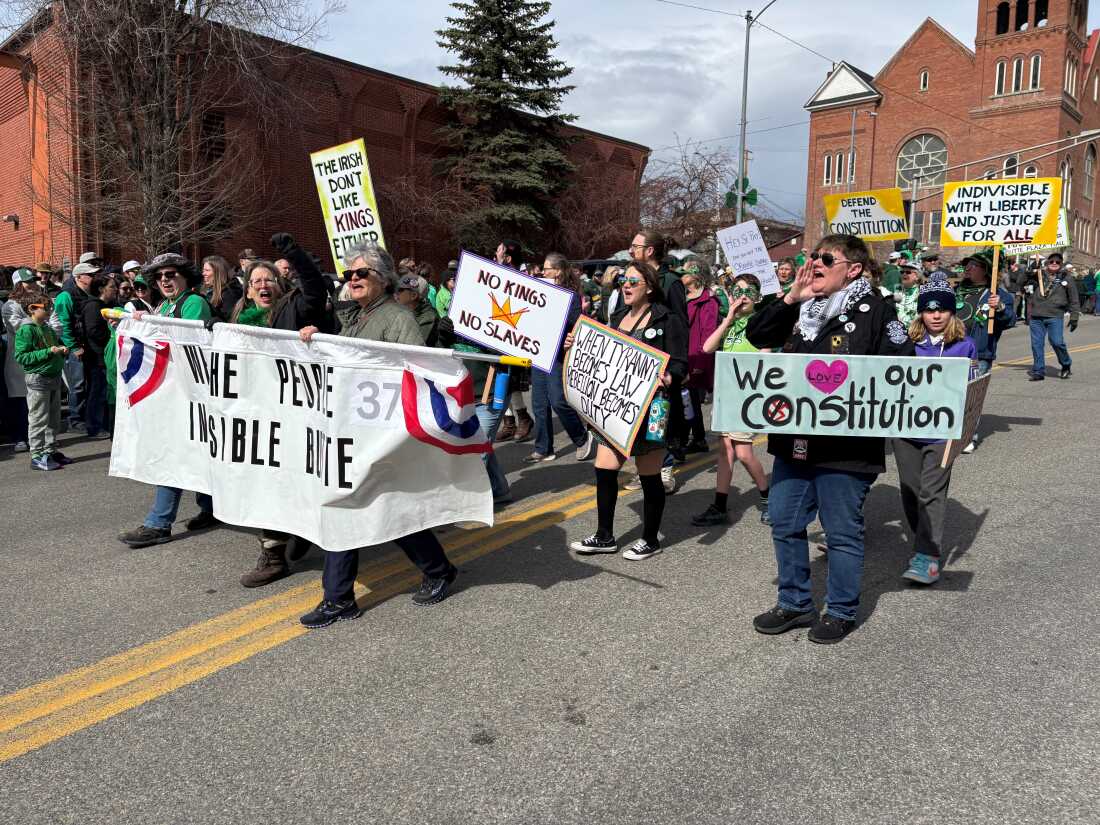
A political group marches in the St. Patrick’s Day parade in Butte, Montana, March 17 2026
Kirk Siegler/NPR
hide caption
toggle caption
Kirk Siegler/NPR
This year’s parade followed an unusually turbulent few days in Montana’s political scene – half of its congressional delegation abruptly retired. Despite the state’s recent tilt from purple to deep red, the races for their seats could be more in play now because of the way Senator Steve Daines and Congressman Ryan Zinke, both Republicans, gave up them up and chose their successors. In Daines’ case, he withdrew his candidacy just minutes before the filing deadline.
Like a lot of people in Butte, Carden is a longtime Democrat. But he says he’s grown disillusioned with party politics.
“I would rather everything be independent where there is no party designation and then you have to pay more attention to who the person actually is,” Carden says.
New Candidate opts to go independent
That’s exactly what Seth Bodnar, a former Green Beret running for U.S. Senate, is trying to capitalize on. He joined other candidates mixed in with Irish dancing troupes and fire department floats, as he walked the parade route along Park Street shaking the occasional hand and tossing candy.
In an interview with NPR earlier in Missoula, Bodnar, who recently resigned his post as University of Montana president, pitched what he says would be his bi-partisan appeal.
“I’m an independent,” Bondar says. “When I raised my right hand at the age of 18 and I swore an oath to this Constitution when I joined the military, not to a political party.”.
Person over party used to be the playbook in Montana, which some call just one long Main Street. It’s how former Senator Jon Tester used to win despite being a Democrat as the state got redder.
The day after Bodnar formally announced he was gathering signatures to get on the ballot, his long shot bid got taken a lot more seriously.
Sen. Steve Daines, who was elected to the Senate in 2014, sent shockwaves through the state’s political scene when he announced in a video posted to X that he’d decided not to seek reelection.
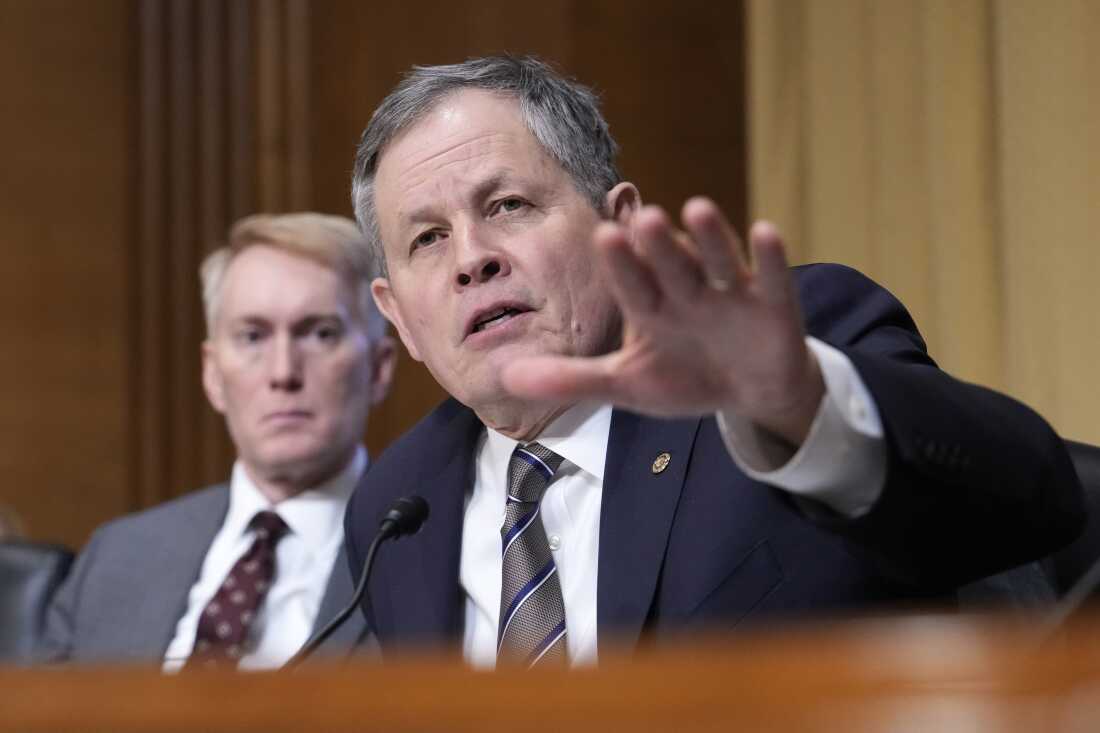
Sen. Steve Daines, R-Mont., speaks at the Senate Finance Committee confirmation hearing for Scott Bessent, President-elect Donald Trump’s choice to be Secretary of the Treasury, at the Capitol in Washington, Thursday, Jan. 16, 2025.
Ben Curtis/AP/AP
hide caption
toggle caption
Ben Curtis/AP/AP
“I’m also very thankful to have served alongside President Trump and my colleagues in the Senate,” Daines said in the video. “Together we built a conservative majority on the Supreme Court, we delivered the largest tax cut in U.S. history, we unleashed American energy dominance and secured our southern border.”
Daines’ late hour withdrawal presumably clears the way for his chosen successor, Kurt Alme, the U.S. Attorney for Montana until he declared his candidacy for Daines’ seat. Daines later said withdrawing earlier could have enticed a prominent Democrat like Tester to enter the race.
Independent Seth Bodnar says it reminds him of the Montana of old.
“We have direct election of senators in the United States in part because of political corruption in this state 125 years ago, Copper Kings trying to buy U.S. Senate seats,” Bodnar says. “That didn’t work back then and it’s not going to work right now.”
But Democrats say Bodnar’s entry as an independent will just split the liberal vote.
The GOP base is angry too
“Montanans are getting very indignant about what they see as out and out dishonesty,” says Roger Koopman, a former Republican legislator and Montana Public Service commissioner from Bozeman.
Koopman says the party establishment’s backroom dealing is a gift to Democrats and especially Seth Bodnar, who he says is a liberal running as an independent.
“They’re going to say, ‘hey, I’m over these Republicans playing games with me, you can’t do that and expect me to vote for you, I’m not going to vote Democrat, but here’s this guy out here who says he’s independent, let me give him a try,’” Koopman says.
Alme has been keeping a low profile. Political pundits say that might be by design. A campaign spokesperson sent NPR this statement: “Anyone could run for this seat. Kurt is running on his record as the Trump-endorsed candidate of common sense who knows how to be tough on violent crime, dismantle drug cartels, and deliver historic tax relief. Voters will decide, and Kurt is confident in his work serving Montana and helping President Trump put America First.”
At Montana State University, political science department chair Eric Austin says he expects party tensions will cool and Republicans will rally around their nominee by November.
“I think in part that speaks to the changes in the electorate in the state,” Austin says. “As the state has become more red, people have more strongly affiliated themselves with the Republican Party and less as independents.”
However, Austin says the midterms will be a referendum on President Trump and there’s growing economic anxiety in Montana. Farmers are getting hurt by Trump’s tariffs. His Iran War has sent fertilizer prices soaring, raised interest rates and the cost of gas.
Back in Butte, at the St. Paddy’s Day parade, longtime Democratic activist Evan Barrett says there’s a resurgence in populist resentment in Montana.

Longtime Montana Democratic party activist Evan Barrett at the St. Patrick’s Day parade in Butte, Montana, March 17 2026
Kirk Siegler/NPR
hide caption
toggle caption
Kirk Siegler/NPR
“It’s almost like a repetition of the past,” says Barrett, a one time economic aide to former Governor Brian Schweitzer.
Ducking into an old storefront to take a break from the spectacle of the parade, Barrett told NPR there’s a feeling in the electorate that a lot of outside money is coming into influence politics, but not staying in Montana and being invested into things like schools.
“So this is a really wild and different year,” Barrett says. “Anybody that tells you they know what’s gonna happen, well, be a bit skeptical.”
President Trump has endorsed last minute Senate candidate Kurt Alme but it’s not clear what kind of effect that might have on voters in November.

new video loaded: Savannah Guthrie Says She Believes Her Mother Was Taken for Ransom
transcript
transcript
Savannah Guthrie Says She Believes Her Mother Was Taken for Ransom
Savannah Guthrie spoke on the “Today” show in her first interview since her mother, Nancy Guthrie, was abducted from her home near Tuscon, Ariz.
-
“The ransom note, notes for ransom requests came. Did you believe those to be real?” “The two notes that we received that we responded to — I tend to believe those are real.” “Really?” “We still don’t know. Honestly, we don’t know anything. We don’t know anything. So I don’t know that it’s because she’s my mom. But yeah, that’s probably — which is too much to bear to think that I brought this to her bedside, that it’s because of me. And I just say, I’m so sorry, Mommy. I’m so sorry. We need answers. We cannot be at peace without knowing. And someone can do the right thing. And it is never too late to do the right thing.”
By Christina Kelso
March 26, 2026

Kentucky among Southeastern states receiving FEMA disaster recovery funding

Guest Column: Louisiana can only win with a stronger workforce

Ski Maine, Where Skiing’s Main Street Ends

Showers and falling temperatures across Maryland Friday

Woman struck, fatally injured, while walking on the Lodge Freeway, state police say

Florida High School Football Rankings: Top 25 teams – Oct. 21

How old is Bo Nix? What to know about Oregon quarterback ahead of 2024 NFL Draft

Cleary's 21 help Le Moyne down Central Connecticut State 69-64 in OT

99th annual Pony Swim held in Virginia

Indiana Members Credit Union announced as new anchor tenant at Bottleworks District

Video: Will ICE Change Under Its New Leader?

DHS shutdown breakthrough comes at cost for Republicans as funding fights nears end

Rubio joins crucial G7 talks as Iran war set to dominate second day
A surprise resignation could open the door for an independent to win a Montana Senate seat

Video: Savannah Guthrie Says She Believes Her Mother Was Taken for Ransom
-

 Detroit, MI1 week ago
Drummer Brian Pastoria, longtime Detroit music advocate, dies at 68
-

 Science1 week ago
How a Melting Glacier in Antarctica Could Affect Tens of Millions Around the Globe
-

 Movie Reviews1 week ago
‘Youth’ Twitter review: Ken Karunaas impresses audiences; Suraj Venjaramoodu adds charm; music wins praise | – The Times of India
-
 Science1 week ago
I had to man up and get a mammogram
-

 Sports6 days ago
IOC addresses execution of 19-year-old Iranian wrestler Saleh Mohammadi
-

 New Mexico5 days ago
Clovis shooting leaves one dead, four injured
-
 Business1 week ago
Disney’s new CEO says his focus is on storytelling and creativity
-

 Texas1 week ago
How to buy Houston vs. Texas A&M 2026 March Madness tickets