Northeast
Five sleeper races that could upend 2026 – from the Alleghenies to the Land of Enchantment

NEWYou can now listen to Fox News articles!
As Clement Moore’s “‘Twas the Night Before Christmas” tells it, families sleep soundly as Santa approaches.
As the new year nears, several election contests may prove just as quiet – until close results suddenly come into focus. Here are five potential sleeper races to watch in 2026:
1. MISSISSIPPI’S 2ND CONGRESSIONAL DISTRICT
Rep. Bennie Thompson, the top Democrat on the House Homeland Security Committee, has not often had to worry about a general election challenge since he won a special election on April 13, 1993.
Predecessor Mike Espy, who recently unsuccessfully ran for Senate in a narrow runoff with Sen. Cindy Hyde-Smith, R-Miss., had resigned to accept President Bill Clinton’s appointment as Secretary of Agriculture.
Thompson’s closest race was that one – against Republican Hayes Dent – at 55% to 45%.
Since then, Thompson has never looked back, and instead made himself a nationally-recognized figure later in his tenure.
He chaired the House Select Committee on January 6 and recently went viral for calling the shooting of West Virginia National Guardsmen allegedly by an Afghan refugee an “unfortunate accident.”
Thompson’s district, spanning from Jackson west to Yazoo City and Vicksburg on the Mississippi River, is one of the poorest in the country – landing at 3rd out of 435 with a median income of $37,372, according to data published by the office of Rep. Marcy Kaptur, D-Ohio.
CONGRESSIONAL DEMOCRATS WIDEN 2026 BATTLEFIELD, ZERO IN ON NEW HOUSE REPUBLICAN TARGETS
Rep. Glenn Ivey (D-MD) speaks to Rep. Bennie Thompson (D-MS) at the Butler Farm Show in Butler, Pennsylvania, on Monday, July 22, 2024. (Derek Shook for Fox News Digital )
Only Rep. Hal Rogers, R-Ky., and Ritchie Torres, D-N.Y. preside over a poorer population.
Last week, an attorney and former counsel to Sen. Charles Schumer, D-N.Y., mounted a surprise primary bid against Thompson.
Evan Turnage, 33, who has been alive just about the same time Thompson has been in Congress, made the idea of fighting the region’s persistent poverty paramount to his new campaign, according to Black Press USA.
“I’ve dedicated my life to leveling the playing field so people can not only get by, but get ahead, and raise a family right here,” Turnage said, according to the outlet.
On the Republican side, retired Army captain and Vicksburg cardiothoracic surgeon Ron Eller will fight an uphill battle to unseat the winner of the Thompson-Turnage bout.
2. CONNECTICUT’S 5TH CONGRESSIONAL DISTRICT
Connecticut is another state that is typically not in political conversation as hosting nail-biter partisan elections.
During the Bush-Clinton years, however, the state was competitive if not outright Republican-favored.
Former Gov. John Rowland was the first in decades to be elected to more than two terms. He ended up resigning in 2004 amid the threat of impeachment over accusations contractors with the state were doing work on his vacation home.
CALL TO DUTY: IN BATTLE FOR HOUSE, REPUBLICANS AND DEMOCRATS LOOKING TO VETERANS
After he resigned, his wife famously wrote a poem critical of the media’s coverage of Rowland’s case, based on Moore’s holiday favorite and called “A Lump of Coal for All the Reporters.” Rowland’s lieutenant, Gov. M. Jodi Rell, took over and was re-elected once before retiring in 2010.
Since then, the state has been reliably Democratic – save for former Sen. Joe Lieberman changing his affiliation to independent.
In 2022, then-State Sen. George Logan – the first Black man elected to Hartford’s upper chamber – mounted a bid against Rep. Jahana Hayes and lost by less than one percentage point.
DOUBLING DOWN: TOP HOUSE DEMOCRAT SAYS FOCUS ON HIGH PRICES ‘ABSOLUTELY GOING TO CONTINUE’
Jahana Hayes, D-CT (left) and her 2024 GOP challenger George Logan (right). (Getty & AP )
Logan tried again in 2024, but lost by a slightly wider margin.
While Logan is not on the ballot at least yet for 2026, recent history shows Republicans could have an outside chance of ending Democrats’ full control of New England’s congressional delegation.
3. MARYLAND’S 6TH CONGRESSIONAL DISTRICT
Republicans have wanted to win back Maryland’s sixth congressional district ever since partisan gerrymandering was blamed for booting 20-year incumbent Rep. Roscoe Bartlett, R-Md., from office in 2012.
Bartlett, an eccentric conservative who later relocated to the West Virginia wilderness to live off-the-grid, is now 99, and was known for addressing various topics that were sometimes ignored but have received newfound attention at present, including warnings about the strength, reliability and hardening of the U.S. power grid.
Bartlett won his last reelection by 28 points but then lost by about 20 the following cycle after the rural district encompassing the entire Maryland Panhandle was adjusted to incorporate the edges of densely-populated Washington, D.C., suburbs.
SHOWDOWN FOR THE HOUSE: DEMOCRATS, REPUBLICANS BRACE FOR HIGH-STAKES MIDTERM CLASH
He was defeated in 2013 by then-Rep. John Delaney, a finance executive – before Delaney was replaced by Total Wine mogul David Trone, who has largely self-funded his campaigns to the tune of millions of dollars.
Trone won re-election before opting in 2024 to pursue retiring Sen. Benjamin Cardin’s, D-Md., seat – which was ultimately won by Democrat Angela Alsobrooks.
He announced this year that he would challenge Rep. April McClain-Delaney, D-Md., the wife of former Rep. John Delaney, in the district.
Meanwhile, former longtime state Del. Neil Parrott, R-Antietam, is mounting his fourth consecutive bid for the seat. McClain-Delaney beat Parrott 53-47 in 2024.
The closest that Republicans have gotten to taking back the seat since Bartlett was defeated came in 2014, when now-FBI Deputy Director Dan Bongino narrowly lost to Trone by about a point.
Bongino notably sought to nationalize the race, pulling in endorsements like Sen. Rand Paul, R-Ky., and rebuking Delaney as someone who could “write himself a check for a million dollars” if he needed to in order to win.
HOUSE GOP CAMPAIGN CHAIR WANTS TRUMP ‘OUT THERE ON THE TRAIL’ IN MIDTERM BATTLE FOR MAJORITY
Del. Neil Parrott, left., former Rep. Roscoe Bartlett, R-Md., right. (Tom Williams/Getty Images)
The future G-man suggested at the time he would rather knock on doors in far-flung communities like Oakland and Grantsville, where he said, “nobody seems to know who [John Delaney] is,” according to the Maryland Reporter.
Given newly-drawn, friendlier maps following litigation over O’Malley-era gerrymandering, Republicans may have a chance to surprise in a district in one of the most Democratic-majority states in the country.
4. NEBRASKA’S 2ND CONGRESSIONAL DISTRICT
While not typically considered a swing state, or one that gets much attention in federal elections, Nebraska’s only urban-leaning district may decide the future of the House of Representatives if the overall contest is as close as it has been in recent years.
Rep. Don Bacon, R-Neb., one of few in his party who have publicly lambasted President Donald Trump, is retiring. The district – centered in Douglas and Saunders counties, including Omaha and Ashland – already has a slew of candidates on both sides hoping to take the moderate’s seat.
Omaha City Councilman Brinker Harding leads state Sen. Brett Lindstrom, R-Omaha, in fundraising, while on the Democratic side, at least five people, including congressional staffer James Leuschen and state Sen. John Cavanaugh, D-Omaha, have tossed their hats in the ring, according to the Nebraska Examiner.
HEADED FOR THE EXITS: WHY 3-DOZEN HOUSE MEMBERS AREN’T RUNNING FOR RE-ELECTION
Bacon, who hails from suburban Sarpy County, won his last race against former state Sen. Anthony Vargas, D-Omaha, by less than one percentage point.
After a recent wave of GOP losses in Florida, Pennsylvania, Virginia and New Jersey, the district shapes up as a tough hold for Republicans in a state that hasn’t elected a Democrat statewide since Ben Nelson retired in 2012.
5. NEW MEXICO GUBERNATORIAL RACE
While Nebraska is a red state that doesn’t often garner national attention, on the blue ledger lies New Mexico.
Topographically and culturally similar to red neighbor Texas and formerly red neighbor Arizona on the other side, the Land of Enchantment is often one that enchants the observer that looks closer at its politics.
Notably, its mountainous border with Mexico has largely kept it out of politically-contentious Trump-wall debates focused on the flatter, desert and river boundaries of its neighbors.
REPUBLICANS HAVE CHANCE TO SECURE GOVERNORSHIPS IN KEY BATTLEGROUND STATES NEXT YEAR
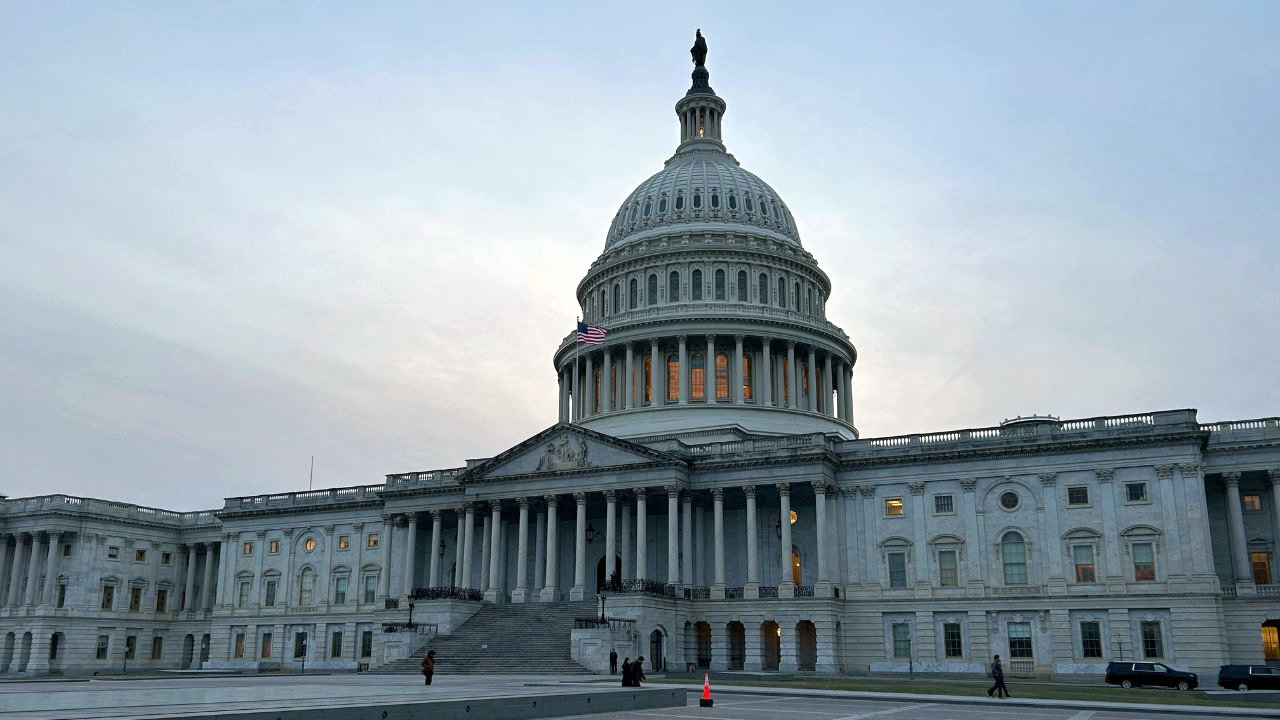
U.S. Capitol Building at sunset on January 30, 2025. (Emma Woodhead/Fox News Digital)
While it lacks the urban population that is typical of most blue states like New York, California, New Jersey and Maryland, Republicans have been increasingly out of power there for years.
Former Sen. Pete Domenici, R-N.M., was the last such lawmaker to represent the state in the upper chamber.
He retired in 2008 and was replaced by Sen. Tom Udall, D-N.M., whose surname is the Mountain West’s equivalent of Cuomo or Casey. The Interior Department headquarters is named after Udall’s father.
Gov. Michelle Lujan Grisham is term-limited. While she was preceded by a Republican, Susana Martinez, her state has been trending more toward Democratic reliability otherwise.
CLICK HERE TO DOWNLOAD THE FOX NEWS APP
Deb Haaland, a former New Mexico congresswoman who was also former President Joe Biden’s Interior secretary, is the biggest name in the Democratic field, while Greggory Hull, the longtime mayor of Rio Rancho, is such for the GOP.
Rep. Gabe Vasquez held off a challenge from predecessor Yvette Herrell in the 2nd congressional district, which spans the southwestern part of the state including Alamogordo and Las Cruces, in what was seen as the GOP’s best chance to make inroads again in the border state.
Read the full article from Here



Boston, MA
Ariana Grande fan gets better tickets to TD Garden concert in Boston after resolving StubHub issue

Ariana Grande is coming to Boston next week and one of her biggest fans in Massachusetts will be there after resolving a ticket issue with StubHub.
Kelsie Duest of Hopedale had two front row balcony seats to Grande’s show on July 23 at TD Garden. Her brother bought them for her on StubHub last year. Her mother said it cost nearly $1,400 for the pair.
But about a month later, Sharon Duest checked her Apple Wallet and noticed the tickets were invalid. She said StubHub offered them a choice, take a refund or different tickets.
Duest ended up accepting the tickets that were offered, only to learn they were obstructed view seats behind the stage and Kelsie wouldn’t be able to see Grande during parts of the concert.
Concerned that her daughter, who has Down syndrome, would miss out on the experience of seeing Grande on stage, Duest tried calling and emailing Stubhub hoping to get better seats.
“We didn’t want anything for free. We just wanted just the tickets that we had,” she told WBZ-TV.
With the concert coming up soon, the Duests reached out to the I-Team’s Call for Action for help, who contacted StubHub.
“We’re so sorry about the issues Sharon experienced with their ticket order, especially given how meaningful this concert is to Kelsie,” a company spokesperson said in an email.
“We understand how disappointing and stressful that situation was. Our Customer Care team worked with them to resolve the issue and ultimately secured upgraded replacement tickets in a section in front of where the original seats were located, allowing them to attend the show with an improved view.”
Kelsie and her mom now have club seats closer to the stage than the tickets they originally purchased.
“I know we couldn’t have done this without you guys. Thank you, thank you from the bottom of our hearts,” Sharon Duest said.
A good rule of thumb with electronic tickets is to always check on them to confirm that they remain valid up until the event. You should also keep good records in case you need a refund or a replacement.

Connecticut
Wethersfield woman accused of sexually coercing minor from New York after meeting him online

HARTFORD, Conn. (WTNH) — A Wethersfield woman was charged Friday after allegedly bringing a minor from New York to her home and attempting to sexually coerce him, according to the United States Attorney for the District of Connecticut.
Amily Colon, 31, was charged on a federal criminal complaint with attempted coercion and enticement of a minor, and with transportation of a minor to engage in sexual activity, according to the U.S. Attorney for the District of Connecticut.
Court documents allege that Colon initiated an online relationship with a 13-year-old boy from New York.
Colon, who identified herself as “Alice,” allegedly had conversations with the victim through a messaging and communications app, according to court documents.
The conversations became sexually explicit, documents state. Then, Colon allegedly coerced the victim to send her a sexually explicit video of himself, and Colon sent back explicit images and videos of herself in return.
On June 26, Colon traveled to an area of New York to pick up the victim and bring him to her residence in Wethersfield, court documents allege. Here, Colon allegedly attempted to engage in sexual activity.
The next day, Colon drove the victim back to New York and dropped him off a few blocks from his home, according to court documents.
Colon was ordered detained in Hartford on Friday.
Officials in Connecticut and New York are conducting the investigation.
Download the News 8 app to get breaking news and weather alerts.
Watch News 8 on WTNH.com or the free WTNH News 8 streaming app on Roku, Apple TV, Amazon Fire TV and select Samsung Smart TVs.
-

 Los Angeles, Ca1 minute ago
‘Moana’ is a triumph for Pacific Islander representation on the big screen
-

 Detroit, MI25 minutes ago
Five shot during funeral at Detroit church
-

 San Francisco, CA37 minutes ago
San Francisco Giants Announce Intriguing Roster Move Ahead of Mariners Series
-

 Dallas, TX43 minutes ago
Dallas seafood wholesaler fined $250K for false salmon labeling
-

 Miami, FL49 minutes ago
Absolutely Not: Florida woman’s “suggestive” license plate goes viral
-

 Boston, MA55 minutes ago
Ariana Grande fan gets better tickets to TD Garden concert in Boston after resolving StubHub issue
-

 Denver, CO1 hour ago
Mitchell Fraboni will be the Bronco long snapper in 2026
-

 Seattle, WA1 hour ago
Seattle real estate owner sentenced to prison for $4.7 million tax evasion scheme – MyNorthwest.com

