Connect with us

News

Canada warns Donald Trump’s tariffs could leave US reliant on Venezuela’s oil

Published

on

Canada warns Donald Trump’s tariffs could leave US reliant on Venezuela’s oil

Unlock the White House Watch newsletter for free

The US would be forced to buy oil from geopolitical rivals such as Venezuela if it disrupted trade with Canada, Ottawa’s foreign minister has warned.

Mélanie Joly told the Financial Times the US president’s threat to impose levies of 25 per cent on Canadian imports would hit “real people” if relations between the two countries descended into a trade war.

“We ship oil at a discount which is, ultimately, refined in Texas. If it’s not us, it is Venezuela,” Joly said, referring to the heavy grades of oil produced in Venezuela and Canada on which many American refineries depend.

Advertisement

“There’s no other option on the table, and this administration doesn’t want to work with Venezuela,” Joly said.

US President Donald Trump imposed sweeping sanctions on Caracas during his first term in the White House.

Joly was in the US capital spearheading Canada’s last-minute effort to avert the first full-blown trade war of Trump’s new administration, with the president threatening again on Thursday to apply tariffs of 25 per cent on Canada and Mexico starting on February 1.

The president said he was considering excluding oil imports from the tariffs — reflecting the US’s dependence on its neighbour for huge supplies of energy.

Despite soaring shale oil production in states such as Texas, Canada accounts for about one in every five barrels of oil consumed in the US and about 60 per cent of its imported crude.

Advertisement

Many US refineries depend on the kind of heavy oil produced in Canada or Venezuela — not on the lighter grades produced by America’s prolific shale industry.

Joly, who had travelled to Washington to meet US secretary of state Marco Rubio and other senior US officials, said she had also warned lawmakers on Capitol Hill that trade tensions would hit “real people”, particularly in Republican states.

“We don’t want that,” Joly said. “We want us to be in a win-win position, and we think we can offer that.”

Ottawa and Mexico City have both drawn up lists of retaliatory tariffs to issue against the US in the event that Trump pulls the trigger on tariffs against them, people with knowledge of the matter previously told the FT.

Canada’s energy minister, Jonathan Wilkinson, has vowed “tit-for-tat” levies on American goods such as steel and orange juice if Trump follows through on his threats.

Advertisement

Trump has launched repeated broadsides against Canada in recent weeks, describing Prime Minister Justin Trudeau as a “governor” and claiming the country should become the US’s 51s state.

Trump said in a speech earlier this month that a US annexation of Canada “would really be something” and he could use “economic force” to do so.

Joly said the idea had not come up in any of her meetings with US officials. “Absolutely not,” she replied, when asked.

“We can be really good friends, best friends, but we will never be a state, nor a colony, period,” she said.

Canada and Mexico have also tried to demonstrate to Trump that they are securing their extensive land borders with the US in response to his claims that drugs and migrants are crossing illegally into his country.

Advertisement

“On the border, I think we’re getting good traction,” Joly said, adding that she would meet with Trump’s border tsar Tom Homan on Friday.

Canada has pledged to spend $1bn on border security, and has recently deployed newly leased Black Hawk patrol helicopters, extra dogs and 60 drones at the border partly in response to Trump’s demands — as well as concerns about weapons and undocumented migrants arriving from the US.

Joly said: “We wanted to reinforce the border as well on our side, because we are concerned with the flow of illegal guns coming from the US and the potential flow of illegal migrants coming from the US.”

Trump has threatened to deport millions of people without permanent legal status from the US, prompting concerns that some migrants will travel to Canada to seek refuge.

Joly said that while the US president had clearly linked his early threat of 25 per cent tariffs with border security, the US and Canada would review their broader trade relationship, including the North American trade deal signed by Trump during his last administration, as part of a separate process.

Advertisement

News

Video: Nvidia Shows Off New A.I. Chip at CES

Published

on

Video: Nvidia Shows Off New A.I. Chip at CES

new video loaded: Nvidia Shows Off New A.I. Chip at CES

transcript

transcript

Nvidia Shows Off New A.I. Chip at CES

At the annual tech conference, CES, Nvidia showed off a new A.I. chip, known as Vera Rubin, which is more efficient and powerful than previous generations of chips.

This is the Vera CPU. This is one CPU. This is groundbreaking work. I would not be surprised if the industry would like us to make this format and this structure an industry standard in the future. Today, we’re announcing Alpamayo, the world’s first thinking, reasoning autonomous vehicle A.I.

Advertisement
At the annual tech conference, CES, Nvidia showed off a new A.I. chip, known as Vera Rubin, which is more efficient and powerful than previous generations of chips.

By Jiawei Wang

January 6, 2026

Continue Reading

News

Lawmakers split over Maduro’s seizure. And, CDC cuts childhood vaccine schedule

Published

on

Lawmakers split over Maduro’s seizure. And, CDC cuts childhood vaccine schedule

Good morning. You’re reading the Up First newsletter. Subscribe here to get it delivered to your inbox, and listen to the Up First podcast for all the news you need to start your day.

Today’s top stories

Ousted Venezuelan President Nicolás Maduro and his wife, Cilia Flores, pleaded not guilty yesterday to federal charges, which include narco-terrorism. U.S. military forces seized them both from their country over the weekend. Yesterday marked their first appearance in a federal court in New York.

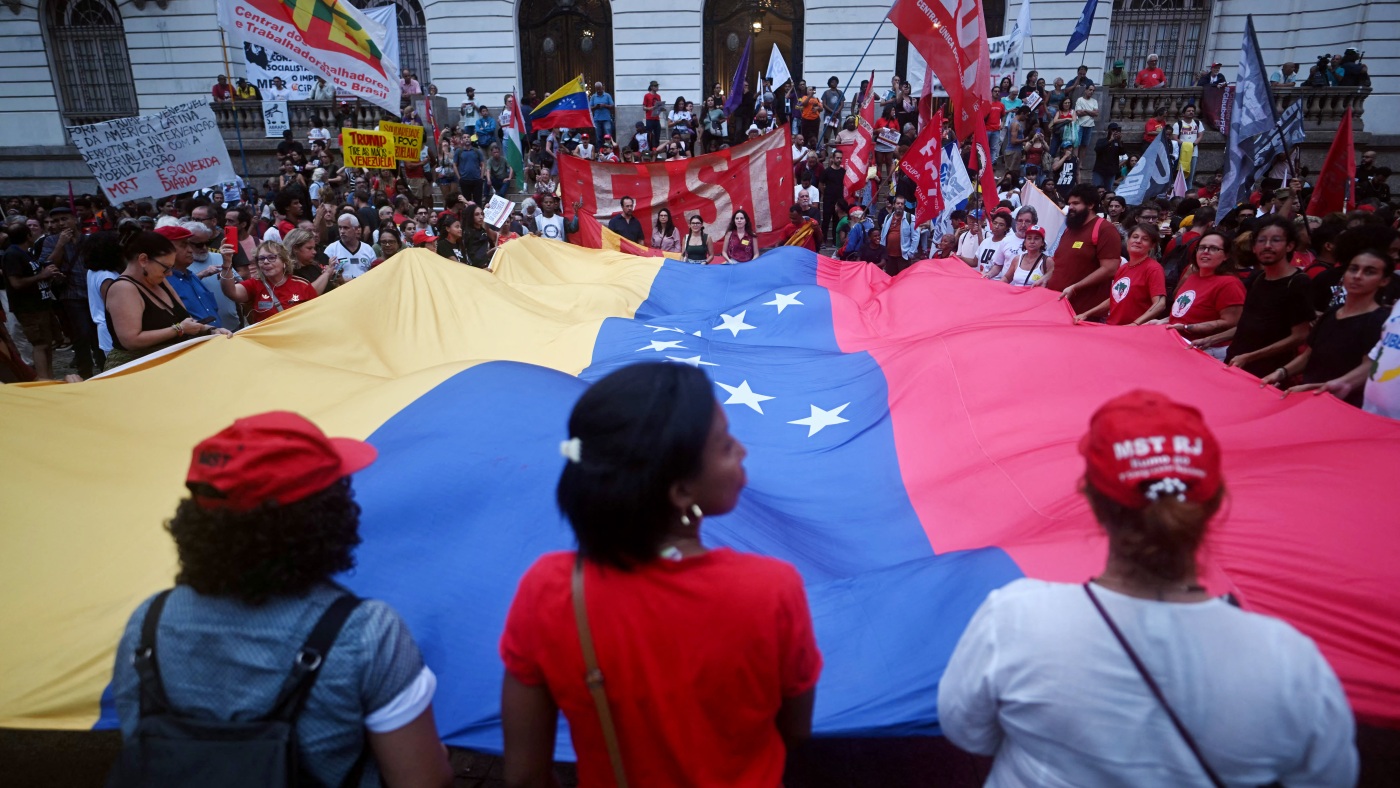
Protesters express their anger toward ousted Venezuelan leader Nicolás Maduro and fly the Venezuelan flag outside the Daniel Patrick Moynihan United States Courthouse in New York City on Monday.

José A. Alvarado Jr. for NPR


hide caption

Advertisement

toggle caption

José A. Alvarado Jr. for NPR

  • 🎧 Before sitting down in court, Maduro made eye contact with reporters and wished them a “Happy New Year,” NPR’s Jasmine Garsd, who was in the courtroom, tells Up First. Flores walked in behind him and appeared to have a swollen eye and a bandaged forehead, which her lawyers explained came from her getting hurt during her capture. Outside the courthouse were heated exchanges between two groups of protesters: those who were against America’s intervention in Venezuela and Venezuelans celebrating Maduro’s capture. A man named Izzy McCabe says the capture is a ploy to take oil and foreign resources from Venezuela. Another protester, Maria Seu, said many countries have been living off Venezuela’s resources for years.

President Trump is set to meet with House Republicans at the Kennedy Center today as lawmakers call for more information on the operation in Venezuela and the U.S. role there moving forward. The meeting comes a day after top administration officials briefed Capitol Hill leaders on Maduro’s capture, leaving a largely partisan divide on the operation. Lawmakers questioned Trump’s decision not to inform Congress before carrying out the weekend seizure. Democrats say the action, which the White House is calling a law enforcement operation, is an act of war. Meanwhile, Republicans have largely aligned with the president’s stance on the situation.

  • 🎧 Democrats say the operation is just the latest example of the White House circumventing Congress, NPR’s Barbara Sprunt says. House Speaker Mike Johnson said Trump has the authority to deploy military forces to address threats to the U.S. When the president has joined meetings like the one he is expected to attend today in the past, it has become almost like a rally. Sprunt says she expects the same again today. The party is gearing up for the midterm elections, which means Venezuela will likely not be the only topic discussed.

The Centers for Disease Control and Prevention is reducing its number of recommended childhood vaccines from 17 to 11. The agency’s new schedule, which includes vaccines that had previously been recommended for all children — such as those for rotavirus, hepatitis A and B, meningitis and seasonal flu — is now more restrictive. The agency made these changes in response to a memo Trump issued in December directing health officials to align the U.S. schedule with those in “peer, developed countries” such as Germany and Japan.

  • 🎧 The new restrictions will lead to fewer children getting vaccinated, with consequences that could be seen for years down the line, Dr. Sean O’Leary, with the American Academy of Pediatrics, tells NPR’s Pien Huang. The agency implemented these changes without any new scientific developments behind them, Huang notes. The agency sidestepped its own advisory committee and didn’t consult vaccine makers.

Today’s listen

seasonal depression WIDE.jpg

Does the lack of winter sunlight drain your energy, or do you struggle to keep up with life’s demands during this season? If so, you may be experiencing seasonal affective disorder, or SAD. In this episode of It’s Been A Minute, host Brittany Luse shares the morning routine she developed for herself to combat this type of depression. She is also joined by Dr. Norman E. Rosenthal, a psychiatrist and scientist who first described seasonal affective disorder in the 1980s, to receive feedback on her SAD routine and learn about how we can all think differently about the rough winter months.

Advertisement

Special series

chapter-2.png

Trump has tried to bury the truth of what happened on Jan. 6, 2021. NPR built a visual archive of the attack on the Capitol, showing exactly what happened through the lenses of the people who were there. In “Chapter 2: Stop the Steal,” we look at how false claims of a stolen election mobilized Trump supporters.

On election night in 2020, Trump claimed victory and said the election was being stolen long before officials declared a winner. He and his allies launched the “Stop the Steal” movement almost immediately, even as U.S. courts rejected the widespread claims of election fraud. Trump campaign officials also admitted they found no evidence that could have changed the outcome of the election. Right-wing activists such as Infowars host Alex Jones and the white nationalist and Holocaust denier Nick Fuentes mobilized the movement. On the day that Congress was set to meet to certify the election, Trump pressured Vice President Mike Pence and Republicans in Congress to try to reject Biden’s victory. These videos highlight the movement that led to Jan. 6, 2021.

To learn more, explore NPR’s database of federal criminal cases from Jan. 6. You can also see more of NPR’s reporting on the topic, including an Instagram post debunking myths about looting.

3 things to know before you go

A pill form of Wegovy, the popular obesity drug previously available only by injection, is seen in a plastic tray.

A pill form of Wegovy, the popular obesity drug previously available only by injection, is now being stocked by pharmacies.

Novo Nordisk


hide caption

Advertisement

toggle caption

Novo Nordisk

  1. Pharmacies across the U.S. began stocking the pill version of the popular obesity drug Wegovy yesterday, offering patients an alternative to the injectable form.
  2. Minnesota Gov. Tim Walz ended his bid for a third term yesterday, saying that he wants to dedicate his final year in office to combating fraud in state programs rather than campaigning. (via MPR)
  3. Wegmans says it is using facial recognition technology in a handful of stores across multiple states to help identify people “previously flagged for misconduct.” (via WXXI)

This newsletter was edited by Suzanne Nuyen.

Advertisement
Continue Reading

News

US oil refiners gear up for comeback of Venezuelan crude

Published

on

US oil refiners gear up for comeback of Venezuelan crude

Unlock the White House Watch newsletter for free

US refiners are braced for a surge in Venezuelan crude that would make them early winners of President Donald Trump’s extraordinary plans for an energy-led regime change in Caracas.

Shares in America’s top refining groups jumped on Monday as traders bet their US Gulf Coast operations could snap up big volumes of Venezuelan heavy crude as Washington looks to ease sanctions and revive production.

Valero, the biggest US importer of Venezuelan crude, closed 9 per cent higher. Phillips 66 added 7 per cent and Marathon Petroleum 6 per cent. 

Advertisement

Some content could not load. Check your internet connection or browser settings.

“Our refineries in the Gulf Coast of the United States are the best in terms of refining the heavy crude,” said US secretary of state Marco Rubio on Sunday. “I think there will be tremendous demand and interest from private industry if given the space to do it.”

Trump this weekend touted the “tremendous amount of wealth” that could be generated by American oil companies returning to Venezuela’s oil sector after US forces captured President Nicolás Maduro and transported him to the US to face trial on drug-trafficking charges. 

That has sparked a burst of interest among energy investors keen to return to Venezuela — home to the biggest oil reserves in the world — decades after expropriations by Caracas led most to abandon the country. 

A flurry of executives was expected to arrive in Miami on Tuesday, where US energy secretary Chris Wright will pitch the benefits of channelling billions of dollars into reviving Venezuelan oil output, which has fallen from 3.7mn barrels a day in 1970 to less than 1mn b/d today as a result of chronic mismanagement, corruption and sanctions. 

Advertisement

While any investment by US companies in rejuvenating Venezuelan oil production could take time, Gulf Coast refiners are well positioned to hoover up crude shipments as soon as sanctions are eased and more import permits are granted, something analysts say could happen quickly. 

Some content could not load. Check your internet connection or browser settings.

“Near-term, Gulf Coast refiners could be among the biggest winners of shifts that could occur here,” said Dylan White, principal analyst for North American crude markets at consultancy Wood Mackenzie. 

“The investment side of the coin in Venezuela is much more slow moving. It’s turning a very slow ship and it involves high-level decisions from a number of companies,” he said. “[But] sanctions policy changing in the US could change the economic benefits for US Gulf Coast refiners tomorrow.”

American refiners and traders import about 100,000-200,000 b/d of Venezuelan crude, down from 1.4mn b/d in 1997. Under current US sanctions, Chevron is the only American producer allowed to operate in the country and imports of Venezuelan crude are heavily restricted.

As much as 80 per cent of Venezuelan exports had been bound for China before the US imposed a naval embargo last month. Much of that could be quickly rerouted to the US if sanctions were lifted.

Advertisement

“The natural proximal home for a lot of those Venezuelan heavy barrels would be the refining complex of the US Gulf Coast,” said Clayton Seigle, senior fellow at the Center for Strategic and International Studies, adding that the fact that the facilities were equipped to process Venezuelan heavy oil could explain “some of the short-term stock market reactions that we observed”.

Valero, Philips 66 and Marathon did not respond to requests for comment on their plans.

US refineries were largely set up before the shale revolution made America the world’s biggest oil producer. Almost 70 per cent of US refining capacity is designed primarily to handle the heavy grades common in Venezuela, Canada and Mexico rather than the light, sweet variety found in Texas oilfields, according to the American Fuel and Petrochemical Manufacturers.

Consultancy S&P Global Energy estimates that from 1990 to 2010, US refiners spent about $100bn on heavy crude processing capabilities, just before the fracking boom sent American production soaring.

“This finally gets some of the [return on investment] back,” said Debnil Chowdhury, Americas head of refining and marketing at S&P, of the potential for a return to significant imports of Venezuelan heavy oil.

Advertisement

“We had a system that was kind of running de-optimised for the last 10-15 years. And this allows it to get a little bit closer to what it was designed for — which means slightly higher yields, higher margins.

“You get to basically use your asset more how it was designed because you’re getting the feedstock it was designed for.”

Data visualisation by Eva Xiao in New York

Continue Reading
Advertisement

Trending