In late April, a slow-moving storm over Texas and Oklahoma spawned an outbreak of 39 tornadoes. That event was just a fraction of the more than 400 tornadoes reported that month, the highest monthly count in 10 years. And the storms kept coming.
Through November, there were more than 1,700 tornadoes reported nationwide, preliminary data shows. At least 53 people had been killed across 17 states.
Monthly accumulated tornadoes
Not only were there more tornadoes reported, but 2024 is also on track to be one of the costliest years ever in terms of damage caused by severe storms, according to the National Center for Environmental Information. Severe weather and four tornado outbreaks from April to May in the central and southern United States alone cost $14 billion.
We will not know the final count of this year’s tornadoes until next year — the data through November does not yet include tornadoes like the rare one that touched down in Santa Cruz., Calif., on Saturday. That’s because confirming and categorizing a tornado takes time. After each reported event, researchers investigate the damage to classify the tornado strength based on 28 indicators such as the characteristics of the affected buildings and trees. Researchers rate the tornadoes using the Enhanced Fujita Scale (EF) from 0 to 5.
Advertisement
But 2024 could end with not only the most tornadoes in the last decade, but one of the highest counts since data collection began in 1950. Researchers suggest that the increase may be linked to climate change, although tornadoes are influenced by many factors, so different patterns cannot be attributed to a single cause.
The year’s worst storms
In May, a mobile radar vehicle operated by researchers from the University of Illinois measured winds ranging 309 to 318 miles per hour in a subvortex of a tornado in the outskirts of Greenfield, Iowa. The event, an EF4, was among the strongest ever recorded.
NASA tracked the line of destruction of the tornado over 44 miles.
Image by Vexcel Graysky, May 28, 2024.
Advertisement
NOAA estimated the damage caused by the Greenfield tornado to be about $31 million. While most tornadoes this year were not as deadly or destructive, there were at least three more EF4 storms, described by NOAA as devastating events with winds ranging from 166 to 200 miles per hour. These violent tornadoes caused severe damage in Elkhorn-Blair, Neb., and in Love and Osage Counties in Oklahoma.
Here are the footprints of 1,644 buildings in the United States that were destroyed or severely damaged by tornadoes this year, according to data from FEMA and Vexcel, a private company that uses aerial imagery to analyze natural disasters.
While losses from tornadoes occur on a regular basis every year, extreme events such as hurricanes can also produce tornadoes with great destructive capacity. In October, more than 40 tornadoes were reported in Florida during Hurricane Milton, three of them category EF3. According to the The Southeast Regional Climate Center, EF3 tornadoes spawned by hurricanes had not occurred in Florida since 1972.
A vulnerable region
Advertisement
Tornado detection systems have improved, especially since the 1990s, allowing scientists to count tornadoes that might have gone undetected in previous years, said John Allen, a climate scientist focused on historic climatology and analysis of risk at Michigan State University. That plays a role in the historical trend showing more tornadoes in recent decades.
Change in tornado activity
Confirmed tornadoes in each county from 2002-22 compared with 1981-2001
While this year’s worst storms were concentrated in the Midwest, many counties across the South have seen an increase in tornado activity in the past 20 years, compared with the prior two decades. These same counties’ demographic conditions, including low incomes and large mobile home populations, make them especially vulnerable to major disasters.
“It only takes an EF1 to do significant damage to a home, an EF2 would throw it all over the place,” Dr. Allen said.
Advertisement
Prof. Tyler Fricker, who researches tornadoes at the University of Louisiana, Monroe, said we will inevitably see more losses in the region.
“When you combine more intense tornadoes on average with more vulnerable people on average, you get these high levels of impact — casualties or property loss,” Dr. Fricker said.
“If you have enough money, you can protect yourself,” he added. “You can build out safe rooms. You can do things. That’s not the case for the average person in the Mid-South and Southeast.”
The C.D.C. identifies communities in need of support before, during and after natural disasters through a measure called social vulnerability, which is based on indicators such as poverty, overcrowding and unemployment. Most counties in Alabama, Arkansas, Louisiana and Mississippi are both at high risk by this measure and have experienced an increase in tornadoes in the last 20 years, relative to the 1980s and 1990s.
County risk vs. change in tornado activity
Advertisement
In the states with the most tornadoes this year, most counties have better prepared infrastructure for these kinds of events.
Source: C.D.C. and NOAA
Note: Change in tornado activity compares tornado counts from 2002-22 with 1981-2001.
Stephen M. Strader of Villanova University, who has published an analysis of the social vulnerabilities in the Mid-South region and their relationship to environmental disasters, said the most vulnerable populations may face a tough year ahead. While two major hurricanes had the biggest impact on the region this year, La Niña will influence weather patterns in 2025 in ways that could cause more tornadoes specifically in the vulnerable areas in the South.
Advertisement
Although not completely definitive, NOAA studies suggest that EF2 tornadoes, which are strong enough to blow away roofs, are more likely to occur in the southeastern United States in La Niña years.
“Unfortunately, a La Niña favors bigger outbreaks in the southeast U.S.,” Dr. Strader said. “So this time next year we might be telling a different story.”
Sources and methodology
Damage costs estimates of tornado-involved storms as reported by NOAA as of Nov. 22.
Building footprints and aerial imagery are provided by Vexcel.
Advertisement
The first map shows preliminary tornado reports from January through October 2024, the latest available data from NOAA.
Historical tornado records range from 1950 to 2023 and include all EF category tornadoes as reported by NOAA. The historical activity change map counts tornadoes in each county from 1981 to 2001, and that number is subtracted from the total number of tornadoes recorded in each county from 2002 to 2022 to get the change in the most recent 20 years compared to the previous 20.
The Social Vulnerability index is based on 15 variables from the U.S. Census and is available from the C.D.C..
Donald Trump has terminated the remaining members of the independent, federal commission that assists election administration officials nationwide just a few months before the midterm elections, multiple outlets reported Thursday.
The remaining three commissioners of the four-member bipartisan commission were forced out on Thursday in different ways. The one Republican appointee resigned and the other two, Democratic appointees were notified of their terminations via email from the White House presidential personnel office.
“On behalf of President Donald J Trump, I am writing to inform you that your position as Commissioner of the Election Assistance Commission is terminated, effective immediately. Thank you for your service,” the email, seen by Reuters, said.
The White House did not immediately respond to a request for comment.
The Election Assistance Commission serves as a “national clearinghouse of information on election administration”, accredits testing laboratories and certifies voting systems, and maintains the national mail-voter registration form developed by the National Voter Registration Act of 1993, according to the commission’s website. The terminations follow Trump and top administration officials’ advocacy to change vote-by-mail requirements and investigations into the 2020 election outcome, which Trump lost to Democrat Joe Biden.
Advertisement
“It is irresponsible and dangerous that this Administration remains dead set on causing chaos for our election officials across this country,” Arizona secretary of state Adrian Fontes said in a Thursday statement. “This move undermines the integrity of nonpartisan election administration.”
The 2002 law that established the commission, the Help America Vote Act, states the president can appoint replacements to the commission.
It is unclear how Trump will move ahead with the commission.
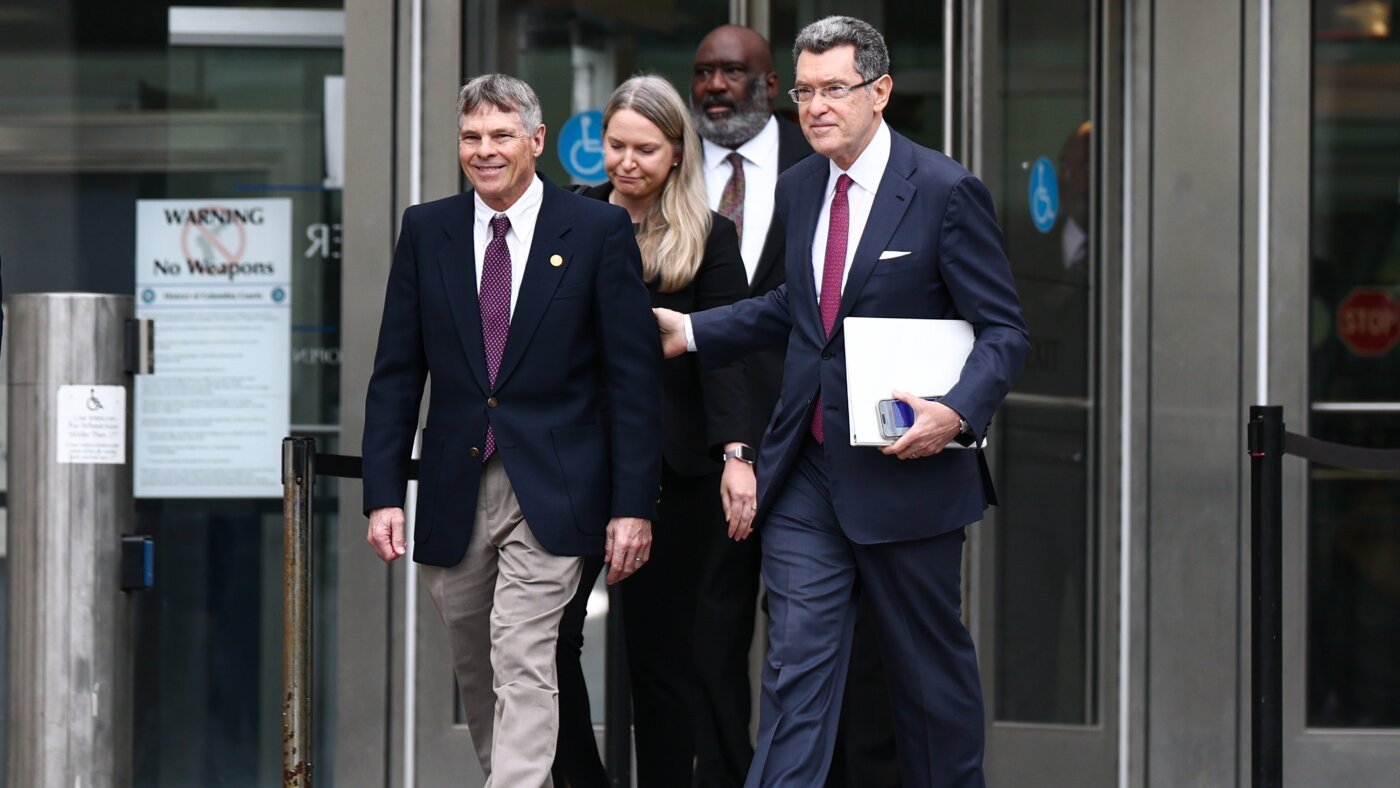
Former U.S. Olympian David Hearn (left) walks with his attorney Norman Eisen to speak to reporters and protesters gathered after his arraignment at the Superior Court of the District of Columbia in Washington, D.C. on Thursday.
Finn Gomez/Getty Images
hide caption
toggle caption
Advertisement
Finn Gomez/Getty Images
Former U.S. Olympic canoeist David Hearn pleaded not guilty to damaging the Lincoln Memorial Reflecting Pool in D.C. Superior Court Thursday morning.
Federal prosecutors charged Hearn with a single count of destruction of property causing more than $1,000 in damage to the pool.
Hearn has previously claimed, which his attorneys repeated during a short press conference outside the court, that he simply touched the water in the pool out of curiosity.
Advertisement
The Trump administration had just completed a $14 million renovation of the pool.
But shortly after the work finished, peeling paint and algae gathered in the water. The remodel has been largely criticized as a massive failure and waste of taxpayer dollars.
Superior Court Judge Carmen McLean released Hearn on his own recognizance. His next hearing is scheduled for Aug. 5.
Norm Eisen, one of Hearn’s attorneys, spoke to reporters outside of court following the hearing. He said the administration is using Hearn as a “scapegoat … for their own failures.”
“It is not a crime to touch the reflecting pool, to touch water in the United States of America,” he said.
Advertisement
Prosecutors say there is a host of evidence against Hearn.
Three more people have been criminally charged with destruction of property at the Lincoln Memorial Reflecting Pool.
Officers say they detained Cameron Thiers, Sophie Dennison-Gibby and Justin Carreno one Saturday afternoon in June and described in court documents witnessing them peeling and removing pieces of blue paint from the Reflecting Pool.
One officer “witnessed Carreno reach down into the reflecting pool and pull up a piece of the blue paint,” according to the court documents.
The officer who detained Dennison-Gibby “found 1 additional piece of the reflecting pool liner” in her purse, the documents said.
All three incidents were recorded on the officers’ body worn cameras, they said in the court documents.
Advertisement
Several “partnering law enforcement agencies assigned to the Reflecting Pool” working with US Park Police were involved in detaining the two men and one woman — including officers from Texas, Oklahoma, Montana and California.
One of the officers said in court documents that Thiers “admitted to removing a piece of blue sealant from the Reflecting Pool and still had it in his hand when I made contact with him.”
The three defendants were arraigned in court Wednesday and pleaded not guilty to the misdemeanor charges of destruction of property with a value less than $1,000. The judge ordered them to stay away from the Reflecting Pool.
Lawyers for Thiers and Dennison-Gibby declined to comment. CNN has reached out to Carreno’s attorney.
If found guilty of destruction of property, the defendants could be fined up to $1,000 and face a maximum of 180 days behind bars.
Advertisement
The New York Times first reported that three additional people had been charged with damaging the Reflecting Pool.
President Donald Trump has repeatedly claimed that vandals caused major damage to the pool by gashing the lining after his administration spent more than $14 million on renovations, though he has not provided evidence to support that claim. The officers who charged Carreno, Thiers and Dennison-Gibby did not accuse them of gashing the lining.
Former Olympic canoeist David Hearn was indicted by a grand jury in Washington, DC, last week for allegedly damaging the Reflecting Pool. Hearn — unlike Carreno, Thiers and Dennison-Gibby – was charged with destruction of property with a value of more than $1,000 which carries a maximum penalty of 10 years in prison, if convicted. He is set to be arraigned in court Thursday.
Crews began draining the Reflecting Pool over the weekend to make repairs, according to Interior Secretary Doug Burgum, for the second time in three months.
The move comes after weeks of problems – algae blooms, green-hued water, a chipping bottom and the administration’s allegations of vandalism – that have plagued the iconic landmark, making its woes the subject of national interest.