Wisconsin
Rural voters and their discontents • Wisconsin Examiner


Is Wisconsin — or the country — really as divided as the maps make it look?
On the spreadsheet of unofficial election totals posted by each of Wisconsin’s 72 counties following the election Nov. 5, a handful showed a clear majority for the Democratic presidential ticket of Vice President Kamala Harris and Minnesota Gov. Tim Walz. Many more counties were won by the winning Republican ticket of former President Donald Trump and Ohio Sen. J.D. Vance. Trump garnered enough votes to carry Wisconsin and enough states to return to the Oval Office in January.
A lot of those Trump-voting counties were rural ones, contributing to longstanding stereotypes about a monolithic body politic of deep blue cities and a bright red countryside.
But months before Election Day, on a mild August evening in a quaint round barn north of Spring Green, the writer Sarah Smarsh cautioned against oversimplifying the politics of rural voters — and against turning a blind eye to a part of the country that, she said, has too often been written off.
“I grew up on a fifth-generation wheat farm in south central Kansas,” Smarsh said that evening. It’s a place of “tall grass prairie, which happens to be the most endangered ecosystem … and simultaneously the least discussed or cared about or protected. And I don’t think it’s a coincidence that that’s the ecosystem of the place and people that I also happen to believe have not been given fair attention and due consideration.”
Smarsh made her mark with the book “Heartland: A Memoir of Working Hard and Being Broke in the Richest Country on Earth.” As a journalist and author she has straddled the community of her upbringing and the urbane, academic world that she entered when she became the first in her family to pursue higher education.
The child of a carpenter and a teen mom, Smarsh has explored the socioeconomic divide in the U.S., mapping it to the destruction of the working class, the demise of family farms and the dismantling of public services from health care to public schools.
“I write about socioeconomic class and I write about rural issues, but that’s because I grew up in working poverty, and that’s because I grew up on a farm,” Smarsh said. And while those identities “are enormously consequential,” she added, she seeks to break down the assumptions that people carry about them. Her message: “You don’t know who my family is, and especially if what we assume is that they’re white trash, worthless.”
It’s a story that gives new context to the election results from 2016 on, and takes on new importance after the election of 2024. The residents of those places dismissed as “flyover country,” Smarsh said back in August, have many of the same concerns of urban and suburban voters, including reproductive rights, public schools, gun violence and other subjects. And understanding them in their diversity and complexity casts politics, especially national politics, in a more diffuse and complicated light.
Where ‘people don’t care about political affiliations’
Concern about climate change and a desire to live more sustainably led Tamara Dean and her partner to move to western Wisconsin’s Vernon County in the early 2000’s, where they built a homestead, grew their own food and became part of the local agricultural community.

Climate change followed them. In their county, extreme weather events became almost the norm, with a 500-year flood “happening every few years or every year,” Dean said in an interview.
“A rural community really coalesces when extreme situations happen and they help each other out,” Dean said. “And when we were cleaning up after a flood, helping our neighbors salvage their possessions or even getting people to safety, no one’s going to ask who you voted for, and people don’t care about political affiliations.”
Dean has written a collection of essays on the couple’s time in the Driftless region of Wisconsin, “Shelter and Storm,” to be published in April 2025 by the University of Minnesota Press.
Distrust of the federal government
Residents, she found, had something of an ambivalent relationship with the federal government.
For all the complexity of agricultural economics, the U.S. Department of Agriculture programs that provide financial farm support were familiar and well-understood by longtime farmers and easily accessible to them, she said. But when the Federal Emergency Management Agency (FEMA) promised recovery assistance for flooding in 2018, “it just took forever to come, and it took a lot of bureaucracy to try to get it,” Dean said. For individual applicants, “getting any kind of assistance might be so daunting that they just wouldn’t think it’s worth it.”
For Dale Schultz, a former Republican state senator who has been thinking at length about politics and government in recent years, the election outcome has prompted contemplation.
Schultz left the Legislature a decade ago after splitting with Republican then-Gov. Scott Walker over legislation stripping public employees’ union rights and weakening Wisconsin’s mining laws.
Since then he has campaigned for redistricting reform and supported the overturning of Wisconsin Republicans’ gerrymandered legislative maps. iIn October he went public as a Republican supporting the Harris campaign for president.
In his part of the state, he saw a distinct contrast between the Democratic campaign and the Republican one.
“I saw an extremely good Democratic effort to talk to people face-to-face,” Schultz said in an interview. The GOP campaign along with allied outside groups such as American for Prosperity, however, appeared to him to focus almost entirely on mailings, phone calls and media.
“It became clear to me that politics is changing from the time I spent in office, being less people powered and more media powered,” Schultz said.
Ignored by both parties
Schultz said he’s observed a level of anger among some of his one-time constituents that has alarmed and surprised him, a product, he suggests, of having been ignored by both parties.

One target has been regulation, to the point where “they’ve lost track of why regulations are important and why they should support them,” he said. Yet he sees the direct answer to that question where he lives in Southwest Wisconsin.
“In the last 20 years there has been a renaissance in trout fishing, like I could not even have imagined 20 years ago,” Shultz said. He credits the Department of Natural Resources and its personnel for working with local communities to ensure conditions that would turn trout streams into suitable habitat to support a burgeoning population of fish. “That doesn’t happen without water quality and water quality regulations, and land use and land use regulations.”
Schultz has been spending time in conversation with friends “who are like-minded and similarly curious,” he said. “And then you just watch and wait and see what happens, and try to voice concerns that are real and that need to be dealt with, and [that] we’re not going to be able to hide from as a country.”
He hopes for the return of a time when people like him, who consider themselves “just to the right of center,” can again “talk to everyone and possibly craft a solution.”
Back in August, Sarah Smarsh offered a gentle warning about the coming election to her audience in the round barn north of Spring Green.
“Whatever happens in November, everybody else is still here — the other side is still here,” Smarsh said. “And so there’s going to be some caring to do, and that’s probably going to be for generations, because we didn’t arrive at this moment overnight.”

GET THE MORNING HEADLINES.



A missing Wisconsin teen was found safe after mysteriously vanishing from home four years ago as her family had believed she was “lured away.”
Joniah Walker, 19, was safely discovered on May 25, the Milwaukee Police Department told WISN on Tuesday.
Police officials didn’t disclose where Walker was found or provide any further information on the case, including whether the teen was with someone else.
Walker, then 15, had disappeared from her Milwaukee home on June 23, 2022.
Walker’s mother, Tanesha Howard, said she last saw her daughter lying in bed when she left for work the morning of her disappearance, according to the National Center for Missing & Exploited Children.
“Joniah was lying in bed because she had just finished school. I went in to give her a hug before leaving for work,” Howard told the organization.
The mother and daughter duo had talked on the phone several times throughout the day before Walker “suddenly stopped responding.”
Walker was supposed to meet her father to apply for a summer work permit but failed to arrive at the designated time.
“He called me and said that Joniah wasn’t picking up her phone,” Howard said. “That is when I immediately knew something was wrong. I left work right away.”
A nearby ring camera captured Walker leaving the apartment complex at around 2:30 p.m. in the Brewer’s Hill neighborhood, a mile-and-a-half north of Downtown Milwaukee.
Video footage showed the teen carrying a large green backpack.
It was the last known sighting of Walker until she was reportedly found last month.
Howard believed her daughter had met someone online after she deleted her digital footprint and never returned.
“Somebody stole her…that was my first instinct,” Howard said. “But when I saw that she left with a big backpack that I had never seen, that’s when I knew. I was like, someone lured her away.”
The protective mother issued multiple pleas for her daughter to come home, begging Walker to “call me,” WISN reported in July 2022.
“She is my youngest daughter, so I always call her by ‘baby girl’ because that is exactly who she is, my baby girl,” she said. “She is what I would describe as a perfect daughter. She is angelic, soft spoken and very intelligent.”
Walker was one of the faces of a legislative push by Wisconsin State Rep. Shelia Stubbs (D-Madison) seeking to pass a bill to create a Missing and Murdered African American Women and Girls Task Force, according to Fox6 Now.
Stubbs says she believed Walker was still alive, telling Howard to hold out hope for her daughter’s return.
“I believed Joniah was still living, and I said that to her – I don’t believe Joniah is dead, it’s only a matter of time,” Stubbs told the outlet.
“I think right now, the family needs their privacy,” Stubbs added. “I know there are so many questions, but I think as time goes by when they are ready to tell their story, they will tell it.”

Wisconsin’s sports teams will have a fitting jersey patch on their uniforms this year.
The Badgers unveiled a Culver’s uniform patch in a new video on Tuesday.
The fast food restaurant, known for its ButterBurgers and Frozen Custard, was founded in Wisconsin and is beloved by those in the state. Now, Culver’s has partnered up with the state’s flagship university.

The Wisconsin Badgers basketball offseason has looked slightly different than normal through the month of June.
Head coach Greg Gard’s class of 2027 rounds out the month of June, featuring three high-profile high school talents. Headlined by four-star in-state sensation Jalen Brown, the class also features three-star center Jack Thelen and Baboucarr Ann, Minnesota’s No. 1 prospect for the class of ’27.
Advertisement
While 247Sports considers Brown the No. 70 player, No. 13 shooting guard, and No. 5 recruit from Wisconsin for the class of 2027, Ann’s status as a small forward is certainly comparable. The outlet’s composite ranking ranks Ann as the No. 63 overall player, No. 18 small forward, and top-rated recruit from his state, making the tandem one of the most prestigious duos to commit to UW in recent history.
247Sports’ director of scouting Adam Finkelstein had this to say about Ann in his recruiting profile:
“Ann is a long-armed, two-way wing who already has versatile tools and yet plenty of potential to keep improving for the foreseeable future… Ann is a long-armed, two-way wing who already has versatile tools and yet plenty of potential to keep improving for the foreseeable future.”
But how did Ann perform during his latest season with Maple Grove High School in Maple Grove, Minnesota?
Advertisement
Through 31 games, he averaged 18.9 points, 4.3 rebounds, 3.5 assists, and 1.4 steals per appearance, according to StribVarsity. If Ann can provide even half of that production as a freshman, Wisconsin’s wing depth could look quite scary when he arrives in Madison.
Contact/Follow @TheBadgersWire on X (formerly Twitter) and like our page on Facebook to follow ongoing coverage of Wisconsin Badgers news, notes and opinion.
This article originally appeared on Badgers Wire: What did prized Wisconsin commit Baboucarr Ann average in 2025-26?
-

 World31 seconds ago
State Department congratulates Keiko Fujimori as Peru’s president-elect following razor-thin vote count
-

 Politics3 minutes ago
Mamdani ripped for claiming victory over capitalism after NYC’s multi-billion dollar taxpayer funded bailout
-

 Health9 minutes ago
American vaccines that transformed public health over 250 years: ‘Outweighs harm’
-

 Sports16 minutes ago
Ex-NFL reporter Dianna Russini interaction with police officer to dodge traffic ticket comes to light
-
 Business23 minutes ago
Joby Aviation creates a joint venture with Toyota to build air taxis
-
 Entertainment31 minutes ago
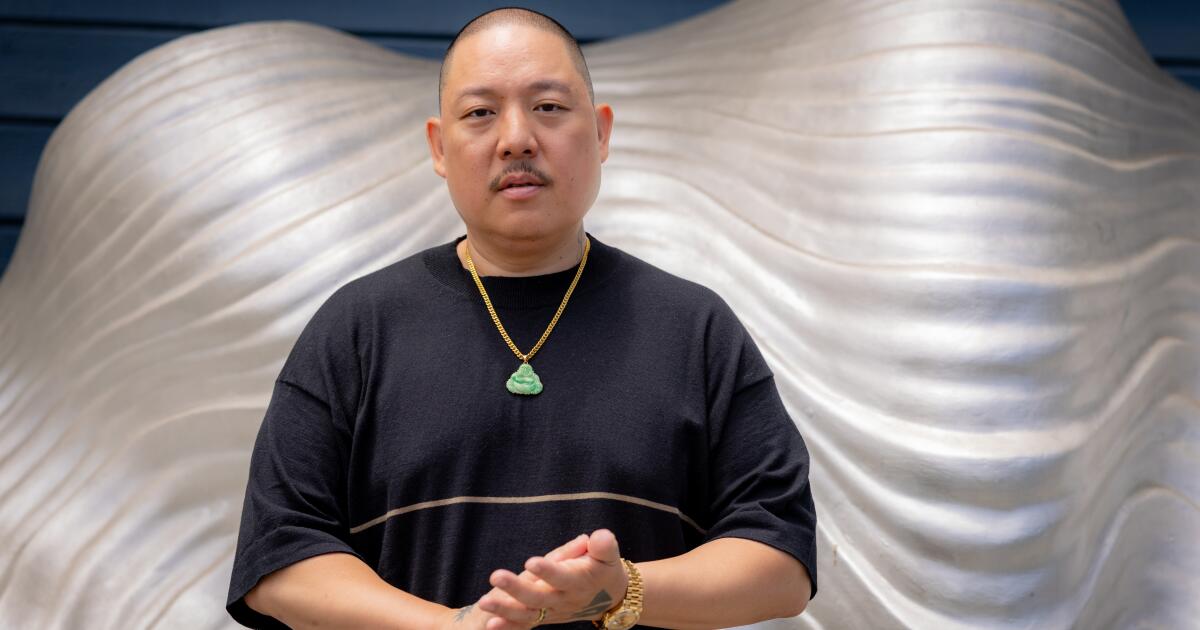
Inside Eddie Huang’s sadboi era and turning a new page with his novel
-
 Lifestyle33 minutes ago
Wait, it’s a candle? Her beeswax fruit and veggie ones look so real, you’ll want to take a bite
-
 Politics38 minutes ago
Commentary: The sad inevitability of Justice Alito’s birthright citizenship dissent

