Wisconsin
How to watch, stream Wisconsin women’s basketball vs. Minnesota: TV channel, prediction


The Wisconsin women make a quick turnaround, closing out 2024 back at home on Tuesday vs. Minnesota.
The Badgers (10-3, 1-1) saw their five-game win streak come to an end at the hands of Indiana on the road this past Saturday, 83-52. The loss was also the first for Wisconsin in Big Ten Conference play this year after knocking off Rutgers earlier in the month.
Serah Williams, the leading scorer, once again finished as the top point-getter for the Badgers with 13. She has done that in four straight and nine games this season.
Minnesota (13-1, 1-1) lost its league opener to Nebraska, 84-65, rebounding with two convincing wins over Jacksonville State and Prairie View A&M. They also own victories over Oregon State, SMU and Houston this season.
Last time out, the Golden Gophers topped Penn State, 90-54, reaching at least 80 points for the eighth time this year. Mara Braun leads three players in double figures while also pacing the team in assists and steals.
The ESPN FPI gives Minnesota an 86 percent chance to win. The Badgers won the last meeting, 67-56, but the Gophers lead the series, 21-10.
Here are details on how to watch Wisconsin vs. Minnesota on Tuesday, Dec. 31:
Who: Wisconsin vs. Minnesota in Big Ten Conference women’s basketball action
When: 3:30 p.m. CT | Tuesday, December 31
Where: Kohl Center | Madison, Wisconsin
Live Stream: Stream Wisconsin vs. Minnesota live on fuboTV (Start your free trial)
TV Channel: B1G+
Our Prediction: Minnesota 67, Wisconsin 60



Wisconsin guard Andrew Rohde reflects on early March Madness exit
Wisconsin guard Andrew Rohde said the Badgers ‘thought we could do so many things’ in the NCAA Tournament before it ended abrupty with an upset loss.
Wisconsin men’s basketball has added a sharpshooting wing via the transfer portal.
Miami (Ohio) transfer Eian Elmer has signed with the Badgers, the team announced April 18. The 6-foot-7 wing will join UW with one year of eligibility remaining.
Elmer averaged a career-high 12.7 points and 5.9 rebounds while shooting 49.8% from the field and 42.9% from 3-point range in 2025-26. His production helped the RedHawks go 32-2 and earn an at-large NCAA Tournament bid.
“We are really excited to add another excellent addition to our spring signees,” UW coach Greg Gard said in a release. “Eian brings a wealth of experience and scoring punch as a 6-7 wing. … A terrific shooter, his skillset and production fit excellently into our plan as we build out next year’s team. Throughout our evaluation process, our staff loved his size, power and skill and truly believe he will thrive in our system.”
Elmer is Wisconsin’s third transfer portal addition since the end of the 2025-26 season, joining former George Washington guard Trey Autry and former Hofstra forward Victory Onuetu. UW also added Australian guard Owen Foxwell.
The additions of Autry, Onuetu and now Elmer leave Gard’s staff with three more roster spots to fill ahead of the 2026-27 season.
The Badgers are looking to replace much of their production from a 2025-26 team that went 24-11. Nolan Winter is expected to be the team’s only returning starter after John Blackwell and Aleksas Bieliauskas entered the transfer portal and Nick Boyd and Andrew Rohde exhausted their eligibility.

MILWAUKEE – Friday’s severe storms have passed. And with that, the threat of any severe weather has also passed for the immediate future as no storms or rain are expected for several days.
However, plenty of damage remains across southeastern Wisconsin as of Saturday morning, in addition to the ongoing flooding threat.
Several area rivers are at flood stage, and there are multiple river flood warnings in effect.
FOX6 Weekend WakeUp on Saturday begins at 6 a.m.
On the scene in the morning
What we know:
Farmstead damage in Franklin
FOX6’s Hayley Spitler is in Franklin on Saturday morning, April 18, getting a daylight look at the damage from last night’s storms.
Storm damage in Caledonia
Friday’s storms left quite the mark across southern and southeastern Wisconsin, including at L and L Farms and Greenhouse in Caledonia.
FOX6 Weather Extras
Local perspective:
Meanwhile, FOX6Now.com offers a variety of extremely useful weather tools to help you navigate the stormy season. They include the following:
FOX6 Storm Center app
FOX LOCAL Mobile app
FOX Weather app
Maps and radar
We have a host of maps and radars on the FOX6 Weather page that are updating regularly — to provide you the most accurate assessment of the weather. From a county-by-county view to the Midwest regional radar and a national view — it’s all there.
SIGN UP TODAY: Get daily headlines, breaking news emails from FOX6 News
School and business closings
When the weather gets a little dicey, schools and businesses may shut down. Monitor the latest list of closings, cancellations, and delays reported in southeast Wisconsin.
FOX6 Weather Experts in social media
The Source: Information in this post was compiled by the FOX6 Weather Experts.

How Aleksas Bieliauskas has grown in first season with Wisconsin Badgers
Wisconsin coach Greg Gard has high praise for Aleksas Bieliauskas about a month into the Lithuania native’s freshman season.
MADISON – One of Wisconsin men’s basketball’s departing transfers is headed to an SEC program with some connections to the Badgers.
Ex-UW forward Aleksas Bieliauskas has committed to South Carolina, he announced on April 17.
Bieliauskas left the Badgers after appearing in all 35 games as a freshman and making 28 starts. He averaged 4.9 points and 4.4 points in 20.2 minutes, and highlights of his freshman year included his five 3-pointers in UW’s upset over eventual national champion Michigan.
He’ll join a program with plenty of Wisconsin ties. South Carolina head coach Lamont Paris was an assistant coach at Wisconsin from 2010-17 on Bo Ryan and Greg Gard’s staffs. South Carolina assistant coach Tanner Bronson and director of video services Roman DiPasquale also are UW alumni.
Bieliauskas is the second of UW’s four departing transfers to commit to a new school. Reserve forward Jack Robison committed to North Dakota State on April 15. Starting guard John Blackwell and reserve forward Riccardo Greppi have not announced their next schools yet.
-

 Technology22 seconds ago
Chinese robot breaks human world record in Beijing half-marathon
-
 Business6 minutes ago
Civil case against Alec Baldwin, ‘Rust’ movie producers advances toward a trial
-
 Entertainment12 minutes ago
Karol G at Coachella was a global hit. Yet other foreign acts fear touring the U.S.
-
 Lifestyle18 minutes ago
L.A.’s unofficial Statue of Liberty is a Fashion Nova billboard off the 10 Freeway
-
 Politics24 minutes ago
Ordered free, still locked up: Judges fume as Trump administration holds ICE detainees
-
 Science30 minutes ago
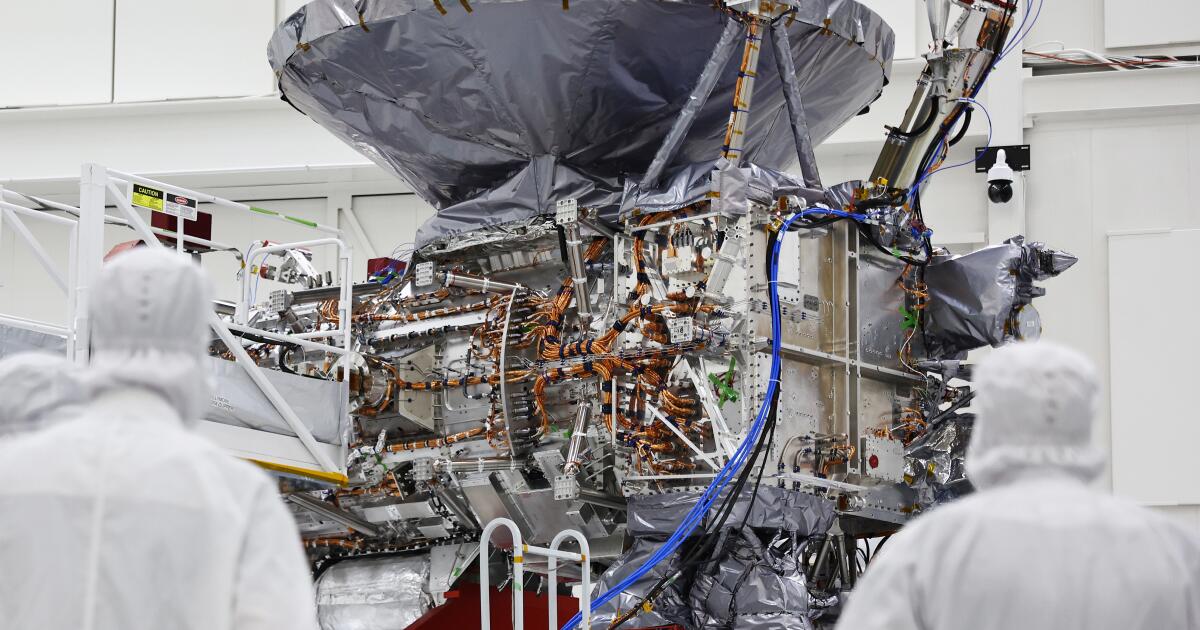
A renewed threat to JPL as the Trump administration tries again to cut NASA
-
 Sports36 minutes ago
After 55 years as a broadcaster in L.A., Randy Rosenbloom is leaving town
-

 World48 minutes ago
Bulgaria votes in eighth election in five years