Ohio
Here’s what won’t make the November ballot in Ohio


COLUMBUS, Ohio — The proposals to overturn legislation overhauling higher education, eliminate property taxes and end qualified immunity will not be on the November ballot, despite advocates trying to get the question to Ohio voters.
Public education advocates have fallen short 50,000 signatures of the needed 250,000 to put a referendum on the Ohio ballot, Youngstown State University Professor Dr. Cryshanna Jackson Leftwich said. She was aiming to repeal Senate Bill 1, a controversial college overhaul bill.
The effort was led by a small grassroots organization made up of mainly Youngstown State professors like Jackson Leftwich. The group had no money, no backing from statewide or national education groups or paid canvassers — which she said was a problem.
Typically, successful coalitions submit hundreds of thousands more signatures, because oftentimes they are invalid. When Ohioans United for Reproductive Rights, the group putting an amendment on the ballot to protect abortion, IVF and contraception, they submitted 300,000 more signatures than needed as cushion room. The group needed around 415,000, submitted 710,000 and ended with about 500,000 valid.
“It shouldn’t take millions of dollars to fight [for] democracy,” she said. “It shouldn’t take millions of dollars for consultants and lawyers for average voting citizens to say, ‘Hey, this is an unjust bill.’”
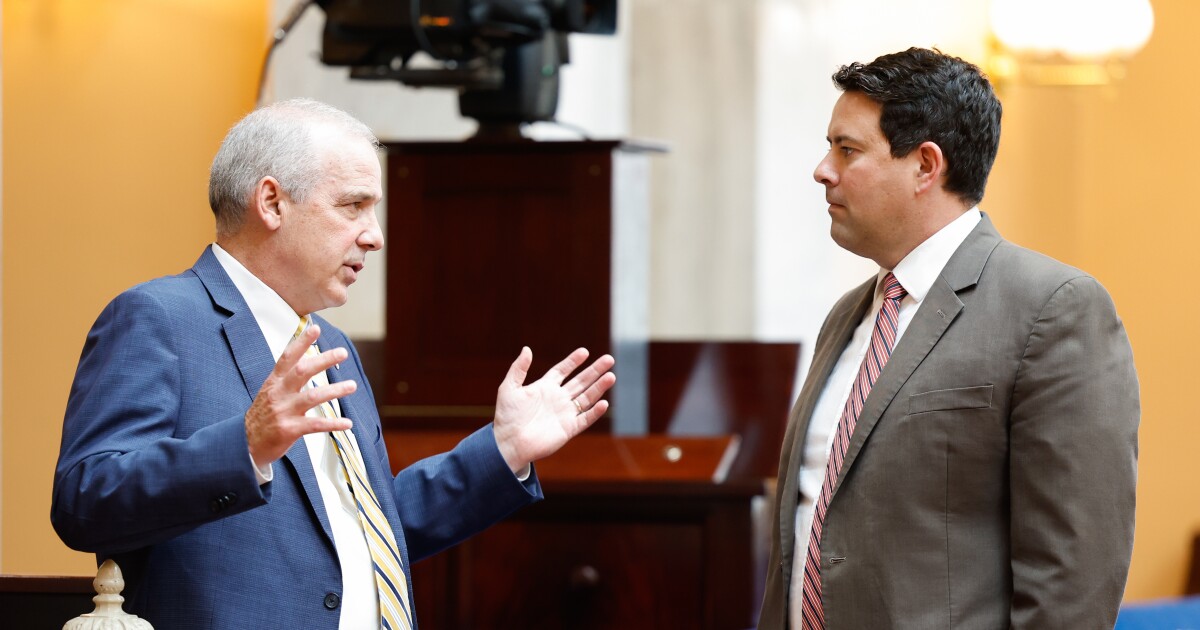
State Sen. Jerry Cirino, the top Republican on the influential Finance Committee, introduced the legislation.
“It provides for a policy to be established for what I call intellectual diversity, which is very important,” Cirino said. “It means openness to all various thoughts about various issues, which is the opposite of indoctrination — indoctrination is when you expose students to only one train of thought, so a monolithic thought environment. That is not good for students.”
Ohio Gov. Mike DeWine signs controversial college overhaul bill banning DEI
This massive bill focuses on what the Republican calls “free speech,” banning public universities in Ohio from Diversity, Equity and Inclusion initiatives, having “bias” in the classroom, and limiting how “controversial topics” can and can’t be taught. Eliminating DEI would mean no diversity offices, training, or scholarships.
“I believe that will benefit students greatly and produce better students who know how to think and analyze and come to their own conclusions,” he added.
Students and professors from across the state have continued to argue that there is nothing wrong with their education, and they are furious that lawmakers are trying to interrupt their classes.
Ohio House bans DEI, passes education overhaul bill
This is one of the most protested-against bills in recent Ohio history. There were roughly 1,500 people who submitted opponent testimony against S.B. 1, and there were about 30 who submitted in support. Which is why Amanda Fehlbaum, a YSU professor, was shocked when no larger organizations “stepped up” to help them, she said.
The group raised $45,000 in six weeks and collected the signatures without any paid assistance, which was very challenging, Fehlbaum added, emphasizing that larger groups said that a referendum would be “too expensive,” she said.
Cirino told us Thursday that he isn’t surprised that the effort failed, because he said the bill is good policy.
“I think their biggest problem was that this was a group of disgruntled faculty members, mostly from Youngstown State, who are satisfied with the status quo in higher education,” he said. “They couldn’t be more detached from reality in terms of what needs to be done to make Ohio’s Higher Ed the very best we can be.”
But the S.B. 1 repeal wasn’t the only “everyday” group that couldn’t get on the ballot.
The Citizens for Property Tax Reform didn’t submit the signatures they gathered.
“It’s such a huge undertaking,” organizer Beth Blackmarr said Thursday.
Blackmarr helped create a coalition of homeowners in Cuyahoga County, hoping to put a constitutional amendment on the November ballot that would eliminate property taxes.
Ohio citizens working to get proposal on ballot to abolish property taxes
Her team, Citizens for Property Tax Reform, knew they weren’t near the 415,000 they needed. She didn’t have an estimate of how many they collected, nor how much money they raised.
“As naive as we are, we may have underestimated, just a little bit, how big the response was really going to be,” she said. “That’s been quite rewarding, so we’ve asked everybody to keep on trucking and keep going.”
Despite both being grassroots, her situation is different from Jackson Leftwich’s for two main reasons: constitutional amendment proposals can be pushed back to future elections, and she told us a month ago that her proposal didn’t even have to reach the ballot.
“Hopefully, what legislators will do is counter with some legislation of their own,” she told me in May.
And it has worked.
“I’m hoping this does help to push us,” State Rep. David Thomas (R-Jefferson) said when I asked him about the tax amendment.
Thomas leads property tax relief discussions in the House and said that he and the other members heard Blackmarr. Since her amendment, lawmakers have been proposing more property tax relief bills and have passed several in the budget.
“This is a win-win for Ohio,” Blackmarr said.
Strategy has to come into play when getting an issue proposed statewide, she added.
“Is this indicative of the challenges that regular people face when trying to access the ballot?” I asked the professors.
“Ohio makes it as difficult as possible,” YSU’s Education Association President Mark Vopat said, detailing all of the work that must be done to go through the extensive collection process. “I believe that the state has made it as onerous as possible for individual citizens like us, — we’re doing this as a voluntary effort — to actually get some sort of referendum passed.”
For all ballot proposals, campaigns need valid signatures from at least 44 of Ohio’s 88 counties.
For referendums, the total signatures must be 6% of the total votes cast for governor during the last gubernatorial election. This makes the number about 248,092 valid signatures.
For initiated statutes, the total signatures must be 3% of the total vote cast for governor during the last gubernatorial election. This makes the number about 124,046 valid signatures.
For constitutional amendments, the total signatures must be 10% of the total vote cast for governor during the last gubernatorial election. This makes the number about 413,487 valid signatures.
There have been efforts to make this harder, though.
Republican leaders in Columbus are floating the idea of attempting to make it more difficult to amend the state constitution, a proposal that was defeated in 2023 by Ohioans across the political spectrum.
Another fight over majority rule in Ohio? Republican leaders float the idea.
Issue 1 in 2023 would have taken away majority rule in Ohio. The proposed constitutional amendment would have raised the threshold for constitutional amendments to pass from 50%+1, a simple majority, to 60%. It was defeated 57-43%.
The following year, 2024, the Senate GOP moved to increase the amount of counties campaigns must collect from and put more bureaucratic layers on advocates. They wanted to require all groups rallying for a cause that is receiving donations and spending money to register as a political action committee (PAC). This means that groups would have to file disclosures with the government, and it could make it more difficult to collect signatures to get a proposal on a township ballot.
OH House agrees to compromise on Biden ballot fix if ‘anti-democratic’ Senate provisions taken out of bill
Other challenges campaigns can face deal with the political offices they must go through.
Ohio activists are starting to gather signatures to get a constitutional amendment on the ballot that would end qualified immunity — a protection for police and other government officials that prevents citizens from suing them.
State law prevents government officials from being held liable for civil damages unless the victim can prove that the officer violated their constitutional rights, which can be an uphill battle, advocates say.
The Ohio Coalition to End Qualified Immunity has been battling Attorney General Dave Yost to get their summary language approved so that they can collect signatures. He has rejected it eight times, and recently, in short, courts have required him to allow them to move forward.
From their approval, they would have only had two months at most to collect signatures. Although initially hopeful for November, their team told us Thursday that they are now aiming for 2026.
But when it comes to S.B. 1, Jackson Leftwich said this isn’t the end for them, either.
“If we got this on the ballot, we would have overturned it,” she said.
The group didn’t specify if and how they would try again, or just rely on the larger groups in future years.
Follow WEWS statehouse reporter Morgan Trau on Twitter and Facebook.






Grand Opening party at new Kroger in Powell
Grand Opening party at new Kroger in Powell
Kroger is opening two more stores in central Ohio and renovating plenty more as part of a $112 million investment.
The “record breaking” funds are meant to “support shoppers and grow communities” in both central and northwest Ohio through 2026, according to a Kroger press release.
“These investments underscore Kroger’s confidence in the long-term growth of our communities and our ongoing commitment to meet customers where they live, work and shop,” said Jon Young, president of Kroger’s Columbus Division, which covers central Ohio, Toledo, Michigan and West Virginia. “By bringing new Kroger Marketplace locations and enhanced shopping experiences to our cities ranging from central Ohio to Toledo, we’re focused on creating convenient, modern stores that deliver fresh, affordable groceries for local families.”
On March 19, the company broke ground on its newest store in Canal Winchester. Construction is continuing at Kroger’s Delaware site at 1650 Sunbury Rd, and the 123,000-square-foot store is expected to open in early fall of 2026. According to Kroger, it will create more than 220 local jobs and brings a $33 million investment to Delaware County, one of the fastest growing counties in the state.
The Delaware location is “bringing the company’s most modern grocery experience to the community,” with “enhanced” produce, deli, meat and seafood offerings, a dedicated sushi counter, specialty cheese shop, as well as an expanded apparel section and on-site fuel center.
The Canal Winchester store will be 118,000 square feet and also feature a fuel center, and is slated to open in late fall of 2026. It’s a $30 million investment and will create around 250 jobs, according to Kroger.
Renovations are underway
Approximately $24 million will be spent on renovations for these 15 existing locations:
- Brewers Yard
- Dublin
- Gahanna
- Lambertville
- Lancaster
- New Albany
- Pataskala
- Reynoldsburg
- Sylvania
- Toledo
- Waterville
- Weirton
- Wheelersburg
- Wheeling
- Worthington
Renovations will differ by store needs and will likely include new product cases, improved restrooms and new decor, among other projects.
Currently, the Kroger Columbus Division employs nearly 18,000 people across the division’s stores in Ohio, Michigan and West Virginia.
Business and consumer issues reporter Samantha Hendrickson can be reached at shendrickson@dispatch.com

‘No Kings’ protests return to Ohio, condemning Trump’s policies
Nationwide “No Kings” protests took place on Oct. 18. Hundreds of demonstrators participated in protests in Columbus area.
A nationwide protest is set to return this weekend, with a “No Kings” demonstration planned at the Ohio Statehouse in downtown Columbus as well as in other area communities.
The Downtown event is part of a coordinated day of action expected to include hundreds, and potentially thousands, of gatherings across the country on March 28.
Mia Lewis, a volunteer with Indivisible Central Ohio and associate director of Common Cause Ohio, said the protest aims to bring together people concerned about federal policy and government overreach.
“We’re fed up with the Trump administration and their overreach,” Lewis said. “We’re taking a stand against illegal wars, injustice and power corruption.”
When and where is the Columbus protest?
The Columbus event is scheduled for 4 p.m. to 5:30 p.m. March 28 at the Ohio Statehouse, according to event organizers.
Participants are expected to gather near the William McKinley Monument before a rally and march through Downtown.
The protest is being organized locally by Indivisible Central Ohio, alongside partners including Common Cause Ohio, ACLU of Ohio and Columbus 50501.
Central Ohio events planned throughout the day
In addition to the Statehouse rally, there are three other rallies planned in Columbus, including at Easton, in German Village, and a senior-focused gathering scheduled from 10 a.m. to 11 a.m. near Neil Avenue and Goodale Boulevard.
Other rallies are scheduled in more than 15 other cities throughout central Ohio. Those interested can visit nokings.org to view a map of events in their region.
What is the ‘No Kings’ movement?
The “No Kings” movement is a nationwide organizing effort that opposes what organizers describe as authoritarian actions by President Donald Trump and his administration.
According to organizers, more than 1,000 events have already been planned across the country for March 28, with thousands more expected.
“I have noticed that most people are unhappy with the Trump administration and they want to see change,” Lewis said.
Organizers say millions of people participated in similar protests last year.
What to expect from ‘No Kings’ events
Organizers say the demonstrations are intended to push back against federal policies and actions they oppose, while also encouraging civic engagement and nonviolent protest.
The coalition has hosted training sessions ahead of the March events aimed at educating participants about their rights and how to safely observe federal enforcement activity.
Organizers estimate attendance at the Statehouse event could exceed 15,000 people, potentially making it one of the largest protests in the city’s history.
The event is expected to include speakers such as state Rep. Munira Abdullahi, D-Columbus; retired Maj. Gen. Dennis Laich and representatives from advocacy groups. Organizers said attendees are encouraged to bring signs and messages important to them.
“Everyone is welcome,” Lewis said.
Trending reporter Amani Bayo can be reached at abayo@dispatch.com.

Three individual state champions, two of whom won two events each, and three anchors of Upper Arlington’s third consecutive Division I team championship squad highlight The Dispatch’s 2025-26 All-Metro girls swimming and diving team.
Eleven of the 12 honorees have appeared in multiple state meets, and the 12th might be poised to join that club.
The Athlete of the Year in each sport – 30 in all – will be announced at the Central Ohio High School Sports Awards on June 22 at Upper Arlington High School.
Maren Berg, Upper Arlington
The junior and North Carolina commit was state runner-up in the 50-yard freestyle (23.09 seconds) and fourth in the 100 free (50.62) – an event in which she repeated as district champion (50.28). Berg, a three-time state qualifier who also won the 50 free at district in a meet-record 22.85, anchored UA’s state-title 200 free (1:33.67) and 400 free (3:25.21) relays.
Alexa Briseno, Gahanna Lincoln
The Division I district champion in the 100 backstroke (54.79) and runner-up in the 100 free by 0.05 of a second, Briseno was third at state in both the 100 back (54.85) and 100 free (50.2). The sophomore also anchored the Lions’ sixth-place 400 free relay (3:32.88) and led off the seventh-place 200 free relay (1:37.06).
Olivia Crock, Watkins Memorial
A senior who has signed with Cleveland State, Crock was Division I district champion in the 200 free (1:52.7) and runner-up in the 500 free (5:01.98) before placing seventh (1:52.55) and fourth (5:02.31), respectively, in those events at state. The three-time state qualifier, who was fifth in the 500 free as a junior and sixth as a sophomore, earned her first top-eight finish in the 200.
Sophie Dankof, Bexley
One of several talented underclassmen for the Lions, who finished third in the Division II state meet for the second year in a row, Dankof won district in the 100 back (58.31) and was second in the 100 breaststroke (1:05.4). At state, the sophomore was fourth in the 100 back (57.92) and ninth in the 100 breast (1:05.45) and led off the second-place 200 medley relay (1:45.67).
Katie Drummond, Bexley
The sophomore enjoyed a stellar season despite coming up 0.26 of a second shy of repeating as Division II state champion in the 50 free. Drummond won the event at district (23.26) and was second at state (23.21), and in the 100 butterfly was first at district (55.98) and third at state (55.83). She also was on the 200 medley relay and third-place 400 free relay (3:35.65).
Riley Hollingsworth, Upper Arlington
A three-time state qualifier, Hollingsworth was on the winning 200 medley (1:42.99) and 400 free relays and finished fifth in the 200 individual medley (2:05.87) and sixth in the 100 fly (55.12). A junior, Hollingsworth was district champion in the 100 fly (55.05) and runner-up in the 200 IM (2:03.38).
Brooke Nagy, Olentangy
A sophomore sprint specialist and two-time Division I state qualifier, Nagy was third in the 50 free (23.43) and fourth in the 100 fly (54.99) on the season’s final weekend after placing third (23.5) and second (55.14), respectively, at district. Nagy, who was fourth in the 50 free and fifth in the 100 free at state as a freshman, also was on the Braves’ third-place 200 free relay (1:35.24) and sixth-place 200 medley relay (1:46.48).
Leah Nebraska, Olentangy Berlin
The Akron signee finished her high school career with two Division I state championship swims, winning the 50 free (22.84) and 100 free (49.98). A three-time state qualifier who was seeded second and fourth, respectively, for those events at state, Nebraska was district runner-up in the 50 free (23.16) and third in the 100 free (53.98). She also was on the Bears’ seventh-place 200 medley at state (1:47.95).
Alexis Peltcs, Hilliard Darby
A senior and three-time state qualifier who has signed with Purdue, Peltcs was Division I district champion in the 100 breast (1:03.28) and fourth in the 200 IM (2:05.03) before finishing third (1:02.04) and fourth (2:03.87) in those events at state. Peltcs was breaststroke state champion and runner-up in the IM as a sophomore.
Sammy Petroff, New Albany
The freshman diver capped a dominant season by sweeping the Division I district and state championships, winning district with 504.15 points and state with 480.4. Petroff was the first big-school diving champion for central Ohio since Olentangy Liberty’s Olivia Lynch in 2020 and first for her program since Nikki Watters in 2016. The top five finishers were all from the Columbus area.
Kiera Powers, Upper Arlington
The sophomore won her first state championships, taking the 200 IM (1:59.79) and 500 free (4:55.92). She also led off the winning 200 free and 400 free relays, securing UA’s third straight team title and 15th all-time. Powers also swept her events at district (2:01.11 and 4:56.49, respectively) and was the No. 1 seed in both at state. She was seventh in the 200 free and eighth in the 500 free at state as a freshman.
Lily Schneider, Jonathan Alder
The Southern Indiana signee and four-time Division II state qualifier dominated the 100 breast in her prep career, winning district (1:03.96) this winter before placing second (1:02.96) at state, 0.27 of a second out of first place. Schneider, who reached state in the breaststroke every year, also excelled in the 200 free, finishing third at district (1:57.43) and eighth (1:57.38) at state.
COACH OF THE YEAR: Ruslan Gaziev, Watterson
A former Ohio State and Canadian national swimmer in his second year as head coach, Gaziev has helped steer a remarkable turnaround for Watterson.
Two years after the Eagles had only one Division I state qualifier and did not score as a team, they had four individual qualifiers, advanced all three relays to state and finished 10th overall – 42 places better than a year ago. That came a week after Watterson placed second in the district meet, its best finish since tying for second in 2012.
A native of Moscow who was raised in Toronto, Gaziev was a four-time first-team All-American in the 100 free and 200 and 400 free relays with the Buckeyes. He also was a two-time first-team all-Big Ten swimmer and eight-time honorable mention All-American. Gaziev participated in the 2021 Olympic Games with Team Canada, helping the 400 free relay to fourth place.
High school sports reporter Dave Purpura can be reached at dpurpura@dispatch.com and at @dp_dispatch on X.

Now a true pop star, Miley Cyrus returns to her ‘Hannah Montana’ roots to fete anniversary special

A look behind the scenes of what could be Google’s biggest test of carbon capture

30 Southern Nevada high school football programs go independent, leaving the NIAA playoff structure

Republicans losing ground in N.H. amid unpopular Iran war, survey says – The Boston Globe

New Jersey death investigator fired for sharing details of Johnny and Matthew Gaudreau’s fatal bike crash

Florida High School Football Rankings: Top 25 teams – Oct. 21

How old is Bo Nix? What to know about Oregon quarterback ahead of 2024 NFL Draft

Cleary's 21 help Le Moyne down Central Connecticut State 69-64 in OT

99th annual Pony Swim held in Virginia

Indiana Members Credit Union announced as new anchor tenant at Bottleworks District

See How the LaGuardia Plane Crash Unfolded

Mullin confirmed as DHS chief as lawmakers near solution on shutdown standoff

Von der Leyen clinches Australia trade deal

Trump administration places Christopher Columbus statue on White House grounds

See TSA Wait Times at Major U.S. Airports
-

 Detroit, MI5 days ago
Drummer Brian Pastoria, longtime Detroit music advocate, dies at 68
-

 Oklahoma1 week ago
Family rallies around Oklahoma father after head-on crash
-

 Georgia1 week ago
How ICE plans for a detention warehouse pushed a Georgia town to fight back | CNN Politics
-

 Alaska1 week ago
Police looking for man considered ‘armed and dangerous’
-

 Movie Reviews5 days ago
‘Youth’ Twitter review: Ken Karunaas impresses audiences; Suraj Venjaramoodu adds charm; music wins praise | – The Times of India
-

 Education1 week ago
Video: Turning Point USA Clubs Expand to High Schools Across America
-
 Science1 week ago
Long COVID leaves thousands of L.A. county residents sick, broke and ignored
-

 Sports3 days ago
IOC addresses execution of 19-year-old Iranian wrestler Saleh Mohammadi