North Dakota
Hennen: Cramer must want a 'big tent' GOP in ND


Sen. Kevin Cramer is headed for a second term in one of the world’s most exclusive clubs, the United States Senate. Having first defeated incumbent Sen. Heidi Heitkamp by 11 points in 2016, he recently cruised to an even more comfortable 33-point victory over his Democratic opponent, Katrina Christiansen.
It’s been quite a storybook journey for the kid from Kindred, North Dakota. His political service began with his work for a little-known statewide candidate in 1984. Next Cramer began working for and then leading the North Dakota Republican Party at a time when Democrats controlled almost all the levers of political power in the state. Cramer was elected party chairman in 1991. He served in this role until 1993, making him the youngest person to hold that position in the state’s history.
Interestingly, even after attaining elected office, Cramer has never stopped building the state GOP. In the just-completed election cycle, two political action committees he controls contributed nearly $175,000 to North Dakota Republicans at every level. In addition to his leadership PACS, his re-election campaign gave nearly $50,000 to the Republican Party. As impressive as the amount is, the diversity of the recipients is more so. Call them MAGA, Bastiat or just conservative disruptors, Cramer supported them. Call them moderate, establishment or even liberal, he supported them. The one thing they all are is Republican.
Cramer no doubt remembers those challenging political times when Republicans were in the minority in North Dakota. Now the only political fights seem to have Republicans fighting other Republicans. So when conservative groups were running ads against moderate Republicans, Cramer helped level the playing field. An example would be his $5,000 contribution to District 10 legislative candidate Steve Swiontek.
When more establishment types ran ads against disruptors, Cramer helped level the playing field, having given $5,000 to another District 10 legislative candidate Jared Hendrix. He also made contributions to the campaigns of Kelly Armstrong, Julie Fedorchak, Josh Gallion, and legislative candidates Jim Kasper, Ben Koppleman and Michelle Powers. Additionally, there were donations to Districts 4, 8, 9 and 12 ND GOP candidate committees.
According to the same recent Federal Election Commission filings reporting Cramer’s donations, Sen. John Hoeven’s Dakota PAC contributed $10,000 to U.S. House candidate Fedorchak and $10,000 to Gov. Doug Burgum’s campaign for president. The rest of his contributions were to U.S. Senate races elsewhere, which is what the leadership PACs are most often utilized for, and a small amount to his legislative district in Bismarck. Hoeven also gave donations to his Senate colleagues who were not up for reelection, but oddly none to Cramer.
Cramer’s contributions might be a way of building bridges between factions of North Dakota Republicans or pushing back on Republican infighting. He is fond of saying, “Politics only works by addition.” His first foray into big-time politics was when Lee Atwater was the Republican National Committee chairman who clearly articulated the “big tent” theory and never lost sight of who the real adversaries are, the Democrats.



The Bison are in the game. For real, this time.
When EA Sports brought back its College Football title in 2024 after a decade-plus hiatus, FCS teams were not included. That’s still the case as the game moves into the third year of its revival, but, of course, North Dakota State has moved up to the FBS level, as members of the Mountain West.
And one of the perks of that move is inclusion in the popular sports simulation. Participating players get $1,500 plus a free copy of this year’s game, College Football 27.
Not bad, huh?
I can only imagine how cool it is for a kid like Abraham Myers, a tight end from Sioux Falls Washington High School, to see himself as a playable character on a millions-selling PlayStation game, but it’s cool for fans, too.
If you’re a Bison fan, it’s all right there. The Fargodome (sorta, EA didn’t bother to include the name, calling it ‘North Dakota State Stadium’), Tim Polasek, the Bison mascot — OK, that’s really about all the detail they went into, and Polasek’s likeness leaves a bit to be desired. Then again, they still haven’t made much effort to make Kalen DeBeoer look like Kalen DeBoer, so whatever, I guess.
In the past you could still play as NDSU, or SDSU, or USD, or Augustana, or Roosevelt High School, or St. Mother Theresa’s Middle School for the Deaf, or any other team, real or imagined, because of the game’s “Create a team” engine, and that’s still there on this year’s game. There are already a few Jackrabbit teams up on the servers that you can download if you’re an SDSU fan and want to play as the Jacks.
Screenshot
But Bison fans (and Sac State fans, and Missouri State fans, etc., etc.) don’t have to do that. Their team is in the game, with their actual stadium and their actual coach and their actual players, and when I fired up the game on Thursday just an hour after it officially launched, I’ll admit it, the first thing I did was start a game in Fargo, pitting New Mexico against the Bison in the Fargodome for a Mountain West clash that sent former SDSU assistant Jason Eck up against his old Dakota Marker nemesis.
The game started up and there they were: Nathan Hayes under center for the Bison, with DJ Scott carrying the ball, Jackson Williams running free over the middle and Myers teaming with Reis Kessel at tight end to create problems in the red zone.

Screenshot
I went right down the field and scored on the opening drive, with Hayes finding Williams on a drag route for the touchdown.
Despite the best efforts of New Mexico’s star linebacker and former Brookings Bobcat Jaxton Eck (Jason’s son), I had no trouble dispatching the Lobos 31-10.
Later I played around with some other fun matchups.
I brought Nebraska into the Dome, and while we all know the Huskers stink now, for someone like me who’s old enough to remember their Glory Days, it was fun to see the iconic Nebraska uniforms on the Fargo turf, and wonder if someday that could actually happen now that NDSU is in the FBS.

Screenshot
Later I played a game at the Big House in Ann Arbor, sending the Bison up against the Wolverines. Michigan got the ball first and after a holding penalty pinned them deep in their own territory, Keenan Wilson’s strip-sack of Bryce Underwood gave the Bison first and goal, and with the Miaze and Blue crowd of over 100,000 roaring, I quickly turned it into a short touchdown pass from Hayes to Myers.
Ultimately I couldn’t keep that up against the Wolverines, falling 31-21.
I played around with some other teams, mostly the ones with familiar faces. Jimmy Rogers and Iowa State, Matt Entz at Fresno State, Missouri State, Kennesaw State, Sac State, Delaware and other former FCS powers.

Screenshot
I also played a few series of the Tennessee vs. Alabama rivalry game to get an early glimpse of what kind of teams South Dakota’s two favorite SEC sons (DeBoer and Josh Heupel) might have in store for 2026.
Much has been made of trying to predict how successful the Bison will be in year one at the FBS level. Some have already anointed them a favorite to grab a G6 playoff spot. Others think they’ll at least win the Mountain West, while few seem to think they’ll finish much lower than third or fourth.
What does EA think?

Screenshot
The Bison are given an overall team rating of 75 (99 is the highest possible), which is higher than many if not most G6 teams. James Madison, for one, gets a 77.
The other Mountain West teams earned the following ratings:
Air Force – 74
Hawaii – 76
Nevada – 73
New Mexico – 76
Northern Illinois – 70
San Jose State – 72
UNLV – 78
UTEP – 72
Wyoming – 73

Screenshot
As for the NDSU players, here are their top rated personnel:
Griffin Empey (LG): 87
DJ Scott (RB): 83
Keenan Wilson (DT): 80
Darius Glance (SS): 79
Myles Mitchell (RB): 78
Josh Magin (RT): 78
Donovan Woolen (LB): 78
Keith Williams (LB): 78
Logan Larson (DT): 77
Jackson Williams (WR): 76
Matthew Stenbroten (DE): 76
Zach Vanderpool (DT): 76
Alijah Wayne (DT): 76
Jaylin Crumby (FS): 75
Kelton McCaslin (DE): 75
Reis Kessel (TE): 75
Nathan Hayes (QB): 74
Nate Tastad (RG): 74
Taylen Eady (FS): 73
Ryan Babatz (LT): 73
Alex Jenkins (LT): 73
DJ Volts (CB): 72
Mekhi Collins (WR): 71
Jack Liwienski (OG): 71
EJ Davis (CB): 71
Will Steil (FS): 70
Drew Klein (K): 70
Makes you wonder how players like Chase Mason and Charles Pierre would measure up. Maybe someday the Jacks, Coyotes and Fighting Hawks will be in the game and we’ll find out.

Screenshot

Screenshot

Screenshot

Screenshot

Screenshot

Screenshot

Screenshot

Screenshot

Screenshot

Screenshot

Matt Zimmer is a Sioux Falls native and longtime sports writer. He graduated from Washington High School where he played football, legion baseball and developed his lifelong love of the Minnesota Twins and Vikings. After graduating from St. Cloud State University, he returned to Sioux Falls, and began a long career in amateur baseball and sports reporting. Email Matt at mzimmer@siouxfallslive.com.

BISMARCK — A West Fargo attorney has been appointed to the North Dakota Ethics Commission.
According to a release, Lisa Edison-Smith was appointed to the commission Tuesday, July 7, to fill the unexpired term of Commissioner Ronald Goodman, who will retire from the board.
Edison-Smith works for Vogel Law Firm, from which she plans to retire at the end of the year, the release said. She specializes in employment and labor law and is also the editor of the North Dakota Employment Law Letter, a monthly publication providing guidance to employers.
Edison-Smith graduated from North Dakota State University and Hamline University School of Law. She was a clerk for the Minnesota Supreme Court and worked in finance and accounting roles at GTE Corp., the release said.
“I am grateful for the opportunity to bring my legal experience and problem-solving skills to the important work of the Commission,” Edison-Smith said via release. “Together, I believe we can improve public trust and deepen the Commission’s commitment to accountability and transparency in North Dakota.”
Commissioners are appointed by consensus of the governor and majority and minority leader of the North Dakota Senate.
Our newsroom occasionally reports stories under a byline of “staff.” Often, the “staff” byline is used when rewriting basic news briefs that originate from official sources, such as a city press release about a road closure, and which require little or no reporting. At times, this byline is used when a news story includes numerous authors or when the story is formed by aggregating previously reported news from various sources. If outside sources are used, it is noted within the story.
North Dakota
Schulz to transition from ND Parks and Recreation to ND Department of Corrections and Rehabilitation

Gov. Kelly Armstrong today announced that North Dakota Parks and Recreation Department Director Cody Schulz is leaving the agency next month to assume the role of chief financial officer in the North Dakota Department of Corrections and Rehabilitation, effective Aug. 17.
Schulz has led Parks and Recreation since being appointed director by then-Gov. Doug Burgum in October 2021. Armstrong reappointed Schulz to the position upon taking office in December 2024. Schulz previously served 13 years in the state Department of Emergency Services (DES), including as business manager and finance officer for seven years and as the state’s director of Homeland Security from 2018 to 2021. Prior to joining DES, he spent nearly 13 years in the private sector as a business owner, account specialist and government and public affairs analyst.
“Parks and Recreation has thrived under Cody’s leadership, opening a new state park at Pembina Gorge, expanding and improving existing parks, making major investments in infrastructure and enhancing visitor experiences,” Armstrong said. “While we will miss his leadership of the agency, we’re excited that he has decided to continue serving the citizens of North Dakota at DOCR, where his experience in finance and accounting will serve the department well.”
“This was an incredibly difficult decision, one driven primarily by the desire to travel less and spend more time with family, especially my aging parents. At the same time, my new role at DOCR allows me to work in finance and public safety – two passions that have shaped much of my career,” Schulz said. “I am filled with gratitude for the team at Parks and Recreation, and I leave with complete confidence in this organization. This is an exceptionally talented team filled with capable, dedicated people who care deeply about one another, our mission, and the citizens we serve.”
A native of New Salem, N.D., Schulz earned an associate’s degree from Bismarck State College, a bachelor’s degree in business administration from Dickinson State University and an MBA from the University of North Dakota. He also served on the Morton County Commission from 2012 to 2020, including as chairman in 2016, 2017 and 2020, and as a member of the Morton County Park Board for eight years.
-
 Sports3 minutes ago
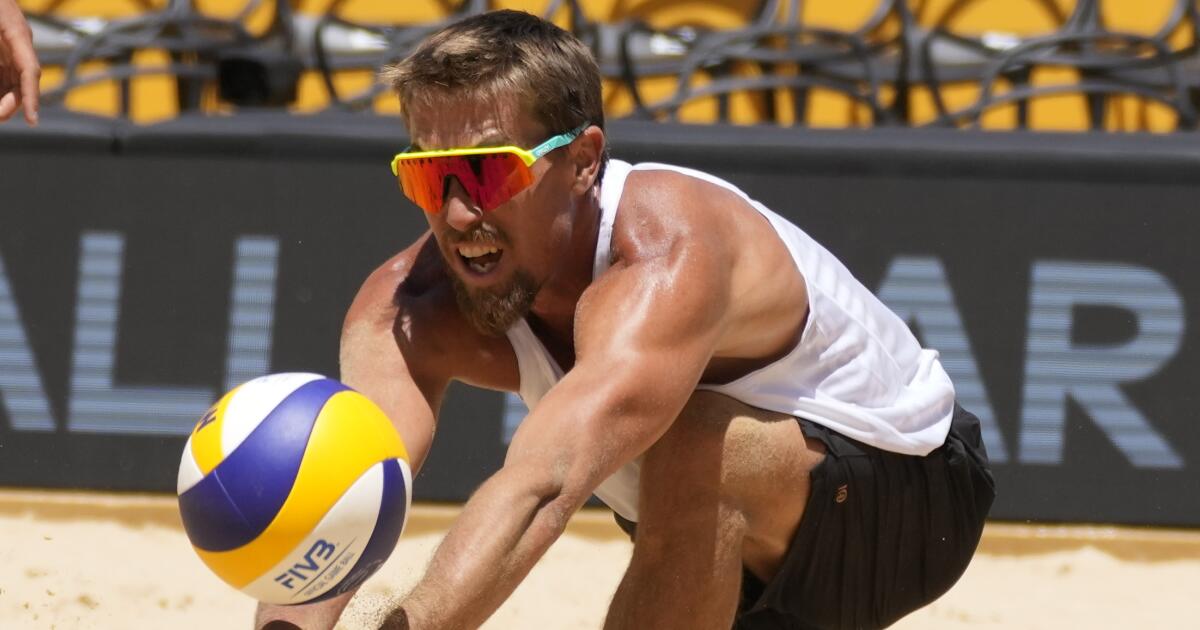
Q&A: Partner, chance to play in Long Beach reignited AVP star Taylor Crabb’s Olympic fire
-

 World13 minutes ago
Moldova president nominates pro-European businessman Tofan for PM
-

 News41 minutes ago
US congressman says he was detained by armed Israeli settlers in occupied West Bank
-

 Los Angeles, Ca2 hours ago
New details emerge in fatal stabbing of boy in El Monte
-

 Detroit, MI2 hours ago
1 dead, 1 injured after two-vehicle crash at Collingwood and Belleterre in Detroit
-

 San Francisco, CA3 hours ago
4 arrested, 3 cited after brawl following Giants vs. Rockies game at Oracle Park
-

 Dallas, TX3 hours ago
Mark Cuban takes legal action against Dallas Mavericks ownership over potential new arena deal
-

 Miami, FL3 hours ago
South Florida Dirt: A timeline of the Vacchi vs. Stern legal battle

