Missouri
Missouri reveals which Chinese assets it will target in $50bn row


Missouri’s attorney general has revealed which Chinese assets the state will be targeting in a $50 billion legal row.
The Show Me State’s legal battle with China has intensified as both sides pursue multibillion-dollar claims related to the COVID-19 pandemic.
And now, Missouri Attorney General Catherine Hanaway has explained what is on the table in terms of what assets will be targeted in the litigation.
“China caused extraordinary harm to our citizens and our economy,” she told Newsweek. “We are committed to holding them accountable and recovering every dollar we can. I’ve been asked if we will seize the pandas at the National Zoo. The answer is no, we are looking at other Chinese-owned assets, including farmland.”
Why It Matters
The confrontation highlights ongoing diplomatic rifts between the United States and China and raises complex questions about international law, sovereign immunity, and the ability of U.S. states to seize foreign-owned property. The outcome could set precedents for future pandemic-related litigation and diplomatic engagement between the two countries.
What To Know
China recently filed a lawsuit in a Wuhan court against Missouri and several state officials, seeking more than $50 billion in damages and public apologies.
In response, Missouri is advancing efforts to enforce a $24 billion U.S. court judgment against the Chinese government and affiliated entities—by targeting certain Chinese-owned assets within the United States.
The current dispute stems from a 2020 lawsuit filed by Missouri, which alleged that China exacerbated the coronavirus pandemic by hoarding personal protective equipment (PPE) and failing to provide timely warnings regarding the virus.
Earlier this year, the Missouri Attorney General’s Office obtained a $24–$25 billion judgment against the People’s Republic of China, the Chinese Communist Party, and related entities after Chinese officials declined to participate in the U.S. court process.
In response to Missouri’s legal success, China has now filed a $50.5 billion (356.4 billion yuan) lawsuit in the Intermediate People’s Court of Wuhan.
The complaint, jointly submitted by the Chinese government, Wuhan’s municipal government, the Chinese Academy of Sciences, and the Wuhan Institute of Virology, names the state of Missouri, Governor Mike Kehoe, U.S. Senator Eric Schmitt, and former Attorney General Andrew Bailey as defendants.
The Chinese lawsuit claims Missouri and its officials engaged in “fabricating enormous disinformation, and spreading stigmatizing and discriminating slanders” that impaired China’s economic interests and reputation.
Alongside financial compensation, China seeks public apologies in prominent American and Chinese media outlets, recovery of legal costs, and the right to claim further damages.
What People Are Saying
Hanaway said: “I find it extremely telling that the Chinese blame our great state for ‘belittling the social evaluation’ of The Wuhan Institute of Virology… We stand undeterred in our mission to collect on our $24 billion judgment that was lawfully handed down in federal court.”
U.S. Senator Eric Schmitt, who initiated Missouri’s original lawsuit, said: “I’ve been banned from Communist China, and now I am being sued and targeted by Communist China in a $50 Billion lawfare campaign, and I’ll wear it like a badge of honor… This novel lawsuit is factually baseless, legally meritless, and any fake judgment a Chinese court issues in this lawsuit we will easily beat back and keep from being enforced against the people of Missouri or me.”
Liu Pengyu, spokesperson for the Chinese Embassy in Washington, described the Missouri lawsuit as “a purely politically motivated maneuver [and] China firmly opposes it, will never accept it, and reserves the right to take strong countermeasures.”
What Happens Next
Missouri is in the process of seeking certification of its federal court judgment—a legal prerequisite for initiating asset seizures under U.S. law. If certification is granted, the state may move forward with efforts to identify and seize Chinese-owned assets, particularly farmland and financial interests connected to the Chinese government or its proxies.
Simultaneously, Chinese legal action in Wuhan courts is ongoing, with the plaintiffs demanding significant damages and public apologies.



Morgan Luebbering, a senior in early childhood education at Missouri S&T, has earned the Missouri Teacher Leaders of Tomorrow Award from the Missouri Milken Educators in partnership with the Missouri Department of Elementary and Secondary Education. Luebbering was a student-teacher at Mark Twain Elementary School in Rolla, Missouri, in the fall 2025 semester.
Missouri Teacher Leaders of Tomorrow celebrates educators who have demonstrated high potential and aims to empower recipients by pairing them with another award-winning educator who will encourage them to pursue excellence during their first year as a teacher.
Only 15 students in Missouri earn the award each year, and this is the third year in a row that a Missouri S&T education student or graduate has earned the award.
“Morgan was nominated by the university’s education department because she is an exceptional student who will make a big difference in students’ lives in the future,” says Dr. Mary Gillis, associate teaching professor of education at Missouri S&T. “The faculty have been impressed by her efforts during her student-teaching experience and her dedication to improving in the classroom. I know she will inspire generations of students, especially those who want to learn science, technology, engineering and mathematics (STEM) in the future.”
Luebbering, originally from St. Thomas, Missouri, will graduate from S&T this May and is already scheduled to start teaching full time in the fall at Thorpe Gordon STEM Academy in Jefferson City, Missouri.
About Missouri S&T
Missouri University of Science and Technology (Missouri S&T) is a STEM-focused research university of over 7,000 students located in Rolla, Missouri. Part of the four-campus University of Missouri System, Missouri S&T offers over 100 degrees in 40 areas of study and is among the nation’s top public universities for salary impact, according to the Wall Street Journal. For more information about Missouri S&T, visit www.mst.edu.

MISSOURI CITY, Texas – The Missouri City Police Department needs your help locating a missing teen who went missing last week.
What we know:
Authorities are looking for 16-year-old Corinne Polk.
Corinne Polk (Source: Missouri City Police Department)
Corinne was last seen on April 2 on Greencourt Drive in Missouri City.
Corinne is described as a Black female, 5′ tall, 114 pounds, with black hair and brown eyes.
Corinne was last seen wearing a royal blue hooded sweatshirt, black pants and pink slippers.
What you can do:
If you’ve seen Corinne or have any information on where she is, contact the Missouri City Police Department at (281) 403-8700.
The Source: Missouri City Police Department

By Brian Consiglio
April 7, 2026
Contact: Brian Consiglio, consigliob@missouri.edu
Photos by Abbie Lankitus
The University of Missouri is scaling up the use of virtual fencing, a cutting-edge agricultural technology that’s gaining attention among livestock producers and state officials.
Thanks to a $3.7 million grant from the National Fish and Wildlife Foundation (NFWF), Mizzou’s Center for Regenerative Agriculture will help hundreds of livestock producers in Missouri and Nebraska save time and labor with GPS-enabled collars for their cattle.
Virtual fencing collars guide cattle to fresh grazing fields with a variety of cues. Once their cattle are collared with the new technology, producers simply draw their virtual boundaries on a mobile app or computer and activate their interior “fences” with the press of a button. That reduces the time producers need to spend tearing down and rebuilding physical fences to move cattle to different pastures.
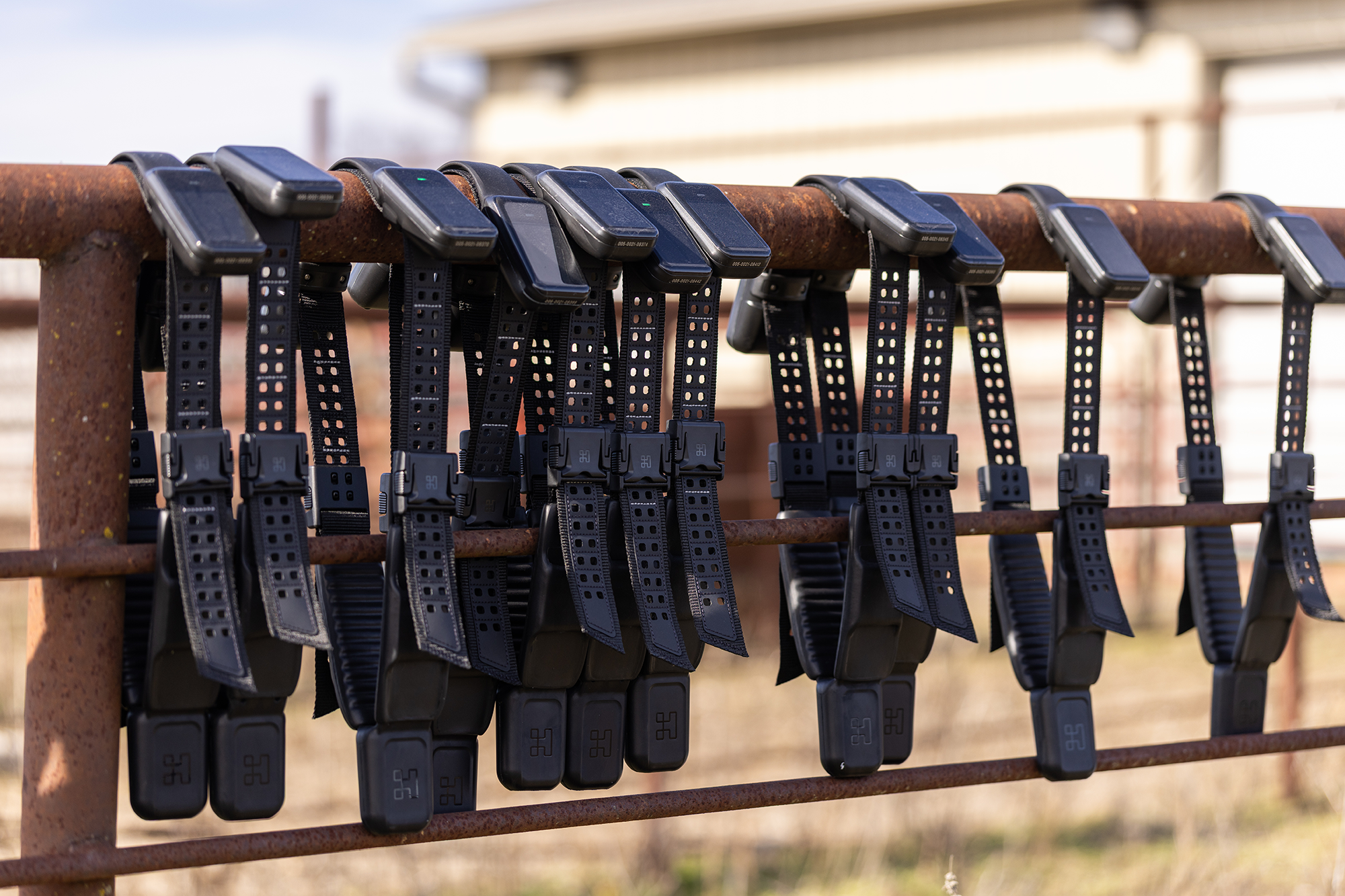
“Not only are we giving producers time back in their day by eliminating the time- and labor-intensive process of constantly moving interior fences, but we are also helping them be good stewards of the land by improving the sustainability and profitability of beef production,” Rob Myers, the center’s director, said. “I heard from one producer who is getting nearly double the value from each acre of land after switching to virtual fencing because his cattle are now eating all the cover crops in one field before moving on to the next field. He loves redrawing the boundaries on his phone.”
Beefing up impact
Myers and his team initially tested the technology in partnership with five Missouri producers. The latest grant will allow the center to expand the project by collaring the cattle of 200 livestock producers in Missouri and Nebraska who collectively manage around 150,000 acres. The award is part of $32.8 million in initial grants announced by NFWF as part of the new Grassland Resilience and Conservation Initiative, supported by funding from McDonald’s USA, the USDA Natural Resources Conservation Service (NRCS), and several key McDonald’s USA beef and beverage suppliers.
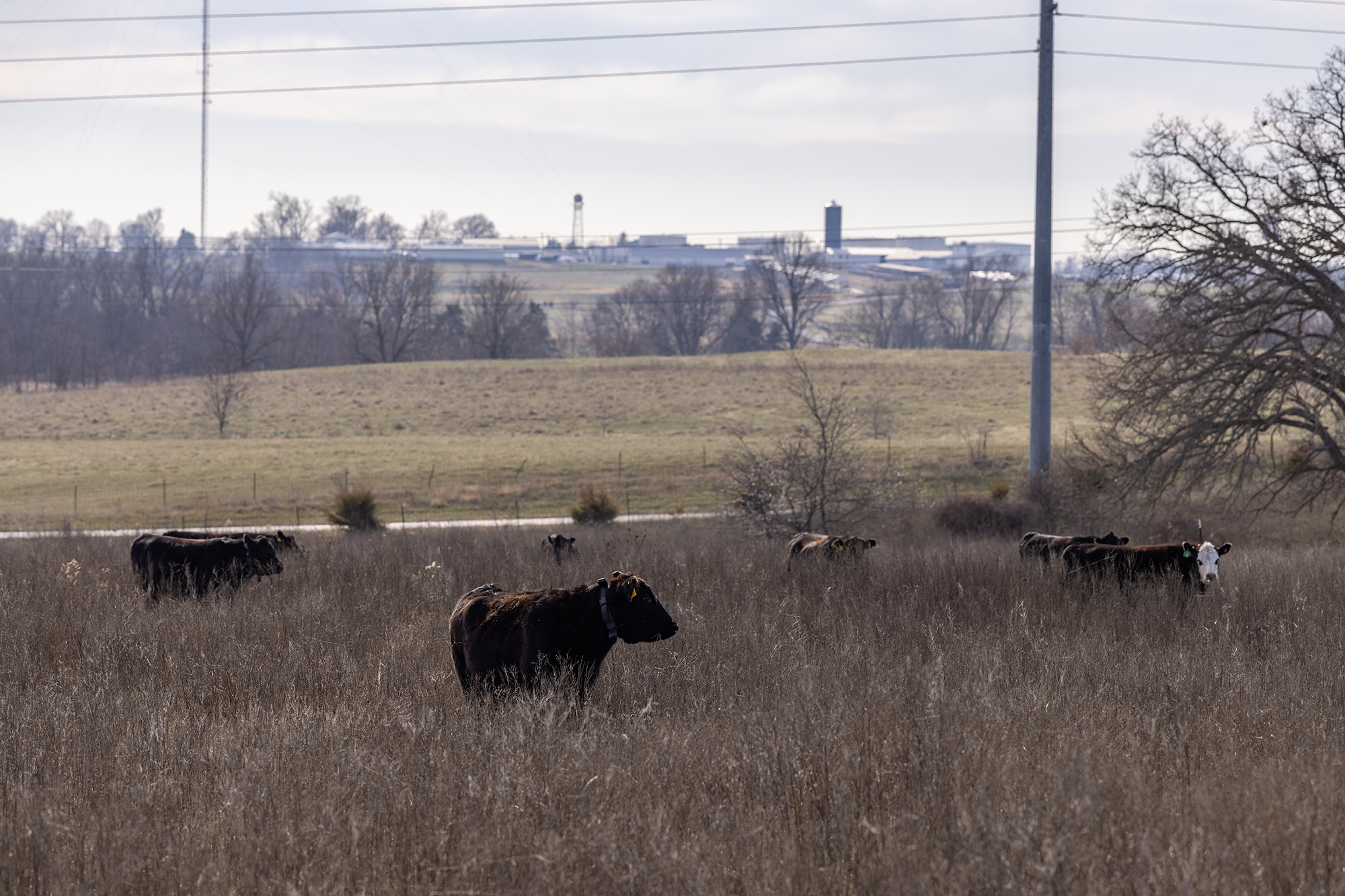
The grant provides incentive payments directly to producers who adopt the virtual fencing technology, which can also be used to protect streams, rivers and other sensitive landscapes. Additionally, Myers and his team will help producers improve their watering systems and plant native forages, boosting sustainability and profitability.
“The grass in most Missouri pastures is tall fescue, which is not native to the U.S.,” Myers, an extension professor in the College of Agriculture, Food and Natural Resources, said. “So, by having native plants also be part of livestock grazing, that extends the grazing season, and it’s great for soil health and wildlife.”
Stewards of the land
The center’s goals — to build more integrated approaches to regenerative farming and develop more resilient food systems — are deeply personal to Myers.
He grew up on a farm in Illinois, seeing firsthand the downsides of soil erosion and the benefits cover crops — plants that enrich soil and hold it in place — had on the farm’s corn and soybeans.
“As a boy, I remember seeing the positive impact cover crops had on soil health, which sparked my interest in regenerative agriculture,” Myers said. “That’s something I’ve been passionate about ever since.”
Myers added that the virtual fencing project is an example of Mizzou’s efforts to improve rural communities by prioritizing engagement.
“At Mizzou, we’re not only doing research; we’re helping society directly benefit from the research through our extension, education and community outreach efforts, and that is what a flagship university is all about,” Myers said. “One of the major challenges in agriculture today, particularly in the Midwest, is how to keep the soil as productive and resilient as possible. I’m very motivated to help producers adopt best practices in regenerative agriculture so they and the next generation of producers will be successful in the long run. And we think virtual fencing can play a big role in that.”

Iran ceasefire deal frays as attacks continue; Trump’s peace terms remain unclear

The Masters is Amazon Prime’s next test in live sports

‘Even the street cats ran’: Inside Israel’s deadliest attack on Beirut

California Supreme Court halts GOP sheriff’s voter fraud investigation

K-9 sniffs out undeclared fruit trees in arriving luggage at Detroit Metro Airport

Florida High School Football Rankings: Top 25 teams – Oct. 21

How old is Bo Nix? What to know about Oregon quarterback ahead of 2024 NFL Draft

Cleary's 21 help Le Moyne down Central Connecticut State 69-64 in OT

99th annual Pony Swim held in Virginia

Indiana Members Credit Union announced as new anchor tenant at Bottleworks District
‘Even the street cats ran’: Inside Israel’s deadliest attack on Beirut
California Supreme Court halts GOP sheriff’s voter fraud investigation

AOC doubles down on call for Trump’s ouster even after ceasefire announcement

EU made ‘no diplomatic effort’ to end Iran war, says MEP Botenga

U.S. and Iran agree to 2-week ceasefire
-

 Atlanta, GA4 days ago
1 teenage girl killed, another injured in shooting at Piedmont Park, police say
-

 Movie Reviews6 days ago
Vaazha 2 first half review: Hashir anchors a lively, chaos-filled teen tale
-

 Culture1 week ago
Do You Know Where These Famous Authors Are Buried?
-

 Georgia1 day ago
Georgia House Special Runoff Election 2026 Live Results
-

 Pennsylvania2 days ago
Parents charged after toddler injured by wolf at Pennsylvania zoo
-
 Entertainment7 days ago
Inside Ye’s first comeback show at SoFi Stadium
-
 Milwaukee, WI2 days ago
Potawatomi Casino Hotel evacuated after fire breaks out in rooftop HVAC system
-

 Indianapolis, IN6 days ago
Fighting Illini begin Final Four preparations in Indianapolis